Showing posts with label Evan Dorrian. Show all posts

09 July 2023

Middle of what

Tangents followed.  They were the longest set of the night and presumably, given their entry in Wikipedia, the stars.  Certainly they have toured and variously lived internationally and recorded several albums and are a managed act.  There was an unfortunate delay with electronics to start, but such is digital life!  Then into a long set of hypnotic sounds moving through rises and falls and presumably improvised changes.  Structurally and even harmonically, I found it quite similar to Ben and Chris, but the style was more rocky.  I thought Radiohead and post-rock at the time, but not really.  This was cello, synth, piano/keys and drums.  The cello was a gloriously toned thing, variously pizz or bow, sometimes playing the role of bass, otherwise melody or counterpoint or pads or other fills.  The piano was sparse, scalar, chromatic, variously defining some of the backing.  The drums really held all, busy but quite soft in tone and that deep woof of the kick as with Chris, moving through rhythms and grooves, in many ways defining place.  There was a laptop, too, but not so prominent in tone, but no doubt essential in presence.  I occasionally heard percussion that wasn't being played on the drums and presumably other live or otherwise sampled sounds appearing softly, gently in support.   The set was very much the longest of the night.  I looked around to see nodding heads moving with grooves.  This was not so much jazz although clearly with plenty of jazz and classical training.  This sounded rockier, louder, and used such traditions, techniques and grooves, harmonies.  Thus post-rock.   I loved on some cello melodies and drooled on some sparse piano melodies of long intervals.  Minimalist, colourful, insistent, effectively repetitious.  Again those little-changing minimalist harmonies and simple scales (perhaps Bb-A-G-D /F) but then some deliciously complex solo piano drops that spelt jazz training. 

Thus the night ended. I thought Miles and Zappa and Radiohead during the night and thought of jazz history and I mused on the series title, Midpoint.  We are probably always at the midpoint of musical and cultural life.  This stuff never reaches an end, at least we hope.

Tangents closed the first evening of Midpoint at Ainslie Arts Centre.  Tangents comprised Adrian Lim-Klumpes (piano, keys), Peter Hollo (cello), Ollie Brown (electronics) and Evan Dorrian (drums).

28 January 2014

SoundOut2014/2 (Saturday afternoon)

It's the most glorious of sunny days and I wonder why I'm going inside to listen to music. This will be recognised later in the afternoon session with some music in the Art School garden, but in the meantime, it's into theatre dark.

The first performer is setting up a complex piece of kit as I arrive. Ross seems to keep adjusting it throughout the performance, because he doesn't really play this, the gear plays itself, but he moves and adjusts and mixes to allow and then manipulate the sounds. There's a loose spinning string forming sine-like curves when it doesn't hit an object in its path. Ross has placed various objects in its path and these seem to have pickups which transfer to a few little mixers and at least one foot pedal. The objects are a zither and various home-built timber panels with nail-like protrusions, and later a set of cow bells. It's a complex sound of percussion and drone, changing pitches with zither movements, various rings and springs and the like. Visually it's strange and aurally, too, but mesmeric. Home-made instruments making intriguing sounds.

The basses are back, this time in two separate outfits, and that's influenced the sessions I attended. Firstly Slawek with John alto and Dave guitar. Dave started with sparse notes, but it's Slawek who bores into this music and leads with prodigious energy. He's a big man with impressive mane. He rocks searching for inspiration before he so much as plays a note, then pizz, bow, thumps, slides, always forceful, unrelenting. Guitar goes through single notes, eBow, feedback and tenor through tonguing and flaps. Slawek stopped for the feedback, loud and simple, still rolling on his feet, then strong notes, heavy vibrato, 5th, 6th intervals, strong German bowing. This is powerful bass. I was not surprised when he told me of a background in punk. Unrelenting and overwhelmingly assertive bass.

Next was bassist Clayton playing a free jazz set with pianist Cor and drummer Evan. Evan is Evan Dorrian well known to the local modern jazz community. He's delved considerably into free and new musics for years, but a strong drummer in jazz and presumably other fields. Cor is from the Netherlands, but apparently now resident in Sydney. Clayton is ex-Sydney recently Berlin. More traditional, if you can say this of free jazz (I think you can). They warmed up, jokingly, with another fast swing although hardly a standard. Then into a delicious set of hard swing, recogisable but malleable harmonies (I found the chords refreshing) that moved in symmetrical steps, diminished or whole tone, piano played with the felt over the keys (strange, this), piano played by directly manipulating the hammers, deliriously free keyboard. Bass moved through swing and walks and tapping and bows to a fabulously effective section as a percussion instrument with drums (sticks placed between strings, other stick tapping, flapping first stick). Stunningly in confluence with Evan. And Evan, explosive, riding, following with body and eyes. These were stares through that percussion passage, and there was close contact here, although not with Cor whose piano was positioned so he couldn't easily glance. A fabulously effective free jazz set and my favourite for this SoundOut.

The three picked up instruments (Cor took a guitar; Evan one tom) and they moved with audience to the garden outside. Some playing with background birds, then a merge into Radio Celeste and her laptop and turntable created musical environment. Earthy sounds; seemingly of the garden we sat in. Pretty and involving and of nature, although perhaps less of a sunny day like that one.

So, that's what I heard of SoundOut 2014, other than one last appearance. I was listening to ABC FM after 11pm, listening to some fascinating modern classical recordings. The I recognised Julian Day's voice, then later SoundOut. He played two tracks from the Friday evening session, Psithurism Trio + (Richard, Rhys, John, Krista, Rosalind) then the trio set of Viv, Melanie and filmist Lousie. More in mid-Feb.

Ross Manning (string instrument) played the first set. Then a trio of Slawek Janicki (bass), John Porter (tenor) and Sean Baxter (guitar). Then another trio of Cor Fuhler (piano, guitar), Clayton Thomas (bass) and Evan Dorrian (drums). An end in the garden with Radio Celeste (radiophonics).

12 November 2013

Pre-Popp

It was a big evening of electronica-cum-experimental. Marcus Popp was being welcomed by two acts: Canberrans Spartak and Sydney resident Hinterlandt.

I’d seen Spartak several times. They are well known to CJ and they’ve taken on various combinations over time. They now appear as a quartet, but more surprisingly, with vocals. Evan sang, and so did Shoeb for a few tunes. I liked this. It seemed to give the music a place and purpose. They sang of “the Thrivers” and the like, so there’s a message, too. The lyrics are sung with the oddest of melodies comprising unexpected intervals moving all over the place, and the harmony matches that. You can hardly speak of scales here, and although you could interpret as harmony, I doubt it’s written that way. The rhythm takes the standard 4 bars of 4/4 with the chunky, truncated grooves of this style. It all works. I like this pop-like take. The guitars and bass, when they are played, tend to the down-beat-on-crotchet-on-one-note/chord style, so that’s no challenge, but they got in some delightful solos, Evan a fabulous one on acoustic drums and another shorter, but nervous and tonally varied one on drum machine, and I admired Matt’s rabidly syncopated bass-machine line on an early tune. I was interested and impressed but also well entertained. Very well done. Spartak were Shoeb Ahmad (guitar, electronics), Evan Dorrian (drums, electronics), Matt Lustri (guitar, bass, electronics) and Rory Stenning (electronics, drums).

Then Hinterlandt, the one-man band project of Sydney - based Jochen Gutsch. I don’t say one-man band lightly here. Jochen played one long tune. He introduced it with trumpet, adding effects and processing, rambling through glockenspiel and guitar and finally back to trumpet to end. There was considerable preparation here: this was clearly not all improvised. The instruments matched against supporting samples and loops at various times. I was impressed by just how much work must have gone into this. The musicianship was nothing virtuosic (not that that’s not an issue here) but the introductory jazz melody on trumpet was quite fascinating and restless with some missing beats and slipping melody. The styles touched on contemporary jazz, rock, metal. The metal was heavy with body-shuddering sub-bass and one hand guitar strums. Then a return to trumpet and an unexpected end. This was interesting and obviously subject to considerable work of composition. I had a few concerns. I did find the sub-bass was oppressive, but sub-bass is common in this music, and I felt the composition was too all-encompassing and thus somewhat unfocussed. Like a pizza with the lot. But what do I know of these styles? Hinterlandt is Jochen Gutsch (trumpet, guitar, glockenspiel, percussion, effects, processing).

30 May 2013

Berlin comes to Canberra

Berlin didn’t come for the C100 celebrations. This was just a home-coming gig for Reuben after a year in Berlin. He was one of a considerable Canberra and Australian contingent over there over recent times. It’s quite a centre of experimental and jazz music these days. Reuben’s in town for a few months before heading off to Melbourne. He was a significant figure in his time in Canberra, and the attendance at this concert is just a confirmation. This was a great concert. I was surprised how comfortably the band settled back in, and also that Reuben hadn’t played with Evan before. You wouldn’t have known. This was wonderful music.

They started with a piece of Berlin art: a 30 minute free improvisation. It’s a demanding form for player and listener but this was easy. The time passed almost without thought. Fluttering trumpet and various noises with or without mouthpiece; ardent drumming with a consistent kick that was so loosely tuned; chordal or single notes from guitar; even or bouncing bow and tonal-centre-free bass walks and clear bass tones. I felt there was a touch of unreadiness to end when due, but this was a masterful display.

Then an interval and doing the rounds for Reuben and the others, then a set of more approachable tunes, from earlier CDs, mostly written by Simon, but also two by Reuben and one from Tomasz Stanko. These were all very well presented and soloed over and they were a very mixed bag stylistically: reggae and jazz and Moroccan and even country touches. Improvised and malleable in interpretation but always with the strongest of grooves. The mix of popular approachability with the jazz skills opens the music to many ears and maintains the substance, even if some of the jokey presentation may disown it. I was floored by the simple beauty of several of Matt’s guitar solos, using chords and single notes, clearly formed and unsustained notes with an edge of distortion, that spelt out inevitable melody that would grace a country lament. Reuben would play with tone and noise then drop into similar lyricism. The rhythms were churning underneath, spelt out by bass and drums, but also by offset chords from guitar. The groove was absolutely steady but implied and richly embellished although sometimes Simon would drop back on a repeating pattern or atonal walk. He only took a few solos, but they, too, would sit relaxed, exploring the highest notes or dropping in a scalar line. Intelligent and tasteful playing all round. Miro sat in for a few tunes, too, so we got his fast exploratory work contrasting against Reuben’s flugelhorn phrasing.

How good was this? Both entertaining with the reggae and the rest and roiling grooves and relaxed but exploratory soloing. Berlin has done good for Reuben, but Canberra seems to have done good for the others, too. Great gig! Reuben Lewis (trumpet, flugelhorn) led a trio with Simon Milman (bass) and Evan Dorrian (drums) then a quartet adding Matt Lustri (guitar) and a quintet with Miroslav Bukovsky (trumpet).

20 August 2012

Limb

Limb was the title of the new music concert. And it was an authentic musical event, not just an informal gig. This had two intervals to allow the stage to be reset, dramatic lighting and shadows, even costumes, and music from free improvisation and percussion streams including the premiere performance of a percussion piece.

The gig started with the Pollen Trio. Three players, piano, trumpet, drums; a looper and some percussion and a ring modulator; some water for bubbly trumpet effects. This is not scored music, but I expect there was a structure. Starting discretely, with a drum kits played with hands, bubbling noises from the trumpet and effects and plucked strings in the body of a Steinway. Swelling with percussion in place of trumpet and a move to mallets and sticks. A trumpet without mouthpiece sounding of hunters’ horn. A rising intensity of repeating piano lines and harmonising, looped trumpet and piano chords looped and growing in power and volume and rock drum grooves. And finally a decay to bubbling trumpet and an end. This is sprawling music to close eyes to and drown in. Minimal change but often a busy hustle. Austin, Miro and Evan have been doing this for sometime and are about to tour the Pollen improvised experience. Pollen Trio are Austin Buckett (piano), Miroslav Bukovsky (trumpet, percussion) and Evan Dorrian (drums).

The rest of the gig was percussion, classically trained, notated, often pitched, complex and dynamic but also with some touches of great beauty. Yvonne Lam started the set with …And now for the news by Graeme Leak. This was a solo percussion piece against Yvonne’s spoken voice (in Chinese?) at start and finish and a news report (in Vietnamese?) over the PA through the middle. The drums were Chinese toms, congas and bongos and some wooden percussion. The drumming followed and reacted to the rhythms and inflections of the Asian tonal languages.

Next was four performers presenting four of six movements of The Heavenly muzak machine by Mark Clement Pollard. This is an exploration of the vibraphone as a machine and as a musical instrument. The movements we heard featured harmonised vocals with vibraphone, then a four part performance with 8 mallets, then a quiet and delicate movement with tapped keys, then a final four part movement with 8 mallets. It was all beautiful and ringing, but especially the tender harmonised vocals and the delicious tapped third movement. The four performers were Bartholomew Haddock, Anna Ng, Yvonne Lam and Veronica Walshaw.

Then William Jackson performed Exposiciones by Andrian Pertout. This was a solo notated marimba piece against another vocal track, as I remember, a news broadcast in English. I was impressed by the detail and skills, but also by the performance of 15 minutes of detailed percussion by rote, but then the accompanying track must have assisted. I was also thrilled by some devastatingly fast stick work. The classical world may not improvise but it sure has chops.

Another interval, another stage change, another set. The final set was a single work composed by Austin Buckett, called Reset: for multi percussion due and field recording and performed by William Jackson and Yvonne Lam. This was a complex setup of quadraphonic recordings and effected percussion, performed in the round with contrasty, white lighting and white costumes and headphones for the performers, scraping snare skins and striking bottles and bass and kick drums and gongs. There was repetition, I think it was in two similar parts, big volume from bass drum hits accompanied by long decays from the gong, prying, interrupted scraping from fingers on snare skins and moving accents from sharply-struck empty glass bottles.

I’m still musing on it a day or so later as I write this. My preference was the tuned percussion. It’s at the unchallenging end of the performance spectrum on the night, but it was ringing and quite beautiful. But when I closed my eyes, I took in the freedom of Pollen and the formed and rhythmic-tonal-(or with open eyes)-visual presence of the pure percussion. All intriguing and musically involving stuff. What a lot of work; what a wonderful presentation; what developed skills and gratifying sounds.

  • Cyberhalides Jazz Photos by Brian Stewart
  • 29 June 2012

    Explosives

    Here’s one I didn’t want to miss. Niels is going overseas soon and Michael and Anna Azzopardi were in town so this gig. It’s enough to say there was some explosive playing and it was absolutely expected. This was Hippo, the music was mostly fusion/funk or thereabouts and the playing was exciting and awe-inspiring. Anna and Michael each provided some tunes and they were very good. Michael’s tunes had his busy, bubbly musical personality. Anna’s were a bit more restrained and generally with a richer harmonic underlay. They were all seriously presentable tunes and they lacked for little against Brecker Brothers and even Corea’s Spain. Anna’s violin was luscious. It’s an uncommon tone in jazz, but hearing Anna this night and one of her influences, Jean Luc Ponty, a year or so ago, I reckon that’s disappointing. It’s attractive, mobile, subtly synth-like (or perhaps it’s truer to say that synths are often like strings), sustained tone, and quite unlike anything else on the jazz podium and it sat well with Niels on tenor, in unison or in response or counterpoint. Niels swapped to flute for the head to Spain, but otherwise this was amplified tenor, sometimes effected. He also maintains a real melodic core, but lets go often enough with dazzling flourishes. This as mostly fusion, so there are furious heads and frequent odd syncopations and some devilish little finishes. It surprised me when they carried them off with limited practice (and good humour when it didn’t quite work) but they were good. This is also a boys’ world of solos. Michael was the essential explosive on stage. What to say to such joyful commitment and sheer virtuosity? I felt the solos could just ramble (or sprint) on indefinitely with new ideas, and these ideas all placed and released with ease and seriousness and bubbling excitement. Hands flailing; substitutions galore; organ or piano or synth or wah; whatever. And always just so apt. I recorded the gig and listened after with amazement at the correctness of the lines and, in Spain, the clear references to Chick’s own takes. But moving on to James, he too was a star. He was playing a Roland effected bass (apparently not midi) that was fuzzed or synthed or just plain clean, and he played massive, fast, easily over the whole neck and into the highest frets with a strangely thumb-free technique that hints at double bass. What a performance! Solid or funky grooves, rich ornamentation and speed and excitement. And loud. Great fun. Not least was Evan sitting at the kit, busy, sharp, clear, taking an occasional solo, picking up on band ostinatos, rhythmically mirroring the elation of the band around him. If I sound stunned, yeah I am. It was not totally unexpected, because I knew this would be a hot gig, but just realising how good this was. Listening back to the recording was an eye-opener, hearing lines that were more mushy in a noisy bar environment. There was some truly hot playing here that would grace most any venue. What a hot gig … and a large part was thrown together the night before. I’m impressed!

    Niels Rosendahl (tenor, flute), Anna Azzopardi (violin) and Michael Azzopardi (keyboard) reprised their old band with James Luke (bass) and Evan Dorrian (drums) at Hippo Bar.

    13 May 2012

    The outreaches of downtown Manuka

    Spartak is currently in season at the Canberra Contemporary Arts Space at Manuka and I got to last night’s gig. They are playing with a series of visitors. Last night’s was Londoner, Ollie Bown of Icarus, who is now resident in Melbourne.

    For me, Spartak is always the outreaches of my sonic experience: minimalist digitally-effected guitar drones from Shoeb with percussive expression layered over the top from Evan. I joke with Megan about it (she prefers Beethoven) but I like it, even if my understanding is short. But then understanding it probably not what’s required with this music. Ollie added laptop convolutions of the live stage sounds that droned or pulsed or mutated to our ears. It was loud or delicate or percussive and always meditative. I heard authentic BBC Radiophonic Workshop (think Dr Who) at one stage and I also felt dense, deep power when I sat near a bass trap corner. I heard Evan’s richly interpretative drummer that just says training and craft to my ears. I heard Shoeb’s electronics and minimal, recurring, slightly mutating guitar chords, although Shoeb's and Ollie's drones often merged to my ears. I even heard some thinly present voice from Shoeb at one stage, although I may have missed it if I wasn’t looking. Experimental and free music of this style is always a walk on the wildside, but I’m refreshed by it and taught again to listen meditatively.

    Even Manuka has its outreaches. The minimalism continued in the visual arts on display and the space. The art was mostly tiny and dwarfed, even in this small room; seating was minimal (actually, none) but I felt that suited the music; most sadly, the walls are bare and refective and so the sound was mushy and the drums sounded distant with reverb. All part of the challenge that is a walk in the wilds of Manuka.

    Spartak performed one night of its Cue Funktion residency with Ollie Bown (laptop) of Icarus. Spartak are Shoed Ahmad (guitar, electronics) and Evan Dorrian (drums).

    29 February 2012

    An Ark in a storm

    The Loft is now underway for the year and I caught the Silver Spine Arkestra last night. It’s an obvious reference and tribute to Sun Ra and I locked in the date when I saw it. I found the electronica and experimentalism of the band was a reminder of Sun Ra, but his embedding in the greater jazz tradition and swing and Ellington in particular was not on show to my ears. I trust the cult-like personal demands of the original were also missing: Sun Ra was inventive but he was also a demanding and idiosyncratic leader. I’ll put it down to his background on Saturn. The SSA played two sets, each comprising a single improvisation. The first was more rhythmically and harmonically obvious. Shoeb played bass guitar here on steady quarter or eighth notes that outlined a two chord pattern. I particularly enjoyed a 2 chord bass loop that was nicely tentative and meditative and seemed to merge the bass into the group improv rather than feature it as a definer of the groove. The second was more airy, as Shoeb toyed with mixer and electronics. For me, the defining point of contact for both improvisations was Evan’s drums with his unconventional rhythmic patterns that defined feels and moved to create structure and improvisational spaces. These spaces were effectively filled by laptop-generated drones and digitally effected, refracted and refactored tones from Reuben, and long, slow contrapuntal notes or bowed sax bits from Andrew on alto. Miro provided the melody, close harmony and percussion that added detail to the whole. I heard a similarity to modal Miles of the fusion period and Miro also mentioned that. I delighted in one precisely placed trumpet harmony with Andrew’s alto that was indelibly pure. And Miro’s trumpet reappeared in processed form from Reuben’s laptop at times. He also played some fascinating African percussion instruments and whirling drones. The second improvisation featured visitor Andy on piano. This was minimalist, meditative, modulating piano taking both gentle bass and alternative rhythmical roles and using closely spaced chords with slight alterations of one note or unassertive arpeggios. Like SSA’s namesake, this is challenging and unconventional music; music for closed eyes and not for visible pleasure; music as sound that crosses into free improvisation. Nice one.

    The Silver Spine Arkestra comprised Miroslav Bukovsky (trumpet, percussion), Andrew Fedorovich (alto sax), Reuben Ingall (laptop electronics), Shoeb Ahmad (bass guitar, synth) and Evan Dorrian (drums). Andy Butler (piano) sat in for the second set.
    20 March 2011

    Kaoss?

    Shoeb Ahmad and his digital processing was the common feature at a challenging concert I attended yesterday. Spartak played the first set with two numbers. Austin Buckett presented a work originally written for a string quartet as the second.

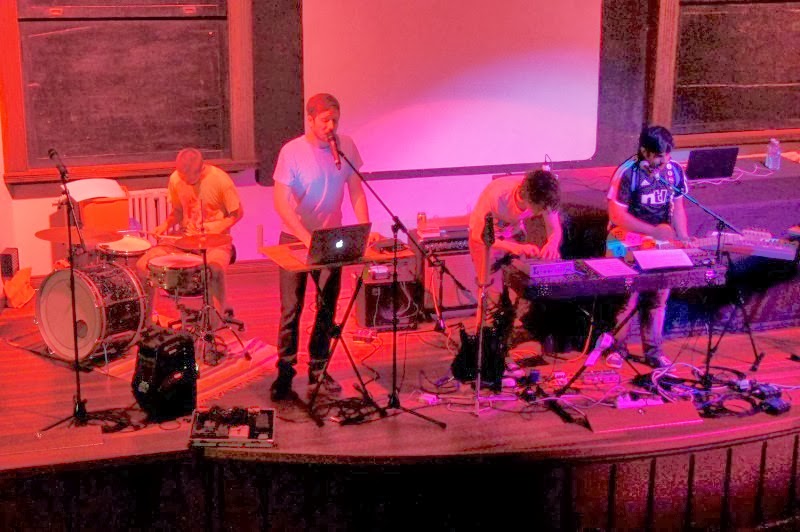
    This was a larger, 5-piece Spartak. I’ve written here of Spartak as a duo. The essence of drums/percussion and processed instrumental sounds was still there, but this was bigger and more exploratory. The first tune was indicative of the approach and structure. Evan started by setting percussion rhythms. Tim introduced a simple melodic line on trumpet, repeating with some small variations. Andrew played mostly harmony notes. He once inserted a snippet of modern jazz (lovely) but returned to simpler harmony notes, which are a better base for Schoeb’s digital manipulations. These digital sounds formed an intense and all-encompassing background for snippets of notes and varied percussion until Tim restated his simple melody and the tune ended. Guitarist Morgan was also there with few notes but extended effects. I couldn’t identify his part, although Shoeb was obviously clear on his space. It’s music that has its own logic and art and it demands intense contemplation. I find it rewarding although the passers-by at the Street seemed a bit non-plussed. I found the clarity and strength of the trumpet was perfect to cut through the environmental noiseworks and also as a base for these manipulations. I also noticed the tunes grew and fell away (obvious enough) and interestingly it was the human sounds that made growth and the digital sounds that accompanied the decay. Not sure I can read any more into this than that the digital followed the instruments, but maybe it’s a comment on our human progress? Growth as a search for harmony, tonality, melody, structure; digital as mechanical, intervened, under human control but not human. The second piece first had me amused with shades of scifi: R2D2 and, more profoundly, Forbidden Planet. Again, the trumpet set intervals and the alto found harmonies, and the electronics bent and repeated these sounds and fed them back amongst a clatter of rhythm. These are not easy sounds, but they are satisfying.

    The second set was Austin Buckett leading a performance of his piece, Stuttershine. It was originally written for a string quartet but performed here by piano, cello, viola and violin with digital manipulations. It started sparse, with rubato notes passed between piano and strings and built to end with a constant arpeggio-like single-note passage on piano that seemed to restate the sparse melodic movements of the first part. Over this was again the digital processing of strings by Shoeb. I really enjoyed the un-manufactured sounds of acoustic stringed instruments as well as the ringing acoustic piano tones. The digital reformulations seemed a bit intrusive to me although the concept of a reworked environment was good. Perhaps this was just a little too loud or edgy for the gentle stings. I found it satisfying work of composition and of performance, somewhat related to Spartak, perhaps as the distant more-upright cousin?

    How great is it that we have such music here? Congratulations and thanks from CJ. BTW, my title, Kaoss, makes reference Shoeb’s principal interface for these digital manipulations, Korg’s Kaoss Pad dynamic effect processor. Shoeb was using the mini-KP with laptop and numerous other digital dongles. Spartak was Evan Dorrian (drums), Shoeb Ahmad (digital manipulations), Tim Bowyer (trumpet), Andrew Fedorovich (alto sax), Morgan McKellar (guitar, delay). Austin Buckett (piano, composer) led a quintet comprising James Larsen (cello), Xina Hawkins (viola), Elyane de Fontenay (violin) and Shoeb Ahmad (digital manipulations) playing his piece, Stuttershine.