
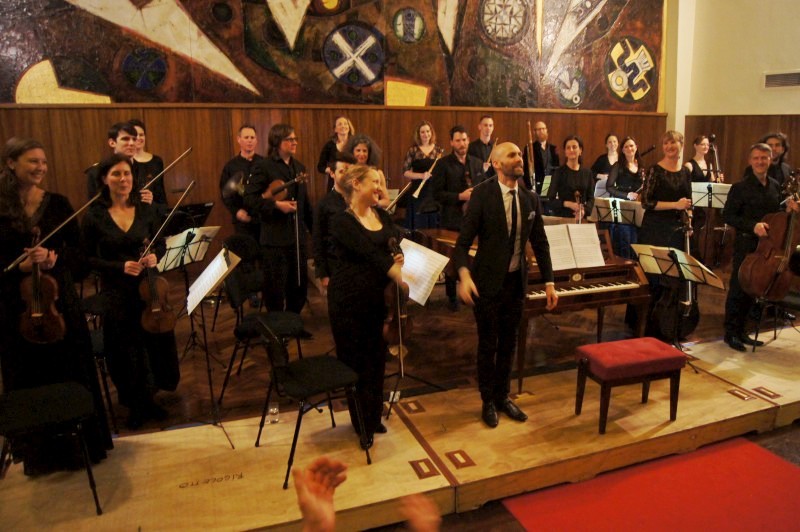
David Greco (baritone) led the Australian Haydn Ensemble in string quartet formation with Skye Macintosh and Matthew Greco (violins), Karina Schmitz (viola) and Daniel Yeadon (cello) at the Albert Hall.
Promoting modern jazz and other arts in Canberra, Australia
David Greco (baritone) led the Australian Haydn Ensemble in string quartet formation with Skye Macintosh and Matthew Greco (violins), Karina Schmitz (viola) and Daniel Yeadon (cello) at the Albert Hall.

We'd heard our mates, the Australia Haydn Ensemble, play a Beethoven Symphony no.6 at Wesley two years ago. Last night they returned with another, B7. Now this is a renowned work (the odd numbered symphonies are, but B6 is OK too) and I was looking forward to the listen, but what really hit me in the end was the effect of this concise version of a well known work. They played it with one flute, two each of violins and violas, one each of cello and double bass so it had nothing of the huge impact of an orchestra but it had clarity and concision and I heard different things. Well, maybe I responded to different lines that were more obvious, clear and precise even if less powerful. Not better or worse but very different and thus informative and expressive. And quite memorable. Of course I listened to Jacqueline on bass, and thought of when I played this work and whether my bowing could have been quite so effective (of course not!). The bass end was all clarity and dynamics, but then this was common throughout the players. I remember sudden dynamic changes by all that stunned. Maybe it's easier with fewer players to define those dynamics. And I felt I understood the structure and changes better; they were more evident. So this was different and hugely enjoyed. It left me with a huge smile on my face. But that was the second half. The first half was another Beethoven, his Egmont Overture, similarly concise and clear. The middle work was Boccherini String Quintet Cmin. It was written for such an ensemble and the music was truly lovely, but nowhere near the complexity and avid life of the Beethoven, so it was lovely and the presentation was not unexpected. It was what it was and it was lovely just for that. So, I left with another dose of Beethoven awe and a huge smile. BTW, they played well, too, and sounded a dream.
Australian Haydn Ensemble performed Boccherini, Beethoven Egmont and Beethoven 7 at Wesley. AHE were Skye McIntosh and Matthew Greco (violins), Karina Schmitz and James Eccles (violas), Daniel Yeadon (cello), Jacqueline Dossor (double bass), Melissa Farrow (flute).

The Australian Haydn Ensemble played Boccherini, Mozart and Beethoven 6 at Wesley. AHE comprised Skye McIntosh (violin, Musical director), Matthew Greco (violin), Melissa Farrow (flute), Karina Schmitz and James Eccles (viola), Daniel Yeadon (cello), Bonita Williams (bass).


 The arrangement has parts taken by different instruments, and apparently this is annotated, so a viola line maybe be identified as from oboe or clarinet or whatever. Cimador's forces were two violins, two violas, cello, bass, flute and keyboard. The cello and bass seemed to just take the known lines, presumably also the two violins for the two violin sections, and, I thought, the piano, but the two violas and flute presumably took on any number of lines from woodwinds or brass or whatever. So it was a fascinatingly different but similar piece. So what else did I note? The whole was sweeter and more open than an orchestra. AHE do great dynamics, but still gut and pianoforte doesn't manage the extremes of modern instruments. The tonal colours of lines changed with the different instruments playing them. The violins and flute were a bit quiet, but maybe that's from where I was sitting. There were also odd tones from odd combinations, eg, flute and cello. These are great musicians and I enjoyed the playing immensely. The bass and cello are a firm and committed block and often prominent - Jacqueline's pizz was particularly effusive - and their application was a pleasure. This group always enjoys itself with smiles all round, but I've noted that before. Some interpretation was unexpected, like the slow take on the early part of the third movement. That surprised me but it was effective. And those lithe runs from the strings and complex plays between hands by the piano. All a huge pleasure and intriguing. Otherwise, they played Mozart Symph no39 Prague and Overture to Magic Flute. More staid than the challenging Beethoven but with their own challenges, not least with some devastating lines. So a great pleasure for my return.


 The Mozart was Fantasy in F minor, K.504 rearranged for "mechanical organ" and it was a strange thing that held little similarity to the ordered, often light, sometimes humourous music of Mozart. The first Boccherini, String quintet op.25 no.6 Amin, was Spanish-influenced and understandable enough in the baroque context but his op.30 "Night music of the streets of Madrid" was anything but. It was written by Boccherini to be performed only in Spain (the Italians are a proud people!) and not to be published outside. But it was, so we have it. It's a programmatic work, with parts named Ave Maria Bell or Soldier's drum or Minuet of blind beggars or Retreat. It tells a story. It also plays the part. First up, a strong rhythmic passage on one note from first violin; a little later, strummed chords on cellos held on laps like guitars (apparently required by the score); still later, a mad viola bowing on one note representing drums and a very challenging bowing over all four strings on violin 2, repeated a few bars later (I was amused to see Caroline's relief after carrying off each of these!). All strange, not particularly contrapuntal or otherwise baroque-like and very resonant of Spain and Flamenco. Thus oddity of this concert. Another, perhaps, was Cambini, a lesser-known baroque composer with a satisfying but fairly uneventful piece. Good to hear music like this occasionally, rather than just the masters: it gives perspective. So, an divergent but satisfying concert, for the notable playing, the humour and interesting journey, but especially for the strange but informative program.

 The AHE has established itself in remarkably short time: this is only its second year. Proof is their welcoming of significant names in period music and their role as ensemble in residence at ANU this year. As well as Erin Helyard conducting from the harpsichord, Daniel Yeadon and Neal Peres Da Costa on the fortepiano, this concert featured Catherine Mackintosh (of Orchestra of the Age of Enlightenment, Royal College of Music, and much more) as guest leader. Many AHE guests are new names to me, but the discoveries are a pleasure. This is all courtly, dignified music, although with its share of humour and pleasure and even profundity, although it's never too obviously displayed. THis was just a wildly successful performance. There were a few slips but all was welcomed with joy and verve and this is of so much more importance in my book. This is not at all staid. Erin was vibrant and mobile; Neal was all eyes, to Erin and Catherine and further; I think it was Simone who was buoyant with joy at the pleasure of it all; AHE stands, so there's constant movement. I noticed myself moving with this music: it's alive, vibrant, it invites movement so you squirm in your seat. The pleasure was evident as the musicians left and in their joy after. A wonderful, musically populated, enlivening concert.

CanberraJazz.net's reports & pics
CJ: Promoting modern jazz in Canberra, Australia.
CJ is brought to you by Eric Pozza, long time jazz lover, bassist, and CJ's author, editor, photographer, webmaster, owner and general dogs body.
> Click on pics to view larger images
v See Labels/Names index below
Initials in the Labels/Names index below are for contributors other than Eric
Subscribe


