 It was a quiet night at the Loft for Miles O’Connell and that was evidence of the University break. I fear we have to get used to it with the brave new venture in music education at ANU. But for now, the small audience was intimate and a pleasure (more for me than the band).


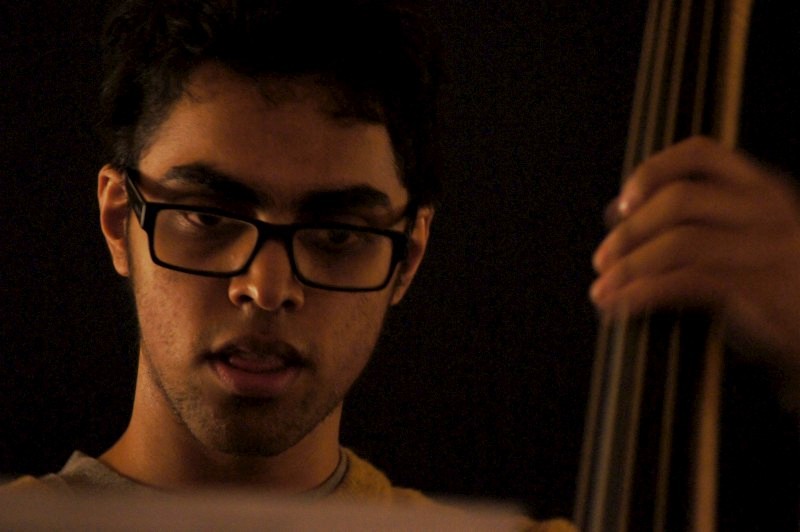
 These were Miles’ compositions: post-bop going on modern ‘60s style, busy and jagged melodies and hard wrung tenor solos, some milder balladic compositions with richer chords, some passing solos on bass and drums, some polyrhythms and changing times, 7/4, 6/4, 5/4, fours, threes, triplets, eights. Miles led but he’s open to change and he reported some tunes which had altered with performance. One original tune idea ended up in just the coda. The band was muttering before how they play difficult charts and make mistakes and recover. There were a few grimaces during the gig, but it’s amazing how unnoticed these things can be. On stage, you feel them all, but as long as the metaphorical train-wreck is avoided, most audience members feel the groove and pick up snippets of melody and that’s entertainment. I’m there often enough myself. The band was also muttering before the gig that the charts are hard and they were apprehensive. I certainly noticed band newbies, Tate and especially Rohan, with eyes glued on charts at various times. Given some odd-time hits, I was most impressed by the outcome. Both Rohan and Tate are well experienced classical players, so charts are their friends, but I guess odd times and syncopations are less so. It was great to see Rohan pop up from a chart with big grin when the groove settled or Luke hit a nice fill or just with respect at Tate’s rich and full-handed chordally-infused solos. And I was in awe at Tate’s comping, too, the way he’d mimic lines from sax, or fill spaces, and in a way they didn’t just fill or support but enriched the tune with another individual but parallel part. I was lucky to be seated near the piano; I might have missed it otherwise. And as a bassist, I’m much impressed by Rohan’s feel for phrasing and his great right hand work. Such assertive tone and tight pizz feels: it’s quite a lesson. Miles was leader and out front for most melodies and he was also a generous composer, giving features to the rest of the band. But when he took the front line, it was sturdy melody dissolving into sustained flourishes and nicely structured from little to lots of notes. Luke was in the previous incarnation of this band and he had charts but was obviously less dependent on them. He’s a humble player, but his swing is easy, his kick is surprisingly assertive (perhaps from where I was sitting) and his snare snap, while not loud, is well formed and sweetly toned. The one non-original was Radiohead’s How to disappear completely. It’s relatively simple but involving tune and made for a quieter spell. Otherwise, the tunes were latin (Green sun), blues-ish (Prism city), polyrhythmic (Zen sickness, dedicated to Miguel Zenon), plaintive 3/4 (Unstoppable, dedicated to Gretchen Parlato), swinging in 7,6,5,4 (Radio silence) and more. Miles was smiling. It was a strong concert and so satisfying; a pleasure to hear but a pain to think of what we’re about to lose. To the cities that absorb our loss, CJ’s greetings.
Miles O’Connell (tenor) led a quartet with Tate Sheridan (piano), Rohan Dasika (bass) and Luke Keanan-Brown (drums).


