Showing posts with label Wang JF 2014. Show all posts

09 November 2014

Wrap up

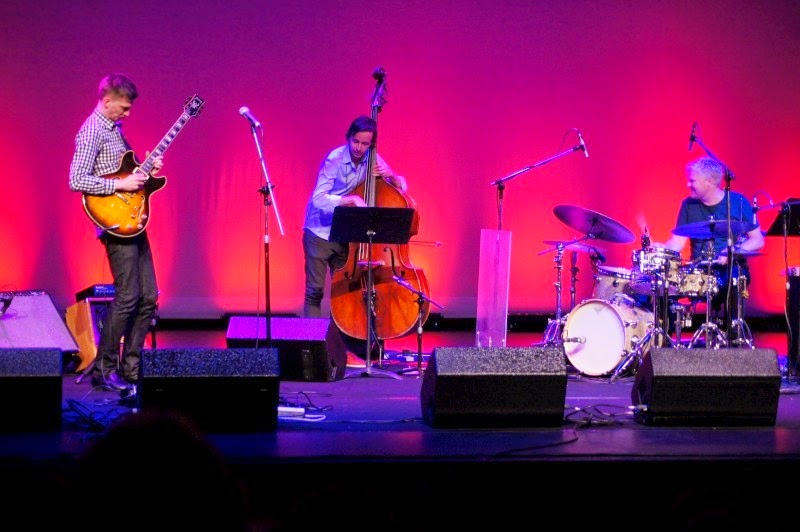
Just a few pics to finish with Wang 2014. I caught these outfits in passing - one tune if that. No comments, although I heard good things about all these outings. The Wangaratta Jazz Festival 2014 was a string of interest. There were a few issues. Many bands played once only. The main WPAC theatre is nice but doesn't hold all so some miss out on major acts: that's a problem. The program has conflicts that are irresolvable, especially between WPAC theatre and hall but presumably for St Pat's and the Gateway. But the town is pleasant and they all come out for the free jazz on two stages on local streets and it's nice to sit there amongst the chatter with a local wine in hand. The local art gallery, right next to WPAC, was displaying the National Photographic Portrait prize shortlist and that was an added benefit. I didn't make the jam session but there's goss that it had had its excitements. So ended Wang JF 2014.

08 November 2014

Mythic travels


I remember being taken by Allan Browne when he presented The Drunken Boat, a dedication to Rimbaud at Wang in 2007. He did it again and I realise now that he did it with the same band. This time, the piece was on Homer's Odyssey. Allan had given a Penguin copy to each of the band and they proceeded to write tunes to relevant myths and a year or so later they recorded and performed it at Wang. I found it deeply satisfying, profound even. It was mostly done with no chatter, although there was a stop or two. There was also some reading form Homer by Allan towards the end. I was a bit surprised by some chatter on stage, but these guys know it and treat it as an old mate, I guess. Some great playing, too. Allan is the senior, herding his crew of adepts through swamps and adventures with the lightest of drums and guidance. Geoff's guitar is deft and speedy; Eugene and Phil up front were one voice or skilled soloists, serious but merry; bassist Geoff was light in line with Allan's lead. There were a ream of written notes here, lots of counterpoint, lots of dots, space for solos all beautifully integrated into the whole, some deeply settled grooves. There was life, deep thought, musical purpose, construction and response to a formative work of Western thought. I guess the word is profound. Allan said they'd make no money from it, like the previous albums of a similar style, but it's an erudite work. I left feeling enlightened. Impressed!

The Quintet was led by Allan Browne (drums) with Eugene Ball (trumpet), Phil Noy (alto), Geoff Hughes (guitar) and Nick Haywood (bass).

07 November 2014

When in Brooklyn, do as


Spoke were totally unexpected and a pleasure and my favourite for Wang 2014. Why? Not for virtuosity, although they had this but carried it lightly. More for the clear work that had gone into the compositions, the ethereal chordless sound, the obvious enjoyment of the band and the pleasure they gave, the irony and contemporary nature of it all, the choice of some great covers, perhaps also the Brooklyn vibe of bicycle spills and pleasant street life they exuded. Like Roger Manins and his Hip Flask, this is a jazz band that entertains beyond the cognoscenti. Megan might enjoy it, and this is good. None of this is to say they were not serious or experienced or skilled. There was some great, forward bass playing and the trombone solos especially grabbed me. The alto was no slouch, either; nor was our Aussie contributor, drummer Danny Fischer. This was his band during his stay in NYC. Good enough that I bought their CD and subsequently the previous two as downloads. Their tunes were of real, ordinary things: Adriana (someone's girlfriend, I think, or maybe a new baby?) and Over the bars (about a bike spill) and Shanghai salsa (about renovations in the Shanghai apartment above waking the late night muso) and Melting (more serious, this, about water). And the covers were lovely things, or maybe they just appealed to me: Beatles' Blackbird (everyone has done it; this was nicely understated and undeformed) and Chaka Khan's Tell me something good (great tune, this) and Mingus' Invisible lady (not one I remembered; listening now, I realise it's a take on Sophisticated lady). This was some great playing, expansive but never flashy despite New Orleans references and a touch of free, but it's more a matter of sum of parts. There was lots of obvious work here, arrangements almost big-bandish, playing tight but light. Open feeling and infectiously joyous. No need to talk of individual strengths. This is communal and skillful but primarily a sheer pleasure. Put this one down to the joy of discovery.

Spoke were Andy Hunter (trombone), Justin Wood (alto, flute), Dan Loomis (bass) and Danny Fischer (drums).

06 November 2014

Tain tours


I carelessly missed his workshop, but apparently Jeff 'Tain' Watts talked about some tunes that had me confused on timing. His concert on Saturday night was not just unrelenting and virtuosic, but was a mass of odd times. Tain advised that one tune was in 13 so he counts 6 1/2 twice. A joke, no doubt, but it's indicative of the complexity of playing odd and changing times and the concentration required. Tain was the other major international at Wang 2014, but unlike Enrico Rava, he had his own band in residence. And his family; more on that later. Suffice to say I was enamoured by the first concert and hammered by the second. He's obviously a driving, busy, skillful drummer in a long-established style. His is not a sparse, punctuated style, but an avalanche of colours and rhythms and intensity that has you pushed into your seat. Same with his band. I sat with new Wollongong mate and drummer Glenn at both concerts. His description was "unrelenting". I had this feeling for the first concert, but intensely so for the second. There was little letup here. Skills, chops, power, speed, excitement with changing times and arrangements. Day 2 was much more simple in terms of tunes and structures, or maybe I was just more atuned. Day 1 was all over the place in time and composition and arrangements and with several feature solos from Tain and many from tenorist Troy Roberts (from Perth) and pianist Osmany Paredes. Tain introduced a final encore on Day 2 (this was a 90 minute concert to end Sunday night and the main festival) saying bassist Chris Smith likes this one. I'm a bassist and I picked up straight away that it's a killer with incessant and very fast walk; something most bassists dread. Probably another of Tain's jokes. Troy did a great job, provided some excellent solos including a hugely extended one at the end on Day 2, and always amazed me by walking back to his mic at the last minute following piano or other solos. Osmany played plenty of fast runs peppered with bop left hand comping - all fast and wonderfully easygoing - but what most impressed me was his tone - strong and loud. Someone mentioned the latin players play hard and this was certainly strongly played. Great. And the quiet but tall Chris down the back was everpesent and up to some ostinato and walking work at the extremes. Plenty of communication, too. Tain would look to space or to the others, Osmany and Troy looked over at apt moments. A wonderful example of the intense pressure cooker of the top level professional US jazz players (I think back to very long and energetic concerts by Corea, Mahavishnu and others). Take no prisoners.

But Tain was at Wang with family, too. Laura Watts performed her own concert first up, with Tain and Chris in support. Laura was born Laura Kahle in the US, raised in Queensland, friend of James Sherlock and Zac Hurren (who sat in for this concert along with Troy), now wife of Tain and mother of two daughters in Harlem. Small world: Brissie to Brooklyn. Laura is also a significant composer, having works performed in the Lincoln Centre and arranging for Danish Radio Big Band, Wynton Marsalis, Orrin Evans and others. This gig had Laura leading a series of complex compositions from her recording Illicit Inquest playing pocket trumpet with a series of visitors sitting in for various tunes. I felt the gig was a bit unsettled, but there was some impressive playing and rich compositions. I'm listening to the free download of Illicit Inquest as I write this and it's impressive.

Jeff 'Tain' Watts (drums) led his quartet comprising Troy Roberts (tenor), Osmany Paredes (piano) and Chris Smith (bass). Laura Watts (pocket trumpet, compositions) led a band with James Sherlock (guitar), Chris Smith (bass) and Jeff 'Tain' Watts (drums) with visitors Zac Hurren (tenor) and Troy Roberts (tenor).

05 November 2014

Mike and the awards


I caught Mike Nock as a performer but he's also the chair of the judging panel for the National Jazz Awards. The awards were for guitar this year and the judges were Mike with James Muller and Steve Magnusson.

Mike Nock is a senior Sydney figure noted for his support for a new generation. At Wang, his band was called Trio+2, the extra two being younger sit-ins Carl Morgan and Karl Laskowski: younger maybe but not unknown. This was unrushed, well developed modern jazz with a feel of rock grooves, often developing some power, with plenty of space for solo development: Outcast, Brett Hirst's Changeling, Perspectives, even This dude abides (written by Mike to a quip in the movie, The Big Lebowski). The rest of the trio was Brett Hirst and James Waples.

I was at Wang for the last guitar awards, and Carl Morgan, ex-ANU Jazz School and well known locally at the time, was on the shortlist. He didn't make the final that time, but he returned victorious. I only attended the final (given program clashes; I would love to have attended the heats). The final contestants were Hugh Stuckey (Adelaide, now Melbourne), Peter Koopman (NZ, now Sydney) and Carl Morgan (South Coast, as I remember, then Canberra, now Sydney). Carl played last and was a clear winner: confident, communicating, interesting and thrilling. He played Scofield's You bet,m Joe Henderson's Isotope and Coltrane's Naima (in a heavy rock-influenced take that worked). Hugh played first with a clear, traditional sounding guitar. His tunes were You're changed, Schofiled's Don't shoot the messenger and Rollin's Tenor madness. Peter played second, more driving and modern. His tunes were Larry Young Backup, Isfahan form Ellington's Far East suite and Scofield's Loose canon. Backing was from Des White and Ben Vanderwal. It's always a game to pick the winners. I've only listened to the finals a few times but never exactly matched the 1-2-3 order. This is art with subjectivity and personal preferences. Congrats to all; they are all worthy players.

Mike Nock (piano) led his trio with Brett Hirst (bass) and James Waples (drums) with visitors Carl Morgan (guitar) and Karl Laskowski (tenor). The National Jazz Awards 2014 final was for guitar and contended by Carl Morgan, Hugh Stuckey and Peter Koopman with accompaniment by Des White (bass) and Ben Vanderwal (drdums).

04 November 2014

Revisiting favourites

Wang JF is mainly composed of the best of the Australian scene and it's a pleasure to catch up with them. In Canberra, I don't see them nearly often enough and Melbourne and Sydney listeners tend to see their own and not those from the other city. As for Brissie, Perth and the rest, I guess they see even less.

I'd recently seen James Muller and Steve Magnusson on two occasions in two different bands. They are such different guitarists and I was intrigued by how they'd work together. James is the ultimate smooth virtuoso; Steve the intriguingly divergent player. In this case, they were playing with Frank Di Sario and Danny Fischer. Scofield and Frisell were obviously on the program, and Solar (claimed by Miles as were many tunes), an original by Frank and some others. Apparently this was the third time that James and Steve have played together. James was breathtaking. I felt Steve didn't quite get the opportunity for his choppy and inventive style. Perhaps there was some competitiveness, conscious or not. I greatly admire each for his playing so I was a little disappointed by this outing. Interesting experiment, but in the end oil and water don't mix.


It's ages since I saw Sam Keevers at gigs with Jamie Oehlers and I've held admiration for his playing ever since. I admire the quiet and respectful with depths to be mined. Certainly his playing was like this when he played a set of tunes by Bernie McGann with his quintet. I felt these was clean, neat, steadily swinging period pieces somewhere around post-bop territory, lithe and steady and admirable as carriages for improv. Spirit song, Brownsville, Sweet Lucy, Mail, Twist. This is standard format with two horns out front. The fabulous pairing of Eugene Ball and Phil Noy were great together and strong apart in solos. Bass was Chris Hale, the first electric bass I'd seen at this festival. From afar, I didn't pick up on the subtleties, but up close this was pick and finger pick and chords with middle, ring and little fingers. This is six-string electric bass, which is an instrument that cries out for a new conception and Chris had one and it was well developed. Not at all standard in this context, but impressive. Craig on drums was steady as presumably required for this outing. Very well played and an admirable tribute and presumably particularly memorable for those who were close to Bernie, for Geoff and others.

James Muller (guitar) met Steve Magnusson (guitar) with Frank Di Sario (bass) and Danny Fischer (drums) supporting. Sam Keevers (piano) led a quintet with Phil Noy (alto), Eugene Ball (trumpet), Chris Hale (electric bass) and Craig Simon (drums) playing a tribute to Bernie McGann.

03 November 2014

One Parrott

I was always confused by the Parrotts – Australians in NYC, bass or horns? Alto/baritone saxist Lisa Parrott mentioned her sister bassist Nicki and all was explained. Lisa performed with old mates at Wang, mostly reforming her band of twenty years before with Cameron Undy and Carl Dewhurst, now playing with Simon Barker. This was a pretty daunting outing. It opened with a head all heavily syncopated hits, through several energetic opening bass solos, dedications to Charlie Haden with a great rendition of Ornette’s Lonely woman which is still mulling in my head, with a little sidestepping into Pixinguinha and a tune about a soccer score (for the record, it was 1-0). I felt a strange NYC presence in Lisa’s alto playing: not all flash but conceptually consistent, sequenced, reasoned but ironic. Not sure if I’m imagining things here. Her alto was also nicely open, woody and softly toned. Baritone is more big and clumsy and Lisa played it in a more simple, bluesy style, but how beautiful was this deeper simplicity on the ballad that Lisa had written with Nicky in response to a Banjo Patterson poem, Do you think that I do not know. Her sidemen were nicely in synch. Simon considerate and detailed; Carl fluent and crisply toned; Cameron energetic and very busy on bass. It’s sometime since I’ve seen Cameron in performance and he’s as impressive as ever. This was a set of much seriousness that verged on the avant-garde and it was a pleasure to hear it.

Lisa Parrott (alto, baritone sax) led a quartet with Carl Dewhurst (guitar), Cameron Undy (bass) and Simon Barker (drums).

02 November 2014

Again Enrico


At the end of his concert, Enrico Rava said he usually doesn’t like a gig in the morning, implying this was different. I think it was. He looked genuinely interested in several of the solos, patting Frank on the back after one of his, leaning against the piano an gazing at Paul during another, smiling at Mirko and Niko at other times. It’s a matey friendship and professional respect on stage that we were to see after the last gig on the night, too. Enrico’s second outing was with a crack team and it was a standards gig. Yeah. That interested me and surprised me in some ways. Standards are often denigrated, but Miles did it and here Enrico Rava did it. The tunes were immediate and comprehensible and the lesson in how you can meld and bend them was intriguing. They started with a cool 4/4 funk groove and I was surprised when it became You don’t know what love is. Not much more standard than that. But these are lessons, exhaustive in their openness to variation. Enrico holds the feels wonderfully so his departures are unobstrusive. Again, the spaces, the interludes of long quick phrases, the tonal plays and a less frequent use of the flutter to the sky. He’s a master. Fellow Italian, now Melbourne-based saxist Mirko took up on some of these skyward flutters and I liked that reference, and he would also play noise, but he was fat, more smooth and straight in spelling the chords while adding passing chords. More harmonically evident. Paul Grabowsky is in another space altogether. His takes are a melange of styles bundled together, harmonic colour changing on a whim. This is death defying improve and a lesson in exploration. There’s no doubting his technique or capability, which I presume is classically developed, but it’s not an easy place to visit. His take on Funny Valentine was a dream; his takes on the more boppy numbers were challenging and stylistically multitudinous. I’m intrigued. Frank was a straighter proposition. Lovely solos that were fresh and unpretentious revisits to the melody. Just so nicely done, and obviously well received by Erico. Niko is another of the Melbourne pack that I wish to visit more. Musically outspoken, vivacious, perhaps capricious. Always a challenge to staid concepts. Nice, but needing acclimatisation. So, Enrico played a much different concert on his second outing. Showing us what standards can be. Lovely.

Enrico Rava (trumpet) led a band with Mirko Guerrna (tenor), Paul Grabowsky (piano), Frank Di Sario (bass) and Niko Schauble (drums) playing standards at Wang.

01 November 2014

Openers 2

Hip Flask is led by Roger Manins and is presented as barbeque music that will go down well with the neighbours as well as the jazzers. It’s true. I loved this outing. All grooves and blues and wonderful playing. It’s an odd combination with nice weight-weight but light-toned Hammond organ and Leslie sharing keyboard space with truncated, dissonance-rich, Monk-inspired quirkiness on piano, driving straight-ahead drumming, fabulously fat and clever tenor, soft but deep and endemic swing from bass and a leavening of stage humour. One tune starts with a wooden flute that’s bought on the day and played in the key of the new instrument. Apparently Stu could only find a plastic descant recorder in Wang, so this was it, wrapping peeled on stage and song key set. Surprisingly, Roger did a decent solo on the thing but lamented at the end “It’s horrible, this thing. Wang, can’t you do better?” He prefers wood. There were new tunes, choppy organ grooves, odd contrasting times. I failed to understand one count; I thought the organ was playing 3 and the rest 4, but that doesn’t sound nearly complex enough for this oddity. There were agile and contorted heads and simple bluesy repeats. There were some stellar solos. I particularly enjoyed the bizarre piano (I write bizarre with great respect!) and Roger’s firm lines, but I reeled from Brendan’s extended outing, soft but strong, long and ever intriguing. It’s not always you can say that of a bass solo but he’s such a master of swing. There was deep ‘70s funk and swapped fours between organ and piano (strange that one, what keyboard contrasts), and a most amazingly beautiful ballad, The beauty in their eyes, with haunting sax over raindrop piano accompaniment, then openly-spelt bass harmonies that were stunning. My foot tapped throughout but my brain synapsed too. Both clever and earthy and open to all. Great stuff.

Then off to the Blues tent for a very different experience. More people, more beer, more dancing, much much much more volume, less grey hair. Perhaps this is the real place for the barbeque and the neighbours (if not for the ears). I’d gone for some authentic, black American blues guitar from Joe Louis Walker. Blues is all much of a muchness and I feel it’s all been played before, but this was obvious quality. It’s not easy to do a style with authenticity and authority and this had both. Great presence, sharp blues solos, thumping drive, basic bass, expressive keys and busy drums. Plenty of dancers up front, plenty of beers, a modicum of cops and the breathalyser on the street outside. And that thapping punch in the stomach from every bass drum kick. Good and social and fun but deadly for the aural anatomy. It wasn’t quite so deafening out of the line of fire of the PA, but I didn’t last too long.

Finally, the Pinsent Hotel, jamming-home of the festival. It’s Friday and not the busy night and the trad end of the scene was in residence. I caught a few tunes from the Syncopators. Again, more entertaining and irreverent than the modern stuff at the major theatres. These were decent players but my interests lie elsewhere, and, wary of breathalysers, I stayed for only one beer.

Hip Flask are led by Roger Manins (tenor sax, recorder) with Stu Hunter (organ), Adam Ponting (piano), Brendan Clarke (bass) and Toby Hall (drums). Joe Louis Walker (guitar, vocals) played the blues with Phillip Young (keys, sax), Lenny Bradford (bass, vocals), Anthony Cage (drums). The Syncopators are Pater Gaudion (trumpet, vocals), Chris Lydowyck (trombone), Richard Miller (clarinet, sax) with Steve Grant (piano), Peter Baylor (guitar), James Clark (bass) and Andrew Swann (drums).