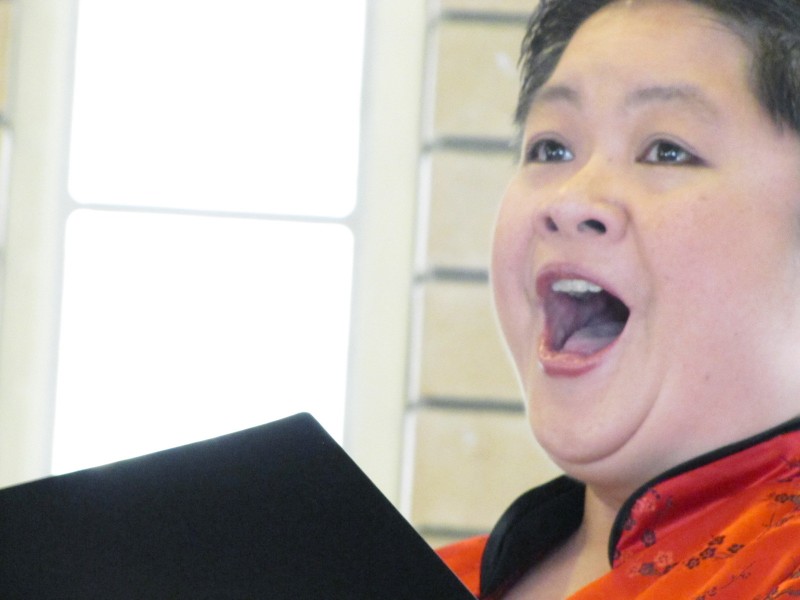
It’s Christmas and that spells carols. They are lovely in their serenity or profundity or frivolity or sheer joy, and singing them is an annual treat. I caught a concert by Louise Page at lunchtime at St Albans Anglican Church, and she was joined at various points by a sweetness of sopranos, both students and ex-students. So this was both pleasing to hear as entertainment and intellectually satisfying as an exploration of diverse voices. The classical soprano is a unique voice. Strong and high, cutting easily through choirs and orchestras, it’s something special. It’s almost instrumental rather than human, proud like the violin, haughty, swelling and unstoppable, beautiful and pure, frequently unintelligible and otherwordly, but glorious and overwhelming. (This becomes literal in the film, The Fifth Element, when Sarah Brightman’s voice merges with synthesizer and soars to an impossible pitch as an alien soprano). Soprano is not a voice of jazz. Jazzers are far more rooted to the earth. Soprano is a cultural peak product, something that demands and rewards time and understanding. The immense vibrato, too, is a thing of beauty but unreality which it shares it with modern classical strings, and increasingly with jazz that’s rediscovering vibrato after Miles’ rejection in the ‘50s. But I diverge.


This was quite a range of songs. Louise started with Joy to the world. Piano accompanist, Phillipa Candy, had arranged this with screeds of diatonic chords that rippled up and down the keyboard. I liked this, as I liked her accompaniment for the whole concert: capable and responsive, while obviously reading the charts. By the end of the session, I noticed, too, how rich and relatively deep and mature was Louise’s voice. All these voices could fill this small room with power and volume, but Louise’s was that much more even and purposeful in her interpretations. I chuckled that the words (Italian or English) remained unintelligible, but the quality was undeniable. Then on through a range of songs: some Australian carols including Wilfred Holland’s Bethlehem that I know from choir days; the common but delicious Bach/Gounod Ave Maria that Louise dedicated to birthing mothers; even pop hits like O come all ye faithful. And through several other, very differently sounding soprano voices. I particularly liked the tune No lullaby need Mary sing, by Joseph Clockey, that displayed unexpected modern melody. Katherine Warren sang that one. O Holy night, by Adolphe Adam, has to be my favourite carol. Julia Wee sang that one. There were humourous ones, like the rejigged lyrics of My true love gave to me, which Louise introduced wryly “for all the mercenary habits we’ve come to accept”. Louise claimed one of her favourites was Robert MacGimsey’s Sweet little Jesus boy, which is written as a black American spiritual with blue notes. There were also songs I think I’ve never heard, perhaps not surprising given the paucity of carolling in my life. I doubt I’ve ever heard Little road to Bethlehem, by Michael Head, which Pamela Andrews sang. I loved it when when we heard some harmonies. First was The silver stars, by William James, where Louise and Sarah Campbell sang together. Then the audience singalong led by pairs of singers with raised voices throughout the chapel. Everyone has to know these superhits: The first Noel; Hark the herald angels sing; O come all ye faithful. That was fun all round. Complete with Louise authoritatively singing a complex counterpoint that had me striving to hold the tune.
What a lovely and satisfying way to while away a lunchtime. Immensely better than … ugh … Christmas shopping. Louise Page (soprano) led various combinations of the sopranos Katherine Warren, Pamela Andrews, Julia Wee, Sarah Campbell and Petra Lindsay with the accompaniment of Phillipa Candy (piano).


 I couldn’t get to Igitur Nos performing Brahms’ German Requiem but I got to the rehearsal the day before. There were times of considerable beauty (and some obviously challenging high notes) and it had me wishing to be there on the day. Matthew was working the choir and visiting singers, so this was interrupted, on-off, “Take it from Bar nn” stuff. So it was interesting but choppy and without the tension and commitment and continuity of performance. The visiting voices were Sydney baritone Raphael Hudson and Hobart soprano Pamela Andrews. The accompaniment was four handed on a Yamaha C7 (I understand it’s All Saint’s new indulgence) by brothers Alistair and Colin Noble. Igitur nos will soon start practicing for Mozart’s Requiem in early November. Here are just a few pics of the rehearsal.