Showing posts with label Mike Majkowski. Show all posts

06 February 2013

Musing and perusing (SO2)

SoundOut 2013 day 2, in which he continues to muse on the nature of this strangeness. I continue to be uncertain over this music. I listen with my eyes closed and it can be fascinating. Some players spark references to traditions and I respond to that. When Luiz dropped into a slow bass walk that was quite free of tonality, I felt comforted. I’m not so settled with some of the bowing and slapping and other techniques. In his clock-conducted piece from Saturday, Jon Rose gave instructions to do something and eating was one option. On Sunday, he improvised by picking up a broom and sweeping the premises and later closed and opened a piano lid and discussed it with a colleague. He also presented a talk of two parties, a woman seemingly uninvited at the mic, he sitting and chatting, talking of marriage and music and more. This was interesting but odd as a music performance (agreed, words are sounds, but they have defined meanings that music doesn’t have). I enjoyed this but was frustrated by trying to catch two related but different conversions at once, but then, that’s probably one theme. I discussed these dilemmas with various friends and performers. One saw this music as taking away all the traditions and using what’s left. He remains a hard-bop devotee. One performer flummoxed me by saying that this music has its own traditions now (almost a century of Cage, Bartók, Stockhausen and the like) and that all the performers are out of jazz or classical training anyway. That certainly had me thinking. Another spoke of texture as a concern, of having no interest in a tonal centre, let alone harmony, how it didn’t matter which strings are muted with bluetak. It sounded chaotic but I loved her playing that ranged from delicate with repeated fingered patterns to loud and tumultuous with impassioned tone clusters that ranged over the keyboard. But then, another player slammed heavy hands on a keyboard with none of her skills and subtlety. It worked and she responded effectively, but it further confused my responses.

So what did we hear on the evening session of day 2? A few group improvisations that were floating and indeterminate to my ears. A combination with the Sydney rhythm section of Mike Majkowski and James Waples floated at first, but took off on top of wonderful rhythmic power from James. This was nowhere near a groove, but well-formed heavy notes with oblique overlays of stick play. I particularly enjoyed Hermione Johnson on piano in several outings. First with Jon Rose and Luiz where Jon’s humour and unconventionality and virtuosity, Luiz’s commitment, bowing and occasional pizz and Hermione’s densely passionate and expansive tone clusters were invigourating and emotionally satisfying. Hermione also impressed me when backing Super-8 experimental film artist, Louise Curham, along with Jeff Henderson on calls and wails on baritone sax. The whole show ended with the Barcode Quartet returning for a set and a welcome to all the other musos to join in to end the festival.

I have lots to learn of post-tonal music. This was a vivid exposure to a field and a happy one with a range of interesting and friendly performers from across the world. I have some reading to do in preparation for next year. And one last cheer to Richard Johnson for his great work in pulling this together for the fourth time.

  • Cyberhalides Jazz Photos by Brian Stewart
  • 24 March 2011

    A world in a raindrop

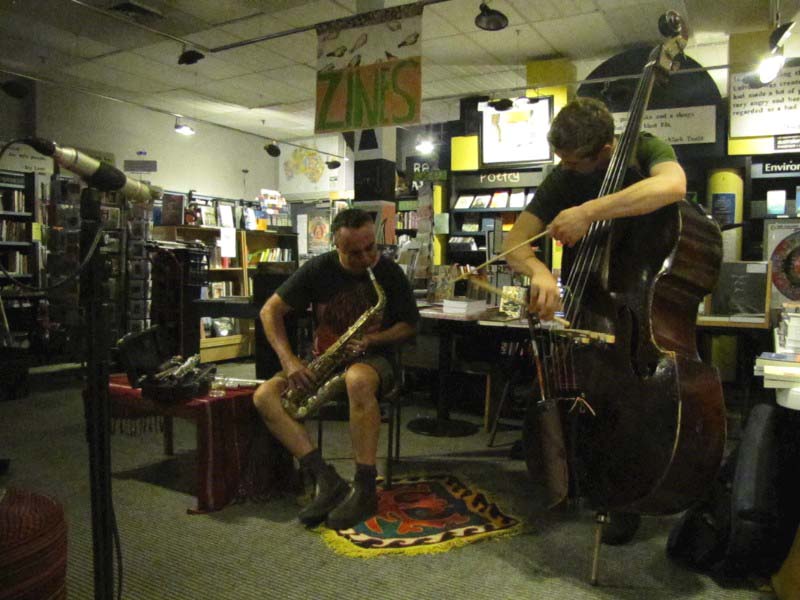
    So I was thinking while listening to the detailed but totally unconventional music being played by Jim Denley and Mike Majkowski. They performed as BLIP during their East Cost tour stopoff at Smith’s Alternative Bookshop for a small group of intense listeners. You have to be an intense listener for this music, to pick up those details in the raindrop. It’s something we forget – that there are sounds everywhere, sounds we can wring from anything. This music makes you remember. The techniques are totally unconventional, of course, so it amuses me that they use conventional instruments to do it. But the intent and the seriousness is there, and the beauty is also evident if you open your mind and ears to the detail. What’s the sound of a balloon path from mouthpiece to alto? Or drums sticks on bass strings, or vibrator in alto bell, or clappers damping bass strings? Or the more earthy and unmediated, like mouth clicks and pops or a stick swishing through the air? It’s that elemental and basic: quite beautiful but otherwise unnoticed. Like windchimes, it’s music of the environment. I’m wondering if that makes it a signature music for our age. It’s certainly not sophisticated (in the original meaning) or urban or I might even say civilised, despite the lovely tarnished alto and the dark, mysterious, rich-sounding bass. There’s technique there. I could see it in Mike’s strong and precise bass hands which he did use for occasional thumb position playing, and heard it as he warmed up on free jazz (for once more traditional and less challenging than the music they played). But abandon the conventional, all ye who enter here. I said to Jim afterwards that I had no idea what they were doing. He (perhaps jokingly) said he felt the same. It’s a world of its own, this art sound, and worthy and fascinating in its own way.

    Locals Andrew Fedorovich and Luke Penders had opened the night with their takes on this style. Andrew played an alto in a mostly conventional way (with lips and no preparation) but the sounds were multiphonics and tonguings and slapping keys and solid, unexpected low notes with airy tones clouding above. This was quiet and pensive, sometimes jagged and gentle so it was occasionally interrupted by the noises of the outside street. Luke performed a piece of electronica with laptop, reference monitors and the like and, what amused me, a synthesizer in a Nintendo (!), the Korg DS-10. Funnily enough, this was the most harmonically structured piece of the night (who would’a thunk it?), with repetition of harsh heavy metallic sounds and a signature truncated rising tone mixed with clicks and pops and random noises. The cosmic background made electronic art.

    Not a night to invite Megan! Jim Denley (alto sax, baritone flute, wooden flute, balloons, etc) and Mike Majkowski (bass, bells, whistles, drumsticks, etc) performed as BLIP. Andrew Fedorovich (alto sax) and Luke Penders (electronics) performed as a warmup.

    This is CJBlog post no. 600.

    13 March 2010

    Roil not my ales

    They tell me there’s a TV ad for Coopers ales that has the bottles rolled by a bartender before opening. It’s an ill-informed service that I’ve struck several times recently. In my book, rolling just gives you a turbid drink by stirring up the sediments. Sediments are for filtering, not drinking, even if marketing agencies suggest otherwise. I’ll have my bottled-brewed beers unrolled and thus unroiled, thanks. But that’s no comment on the band, Roil, that featured at hellosQuare’s event last night at Street Theatre 2.

    Roil is a piano trio comprising Chris Abrahams, pianist of the Necks, with Mike Majkowski and James Waples. This in another band in the free tradition, but considerably different from Chris’ Necks. There’s more a sense of free and other forms of jazz, and avant-guard classical, in this tradition. I was most taken with some passages that developed as highlights, where Chris was playing fast and extended atonal runs, against a rapid, almost walking, similarly atonal bass and a busy drum feel. But there was plenty of searching with quiet music and big ears and unconventional use of the instruments, too. Mike leaning over the bass, bouncing dowels off strings or tapping the bass body or strings, or plucking strings below the bridge. Chris doing similarly unconventional things, playing with exposed hammers and strings on an upright Yamaha. But he also played conventionally, and it was a delight: winsome lines, light, playful, mobile in harmony and gingerly in melody. The Yamaha upright sounded wonderful with his gentle touch in conventional styles. James seemed generally more conventional in technique, but I loved some of his strongly syncopated, even delayed beats that had me hanging in anticipation. They played three numbers which I noticed were introduced by the three members in turn. Chris started the first tune, then Mike, then Ben, so although there were no composers, you could identify someone for the initial concept. It was a fabulous display of excellent musicianship all round, terrific listening and inventiveness, and an inspiration to visit the world of truly free but profoundly educated improvisation. A stunner. BTW, my preferred definition of “roil (v.)” for this purpose is “make turbid by stirring up the sediments of”, from Princeton’s Wordnet. Roil: it fits the band perfectly (but not the ales).

    Preceding Roil were two solo artists in the electronica field. Firstly Tim Dwyer appeared as ///âÂ?²âÂ?²âÂ?²\\\ with “dubbed out garage drone-tones”. It’s pretty new to me as a performance art, although I’ve heard this type of music on radio. I liked it. It’s got beats (rather than a groove) although I only noticed 4/4 rhythms; it’s got visuals with a projection screen for computer graphics; it’s got movement and chutzpah. Technically, it’s got loops and echoes and effects, simple keyboard lines and alto sax, and with recurrent vocal utterances. He presented in a matey, jokey, baseball cappy way that didn’t exude seriousness, but I liked it. The second presentation was by Robert Curvengen, resident of Germany and Northern Territory. This was a different approach using different technology: a calm, murmuring study of natural sounds; a constantly mutating mix of drones and various natural sounds played from three CD players and two turntables and carefully blended. It was mysterious and constant and only slowly changing, so a click or pop from the turntables (something despised in pre-digital days) or a similar forest snap or insect crackle from a CD was an essential statement. I found it mesmerising if a bit long, but I’m not an afficionado. A mate with these musical interests was impressed. It ended unexpectedly with a blown fuse, sadly for Robert.

    So, a fascinating visit to other fields of music. I enjoyed the electronica, if that’s what these were, but I was blown out by the skills and detail of Roil: just fabulous. Their obvious high spirits after the set confirmed it as a successful performance. BTW, I was recording, so hopefully it will make it to ArtSound’s Friday Night Live sometime.

    Roil is Chris Abrahams (piano), Mike Majkowski (bassist) and James Waples (drums). Tim Dwyer and by Robert Curvengen performed solo sets. HellosQuare Recordings promoted the event and are promoting more in coming months. Keep an eye on CJCalendar and arrive early. This was a well-deserved sellout.

    05 June 2008

    Alpha to Omega

    Alpha is for the soft and lyrical ballads, played with acoustic tones and cut times. Omega is for the breaks into frequent cacophonies and occasional free jazz which were often such vivid developments on the alpha themes. Three omegas is for the three amigos, mates, that got together to play this music that was such a unique mix of bitter and sweet.

    To me, the Three omegas played a deceptive set: unexpected and unusual in its approach and intent. David plays with a sharp, tangy, unadorned overtone-rich sound on his semiacoustic. We expect sweet, Django, and we get some lovely ballads played with lyrical interpretations, and with a level of soloistic shape which a guitarist friend was raving about. Similarly with the others. Mike is also clear and sharp in his tone, and can be melodic in his bass playing, and James had a tonality that I loved on a large snare and a deep floor tom that sounded as if he fell into the skin. There were some pure melodic solos from David and Mike, but, then, gradually, all this melody devolved into cacophony; growing, growling, held at a level of extreme tension for some minutes. I didn’t time it, but this was not restrained! This was full descent into abyss stuff. Bass and guitar strumming, with form delivered from tripletted drums which may have been solo, may have been structured, or may have just been there. But it gave some stability until the band gradually returned to order, to better understood vistas. This was the first time, but the night continued thus. Pretty melodies, sweet tunes, devilish cacophonies, occasional free play, tunes again... And other than one standard (Django’s “Castles of my dreams”), these tunes were compositions by the band. Not surprising.

    It was an interesting conception: an unusual one and very engrossing. Sets moving over extremes of tension: alternatively sweet or tense, always protracted. Here pure, sweet melodies; there descents to madness and excess. The show had this changing shape of one to the other, almost unnoticed until it was on you. Nice one.

    The Three omegas are David deVries (guitar), Mike Majkowski (bass) and James 'pug' Waples (drums).

    28 September 2007

    Two bars to a treat

    Text and pics by Brenton Holmes. Mike Nock Trio - Mike Nock (piano), Mike Majkowski (bass), James Waples (drums) with Jacam Manricks (alto sax, NY) at Hippo. It only took two bars and I knew I was in for a treat. Majkowski and Waples laid down an impeccable muted intro on bass and drums. Enter Jacam Manricks - mellow, haunting. His lyricism was remarkable. The tune, Aeronautics, was his own, but this was no flashy-just- flown-in from-New-York routine. Instead we heard a gentle, perfectly shaped line that oozed musicianship. When he moved up a notch into his solo the phrases lengthened, the tone brightened, the contours had a more dramatic sweep. But the lyricism stayed. Manricks built the intensity, working off a rhythm section made in Mike Nock heaven, opening out into long, running sweeps, running up staircases of notes, delivering swirls of impressive virtuosity. Still the lyricism stayed.

    Waples gives a lot of drive from his ride cymbal, and there's power in everything he does, but while his presence is strong, he's not intrusive. Majkowski has to be one of the finest bassists on the Sydney scene, and he and Waples have a rapport that glows. Their playing was one of the unrelenting joys of the night.

    When Nock took his first solo in the tune I was struck by how much it reflected Manricks opening style. Whether this was a deliberate ploy, or just intuitive ensemble music-making, it worked brilliantly. As he built up a head of steam, we soaked up vintage Nock. Sadly, his new electric piano wasn't doing him any favours. Something about the settings had the instrument sounding more organ than piano. As a result, clarity suffered , and what would normally have shone as a sparkle of notes came out more as a smear of tones. It was something Nock had to contend with all night – although some judicious tweaking improved things a little in the second half.

    The rapport between bass and drums extends to Nock. This is a trio that clearly enjoys each other's company and shares a deep musical intimacy. You can almost feel them listening to each other. Their responsiveness extends to the most subtle of interactions. It's like they share a fused musical brain. I found the effect extraordinary, and one which is decidedly rare. I struggle to recall a similar trio experience.

    When Majkowski solo-ed I couldn't wipe the smile off my face. He was rivetting - strongly melodic, not a cliché in sight, and technically superb. His effort was short and sweet – something which characterised almost all his solos. They are the musical equivalent of those wonderful 9x5 masterpieces of the Australian Impressionists. Everything you could wish for is there.

    Super Side Slippery Skip, the second tune of the night by Manricks, was a straight ahead swing with the intricate melody doubled on sax and piano. There was something cheeky about it – almost like it was a parody of a blend of the most played tunes in the Real Book. But it cooked. The rhythm section locked into a groove while Manricks gambolled all over the place - kinda Dexter Gordon meets Ornette Coleman with a dash of Dave Liebman. The band then really began to open out, managing to achieve a more expansive ensemble feel through the seemingly contradictory process of all the players pumping out solos simultaneously – a kind of bristling inventiveness.

    When they dropped back to give Mike Nock some space he gave the lower registers of his still muddy piano a serious workout before moving into a more atonal style higher up the keyboard. He switched back and forth between sections that were rhythmically and harmonically conventional and passages of very free, angular and arresting playing. Again, bass and drums were with him all the way. Waples was particularly adept at building off and responding to Nock's soloing while the other Mike continued to give them both all the nourishment they could possibly need.

    Majkowski again delivered a striking solo – full of invention, bending rhythms to his purpose without a hint of losing structure. Then it was time to swap fours between drums, piano and alto. Waples made the most of every four that came his way. Each time, he took his material from the preceding solo, sculpted it into a new shape and handed it back as a shiny new toy. Nock and Manricks clearly enjoyed it. The number closed out with a return to the melody doubled on piano and sax before wrapping with a tight, neat finish.

    Next up was, for me, one of the highlights of the evening – probably because of its audacity. Manricks took the over-exposed Australian folk tune Bound for Botany Bay and turned it into an arrangement in 5/4 time that was a sheer delight. When Manricks moved into his first solo he again revealed the polished professionalism that his recent years of hard work in the US have no doubt helped him to achieve. You could hear the main Botany Bay tune being morphed one note at a time into its improvised version. Manricks kept faith with the strong 5/4 rhythmic phrasing as the shift evolved, then simply freed himself from it to sail breezily into an extended solo. Majkowski complimented the effort with another fine solo of long clear lines, never sacrificing the music to technical cleverness. On this occasion, Nock's solo seemed a little flat, though I suspect it was largely a product of his having to deal with the uninspiring sound coming from the piano.

    The last tune of the first set was Mike Nock's Transitions, a pacey number with a backbeat funky feel and punctuated phrasing in its opening section before kicking into a fast swing. The funky section gave a strong structural foundation to the piece, and the switch to swing was effective when one might have expected it to feel cliched. Nock's chord voicing skills were on full display in his accompaniment. It's obviously a tune that he has a lot of affection for. His solo mixed short flurries of notes with long, chromatically ascending stretches that drew the rest of the rhythm section with him. The master was strutting his stuff and the apprentices were with him all the way.

    Waples entered with a dramatic drum solo, but the sustained high volume playing pushed it into more a technical display than a musical statement. It would be unkind to judge him harshly on this account, because throughout his ensemble playing Waples had consistently demonstrated his credentials as an inventive, musically strong drummer. A nice, tight ending out of the funk theme closed the set to the enthusiastic applause of a very satisfied audience.

    Manricks introduced the first number of the second set with the warning “don’t try this at home”. Creatively titled Number One, it was a full-blown excursion to the avant-garde – a musical Jackson Pollock on speed. The audience loved it. The very free-flowing alto introduction offered no obvious meter, and as Nock moved in, the piano and alto locked into a dance that steadied the piece for take off into totally free fireworks. It was all there – bowing, slapping, squeaking, thumping, full-frontal atonality. It would have done justice to a contemporary art music gig in Vienna. The music ebbed to a reprise of the opening section, with piano and sax shadowing and echoing each other, then swelled to a climax of slapped bass and pounded floor toms before tumbling gradually into silence.

    Mike Nock’s Homage was next on the list – a gentle swing that really gave Nock a chance to shine. Again, it proved the trio to be very much at home as an ensemble, with bass and drums giving exquisite support. When Manricks introduced the main tune on alto it put me in mind of the song melodies that the brilliant Stephen Sondheim has given us. The mellow solo was eloquent over a sustained pedal bass. Manricks played with the notes like a kitten patting a ball of string. Nock’s solo kicked off with handfuls of fourths, peppered with groups of skipping phrases that would end with a quick dash up the keyboard. Bass and drums chased him all the way – although occasionally Waples playing knocked the balance askew. Majkowski’s bass solo started with long repetitive phrases that grew into a beautifully crafted effort. There was an almost architectural quality about it, with lots of interesting features to give it internal colour. The piece wound out with the main melody. Definitely Sondheim !!

    Jacam Manrick’s Gangbusting produced an opening alto line that sounded like a jaunty, slightly drunk bossa. But it turned into a feisty 7/4, which the group held together meticulously throughout the piece. No small miracle was happening here, because there were lots of chord changes, and with the on-stage lighting almost non-existent, reading the charts must have been a nightmare. Hippo needs to get its act together in this respect. Nock’s solo hit the spot again. Bass and drums tucked in behind every move. Their rapport is almost spooky. Waples drum solo was very disciplined, keeping the pervasive 7/4 pattern in the foreground, and fed beautifully back into the close.

    The penultimate tune was Mike Nock’s Essence. Delicious in every way – basically a steady jazz waltz, but with a punctuated melody that gave it a very attractive quirkiness – Nock caressed the work into life ready for Manricks to adorn with his alto. Manricks always conveys the impression that he knows exactly where he’s heading and what he wants to achieve, but there’s absolutely no loss of spontaneity in the feel. He is clearly a highly skilled musician. His Doctor of Musical Arts, and an impressive record of composition, suggests that his knowledge is deep. His playing, his fellow musicians and his audiences are the fortunate beneficiaries. Nock returned to deliver another solo that was almost rhapsodic at times, with Majkowski and Waples keeping the faith as ever.

    A fast swing capped off a marvelous night, with Nock’s Triflin’ providing the platform for some sizzling playing. Jacam delivered his long lines buoyed up by a rhythm section giving him everything he could possibly have asked for. He was like a surfer in the zone , riding a long, slow-breaking wave that went all the way to shore. Majkowski had his final chance to strut his stuff, and he did it with aplomb – and with Waples right there with him. Nock played his solo like a mischievous child who refuses to go to bed and keeps running back to the dinner party, sneaking away, then returning with glee to liven things up. Waples provided a powerful solo, but one which was neat and compact. The final round was a sparkling affair – spoiled marginally by an unnecessarily excessive exit. But hey, where there is no extravagance there is no love.

    Nock is an eminence grise of downunder jazz and we should all feel blessed by his presence. His comrades on the bandstand are all his former students. Nock admires Manricks both for his musicianship and his professional zeal, and the respect is reciprocated, and Nock is thinking of putting another band together especially to tour with his young US-based protégé. Watch this space.

    18 August 2007

    White Eagle on target again

    White Eagle is always an anticipated outing. Usually, it’s a local band and an import. Both are interesting, often in vastly different ways. But they are always interesting. So, before I proceed, let me make a plug for WE. Don’t let the music die. Support White Eagle. It was not a big turnout last night. WE needs audience. Be there.

    The local band for this latest event was one I’ve been awaiting, the Sally Greenaway Septet. It’s made up of very capable Jazz School graduates, but it was not this so much that interested me. What was interesting was the potential for original, richly orchestrated music, rather than hot blowing. We got quite a bit of blowing, too, but the sounds of a largish front line was the attraction. I was thinking of bands like Carla Bley’s or Dave Brubeck’s Octet. This is a band with multiple composers and comprises 7 players including a decent front line. Promising! We got Sally Greenaway and Jenna Cave, composers who impressed last year with their “Take it in colour” CD. Added to this were an original composition by Rob Lee and some covers of Stefon Harris, a favourite of Sally's.

    On the night, the Septet comprised: Sally Greenaway (piano), Phill Jenkins (bass), Ben Braithwaite (drums), Jono Apps (trumpet, flugelhorn), Jenna Cave (alto, soprano sax), Alistair Clarke and Rob Lee (trombones). As you’d expect, the sound was frequently luscious. The clear, bell-like brass tones were bliss, most notably when the troms played with the softer flugel. The sounds were highlighted particularly on Sally’s compostion, Take a break, which featured the four horns twisting conterpoint lines with no rhythm backing. The tunes were mostly modern styles, but a final number used cut-time and sounded of early jazz. In all, 5 of 7 tunes were originals.

    Solos were played all around. I was especially taken by Jonno, who just seems to improve his soloing with each performance that I hear. Both the troms did highly capable solos, but I must highlight Alistair’s playing on the night. He replaced Valdis Thoman at short notice, but you wouldn’t have known it. His reading was exceptional, and his solos lively and true. There were impressive solos from Sally and Phill, and I especially liked Ben's effort with unison backing.

    The import for the night was Arrow out of Sydney. They seemed to be missing one member (vibes) but the remaining players performed brilliantly. I understood why when I noted the names, well known in the JazzGroove scene. Unusually, Arrow is led by a drummer. But this is a drummer who composes, so he’s a more musical style of player. His compositions were cryptic in titling, modern and quite melodic in style, and often displayed rhythmic changes or twists which we should expect in a drummer’s charts. Just for the record, the tunes included titles like: The Russian, Obtuse, Solipsism, Big C reprise and the like. Wayland was clearer in its dedication to Sean Wayland, the Sydney pianist now resident in NY.

    Arrow was Paul Derricott (drums), Mike Majkowski (bass), Simon Ferenci (trumpet) and Hugh Barrett (Rhodes/piano). Missing on the night was Dale Gorfinkel (vibes). Every player performed with excellence, and the band itself displayed that energy, commitment and passion that I’ll put down to a big city buzz. Whatever, it was hard and inspired from the top. I loved Simon’s long, sinuous and always correct solo lines. Great playing! Paul played with power and grace, pushing the tunes but also playing with considerable but subtle chops. A perfect match for Mike. Mike’s visited Canberra frequently over recent months. He’s always hugely committed and perfectly capable: an excellent rhythmic support, but also a capable soloist. Amusing at times too, as he strums or whacks or drums the bass. It’s not done for humour, of course, and often it forms a perfect, unexpected climax to his solos, but you can’t deny a certain tongue in cheek aspect. Hugh performed well too, variously octave solos or more mainstream, in our out of the harmony. This was occasionally quirky but mostly hard and committed modern jazz with an attractive melodic component. Very nice stuff.

    So, another night that hits the mark at White Eagle. Let’s keep it going. Keep music live. Make a date with each White Eagle.

    21 July 2007

    Bloody cold night, hot jazz

    Carl Morgan and Marc Hannaford each led trios for the latest White Eagle session. They shared a bassist and a jazz school. But otherwise these were very different outfits. Carl’s trio presented standard tunes with go-ahead bop playing. Marc was more the modern, compositional, creative end of jazz. But both gave us highly competent and interesting presentations.

    Carl’s trio was Carl Morgan (guitar), Mark Sutton (drums) and Mike Majkowski (bass). This was a straight-ahead jazz outfit. There was at least one original by Carl, but otherwise the set was made up of renowned standards including Recordame, Coltrane’s Lazybird and Wayne Shorter’s Black Nile. Carl is well regarded at the jazz school and is developing into a masterful player. He uses a crisp, clear tone, perhaps with a little reverb, but otherwise uneffected. It allows lots of easily-understood scalar and arpeggiated runs and sometimes abstruse chordal backing (hints of Scofield, of course). And he also shows a more lyrical side at times. Mike capably held clear harmonic structures in walks and syncopated backings, and played several rhythmically strong solos. I particularly liked the fast and highly rhythmic solo passage to start Black Nile. Mark provided strong support or drums and some clearly stated solos. He was the oldest and presumably most experienced of this trio, and I feel it showed. The young guns like their fingers on the trigger; the wisdom of age is somewhat more restrained. Same as it ever was. And it’s great to see the tension. So, Carl’s trio gave us a very interesting, capable, straight-ahead performance.

    Marc Hannaford’s was a very different trio. Partly because it was four piece for some time, when Miro joined in. But mostly because the music was so different. The band was Marc Hannaford (piano), Mike Majkowski (bass), Alex Masso (drums), sometimes with Miroslav Bukovsky (trumpet).

    This was more modern, compositional, exploratory. I think the pieces were all compositions by Marc himself. I saw some charts, and they were pretty sparse, but they had underlying complex concepts, harmonies, ideas that were informing them. Apparently two tunes were based on rhythm changes, but throughout the night, I only heard one limited passage of perhaps 16 bars that was obviously these changes. And apparently Giant steps was hidden in there somewhere, but I never picked it up. (I wasn’t the only one to miss it). What I did hear was some interesting melodies with sometimes odd or broken times, obtuse bass lines, open and punctuated drums, ongoing fluidity and interactive changes of style including occasional free playing and some fabulous piano and trumpet soloing.

    Marc introduced the tunes with titles like Beaver in the hallway (this was one where the title actually seemed to match the tune), Mustard cucumber (Mike’s favourite sandwich; sounds good; must try it), Dark pants, Fortunate incompetence, Cubist no. 7 (hidden rhythm changes; in retrospect, the cubist reference is apt). I loved listening to Marc’s piano solos. Fast, fluent passages broken in little snippets of a bar or two, or occasionally longer lines. Sometimes I heard modern classical; perhaps he has some classical training. Miro joined for several tunes. His playing was quite different, more bop-influenced. Again, great playing, and this despite being new to the charts. Both Mike and Alex formed a superbly effective component of all this. Alex was closely following the others’ playing. It was fairly soft volume- and touch-wise, but mobile. Mike changed style throughout, but his walks most interested me. His note choices capably obscured the underlying chords, to give that seemingly undefined tonal centre that makes for modern jazz.

    Sadly, too few people attended. They missed some great performances. Also, the piano needs some work, or at least a tune. It was a pretty honky-tonk version of Marc Hannaford that we heard. But despite this, it was another great night at White Eagle.
  • Marc Hannaford's MySpace site
  •