Showing posts with label Valdis Thomann. Show all posts

09 November 2025

Gai Paris

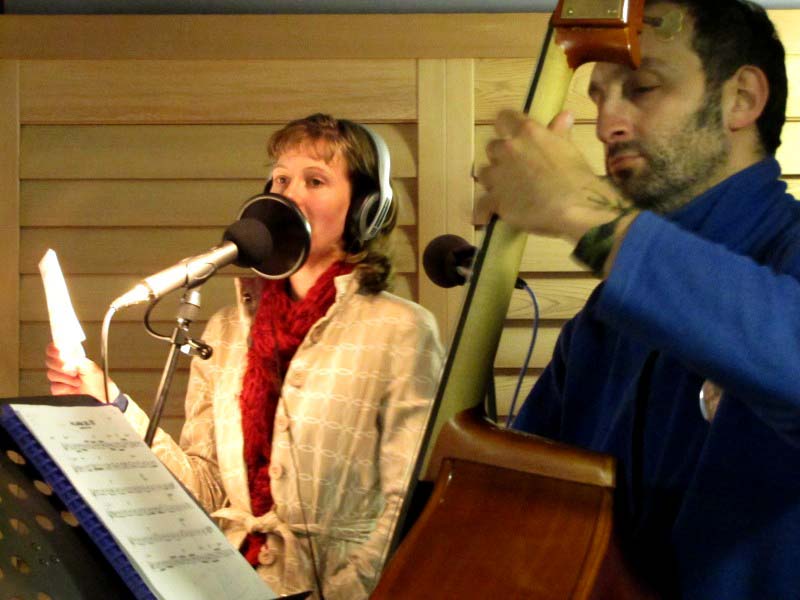
C'est vrai!  Paris is strong on jazz and, as I understand, also on earlier jazz styles and we have our own authentic Canberra-cum-Australia reps in the midst of that scene.  This weekend they were home to visit family and we caught them at Smiths, upstairs, in McGregor Hall.  Leigh Barker is the leader and also the Canberra person but now in Paris with Heather; otherwise Melbourne, the Coast, another Canberran and Latvia.  Latvia?  Well pianist Max Teakle was genuine Latvian on tour and he recognised local sit-in Valdis Thomann for his Latvian roots.  Paris can also be quite mixed and bohemian.  Whatever, this was hugely fun, inviting, joyous music.  Leigh leading with his gut strung bass; Heather with the most apt voice for this style and a good bit of playful pleasure and, to boot, violin.  Eamon just the part with an Elvis lick and overall presence and wonderful trumpet and Valdis hugely impressive as the trom offsider so comfy he seemingly had had a life lived in this very band.  And not least, Mark down the back setting and syncopating the tempo.  Just lovely.  Often slow, always rock solid steady, sometimes toungue-in-cheek implications, through a string of standards of Ellington and Frankie Valli and Billie Holliday and June Carter Cash and plenty of originals from Leigh and perhaps others.  All from their album that Leigh was indulgently spruiking on the night, Cross Street, in all formats (although only 7 vinyls available on the night).  Just great fun and great entertainment from a very professional outfit playing the era.

Leigh Barker (bass) led his band with Heather Stewart (vocals, violin), Eamon McNelis (trumpet), Valdis Thomann (trombone), Max Teakle (piano) and Mark Sutton (drums) at McGregor Hall, upstairs at Smiths Alternative.

24 November 2014

Nick's nonet


I've been musing over why I like nonets or octets. When treated as an ensemble, these are little big bands, so why these rather than the larger formats? I've decided it's because the writing becomes so clear, the lines so crisp and the solo spots so integrated and unjarring. We were hearing each voice anyway, so when some just drop out for a different texture or a solo, there's less change, less loss, more continuity. I was not certain I could attend Nick Combe's Nonet concert at Street 3 but at the last minute, I could, and it was a thing of great pleasure. Nick is soon off to Melbourne (we've lost many recent graduates to Melbourne with smaller numbers to replace them) and he gathered his cohorts together for a recording of his charted works. We've been hearing Nick's charts over the years and this is a culmination album, using his frequent offsiders. It was a strong band and one that has a collective history even if it's somewhat spread to the winds these days. We were in the generous Street 3 space, the musicians all laid out on carpet and studio-miced, some seats and cushions for an intimate audience. The recording was just 7 tracks, but there's lots of work in these, in terms of composition and arrangements and elaborations. And interestingly, Nick has a story for each. These are not just abstract compositions, but they speak of loves and losses, buses and places and health and happiness. These are Nick's encounters or experiences so the tapestry of changes and repeats speak of real emotions. This feels real. Nicely played, too. These were solos for the studio, careful, not overextended, nicely detailed and developed.

The gig started with Love is a job from Hell. It's a work in 3 parts, starting with a slow bluesy feel in 6 with dissonance and some nifty baritone sax fills and a driving guitar solos and the tenor providing embellishments that paralleled the earlier bari lines and finishing with solo piano. Then Moira, a light 2-feel with a piano trio and brushes and swelling with horns and some lovely solos on trumpet and tenor. Then Once is enough, inspired by a TS Elliot fragment and featuring a melody that's fascinatingly spelt out on different instruments, over brushes in a count of 16, then into guitar/piano and a lush horn fill and slowly swung piano trio and what I heard as an islander melody. Then Centrelink Blues referring to queues and free money. Nick has a nice story here. Medium-up blues with spaces for solos and a beautifully unhurried and thoughtful trumpet solo. I was loving both trumpeters despite vastly different approaches. Then Shoosh, everything will be alright that tells of Nick as helpful ear with slow 4 and lovely horn swells. Then Louis' precious woman, dedicated to Louis Nowra, a complex number that speeds eventually to cacophony then instrument drop outs into solos and rim shots. And a final Lemon and honey, a quickish reggae that Nick had on his mind when sick in bed. I was struck with the understated but supremely self-assured trombone here. Then thanks and chatter. It was all more rich than I can recount here. This was a musical pleasure, but also a recording and I can only look forward to the release. Nick's developed some complex and satisfying charts and this is one memory that can be confirmed soon enough on release, probably early 2015. Buy it!

Nicholas Combe (baritone sax, composer, arranger) led his nonet in a live recording at Street 3. The band comprised Nick with Reuben Lewis (trumpet), Alex Raupach (trumpet), Tom Fell (tenor, alto sax), Valdis Thomann (trombone), Matt Lustri (guitar), Damien Slingsby (piano), Simon Milman (bass) and Aidan Lowe (drums).

10 August 2012

Old and young guns, pt.1

The concert was entitled 21+75 because it marked the recent birthdays of each artist. Andy Butler was the junior; Bernie McGann the senior. If this expresses the quality of jazz in Australia as it has been and as it will be, I can only be proud. These were two seriously satisfying sets, and I was not the only one who left in thrall.

Andy led a big band (and for one tune, an octet) performing a series of charts that he’s developed with sponsorship and mentoring from Steve Newcomb under an Australia Council program. I know the band is brought together for this performance, so I was mightily impressed by how easily the band took to the charts. They weren’t easy, with odd times and syncopated conversational passages back and forth between parts. There may have been a touch of hesitation from the horns but nothing at all from Mark on drums. I particularly noticed his solo, which was solid, even magisterial. And a mix on a decent PA made all the difference. You always hear the snakey reeds and the blasting trumpets, but the tuba can be lost with its bell pointing to the ceiling. Tonight it was here and proud and speaking with its own voice. There were solos all round, of course, but the excitement here is in the tone and the orchestration and composition. The first tune was as yet unnamed and I heard it in 7/4 but perhaps with 4/4 passages. Poco was a highly syncopated unyielding pattern over 16 with a buzzing bee swarm as resolution. I missed the third tune’s title, but it was sleazy and slow and arranged for octet. The big band returned for Ode to Skype, if I remember correctly, in triple time. Andy later told me he communicates with Steve (and his girlfriend) over Skype. The final tune was Tightrope. There as a lively buzz in the foyer after Andy’s concert: for the pride in achievement as well as for the beer line. This gig was joyously received and Andy was talking of other gigs. But how to do this with such a large outfit? We can only hope.

Andy Butler (piano, composer) led big band comprising John Mackey, Niels Rosendahl, Matt Handel, Tom Fell (saxes), Miroslav Bukovsky, Alex Raupach, Ax Long, Scott Temby (trumpets), Rob Lee, Valdis Thomann, Patrick Langdon (trombones), Peter McGovern (tuba), Max Alduca (bass) and Mark Sutton (drums)

  • Cyberhalides Jazz Photos by Brian Stewart
  • 05 August 2012

    Colour against the dark, part 2

    It’s only a small room so they could hardly fit on stage, but the sound of Alex Raupach’s Dectet was lush with the tuba and various horns and the soprano voice performing sometimes as a singing voice and otherwise wordlessly as another instrument. This sound just has to remind you of Miles in the ‘50s. The tonality and harmonies and voice movements may be influenced by Gil Evans (the ballad was spot on) but the music was contemporary. The one non-original was a piece by drummer John Hollenbeck. It sat minimally against an insistent and heavy drum pattern then grew into melody and withdrew again to melodic minimalism. The last (as yet untitled) tune of the night seemed to be similarly contemporary with perhaps cacophony replacing minimalism. An earlier tune was cabaret-zany music as a setting for lyrics in Franglais by Liverpool poet Neil Innes. Andy’s Drag was more slow and bluesy and ripe for solos. Matt was his normal stunningly fluid and expressive self; Alex impressed me with some very purposeful solos on trumpet and muted trumpet and flugelhorn. Andy’s style was hard and abrasive and exploratory with single-note lines in a hard-bop style and formed an interesting contrast to Tate’s gentler tone in the previous set. I hadn’t heard Valdis for some time and I luxuriated in his solo of essential lines portrayed with richly satisfying tone. The tones of Ben and Tom and especially Peter’s tuba was essential for the lush performance. I was surprised by Ben on flute at one stage, when I thought I was hearing voice. Mark added rhythmic grunt and lots of percussive colour and Rohan sounded strong and beautifully tuneful on bass. But this was essentially a group performance in a way that smaller formats aren’t. It was lush and rich and satisfying and it must have been lots of work to orchestrate. There were some minor lapses in intonation, but nothing a little practice or regular performance wouldn’t fix. This was part 2 of a concert that confirmed the quality of our local jazz product (while it lasts). I enjoyed it, but more, I was truly impressed.

    Alex Raupach (trumpet, flugelhorn) led a dectet with Rachael Thoms (vocals), Matt Handel (alto, tenor), Tom Fell (tenor, baritone sax), Ben Sutcliffe (tenor, flute), Valdis Thomann (trombone), Peter McGoven (tuba), Andy Butler (piano), Rohan Dasika (bass), Mark Sutton (drums).

    30 July 2010

    Transit lounge

    Jazz-trained players don’t just play jazz. Jazz training is a catch-all for a range of syncopated, modern styles and the forefront of jazz has always been a sponge for influences. Last night, I caught Dub Dub Goose and Los Chavos. DDG is a dub/reggae band, and Los Chavos is a latin outfit. Both play insinuating styles that appeal broadly and get the dancers on the floor, and both are seeded with local jazz training.

    Firstly, Dub Dub Goose. I hadn’t heard them since their first gig at Moruya a few years ago. The Goose is now much more developed, more purposeful and confident, and with a CD under its belt. The band has a firm lead from Beth Monzo, who plays guitar and sings out front. I presume she writes a good deal of the quirky, entertaining and (age-)relevant lyrics. The combination of a strident and uncompromising female voice, the vibrant horns and energy and good humour make this a thoroughly entertaining outfit.

    I have also written here of Los Chavos, when they played at the launch of the Canberra Musicians Club. They were good then; they are now that much more alive and confident. Latin is perhaps the master beat of the rhythmic universe, so it’s no surprise to see the dancers pop up when they get going. Again, there’s a front line of horns, and inevitable percussion and interestingly a keytar (someone told me this is what this strange over-the-shoulder keyboard is called, as has been used by Chick Corea and Herbie Hancock and a string of boy bands). I expected simple melodic lines, but Alex Carder was playing some interesting chordal fills with bends, so the instrument defied my prejudices. Otherwise, I noticed the commitment and joy that Andy Jauregui sings with, and also drummer Amanda Waite. I was standing beside the stage when I was surprised by her competent introduction: clear and immediate, seeming to come from nowhere, and leading the band into an instant solid groove.

    DDG and Los Chavos were playing at the Transit Bar. It’s quite different from most jazz venues, of course. These bars are more beer-spilled, younger places with pool tables, punchy PAs and DJs in the breaks that are louder than the bands. I liked it. I was there with my two sons, but I even came across an old mate from the Blues Club, obviously determined to grow old disgracefully. So should we all.

    Dub Dub Goose were Beth Monzo (vocals, guitar), Nick Combe (bari sax), Reuben Lewis (cornet), Valdis Thoman (trombone), Matt Lustri (guitar), Ben Fowler (bass), Matt Sykes (drums). Los Chavos were Andy Jauregui (vocals), Valdis Thomann (trombone, vocals), Corey Booth (trumpet, vocals), Amanda Waite (drums), Simon Milman (bass), Alex Carder (keys), Matt Lustri (guitar).

    12 June 2010

    Milonga on air

    It was like a broadcast milonga. Tunes broken into tandas (that set of tunes for a tango dance) separated with cortinas (the disparate “curtain” music that allows the dancers to swap partners at a social dance, ie, at a milonga). So it was when Los Jovenes del Tango performed last night for ArtSound’s Friday Night Live. Actually, I’m cheating. I’d never heard of a milonga or a cortina (other than Cortina d’Ampezzo) before last night, but I’d heard some tango, and we all know how seductive it is (musically and otherwise). This music of the bordillos of Argentina is the music of prostitutes and the lower classes that was later taken on by French upper classes, and became an international music, impinging on jazz and classics. I’ve written on CJ of Marcella Fiorillo, Canberra’s wonderful link to Argentina, performing a tango opera of Astor Piazzolla, Maria de Buenos Aires. This was less formal and less classically-composed, but still ordered and complex with emotional crescendos, some unexpected time signatures and the inevitable words of passion. During the intermission interview, Natalya quoted one line: “I slit my wrists and bleed at your feet”. Not light hearted and not writing of the middle classes, other than perhaps their impassioned teenagers. But unlike teenagers with their passions, this feels true. This feels of backstreets and desperation. I can hear why people get so committed.

    The band was an uncommon mix, too (as was Marcella’s Piazolla orchestra). The backing was Simon on a steady double bass and Liena on a classical pedal harp that performed various lines for guitar and others. There was no bandenoneon, but Valdis drew notes of heart-on-the-shoulder emotions from the bellows of an accordion and Lathika’s violin generously emoted each impassioned line. I particularly noticed both the violin and accordion for these intimately voiced melodic snippets. Valdis swapped for trombone at one stage and that fit nicely too. Natalya provided the voice. I found the tango voice strangely enervated but I expect that’s the nature of tango singing: a world-weariness that we also recognise in cabaret, perhaps a European equivalent with a similar dark history. But it’s lovely music of rhythm and passion but also with an end-of-time edge.

    Los Jovenes perform regularly for milongas of the Tango Social Club of Canberra, so if you have always wanted to indulge in dancing this Argentinian passion, chase them up. Link below. Los Jovenes del Tango are Natalya Tacheci (vocals), Lathika Vithanage (violin), Valdis Thomann (accordion, trombone), Liena Lacey (harp, viola) and Simon Milman (contrabass).

  • Tango Social Club of Canberra
  • 12 December 2009

    Double header: set 2

    John reappeared with the band he got together to perform his compositions for his recent Recital at the Jazz School. They had performed for the recital, and presented one ArtSound Friday Night Live (which I sadly missed), and this was their one gig. But what an gig! I always love the complexity of interwoven written horn lines. Here, the bell-like clarity of two trombones and trumpet/flugelhorn rang through, with Jo Lloyd’s impassioned alto fills. Wonderful, goodebumps material, this. Then time for solos all round. I noticed the diverse guitar styles, at least in solos: Andy’s rapid lines; Matt’s minimalist explorations. Raf especially commented on their accompaniment; I missed most behind the horns but noticed some single note counterpoint that was fascinating. Raf was involved and entertaining as he inevitably is, with slap and solos on his Yamaha. Grey did another minimal but melodic solo, accompanied by unison voice. Jo always excites, and was no less here, sounding increasingly professional in style and comprehension. Rob’s solo was melodic and rich; Valdis’ was more simple but strong and emphatic. Bari always reminds me of Mingus bands, and I enjoyed Tom’s solo. John was leading so more out front, the smiling leader, again more outspoken in this context than in the Boys. They played a version of Freddie Freeloader, but otherwise it was originals with lush front line harmonies ringing with the clarity of brass over a range of changing rhythms and grooves – funk, rock, jazz, 12/8, 6/4, well varied. There was some intonation that wasn’t perfect, but this is not a regularly performing band and the music is not trivial or constant. But it was was vibrant, alive, informed music. Truly impressive stuff.

    Three By 3 was led by John Milton (drums) and played charts compased and arranaged by him. The rest of the band was Jonty Hall (trumpet), Joe Lloyd (alto saxophone), Rob Lee (trombone), Valdis Thomann (trombone), Tom Fell (baritone sax), Matt Lustri and Andy Campbell (guitars), Grey Milton (piano, vocals) and Rafael Jerjen (bass).

    27 September 2008

    Flavours over layers and a nice march

    I’ve noticed that student music has been wonderfully varied recently. Not to say I don’t like standards; I do. But it’s exciting to hear new music, and doubly so when it’s so unpredictable and in such varying styles.

    Matt Sykes presented his largish band, The Melds, last night as a Friday Night Live concert on ArtSound. Just the makeup of the band told you this was different: nine players, three guitars. Sounds interesting before you hear a note. Then it all starts with pedal bass, polyrhythmic drums, layers of guitar colours, organ pads, then a recursive melody on the horns, references to sustained grooves a la Bitches Brew. The band continued without a stop into another harmonically simple tune with repetitive trombone melody; again richly layered with complex tonalities, again with crossing rhythms from various instruments. I’m wondering, who’s conducting this? I’m also wondering why it is that trombone players are so often so simply and perfectly melodic. Continuing into thin, effected guitar chords with other guitar sounds layered over, and another simple, pensive, recursive melody and some sweet horn harmonies. A wonderful solo on trumpet; a stunning response on alto. Wailing un-guitar tones reminiscent of Scofield synth play and a ‘bone solo. Still no break; now three tunes running a long medley; perhaps 25 minutes. Hypnotic, soothing, emollient. A break for a Hymn for leaving; balladic, developing into a relatively bouncy two feel, and a blissful alto solo. And that organ again. But there’s no keyboard; just guitars. The other guitars are effected, but Matt Lustri’s more bizarre, toying with Mike Price’s Roland guitar synth on loan: pads, organs; unreal tones or tones only too real like Hammonds and even steel drums.

    After the break, a bass solo intro, and those steel drums just making the lightly swinging Caribbean tune sound the part. This is where we noticed the good humour. Lots of guys jumping and laughing. This is a group of students, after all. Prime of life stuff. Mates having a ball but musically serious despite the jocularity. Then something that verged on the more mainstream, and another searing alto solo from Joe Lloyd. Then a bouncing European march, a complex piece reminiscent of the great Carla Bley: Simon Milman’s Explorations in clown music. The concert ended with a seemingly free improvisation of reversed sounds and cacophonies. I was in the studio at this time. Simon was conductor and guide; Valdis was the stentorian voice calling the end … to considerble mirth! The end to a fabulously entertaining and category-challenging concert. Great work, guys. A blowout! Loved it.

    The Melds are led by Matt Sykes (drums) with Simon Milman (bass), Matt Lustri (synthesiser guitar), Adam Guzowski (guitar and effects), Andy Campbell (guitar and effects), Valdis Thomann (trombone), Reuben Lewis (trumpet), Joe Lloyd (alto saxophone) and guest Hugh Deacon (percussion).

    02 April 2008

    Godly tuba

    Gareth and his mates performed last night at the Gods as the Gareth Hill Quartet. It was a return performance of the Sam Young Quartet which performed at Hippo’s a few weeks back, this time without Miroslav Bukovsky sitting in. As sometimes happens with jazz players, this band appears under different names when the bookings call for it. When they go incommunicado, they can also appear as Lookwell, a name taken from a favoured, but very short-lived (single episode?), TV program. Confused?

    The performance was not so confusing. This was a quieter and more attentive environment for the band, and it highlighted the interplay and good natured friendship between the players. The playing was much as observed at Hippo, but it was all clearer and more evident in this listeners’ environment. Aron’s guitar was malleable, sometimes dirty, and often intriguingly indeterminate in pitch. Valdis played some lovely, often simple but always tasty solos and backed with interesting counterpoint or ostinato lines. Sam watched the others studiously, and played well structured solos and responsive support. Gareth is a keystone, at one time holding a 6 feel across 4/4 for a lengthy passage of melody and solos, and at various other times soloing and backing with comfort and solidity.

    I caught more of the names and composers of tunes this time. They played Scofield’s Cool and Ellington’s African flower. African flower is a lovely, unforced Ellington melody (aren’t they all?) and it was a treat to hear it played on a sultry and sinuous trombone. The other tunes were all originals, roughly equally shared between Aron, Sam and Gareth. I heard post bop, New Orleans marches, fusion, lullabies, Wunderlust and more amongst the styles, so there was variety.

    It was a worthy return performance, another satisfying concert at the Gods, and another recording to listen out for on ArtSound over coming weeks or months.

    The band comprised Gareth Hill (bass), Aron Lyon (guitar), Valdis Thomann (trombone, tuba) and Sam Young (drums).