Showing posts with label CIMF2015. Show all posts

12 May 2015

g-l-a-s-s

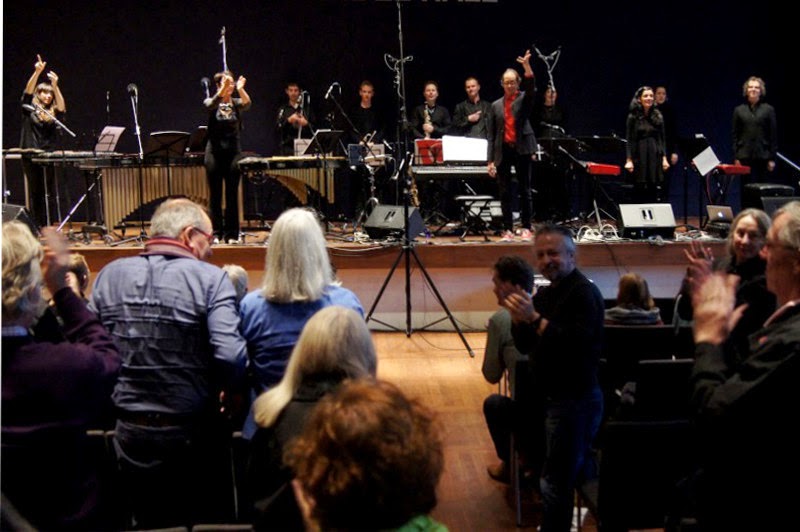
It was an afternoon of (Philip) Glass. We were in the Gandel Hall at the National Gallery, not at the Fitters Workshop, next to the Glassworks. This was a mammoth outing. Three hours of Philip Glass. Ensemble Offspring and associates were playing a string of formative works by Philip Glass. He's somewhat notorious for his minimalism and apparently caused considerable stirs when his works were first presented at various locations in NYC. While listening, I became aware of how we are now acclimatised to this approach, even if I've had some questioning comments since. But it's fifty years back now. The works were dated 1968 to 1976 so the early ones are from the Summer of Love, 1968, high Hippy, but this is not Hawkwind or psychedelia. They are out of the fine music tradition (Glass studied with Nadia Boulanger in Paris) even if they are outside it. This is music reduced to a minimum, based on repetition and alternation of melodic cells. I wondered if it's prefigured by change ringing with its permutations of bell rings. The effect of the moving cells has a similar effect. But references are more to India and drumming and that fabulous percussion singing called Konnakol. Glass' music is intense, unforgiving, unrelenting, fairly loud; then it stops. The introduction suggested those in the know were the ones at the back lying on pillows, but then this is no longer the '60s (and the audience was no longer in its 20s). Audience could come and go through the performance. All very much of the period. The beats were intense and satisfying and the crossing rhythms were fascinating and forming their own mutating sub-rhythms. In one piece that I consciously tapped, I felt 6/8, noted three-note patterns and also quaver pairs (quaver pairs in 6/8?) but I couldn't easily tap to 5. I wondered about how it's written, then realised (again for this one piece but the approach seemed common) there was a cell pattern separating varying repeats of another pattern. I could guess how that might be written. The performers often nodded heads, no doubt identifying changes. There were a few slipups where someone stopped to await another nod.

We heard a string of works of varying degrees of complexity. Claire Edwards started with 1+1, a very simple work tapping a timber board. It reminded me of rhythm exercises I used to practice with a drummer mate. This was very early. Then Music in similar motion, played on two vibes and keyboard containing only ~6 notes. They played Music in contrary motion later, on two vibes, e-piano and 2 keyboards. The contrary motion was more complex and demanding of concentration but just as devoid of respite. I thought there was a drone there, too. Tough on the musos: have a moment's doubt or flinch and you're lost. The percussive pitch of vibes and the organ tones of keyboards were key, but Glass later expanded with instruments for overlaid pitches and alternative rhythmic patterns. Music for fifths was played on e-percussion, keyboard, clarinet and soprano sax but here the wind instruments just seemed to add tonal variation, playing the same unyielding lines. Knee plays 1-5, from Einstein on the beach, was the latest work (1976) and it's a big departure. A single simple three note line on e-piano, a string of singers with simple, beautifully enunciated voices singing 1-2-3-4/1-2-3-4-5-6/1-2-3-4-5-6-7-8 sometimes missing a number and a violin that is Einstein playing a devilishly difficult extended solo line, then again later. Just glorious, uplifting, fascinating. It must have been a devil of a work to play. Graeme Jennings (a CIMF2013 houseguest!) took it on, but I think it's something you'd have to live with for considerable time: no break, wild bowing and totally unforgiving. I was deliriously loving this all, although at 2 hours I was flagging. But then the finale, another highly developed work, Music with changing parts, dated 1970. The style was like the early ones, but beyond. I'm not absolutely sure of this (some musos were obscured in the back line) but I think this was played by 2 keyboards, e-piano, vibes, marimba/percussion, trumpet, alto/soprano sax, piccolo, bass clarinet and two female singers. The repetition of cells was there, but accompanied by long tones and various rapid repeated melody snippets. Someone said after that it was a NYC soundscape: ships on the Hudson, taxis, police sirens and the rest. I could believe this. This performance was limited to just 45 minutes (it can go on for hours) and I could have enjoyed more.

I loved this gig. I'd been bathed in beats and crossing rhythms of few, repetitive notes and tapped my foot dry (most just sat still, this being a classical audience, but how could you not move to those deliciously abstruse beats), absorbed some beautiful tone and voices and meditated on this all. And put tissues in my ear for the unrelenting volume: the volume wasn't so loud, but it came constantly. Great gig and another CIMF revelation.

A World of Glass was performed by Ensemble Offspring and associates. EO are Claire Edwardes and Bree van Reyk (vibes, percussion), Jason Noble (clarinet, keyboard) and Jim Nightingale (saxes). Their friends were Graeme Jennings (violin), Gabi Sultana, Alister Spence and Roland Peelman (keyboards), David Shaw (flute) and the Song Company with YAFF vocalists.

11 May 2015

Revelations aplenty

Revelation is a word I find I'm using frequently for this CIMF. Sadly I've attended too little due to conflicts, but what I've attended has been rich with the modern and somewhat unexpected. Movers and shakers was all contemporary and a great mix of styles. Two of four composers were not just contemporary but in attendance. The gig started with Brian Howard Full fathom five. Amusingly I sing FFF in a choir, but nothing like this version. This was scored for 15 players; a thrilling and powerful 2-feel; swelling notes and sudden stops (reversed envelopes); tones moving throughout; notable trombone and explosive bass drums. Apparently it's written in response to Jackson Pollock's response to Shakespeare. Next was our late local master, Peter Sculthorpe Island songs for saxophone and ensemble. This was two movements with Amy Dickson featuring on soprano and alto sax. More expansive than FFF, meditative, strings and sax interspersed with various percussion and the sounds of seagulls (sliding cello harmonics) and other (sliding violin harmonics). I felt hope and satisfaction and survival and a sense of location. Kate Moore Velvet followed as a cello/piano duet played by Roland Peelman and Geoffrey Gartner. It's described as a response to flowing garments and cloth in the paintings of Leonardo and others. It's a beautiful subject, all draped opulence and on canvas so real. The image was vivid. Firstly 5/4 broken 3-2 displaying free folds and falls of fabric. Then perhaps into 6 feel and perhaps 3 and a response to the emotions of the paintings and a delicate insistence. To finish, a famed work of minimalism, John Adams Shaker loops for strings. Four movements, intense, incessant despite dynamics, 4s and 2s, and even a feeling of trains (not sure I should hear trains!). Again, this was a survey of some excellent and inventive music over various contemporary styles and so well played. Look for it on ABCFM as a live concert: they were recording.

The composers were Brian Howard, Peter Sculthorpe, Kate Moore and John Adams. The performers were Amy Dickson (sax), Geoffrey Gartner (cello), Roland Peelman (piano, conductor), New Zealand String Quartet comprising Helen Pohl (violin), Douglas Beilman (violin), Gillian Ansell (viola) and Rolf Gjelsten (cello), Tinalley String Quartet comprising Eoin Andrerson (violin)Lerida Delbridge (violin), Justin Williams (viola) and Michelle Woods (cello) and Barbara Jane Gilby (violin), Anne Horton (violin) and the YAFF String Players comprising Emmanuel Cassimatis (oboe), Amy White (clarinet), Christopher Martin (bassoon), Ros Jorgensen and Nigel Croker (trombones), Gergele Malyusz (horn), Leanne Sullivan (trumpet), Kyle Daniel (double bass), Jim Nightingale (sax) and Claire Edwardes and Bree van Reyk (percussion).

10 May 2015

A cold one


This was a cold one. We stood and shivered our way through a series of pieces on the Carillon. The wind blew through the recording I made. But the pieces were interesting, more so than some other Carillon gigs I've heard. A few locals were represented, people who know the carillon: Larry Sitsky, Leonard Weiss, Kate Moore. Kate's tune was commissioned for the carillon for this festival. One of Leonard's tunes was previously commissioned. There was a rag from Elena Kats-Chernin and she's sometimes in Canberra so may also know the carillon. Kate has lived in the Netherlands for the last 13 years and knows any number of carillons: they are a thing of the low countries and thereabouts. The Carillon plays with two hammered keyboards and a pedalboard. In action it looks heavy, played with clenched fists. Some sounds are deep and some light and airy. I warm to busier passages, where the harmonies become more evident with runs of notes. But pairs of notes are playable and Kate used them in her piece with cello. That was the only composition that was not solo bells. Kate's piece was For Elyse, with sustained cello played over regular harmonic accompaniment from the bells. Particularly mystical in that cold and falling darkness. Strangely, I am told the bells are only heard in the keyboard room, high but below several stories of bells, through speakers. Kate's cello was acoustic and processed and heard in the keys room, but heard over PA at ground level, with the bells sounding acoustically. Lennie played several of his own pieces; Lyn Fuller is the chief carillonist and played others; Thomas Laue and Anna Wong played others. It was a struggle against the elements, but intriguing and a pleasure.

Leonard Weiss, Lyn Fuller, Thomas Laue and Anna Wong played carillon. Kate Moore (cello) also played at the Carillon for the CIMF.

09 May 2015

Noises


James Turrell is described as the greatest artist of our time ... by some. I enjoyed some of his exhibition and admired some techniques, but I prefer Botticelli. But James and Oliver of The Noise were playing in the very echoey space of the Turrell Skyspace at the National Gallery yesterday and I enjoyed that experience. The dome itself seems strangely out-of-place to me, non-Australian, with ferns growing over (I saw them dead and dry a year or so ago) and all that water and green grass. The colours are not right. The open eye to the sky gathers some Australian colours, but seems to me to steal it for the benefit of the artist. But the techniques are perfect. The laser-levelled water edges are incredible, if the work of the builder. The sharp edged eye on the sky is also wondrous, although seems to be suffering a little now. Its edge is getting haggard and there are spots in the dome that break the sense of perfection. But perhaps the masterpiece was below me. The woman next to me observed that the concrete seats we were sitting on were heated. So it was! Comfy.

James and Ollie played for about 45 minutes. It was one mutating piece, improvisation perhaps with some guide. Mesmerising, suitable for closed eyes, I think accompanied by drones (presumably that was the purpose of the two speakers fed from a laptop under Ollie's seat). I enjoyed this, didn't find it at all stretched or straining. My android tuner told me A was the central note, moving through C, C#, D, F. Fairly tonal, although mesmeric rather than melodic, sometimes moving stepwise, sometimes making noises rather than clear tones, with backs of bows or whatever. I liked this immensely. It's new, it's even n(N)oise, but it's music of its time and apt for the space. Spacey, even. They did it very well.

James Eccles (viola) and Oliver Miller (cello) are two of The Noise and they played at the Turrell Skyspace at the National Gallery.

06 May 2015

Inside the whale


Kate Moore, resident composer at this CIMF and our house guest, gave a presentation at the School of Music. I've been hearing her contemporary classical music and chatting with her about it, but this was an overview of her composing as a profession and an introduction to a few of her compositions. It was truly fascinating. This new music is somewhat a new world to me. Hearing Kate's words clarifies many things. She opened with some background: her time at ANU; her experiences at the Royal Conservatorium of Music in the Netherlands; her commissions and her approaches and her colleagues. Just some of what she advised: work hard and do what you love; find people to work with; companionship is also important (I imagine it is especially so for the secluded composer); find your own philosophy/approach through comparison (not sure I express this well) or "try different things and leave some behind". She talked of her composition, Sensitive spot, and watched a video of it performed by pianist Saskia Lankhoorn at the Bimhaus. It's a work is in geometrical form, played and recorded several times as perfectly as possible, then overlaid, so perfection appears from errors, or perhaps, from divergence. I heard it as intense, mutating, hammered chords with a varying electronica drone.

Then questions. Program notes are important, they can be in various forms (not just words on paper) and are a "window on the composers' mind". The Dam was the piece composed as a commission for this festival (see CJBlog post Revelations of 14 May). It portrayed an Australian farm dam, a place, on her parent's property. I was impressed by her obvious careful listening, as she spoke of frogs chattering similar songs with different frequencies playing off each other, tremolo effects, drones, resonances, spatial implications ("You can hear the soundscape ... the horizon; imagine a picture through sounds". Picturing the horizon through sounds! This is excellent listening). Also of the challenges of this commission: old and new ensembles, separated by 50+ metres, tuned at 415 (baroque) and 440 (modern) so needing to be transposed a semitone, different techniques and tones and textures. Kate approached the ensembles as shadows of each other, different, self-sufficient but reinforcing (brilliant!). There was a question about schools of composition which I felt Kate queried with great self-awareness. We are all products of our time and place; she was influenced by indie rock and classical cello and Aussie composers too; we select labels also from our own knowledge and experience (so true!). Yes, she focuses on structure with rhythm as a driving force, but so do many composers from many backgrounds. Seek a truthful language, a language of our time, an honest voice. She writes on acoustic piano; she improvises to build / find material then chips away at this to refine it, perhaps to a geometric pattern or a process. It's a long process; one work can take a year. What of difficult commissions? This is your profession so deal with it. Work through it; remove self and break down then build back up; don't panic (!) A good mentor is a help, even one outside the field: composition is a solitary profession. You need a reason to write a piece, a question to solve. Pieces are isolated but also intertwined: they have their own narrative but together they build another narrative.

The end was a listen to Kate's composition, Fern, while following the score. The music reflects the form of a fern, branches on smaller branches. There's proportion, meter, duration, rhythm; one melodic snippet runs throughout, differently placed and stretched or shortened; "always the same, always different, but no direct repetition". The music really was quite beautiful and blossomed for me when known more closely. This was a further revelation. I am warming to this new music. Megan won't be impressed (but, don't worry, I still dig Bach and Beethoven ... and Miles and Mingus).

Kate Moore (composer in residence at CIMF) gave a public workshop at the ANU School of Music.

  • Sensitive spot, composed by Kate Moore, performed by Saskia Lankhoorn (YouTube)
  • 04 May 2015

    Revelations


    Bach's universe was the opening gala concert for CIMF 2015. It's not the first concert, residing as it is after the second concert of a series of the complete Beethoven piano sonatas. I found this a hugely refreshing outing. We all love JS - he's central to our conception of the Western musical canon these days and everyone's fave - but this intermingling of his pieces with contemporary works was a revelation. The Bach was a full violin partita (Partita no2 D minor BWV1004; not sure this was expected, but it was welcomed), a trio sonata variously with harpsichord and baroque organ (Trio sonata G major BWV530) and a cantata (Jauchzet Gott BWV51). Intermingled in the program, although tellingly performed from a second stage at the other end of the longish hall, were Steve Reich Vermont Counterpoint, Alister Spence Time is time enough and Kate Moore The Dam (a Beaver Blaze commission). I loved the Bach, of course. I especially noted Rebecca Chan, who did a great job on the lengthy and virtuosic violin partita from a spot in the middle of the hall. The hall was unexpectedly laid out in two long but shallow rows of seating facing each other with a stage at each end, to right and left of the seated audience. Strange, but it worked, allowing quick transitions, varied instrumentation and a differing and more democratic experience of placement. We were right up against the southerly stage, so the Bach was distant and echoey. Interesting. Also noted, if distant, were Rosanne's Hunt's baroque cello and Alex Oomens' apt soprano and the ringing pleasure of Leanne Sullivan's occasional baroque trumpet.

    It helps that we were close by, but on the night I was more excited by the contemporary music and this was a reminder to me after lots of recent, relatively earlier music. Contemporary is harder to sell so less common but when it's as good as this, it's exciting and vibrant and intimately expressive of our era (not that Bach and Beethoven have nothing to tell us; good is good, after all). The three works were that. Firstly, Stave Reich Vermont Counterpoint played brilliantly by Claire Edwards. She really was a star of my experience of this concert. Then a duo with Claire and Amy Dickson playing a work by Alister Spence on gongs and marimba and a busy and not overly jazz-influenced soprano sax. Then a finale with Kate Moore's The Dam which was commissioned for this festival. This was played by two ensembles, baroque and contemporary, one at each of the hall, led by Roland Peelman in the centre and Kate at the contemporary end. This was somewhere around minimalism, richly varying rhythms and time signatures beating in and out, regularity amongst change, conversations between eras and tones and colours and localised with William Barton's didj. I'm looking forward to a peek at the score, but suffice to say, lots of mutating counting required. Our experience was influenced by placement, but that's all part of it and it fits. But it's all relative and that's Einstein and the festival's theme.

    JS Bach, Kate Moore, Alister Spence and Steve Reich were performed at the CIMF Gala concert entitled Bach's universe. At the south end were Kate Moore (conductor, composer), William Barton (didgeridoo), Amy Dickson (alto, soprano sax), Claire Edwardes (vibes and other percussion), Pete Harden (baritone guitar) and ??? (piano). In the middle were Rebecca Chan (vioin) and Roland Peelman (conductor). At the north end was the Festival Bach Ensemble comprising Alex Oomens (soprano), Leanne Sullivan (trumpet), Matt Greco (violin, director), Annie Gard (violin), Heather Lloyd (viola), Rosanne Hunt (cello) and Anthony Abouhamad (harpsichord, baroque organ, director).

    03 May 2015

    Our CIMF


    The Canberra International Music Festival remains a spark on the Canberra music horizon. It's somewhat changed this year. Roland Peelman has taken over as artistic director and the main venue is the Fitters Workshop. I read Roland's message in the program and it appeals to me in several ways: the recognition of Canberra as a place of "knowledge, science and ... fact-seeking" as well as the more obvious government and governance reference. Actually, we can claim a good bit of the governance, but much of the government actually comes to Canberra. We can't lay claim to Abbott or Hockey or Babs Stilton. But Roland admires the view of setting sun in hills and they have been spectacular recently. Perhaps for all this, the theme of this festival is Einstein. This year is the 100th anniversary of the Theory of Relativity. Amongst all the hoo-ha and expenditure on another recent centenary this one is easily forgotten, but it's a mark of this institution and of Canberra that Relativity that would be remembered here. It's a mark of genius, of awareness and broadening minds. Amongst this, Roland attests this CIMF as "unashamedly" celebrating the great Western classical tradition. But CIMF is not staid, for amongst the Bach and Beethoven there are the minimalists and the contemporaries and the commissions. This is nothing if not a refreshing and intelligent event. We are involved through attendance, of course, although not so much of that (it's a busy time otherwise). We are hosting a few of the visiting artists and this is a much deeper involvement in some ways as well as just plain good fun. Kate Moore is a visiting composer and Pete Harden is performing on baritone guitar. International visitors are a reminder of difference and this is great for a settled life. These two live in the Netherlands but are from Australia (Kate studied at the Canberra School of Music) and England. This visit is much fun, although maybe I should avoid too much chatter on music. There is more to life besides music even during this week. CIMF is looking great.

    22 November 2014

    Celebrating Relativity


    The Canberra International Music Festival always has a theme, and this coming year it's the centenary of Einstein and General Relativity. Only in Canberra, although Relativity is more general than may be otherwise recognised. Why only Canberra? Because this is a city of universities (ANU, UC, ADFA/UNSW, ACU, CSU) as well as a city of CSIRO, Mt Stromlo, our Nobel Brian Schmidt, let alone various arms of government (which are not all security related, even if Howard's memorial as the second largest building in Canberra is the still-unoccupied ASIO building, amusingly built in the shape of a parabolic dish aimed at Parliament House! Did no-one see the symbolism on paper? More worrying, perhaps someone did). But we can be proud of our CIMF. The launch was in the Shine Dome, the saucer-shaped headquarters of the Australian Institute of Science (yes, Virginia, they recognise climate change, and yes, Virginia, Quadrant has questioned their integrity). Alex Raupach was improvising as we entered. The speakers were from the Committee but also physicist John Rayner who explained that the intellectual prompt for General relativity is our inability to tell the difference between gravity and acceleration. Then on through maths and spiritual dimensions and the parallel tumult in music and physics in the early C20th and space / time and Newton / Einstein and determinism / probabilistics, and strings and the GUT. Fascinating. Then Emma Rayner with a Bach cello suite, played beautifully and perfectly fitting this formal but intriguing space. Come to think of it, some of the wall is actually string (!) so I guess string theory is doubly apt (and even predicted) here. Then music director Roland Peelman who introduced each work over each day. The program is on the website, but I noted the complete Beethoven piano sonatas in 8 concerts, Bach of course, Brian Schmidt at Stromlo, ANUSM graduate now La Hague resident Kate More as composer in residence, Andrew Ford with Imant Tillers projections in a commission by Barbara Blackman, Sculthorpe and Brahms and kids concerts and Ensemble Offspring playing Philip Glass' Music in Twelve parts (over 3 hours non-stop) and overboarders Deb Conway / Willy Zygier. Plenty more; see the program. Add some wine and cheese and we're looking forward to another exceptional gathering. Canberra International Music Festival; with new MD; 1-10 May; deeply satisfying music with cerebral affinities.