Showing posts with label Matt Lustri. Show all posts

29 May 2023

Hot pop

It was pretty sophisticated popular music but I'll dub it Hot pop anyway because it was fun to hear and no doubt fun to play.  This was Elise leading on a range of sophisticated modern musics with a few visitors from north of Sydney and a few hot locals.  The visitors were Toby Hall and Pete Grey.  Toby has come to town for various jazz gigs in the past although I haven't caught him recently.   He was all pushing and playful and drawing all from Elise and the band.  Pete was new to me, playing a very sweet and inventive gig on a red JB, slinky and fingered and nicely busy and just one little slap line.  The locals were Matt Lustri, local guitar whiz, now also singing harmony and one front line as Matt "Bianco" Lustri.  I like his calm but explosive and well effected guitar, although this was more subdued than I've seen him before, given the more poppy material.  I admire singers and Matt singing was new to me.  Ross Buchanan is a common sight around town and this blow-out performance just confirmed why: busy, charging, unrelenting, staccatos or extended phrases on piano and organ.  I loved to see Pete's glances of interest following a few particularly driving fast repeating staccatos.  It worked a treat.  And Elise, leading on vocals, friendly in presence and with flute melodies and solos to add to the sounds, and with a fabulous repertoire of interesting tunes, a few new to me and worthy of investigation, and danceable beats.  Noel Gallagher, Matt Bianco, Derek Trucks to Bowie Life on Mars and Prince Diamonds and pearls and even Gil Scott-Heron Lady Day and John Coltrane.  And some blues and latin and always driving groove with just a touch of the quieter.  Great fun, tapping toes and some new and reappraised works of genius.

Bella Groove appeared at Smiths featuring Elise Walsh (vocals, flute), Matt Lustri (guitar, vocals), Ross Buchanan (keys), Pete Gray (bass) and Toby Hall (drums).

10 September 2017

Zapped


Zappa has been on my radar for years but not so much on my turntable so a retrospective like this was a blessing and a huge excitement. And this one was a learned outing. Gathered by Steve Fitzgerald after his Masters studies of Zappa and informed by musicologist Stephen Loy who speak between sets on Zappa, the Mothers, the '60s, pop and avant garde and Adorno. As for the music, it's similarly complex and considered and influenced and a mass of work to prepare. Lots of 16th-note unison lines and odd starts and stops and changing rhythms and whimsical grooves. The original had plenty of famously sly lyrics, too, and Clare presented some of these in tunes from mid-first set on. The two sets were very different. First up was more acoustic, or at least, less rocky, read, no drums: vibes, alto/soprano/flute, Rhodes/Moog, double/e-bass. The second set added tenor and screaming guitar, Zappa's instrument, and Steve switched from vibes to kit, so louder and heavier and rockier. We learnt of Zappa's influences in C20th "classical" music - Stravinsky, Schoenberg, Varese, Cage; of Adorno's critique of art as commodity or resistance; of Zappa's perverse approach of innovation presented as a "product" or "entertainment", contradicting Adorno's perspective; of Zappa's catholicity in querying whoever, straights or hippies; of his clever contrariness joined with biting hilarity - Stephen Loy quoted Zappa: "I'm really just a phoney but forgive me 'cos I'm stoned" or "Is there any art at all ... it really doesn't matter". So much for pretensions when the guy who says that is a master. Also interesting was to touch on these "fine music" influences in rock at the time, on the Beatles (Revolution no.9, Sergeant Pepper, etc). Little time to touch on that, but it's significant that Zappa's music was recorded by the LSO and Boulez. Steve's vibes were a huge pleasure, classically trained and vital and so precise; Callum played the hardest of lines with panache and some great solos; Clare did a great job, mostly Rhodes, sometimes with effects, some Moog synth and a great take on some very challenging vocals; Jared's bass was a pleasure, great tone on double and demanding reading throughout. The second set had Steve on snappy and superbly apt rock drums (one of very many pleasures on the night), Josh on tenor with one memorably searing solo and Matt Lustri doing a fabulous take on Zappa's solos, all busy and dirty. Zappa was prolific but had an exceptional band and following in the early '70s (I saw him on tour in Adelaide at this time) and much music was from then. The finale was Peaches en regalia; others included Black page, Uncle Meat, Don't you ever wash that thing, Twenty small cigars, Sofa, Echidna's arf, Idiot bastard son, Zombie woof, Watermelon in Easter hay, Son of Mr Green Genes. Names that suggest the times but also Zappa's wit. So, a great night that must have taken a huge investment of time or some exceptional reading (probably both). I loved it and learnt lots.

Steve Fitzgerald (vibes, drums), Calum Builder (alto, soprano, flute), Clare Fitzgerald (Rhodes, Moog, vocals), Jared Plane (double and electric bass) played Zappa. They were joined for the second set by Matthew Lustri (guitar) and Josh Buckler (tenor). Stephen Loy (musicologist) spoke between sets.

24 December 2015

Advent


Musicians coming home to visit the family. Old ANU bands getting together to play their greatest hits. Some great jazz from musos that we hear developing further year by year, in Canberra or elsewhere. Same Hippo. Such a pleasure to be part of all this at this time. The latest was Reuben Lewis & the Snake Charmers. Reuben was back from Melbourne. Aidan for a second recent concert in recent days, was back from Berlin. Both dropping in for Christmas cheers. Both with old sparing partners, Simon and Matt, in a format they have all played frequently. Tunes by the band, Reuben and Simon, with occasional covers. Bjork Hyperballad for one. Otherwise, I recognised old favourites through the set: a groove in 3 with just 2 chords, tom-heavy drums and fingerpicking guitar accompaniment and simple but gorgeously effective melody; a rock groove with four falling chords over 16 bars; a reggae; a rural theme that reminded me of horse-riding, lazy, with A and B sections; a medium -up latin. All so nicely played. Simon holding exemplary, simple bass lines that just work. Great guitar solos from Matt and unaffected variations from Aidan and clarity of melodic purpose from Reuben. Such a pleasure. Original tunes; modern yet firmly planted in a sweep of musical history; relaxed but complex and satisfying. At Hippo for the 23rd day of Advent.

Reuben Lewis (trumpet) led the Snake Charmers at Hippo. The Snake Charmers were Matt Lustri (guitar), Simon Milman (bass) and Aidan Lowe (drums).

27 November 2015

Another goal


It was Simon Milman's Goal to Hurl again, this time in the noisier environment of Hippo with his less experimental repertoire. I just looked up my last writeup of G2H at Hippo: the band was the same, and obviously so were several tunes. All written by Simon and developed by this band. Fabulous band; great and varied tunes. Original tunes are such a pleasure after endless Real Book charts (as good as they are) and these were of a style and era that's a favourite of mine. What styles? Swing, groove, ballad, slow groove, calypso, reggae, a Nino Rota amusement (something like a polka 2-feel), something in 6, something intervallic with a slow 2-feel, a fast post-bop reharmonised blues and a slow dotted-feel with country openess to finish. Witty, informed, varied. Always with a strong bass groove, embellished drums, some ecstatic high guitar (one solo took the sound of a single note organ line - astonishing and unexpected but fitting) and Tom's huge, bluesy tone and unforced chromaticism. Totally different from their outing just days before, playing experimental guided improv at Ainslie Arts Centre. Such a great pleasure.

Goal to Hurl are Simon Milman (bass, compositions), Tom Fell (tenor), Matt Lustri (guitar) and Luke Glanville (drums). G2H played at Hippo.

22 November 2015

Septology


So said Simon Milman as he introduced the first set of his band Goal to Hurl. Jokingly. This was experimentation that I could easily enjoy: in the jazz tradition, informed chops, skills and intellectual exploration. It might have been a mystery, but we were let in on the secrets so we had some bearings. It's a skill of note. I was mightily impressed, intrigued but dumbfounded. It was not easy to imagine doing this. The first set was a series of 7 (read Septology) x 6-minute explorations guided by the most macro of charts. Stopwatches coordinated to start, then two minutes segments each guided by a simple instruction, then an end. The septology was: Density; Dynamics; Timbre; Articulation; Tempo; Extend-truncate; Duration. Otherwise this was all improvisation and intense listening. A rock beat and jazz swing appeared, some bowing, some more lyrical sax later after less tonal matters, a delightful but very background guitar solo line, bass slides and extended intervals. Nothing much planned but an intriguing and convincing investigation. The second set was also guided at a macro level. Simon called it Combination music, solos and groupings of 2 or 3 instruments, passing through the band, 4 parts again of 6 minutes each comprising 2 minutes solo then 2 minutes duo then 2 minutes trio, then start again with different permutations. More listening; more improv; different guiding framework. Then a small recapitulation as an encore. Again, intriguing and very successful. This is richly jazz-inspired experimental that I can immerse myself in with great pleasure. Loved it.

Goal to Hurl played at the Ainslie Arts Centre for the Confluence series. G2H are led by Simon Milman (bass) with Tom Fell (tenor), Matt Lustri (guitar) and Luke Glanville (drums).

19 March 2015

Just so agreeable


Simon Milman returned with a new band playing his compositions. Simon covers a broad field and seems to have always provided at least some compositions for the bands I've seen him play in. I heard him with Wanderlust last year launching an album of his tunes. This band is Goal to Hurl. They played at Hippo for their first outing and it was wonderfully accessible music: varied styles with reliable grooves, satisfying and challenging melodies and some great solos. I only caught the first set but I was sold. First up was an insistent latin feel with nice unison head. Then a reggae, then a laid back four feel, then a country cowboy feel that turned to European playful lightness that made me think of Nino Rota or Jacque Tati. Then a bent post-bop blues with substituted changes and a calypso to finish the set. Very approachable but also deeply interesting and wonderfully played. I loved the incessant but not-at-all plodding grooves. There was consistency and drive but also embellishment and enhancement. Simon's walk on the medium up blues was exemplary - nicely repeating notes, nicely explored registers and scale degrees; one other was just simple arpeggios through the chords and it worked a treat; others spelt the groove, but moved easily through enhancements. Drummer Luke, too, was strong on groove, never confusing the beat, but easily adding colour. Guitar Matt was clear and choppy in comping and had some great phrasing in solos and some exciting high lines. I was particularly taken by Tom on tenor. He's playing with laidback blues balls but also with contemporary jazz analysis. He takes time, explores, sideshifts or substitutes or just spells out the changes, with firmness and big tone and inevitability. Nice. And the whole was like that too: easy, unforced, not superfluous or unexpected. These are seasoned players and it shows.

Goal to Hurl comprises Simon Milman (bass, compositions), Tom Fell (tenor), Matt Lustri (guitar) and Luke Glanville (drums). They played at Hippo.

24 November 2014

Nick's nonet


I've been musing over why I like nonets or octets. When treated as an ensemble, these are little big bands, so why these rather than the larger formats? I've decided it's because the writing becomes so clear, the lines so crisp and the solo spots so integrated and unjarring. We were hearing each voice anyway, so when some just drop out for a different texture or a solo, there's less change, less loss, more continuity. I was not certain I could attend Nick Combe's Nonet concert at Street 3 but at the last minute, I could, and it was a thing of great pleasure. Nick is soon off to Melbourne (we've lost many recent graduates to Melbourne with smaller numbers to replace them) and he gathered his cohorts together for a recording of his charted works. We've been hearing Nick's charts over the years and this is a culmination album, using his frequent offsiders. It was a strong band and one that has a collective history even if it's somewhat spread to the winds these days. We were in the generous Street 3 space, the musicians all laid out on carpet and studio-miced, some seats and cushions for an intimate audience. The recording was just 7 tracks, but there's lots of work in these, in terms of composition and arrangements and elaborations. And interestingly, Nick has a story for each. These are not just abstract compositions, but they speak of loves and losses, buses and places and health and happiness. These are Nick's encounters or experiences so the tapestry of changes and repeats speak of real emotions. This feels real. Nicely played, too. These were solos for the studio, careful, not overextended, nicely detailed and developed.

The gig started with Love is a job from Hell. It's a work in 3 parts, starting with a slow bluesy feel in 6 with dissonance and some nifty baritone sax fills and a driving guitar solos and the tenor providing embellishments that paralleled the earlier bari lines and finishing with solo piano. Then Moira, a light 2-feel with a piano trio and brushes and swelling with horns and some lovely solos on trumpet and tenor. Then Once is enough, inspired by a TS Elliot fragment and featuring a melody that's fascinatingly spelt out on different instruments, over brushes in a count of 16, then into guitar/piano and a lush horn fill and slowly swung piano trio and what I heard as an islander melody. Then Centrelink Blues referring to queues and free money. Nick has a nice story here. Medium-up blues with spaces for solos and a beautifully unhurried and thoughtful trumpet solo. I was loving both trumpeters despite vastly different approaches. Then Shoosh, everything will be alright that tells of Nick as helpful ear with slow 4 and lovely horn swells. Then Louis' precious woman, dedicated to Louis Nowra, a complex number that speeds eventually to cacophony then instrument drop outs into solos and rim shots. And a final Lemon and honey, a quickish reggae that Nick had on his mind when sick in bed. I was struck with the understated but supremely self-assured trombone here. Then thanks and chatter. It was all more rich than I can recount here. This was a musical pleasure, but also a recording and I can only look forward to the release. Nick's developed some complex and satisfying charts and this is one memory that can be confirmed soon enough on release, probably early 2015. Buy it!

Nicholas Combe (baritone sax, composer, arranger) led his nonet in a live recording at Street 3. The band comprised Nick with Reuben Lewis (trumpet), Alex Raupach (trumpet), Tom Fell (tenor, alto sax), Valdis Thomann (trombone), Matt Lustri (guitar), Damien Slingsby (piano), Simon Milman (bass) and Aidan Lowe (drums).

19 April 2014

Farewell


Simon Milman has hands in many pots. And it's not just that he's part of them. Someone mentioned to me at Simon's farewell event at Smith's that he will be missed, not just for his playing, but for his leadership. Simon's active; he creates things - music, combinations, events, lots of CDs - and these things range over a broad field. I've mostly caught him doing jazz things, in the jazz scene, but he's active with the Canberra Musicians Club, which is more indie and JJJ, in Afrobeat and Latin and more. I first caught him playing Ornette on acoustic bass guitar in a trio. His playing is well influenced by these sounds, so his standards take on a sophisticated, harmonically indistinct flavour. But he also plays I-V in its place, and there was a bit of apt simplicity in his playing with Nick Combe's Nonet at the farewell event. There was some of the free improv too, in a short appearance as Erebis ("Australia's number one [Japanese] free improvising Elvis"). He introduced Properties of two particles with a bowed first particle lasting 1m8s and a pizz second particle lasting 47s; micro, virtually subatomic. I missed a gig where Erebis performed macro, apparently playing an hour with Miro Bukovsky. FWIW, I preferred the second particle with some harmonic movement, but mainly diatonic with large intervals. Nice. Erebis was followed by obviously close friend Alice Cottee, voice and guitar on some interestingly constructed songs of passion and intriguingly revealing metaphors. She spoke of meetings of creatives and this fitted the part: both fascinating and, I can only guess, searingly honest. It's so often the woman with the guitar who does just this for personal matters. Then some jazz that's close to my heart: Nick Combe's nonet playing five of Nick's charts. Bluesy and Mingus-inspired; five horns out front for plenty of interesting solos and the interplay of solo and accompaniment and the enhanced richness of melodic statements. Quite blissful to my ears. They played a slower break-up song; a lighter 8-to-the-bar song of joy and running in parks; one of rolling arpeggios speaking to a poem by TS Elliot; a quieter one called Shoosh (perhaps Shh...); a final upstart blues stated last time around with charted dissonance. The solos were intelligent and searching throughout which is also a tribute to Nick's charts. Then another SM alter-ego: Coolio Desgracias appearing with Housemouse. Local rap in kimono: driving in Queanbeyan, jazz clap, local themes. Amusing, clever, rhythmically insinuating and neat with triplets, although this seemed a pretty casual performance for friends with a degree of laxity. Rap's somewhat a return to memorised epics, so it has unexpected traditional roots amongst its irony and quips. Much enjoyed. I didn't stay for the later DJ set. Simon will be much missed by wide span of the Canberra musical community but movement is life. Best of luck to Simon but he's a local, so he'll be seen again.

Simon Milman performed Erebis (bass). Alice Cottee performed solo (vocal, guitar). Nick Combe (baritone sax, compositions) led a nonet with Tom Fell (tenor), Josh Hart (trombone), Alex Raupach (trumpet), Eddie Bernasconi (trumpet), Matt Lustri (guitar), Damien Slingsby (piano), Simon Milman (bass) and Aidan Lowe (drums). Simon Milman (Coolio Desgracias) and Matt Lustri (Housemouse) rapped.

12 November 2013

Pre-Popp

It was a big evening of electronica-cum-experimental. Marcus Popp was being welcomed by two acts: Canberrans Spartak and Sydney resident Hinterlandt.

I’d seen Spartak several times. They are well known to CJ and they’ve taken on various combinations over time. They now appear as a quartet, but more surprisingly, with vocals. Evan sang, and so did Shoeb for a few tunes. I liked this. It seemed to give the music a place and purpose. They sang of “the Thrivers” and the like, so there’s a message, too. The lyrics are sung with the oddest of melodies comprising unexpected intervals moving all over the place, and the harmony matches that. You can hardly speak of scales here, and although you could interpret as harmony, I doubt it’s written that way. The rhythm takes the standard 4 bars of 4/4 with the chunky, truncated grooves of this style. It all works. I like this pop-like take. The guitars and bass, when they are played, tend to the down-beat-on-crotchet-on-one-note/chord style, so that’s no challenge, but they got in some delightful solos, Evan a fabulous one on acoustic drums and another shorter, but nervous and tonally varied one on drum machine, and I admired Matt’s rabidly syncopated bass-machine line on an early tune. I was interested and impressed but also well entertained. Very well done. Spartak were Shoeb Ahmad (guitar, electronics), Evan Dorrian (drums, electronics), Matt Lustri (guitar, bass, electronics) and Rory Stenning (electronics, drums).

Then Hinterlandt, the one-man band project of Sydney - based Jochen Gutsch. I don’t say one-man band lightly here. Jochen played one long tune. He introduced it with trumpet, adding effects and processing, rambling through glockenspiel and guitar and finally back to trumpet to end. There was considerable preparation here: this was clearly not all improvised. The instruments matched against supporting samples and loops at various times. I was impressed by just how much work must have gone into this. The musicianship was nothing virtuosic (not that that’s not an issue here) but the introductory jazz melody on trumpet was quite fascinating and restless with some missing beats and slipping melody. The styles touched on contemporary jazz, rock, metal. The metal was heavy with body-shuddering sub-bass and one hand guitar strums. Then a return to trumpet and an unexpected end. This was interesting and obviously subject to considerable work of composition. I had a few concerns. I did find the sub-bass was oppressive, but sub-bass is common in this music, and I felt the composition was too all-encompassing and thus somewhat unfocussed. Like a pizza with the lot. But what do I know of these styles? Hinterlandt is Jochen Gutsch (trumpet, guitar, glockenspiel, percussion, effects, processing).

30 May 2013

Berlin comes to Canberra

Berlin didn’t come for the C100 celebrations. This was just a home-coming gig for Reuben after a year in Berlin. He was one of a considerable Canberra and Australian contingent over there over recent times. It’s quite a centre of experimental and jazz music these days. Reuben’s in town for a few months before heading off to Melbourne. He was a significant figure in his time in Canberra, and the attendance at this concert is just a confirmation. This was a great concert. I was surprised how comfortably the band settled back in, and also that Reuben hadn’t played with Evan before. You wouldn’t have known. This was wonderful music.

They started with a piece of Berlin art: a 30 minute free improvisation. It’s a demanding form for player and listener but this was easy. The time passed almost without thought. Fluttering trumpet and various noises with or without mouthpiece; ardent drumming with a consistent kick that was so loosely tuned; chordal or single notes from guitar; even or bouncing bow and tonal-centre-free bass walks and clear bass tones. I felt there was a touch of unreadiness to end when due, but this was a masterful display.

Then an interval and doing the rounds for Reuben and the others, then a set of more approachable tunes, from earlier CDs, mostly written by Simon, but also two by Reuben and one from Tomasz Stanko. These were all very well presented and soloed over and they were a very mixed bag stylistically: reggae and jazz and Moroccan and even country touches. Improvised and malleable in interpretation but always with the strongest of grooves. The mix of popular approachability with the jazz skills opens the music to many ears and maintains the substance, even if some of the jokey presentation may disown it. I was floored by the simple beauty of several of Matt’s guitar solos, using chords and single notes, clearly formed and unsustained notes with an edge of distortion, that spelt out inevitable melody that would grace a country lament. Reuben would play with tone and noise then drop into similar lyricism. The rhythms were churning underneath, spelt out by bass and drums, but also by offset chords from guitar. The groove was absolutely steady but implied and richly embellished although sometimes Simon would drop back on a repeating pattern or atonal walk. He only took a few solos, but they, too, would sit relaxed, exploring the highest notes or dropping in a scalar line. Intelligent and tasteful playing all round. Miro sat in for a few tunes, too, so we got his fast exploratory work contrasting against Reuben’s flugelhorn phrasing.

How good was this? Both entertaining with the reggae and the rest and roiling grooves and relaxed but exploratory soloing. Berlin has done good for Reuben, but Canberra seems to have done good for the others, too. Great gig! Reuben Lewis (trumpet, flugelhorn) led a trio with Simon Milman (bass) and Evan Dorrian (drums) then a quartet adding Matt Lustri (guitar) and a quintet with Miroslav Bukovsky (trumpet).

30 October 2012

New Action

New Acton is often a place of edgy, civilised, arty action. Last Saturday it was Art, Not Apart. It amused me that it was described as Melbourne-like. Melbourne has such a reputation these days, and as far as I’ve seen it fits. But this is Canberra, with its intimate scale and all-ages familiarity. It’s an intelligent community, if staid, and this was a perfect, sunny day. I’d gone to check out the Afrobeats of some mates in Nyash; all jazz school trained. But there were dancers aplenty, arty markets, a short film festival, poets, graffiti walls, a range of musics and more. Nyash were great fun. How can you not groove to Afrobeat. I loved it; many danced to it; this was seriously good cheer. Just one set, of two Fela Kuti numbers, one from the Skatalites, an original, maybe another. I understood the style by seeing it live: two guitars, one strummed, one funky single note lines; busy, synocapted but constant and repeated bass; drums and cross-rhythmic percussion; some yelps and hollers; and that neat horn front line of trombone, bari and alto saxes. Lively, insistent, involving music. I’d just caught the end of Goji Berry Jam. Then there was Schwa. This was intriguing, experimental art: improvisations of double bass, chalk and dance. Chalk? Yes, chalk wall and pavement painting. All to Rohan Dasica’s improvised double bass on pizz and bow. I was not wholy convinced, but maybe that’s too much swing and melody in my mind. This was experimental. The rhythms were there but hardly grooving like the soul of Nigeria. This was not the only experimental music. A quintet taken from classical players of the Canberra Symphony Orchestra played an original set in a style something like Miles fusion accompanying a story of outback travel. I wasn’t too comfortable with this. They were certainly capable players, but it’s a different awareness from dots on pages, as were the electronics at their feet. And perhaps the words might have been more image-rich and poetic. But there was a poet, too. I heard CJ Bowerbird with several poems, and I enjoyed these immensely, even if I missed some lines. He used deceptively common language but there was musicality and also lighthearted but serious intent. Much enjoyed. Otherwise, there were scantily dressed, body-painted girls dancing (one of many sights for very many oggling cameras), markets, demos, sales, films. I saw my first 3D printer at a geek table. I drooled for crepes but forgot to return to eat some. I watched the community graphics and joined in for a short film but didn’t await the delayed start. I played with tuned bells. The sun was direct but the shadows were gentle. This was a lovely afternoon, for all ages and all indugences (and all photographers – have I ever seen so many in one place at one time?). Some oddities of contemporary arts and some inculcated grooves. Very cool.

Urban dictionary tells me that Nyash are female buttocks with personality. Its also a local Afrobeat band comprising Dan Kempers (drums), Rafael Florez (percussion), Simon Milman (bass), Jack Palmer (guitar), Matt Lustri (guitar), Sophie Chapman (trombone), Andrew Fedorivich (alto sax), Nick Combe (baritone sax). The event was Art, Not Apart. CJ Bowerbird poetised, Schwa improvised and an ensemble taken from the Canberra Symphony Orchestra memorised; Alison and Jamie were were colourised then mobilised; Goji Berry Jam extemporised. Schwa comprised Rohan Dasica (double bass) with Adelina Larsson (dance) and David Keany (chalk). Everyone photographed.

28 June 2012

Taking me back

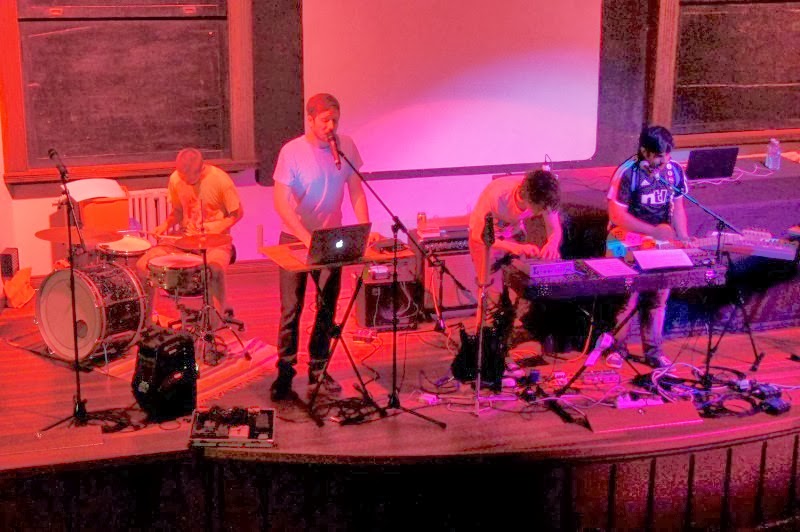
At least for Fats Homicide’s first set, I felt I’d been taken back to jam bands of the ‘70s: guitar based trios; rock rhythms at medium and slow 4/4 tempos; guitar or bass solos with effects; limited structure and dynamics. The effects were more sophisticated (I liked an arpeggiator, and the synth and echos were extreme and interesting) and the playing was better (these are all trained players, after all), but the outcome (and I guess the intent) was similar. I liked it well enough but it's not so much a current interest. The fact that 2XX was recording just seemed to fit this scene and even some faces seemed new. But then the last tune of the first set was different: a sweet ballad was a delightful change and it set up for a very different second set. It started with a nice waltz drum feel with a descending bass pattern and lovely distorted guitar melody and solo. Matt is a lovely guitarist, and I enjoyed several fuzzy, sustained guitar solos during the night, and his leads and feels were always suited for the tunes and nicely leading, in the way that voices lead. Simon dropped in lots of chords in this format and some rabid effects which I loved but could hardly identify with the bass. I particularly liked one small, simple passage of pure Precision-bass styled tone but it was rare (he was playing with lots of effects and distortion), and also some nice riffs that gave more rhythmic solidity to the music. The bass chords filled out the sound, but I preferred the definition and openness and rhythmic form of the riffs. They played a country rock beat with tremolo guitar playing blues licks with sparse bass chords which was lovely, but I wasn’t too keen on its descent into metal distorted repeating quarter-note bass. Then more metal with syncopated bass riff. Kay was obviously having a good time on this and this was infectious. There were smiles going around with the audaciousness of it all.

So what of Fats? It’s got its rough, brash side and that joy in extravagance but there’s also order and even sweetness peeping through at times. Not sure they’d want to admit it, though. Fats Homicide are Matt Lustri (guitar), Simon Milman (bass) and Kay Chinnery (drums) and I expect they will appear sometime soon on 2XX.

30 July 2010

Transit lounge

Jazz-trained players don’t just play jazz. Jazz training is a catch-all for a range of syncopated, modern styles and the forefront of jazz has always been a sponge for influences. Last night, I caught Dub Dub Goose and Los Chavos. DDG is a dub/reggae band, and Los Chavos is a latin outfit. Both play insinuating styles that appeal broadly and get the dancers on the floor, and both are seeded with local jazz training.

Firstly, Dub Dub Goose. I hadn’t heard them since their first gig at Moruya a few years ago. The Goose is now much more developed, more purposeful and confident, and with a CD under its belt. The band has a firm lead from Beth Monzo, who plays guitar and sings out front. I presume she writes a good deal of the quirky, entertaining and (age-)relevant lyrics. The combination of a strident and uncompromising female voice, the vibrant horns and energy and good humour make this a thoroughly entertaining outfit.

I have also written here of Los Chavos, when they played at the launch of the Canberra Musicians Club. They were good then; they are now that much more alive and confident. Latin is perhaps the master beat of the rhythmic universe, so it’s no surprise to see the dancers pop up when they get going. Again, there’s a front line of horns, and inevitable percussion and interestingly a keytar (someone told me this is what this strange over-the-shoulder keyboard is called, as has been used by Chick Corea and Herbie Hancock and a string of boy bands). I expected simple melodic lines, but Alex Carder was playing some interesting chordal fills with bends, so the instrument defied my prejudices. Otherwise, I noticed the commitment and joy that Andy Jauregui sings with, and also drummer Amanda Waite. I was standing beside the stage when I was surprised by her competent introduction: clear and immediate, seeming to come from nowhere, and leading the band into an instant solid groove.

DDG and Los Chavos were playing at the Transit Bar. It’s quite different from most jazz venues, of course. These bars are more beer-spilled, younger places with pool tables, punchy PAs and DJs in the breaks that are louder than the bands. I liked it. I was there with my two sons, but I even came across an old mate from the Blues Club, obviously determined to grow old disgracefully. So should we all.

Dub Dub Goose were Beth Monzo (vocals, guitar), Nick Combe (bari sax), Reuben Lewis (cornet), Valdis Thoman (trombone), Matt Lustri (guitar), Ben Fowler (bass), Matt Sykes (drums). Los Chavos were Andy Jauregui (vocals), Valdis Thomann (trombone, vocals), Corey Booth (trumpet, vocals), Amanda Waite (drums), Simon Milman (bass), Alex Carder (keys), Matt Lustri (guitar).