


Vince Jones (vocals, flugelhorn) performed with John Mackey (tenor), Matt McMahon (piano), Brett Hirst (bass) and James Hauptman (drums). They performed at the inaugural Canberra Jazz Festival at Smiths.
Vince Jones (vocals, flugelhorn) performed with John Mackey (tenor), Matt McMahon (piano), Brett Hirst (bass) and James Hauptman (drums). They performed at the inaugural Canberra Jazz Festival at Smiths.


The Evans Robson Quartet were on tour and they are royalty in Australian jazz and I was lucky enough to be free for their Smiths gig. This was the last of their tour and it showed. They are always capable and correct but this was the neatest and most precise that I could imagine. I was in awe, hearing tightness and accuracy that seemed above any norm. I noticed a quiet start from Hamish on drums, exploratory and informed by rudiments and that was a theme to continue through the night, so bass was equally perfectly timed and intoned and adventurous in phrasing, and those two matched saxes, Sandy on tenor or curved soprano and Andrew on alto or bari, just spelling harmonies but not chords as in piano or guitar, and always aware and responding to the other. One interaction just caught my breath, but many more deserved it. This was the final night of their tour, so we heard skills and seriousness but also inventiveness combined to explain the perfection, all with a joyous stage presence. Complex heads of interweaving lines, not showy and sometimes understated but always satisfying and telling. Do I have to say I was enamoured by this concert? Perhaps not. Just beautiful works of a deep musical maturity.
The Evans Robson Quartet toured thei latest ablum Zenith and appeared for the final performance at Smiths for Geoff's Jazz. Evans Robson Q comprises Sandy Evans (tenor, soprano saxes), Andrew Robson (alto, baritone saxes), Brett Hirst (bass) and Hamish Stuart (drums).

It was pretty much the ending but we had some seniors of the SIMA scene in the Sandy Evans / Andy Robson Quartet with offsiders Brett Hirst and Hamish Stuart. Well, that's a mighty team and it showed with a range of original compositions in all manner of modern styles, latinish, dedications, ballads, memories of James Greening and Ornette Coleman, some simple and folkloric, some burning modernist, all done with grace and joy and immense competence and commitment. It was a pleasure to see the interest and smiles from Andy at a Sandy solo and Sandy at an Andy solo. Great and not unexpected but always appreciated and welcomely imbibed, melodious and entertaining, good mannered and inviting, stimulating and challenging and rich in references to other cultures. And devastating with chops that were quick but purposeful. Do no wrong; present no hype. How can you not love this music? They've all played together for yonks through all manner of bands and are now preparing for another album in this formation, I guess with these tunes. One to get.
Sandy Evans (tenor, soprano sax) and Andy Robson (baritone, alto sax) led a group with Brett Hirst (bass) and Hamish Stuart (drums).

Good and bad here. The bad was that I could only hear Sandy Evans Trio or Andrea Keller solo. Well, I could walk between venues but how much would I miss. I mentioned this to manager Zoe but I understand the problems with programming. None-the-less, it's my greatest disappointment of these days. I'd heard the two the day before and adored both and Andrea Keller is in Melbourne so more difficult to catch. But life is like that. The good?
Sandy Evans Trio was my favourite event of the festival. Not something new or unexpected. I'd heard them all before together and apart and admired all their playing. Together, despite few gigs over recent times due to Covid, they just excelled. To some degree, the style is a preference of mine, as we all have preferences given what's hot when we discover something. For me, it was '70 modern jazz much like this. I could have hiked down to Andrea K but I melted and decided to stay. The sound was to die for and this was also part of the pleasure. The bass was pickup into Ampeg and otherwise unamplified, so levels fitted to bass. The sax was one large diaphragm, with distance nicely controlled by Sandy; the drums were one overhead and one kick mic. And the space was good. Brett sounded so solid and expressive, double stops and more and Toby laid deep grooves, but was also loud and explosive or varied and fluid. Sandy played over, moving tonalities, delirious long phrases or reticent and restrained, always gloriously toned (I felt I could hear the bell itself this was so intimate; thus the pleasure with the sound), intellectually questing, grunts or space or abstract melody. Then a tribute to Bernie McGann and wife Addie. My god, so beautiful. Then a quick tune with unison sax/bass and something "so you can contemplate your own identity" and then Invasion day at the beach, introduced as a "punk rock thrash disco yobbo feel". Loved'm all. An important band playing a gem session expertly and with integrity.


It's the premiere OWJF (Orange Winter Jazz Festival and I'm there, not for day 1, the more sparse Friday, but for Saturday and Sunday. This is also the weekend of the Merimbula JF I rememebr, Queens Birthday weekend - the clash surprises me as there aren't so many JFs - but there are only so many long weekends. Strangely the Monday is being left empty. The chance is there for future events. And it's colder than I remember Merimbula, from a cold spell and presumably from a country town far from the sea. Colder than Canberra! Happily, the weekend was relatively free for me and there were a string of bands which I'd sadly missed in Canberra so I'm here. Orange is a 3.5 hours drive from Canberra, past the fish museum.
I arrive in time for a rerun of Hilary Geddes Quartet. The tunes were as I'd heard a week before at the Street, similarly intriguing and well played, if not so intimate given the space. I had another go at counting one tune and decided on 7 but it also went into 8s and 6s then I got lost. Col Hoorweg commented he avoided the counting. Sensible! But again some intriguing playing. I missed a real piano this time, but bass sounded great and max laid some nice solos. The acoustics didn't suit drums quite as well as the previous gig, but again Alex is a star of sharp, incisive and somewhat sparse playing and I love this. And we for another of Hilary's blaring rocky solos that again I love and I think i understood the song of late sleeper next to highway better this time. So a satisfying start. Interestingly, I will hear Hilary in many guises during the day. She is seriously versatile. If antyhing, that may be a theme of this festival, seeing several basses with extensions, a classical implement not used in jazz and not used here.
Then to Phil Slater's Dark Pattern. Dark Pattern was the work not the grouping. Truly incisive and deep playing but dark it was. This is, of course, one of the senior and renowned collections of musos here this weekend. These are not the young tykes making names, but the seasoned and experienced performers. Revered. and they easily deserved it. I thought Miles from before the jazz rock, all thoughtful and sparse and gorgeously beautifully toned trumpet with careful harmonies and multiphonics from Matt Keagan beside him and Brett Hirst and Matt McMahon and Simon barker, all renowned for seriousness and virtuosity. It raised a theme in my mind about mature players, what they do in later years. It was to be with me with The World and The catholics later. This was a concert of glorious tone, continuous playing (the tunes ran into each other, attacca), chart reading, thought and depth and satisfaction but, I thought, not too much joy. And so be it. Maybe just telling the story of our times...
Hilary Geddes Quartet performed and Phil Slater played Dark Pattern at the inaugural Orange Winter Jazz Festival. Hilary Geddes (guitar) performed with Matthew Harris (piano), Max Alduca (bass) and Alex Inman-Hislop (drums). Dark Pattern was performed by Phil Slater (trumpet), Matt Keegan (saxophones), Brett Hirst (bass), Matt McMahon (piano) and Simon Barker (drums).

The theme was obviously Spain and related but I felt it was jazz. This was the Australian Chamber Orchestra and the program was called Sketches of Spain which says Miles to me and a track off Sketches of Spain, Solea, was on the program and so was Chick Corea Spain. But the first half had Iberian references from Debussy and a Ravel take on the Blues, which seemed strange and perhaps a bit unsatisfying even if Ravel was quoted as promoting this "popular music" and its players with their "frightening virtuosity". And there was Boccherini with a tune about the streets of Madrid and Bizet Carmen arranged by Rodion Shchedrin for his dancer wife Maya Pilsetskaya. But the jazz was confirmed in the second half by the presence of jazz literati Matt McMahon, Phil Slater, Brett Hirst and Jess Ciampa and that program of Miles and Chick, joined by a short Ave Maria in 8 parts played by the jazz quartet and four string parts and written by Tomas Luis de Victoria. I'd enjoyed the first half, especially for the Carmen, but I just grooved to the second half. Phil Slater's take on Miles was very satisfying and the Ave Maria was lovely (I like him: I did a de Victoria piece on The Pots Going Viral) but Spain had me blissed out. That fabulous theme, the complex and lengthy arrangement originally performed by CC with the London Symphony to win a Grammy award. I laughed at the string sections passing around and authentic jazz solo (in unison and not improvised obviously) and the rich and often dissonant harmonies in piano and a lovely long bass solo that obviously intrigued the ACO low end and Brett's effective pizz accompaniment and Phil's lines out front. The string accompaniment was a pleasure even if the improv that's at the heart of jazz was missing. But this was crossover and I admire musicians who are daring and exploratory enough to do it and the ACO felt the part. So I ended walking out with a smile on my face. Some classical mates were somewhat nonplussed but I thought it worked and, perhaps only in a jazzer's book, I thought Matt and mates were the heart and authenticity of it all. Not putting down the classical, but jazz and classical are different mediums requiring different skills, the hottest chops and reading in classical and the invention of improv and the feel of a groove in jazz. Different and both worthy but this was jazz territory and Matt and Phil and Brett and Jess blew a storm to my jazz ears. But nice all around and deeply fascinating.


 Some people have nothing to prove and it's lovely to see and hear them. Mike Nock has earned that position with his long term influence here and overseas. He's joyous, capable, relaxed, knowing and apt in his interpretations. It's easy, never forced, not uncomfortable, but that's not to say it's not challenging, for it often is, or not interesting, for it certainly is. He's playing with younger offsiders these days, as could be expected. He's not so young now, although light of heart. Those offsiders are Brett Hirst and James Waples and they are easily with him, respectful of his lead but also adventurous and virtuosic while understated. All that sounds like a blissful gig and it was. The tunes had a few lesser knowns but featured a string of standards. Bernie McGann appeared in Spirit song. They started with Lady be good and Lollypops and roses and finished on Poinciana, which only became evident as the song itself after some time. Moanin' got in there. A few I didn't know were Golden earrings and Fresh water. He led with a piece that he called Curl that turned out to be a baroque piece of ~1600. I didn't catch the original title, but it sounded eminently modern as they did it. They also merged Summertime with So what and that worked a treat. What I noticed, though, was an immense respect for melody. It seemed to be present throughout his playing and to some degree from the others. It's not the thing of bebop, which takes the chords after using the melody just for a starter. This was more a consideration throughout. That interested me. And he was just a nice, chatty, jokey presence on stage, too. Again, nothing to prove except to play the music and display jazz. Great stuff and a lovely trio.


 The trio was excellent: Brett Hirst and NYC-based Taylor Eigsti, returning just a few weeks after appearing with Eric Harland at the Capital Jazz Fest. What a treat. Every one of the players performed with great chops and seriously interesting exploration. The music was moving, driving, sometimes floating; complex and convincing contemporary jazz. They were to play at Smiths, but alas. They did play at Vivaldi and it was a wonderful venue. Too poorly attended, despite the frequent announcements by Reuben. What a gig was missed. Taylor's jazz lines just floored me; consistent, expressive, inventive but easy and unforced. His ease of four note snippets had me thinking McCoy Tyner but he's a magpie. Brett's solos were so well spoken, nicely intervallic or scalar and always compelling. Reuben was leading, busy, pushing the beat, full of colour and movement and often expressing it all openly on his face. I fear we are entering the winter of our jazz-discontent here in once rich Canberra. Thank the gods for the Gods. Otherwise, save your dollars for NYC. The frosts are setting, in Canberra, in jazz and more. But this was a great concert and hugely enjoyed while it lasted.


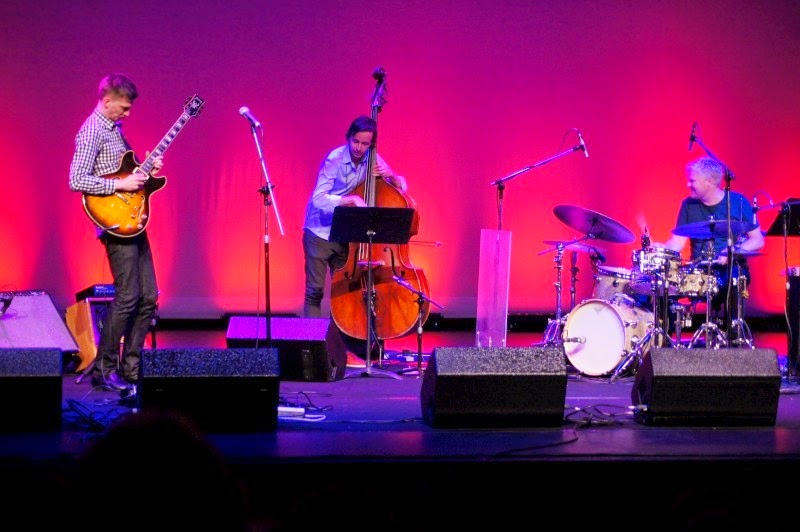


 Mike Nock is a senior Sydney figure noted for his support for a new generation. At Wang, his band was called Trio+2, the extra two being younger sit-ins Carl Morgan and Karl Laskowski: younger maybe but not unknown. This was unrushed, well developed modern jazz with a feel of rock grooves, often developing some power, with plenty of space for solo development: Outcast, Brett Hirst's Changeling, Perspectives, even This dude abides (written by Mike to a quip in the movie, The Big Lebowski). The rest of the trio was Brett Hirst and James Waples.


 Mike Nock’s Quintet, his trio with two friends, was an interesting gig. Right from the top it felt like comfortable old times. The lines and melodies and grooves were old family: jazz rock, Miles, Herbie and the like. I could hear the same piano accompaniment. I could feel the mildly mutating rhythm section as it settled behind the front line with a choppy ocean busy-ness. The chords flowed by slowly, perhaps 4 bars to one chord, regularly changing and gently paced, leaving the soloist plenty of time to feel the changes. These were post-hippy times, still gentle and emotionally committed. This feels good to my ears. I think of Buster Williams and some favourite albums. Nick Garbett’s new to the band, smiling, enjoying the outing and playing wonderfully structured solos, a cry, a pause, a volley of falling notes. Miles again, space and notes that crawl against the backing. Karl fills the space more, but does a similar take with falling lines although somewhat more blues infected. Mike is adventurous, taking an idea and extending it over long ranges, or stopping and finding some unexpected and obtuse take on the chords before reimagining lines into contrary scalar movements. There was a blues starting with a bass solo that could have started a Mingus tune and leading into a slow, deep Southern langour. Here, Karl’s solos are all bends and blues and Nick’s are wakeup calls of sudden high staccato and some florid, some languid fills. Then TBA, a bouncy contemporary feel with concurrent solos from the horns and clavinet from Mike. Somewhere, James had taken a solo against a piano/bass phrase. This was all punchy with neat rudiment-induced divisions of the beat and triplets that delay the feel and rolls tat explode into cymbals. Explosive for a jazz solo; Nick smiled some more. The second set started with the band settling into a D minor bass groove and settling into a slow funk for the solos. Slow news day was more story telling, with a floating intro and pensive melody: portraying a lazy news room or perhaps some personal relief at a benign nightly news. Not surprisingly, the first solo was from bass then sax, the softer horn. Last tune of the night was Colours, long with feverish walks and rabid collective improv and slips into free jazz. Nice gig. Mike Nock (piano) led a quintet with Nick Garbett (trumpet), Karl Laskowski (tenor), Brett Hirst (bass) and James Waples (drums).
 The eternal triangle of jazz has to be the piano trio.

 Pen Island played the other night at the Loft and they are a piano trio, but they are exuberant and fun and virtuosic and iconoclastic, so they didn’t feel so eternal, except maybe when they played Tony Williams’ beautiful tune, PeeWee, or their own gentle, thoughtful tune called Gloria’s whole. Most of their originals were dissonant and hugely energetic and richly improvised so they felt far more transient. They played a few known tunes, too, in this style. Autumn leaves was one. Now we all know Autumn leaves: no jazz musician could pass his training without it. Pen Island played it, but I had no idea where the tune was or what were the chords or the melody. I asked Brett later, and apparently he had played the chords backwards (starting with the last chord and reading left and up), extending each chord to four bars, and Gerard had played the melody in inversion. Then they’d improvised over that. The first set had been one long improv. Brett confirmed: no key, no preconceptions, just big ears. They finished with Skylark which should be as identifiable as Autumn leaves to my (smaller) ears. This had Brett playing the melody (“fairly freely”) then a solo, then piano playing the tune over a flattened bass riff (b5, b9?). But again, all richly improvised and heavily substituted so I only caught hints of melody during the first bass chorus. Bad Plus came to mind with their knavish energy, and I heard their atonal clamour a few times, but this was more unconventional, more extreme, more challenging. I loved it but I didn’t always understand it. I could hear extensions on bass and sequences on piano and lots of rock-influenced drum grooves and even a few walks. They were clear enough. But the whole was far more enveloping. There was some real beauty at times that took you back amongst the delirious energy. There was a bass tone to die for: big and round and clear as day. There was harmonic cleverness and massed 20th century dissonance from piano. There was a wonderful drum solo at the end that developed on Miles’ coloured and sometimes disjunctive style. There was a precision in the rests and returns that surprised and pleased me. There was some tuneful playing with obvious skills, but that lyricism was a surprise. These were players searching the boundaries with only ears to survive by and doing it at breakneck speed. Exhilarating and devilish and daring.
 My path to jazz was from Cream and Hendrix through Yes to the great jazz rockers, Mahavishnu and Weather Report and Return to Forever, then through Music to midnight to the jazz tradition. I’m not alone and it seems I share this background to some degree with Mark Isaacs. I heard his Resurgence Band at the Jazz School at the start of his current national tour and it stunned me. His words on the cover of Aurora, the album he’s touring, talk of this very history and how it deserves revisitation. You can hear it clearly in this music: the infectious melodies of Chick Corea; the supple grooves of Weather Report; the soaring guitar and unison lines of RTF; the contortions of Mahavishnu. These were obvious. The rock grooves and the chunky bass patterns were par for this course and wonderfully solid but responsive. Not a swing in sight. But there was a real richness of composition. It struck me just like when I heard Chick Corea playing No mystery recently at the Opera House. Long and contorted and deeply involving, fascinating and lyrical and with great detail. This is written music and it demands good readers given the complexity of melodies and the counterpoint exercised by the front line instruments. But there’s also a live component here, of composition or at least arrangement. I noticed Mark signalling bass to come in (yes, bass dropped out several times in this music and the effect rendered orchestra-like variation) and he was otherwise conducting crescendos and the like. Conducting and orchestration are attractive words here, because the classical/jazz crossover was particularly identifiable in this band. Most charts were more like complex lead sheets - charted melody and chords - but at least the piano chart for Will of the Wisp was fully charted dots that crossed clearly into classical detail. And the accompaniment that Mark laid down sounded of classical technique and harmonic conceptions: complex and rich, technically impressive and conceptually whole. And his solos were coloured and mobile and full handed and expansive over the keyboard and sounded to me of twentieth century classical styles, rather than single note jazz sax. He did one extended passage that was classical in form. This was mostly minimalist, but I heard tonal colours that I associate with Debussy, but I’m little educated in this. Mark suggested to students that they listen to William Walton and Khachaturian concertos. I spoke to him afterwards and he said classical people say he sounds like jazz, and jazz people say he sounds like classical. That sounds right. Whatever, it’s a wonderfully attractive but also musically satisfying crossover.


 And what of this band! One passage had me thinking of James Muller as Aussie pub rock on harmonic steroids. Here he was playing rock grooves with distortion and sustain, shrieks wrenched from his guitar, blatant and prolific with long lines that reached to the guitar heavens. Mostly it was those same shredded lines but cleaner and always defined and uplifting and exciting. Always virtuosic. James is one of those players who grabs a band by its … well you know what I mean. Matt Keagan appears to me as more restrained and concerned with tonal purity. But he too let go with intense and busy harmonic washes with a free-jazz lack of restraint, on tenor but also on a soprano that sounded of the Kasbah. I just love Brett Hirst’s playing so no surprise how I found that. This was fat and funky and in some ways a departure from the jazz rock tradition, which is usually fast and furious on e-bass. Double bass is slower, but the tone was delightful and I preferred it, and the chunky grooves sat so well and were so well varied. His solos, too, were stunners and quite unique - probably because double bass isn’t the common instrument in this rocky context. They ventured over the neck with blues and other lines, but to me they were infused with groove more than melody. And Tim Firth was wonderful: open to all the surrounding performers, bouncing ideas with his sidemen and highlighting features in the charts with clarity while chopping up the groove with improv and doing all this at nicely controlled volume levels. Suffice to say I liked the band!
 Dominique Fillon didn’t actually play Joyspring but he may as well have, because this was a night of great joy in playing. Dominique doesn’t play at the extremes. The style is more latin-influenced mainstream with delicious tonal playing. It’s very attractive jazz and capable of great popularity. We saw it on the night. The two sets went down a treat with a mixed audience. There were smiles all around during and after the show. There was a friendly patter with the audience, even one that started by offering a string of languages. Hands up, who speaks French (plenty), English (most), Spanish (several), Portuguese (a few), Russian (surprising there were several, but this is Canberra). And so it went. Attractive, lively, beautifully played music and open, friendly interaction. Dominique is self-taught, in his bedroom, from an early age, listening to the greats. The result is earthy and personal and perhaps less intellectual. The lines just glowed with melody, not at all hard to decipher or appreciate. This was a performance in which entertainment was important and it was none the worse for it. Jazz was like this through the mid-20th Century when it was a popular art form. It may be still that way in Latin American countries. And it’s no less for it, this lovely fusion of entertainment and art.


 Dominique is on an Asian tour with his Australian Trio: musical mate Nic Cecire and Brett Hirst. They are a sympathetic band. Nic is very understated, listening closely and laying right back; feeling grooves and leaving solos to when he’s called. They were exciting when they came, too, loud and thrashing and obviously well received by an excited audience. (What did your Mum tell you? It’s the quiet ones you have to watch!). Brett got lots more solos and they fitted like gloves to the tunes, sometimes melodic, other times rhythmic, mostly with a twangy, metallic Jazz Bass tone. Dominique played with little atonality but one descent into expressionist tonal playing had me thinking he was classically trained. Presumably it was just more listening. He occasionally sang, too, or more correctly, followed melodies with his voice. They played mostly original tunes from his recent CD. Its title, Americas, may explain the latin impression. A big swinging rhumba was well received, but there was also a dedication to Michel Petrucciani and a lovely ballad for his wife, Song for Ake. There was just one non-original that I remember, a funk-rock take on Wayne Shorter’s Footprints. And a piano tone to die for. The band had borrowed gear locally, but Dom carried his piano tone in a traveller’s laptop. What a tone it was: close your eyes and this was a real piano (very different from my experience the following night). But the memory I will most hold from the show is the ironic but very affectionate groans when he explained how he’d written his romantic Song for Ake. This was an audience in touch with a performer and some really nice blokes. Not many shows speak with such joy and humanity.
CanberraJazz.net's reports & pics
CJ: Promoting modern jazz in Canberra, Australia.
CJ is brought to you by Eric Pozza, long time jazz lover, bassist, and CJ's author, editor, photographer, webmaster, owner and general dogs body.
> Click on pics to view larger images
v See Labels/Names index below
Initials in the Labels/Names index below are for contributors other than Eric
Subscribe


