Showing posts with label Eric Ajaye. Show all posts

13 December 2023

A free Tuesday eve

I had a Tuesday evening free and that's jazz night at Molly with a string of small bands and this night was Eric Ajaye with Sean Kirk and Elliot Kozary.  I'd seen both Sean and Elliot but I need a better knowledge of the current crop of jazzers so I was there.  I was fascinated.  Eric introduced the band, the songs, and the players as young playing old, meaning mature.  I could agree.  I was sitting with one bassist and had another at the next table and it was easy enough to fathom Eric's style, his soft tone, generous volume, indulgent slides and deep vibrato.  Throw in his lovely sense of melody and it's a huge pleasure and a core of the band.  We could also discuss his e-bass and parallel amps and solo strings detuned.  But I was not so clear on the other two.  First up, Sean.  It seemed to me he was freely improvising over the rhythm, but the core could come through, too.  Then I noticed his hands, right hand playing snare and left playing a ride cymbal beside the hi-hat.  He explained this as open handed.  I hadn't heard of it but it made perfect sense when he explained he's left handed playing a right handed kit.  Interesting and maybe it lent itself to his style.  Dunno.  Being a bassist I thought of Mononeon but then there's Hendrix of course: worthy associations, even on different instruments.  Then Elliot.  There are no left/right hand pianos but I was intrigued by his sense of tonality, unsure if it was substitutions or extension or maybe fourths.  He spoke of rootless left hand (or two handed) voicings and thus extensions.  And occasional drop 2 chords.  His sparse and delayed melodies suggested Keith Jarrett to me and he confirmed that, but also Bill Evans and Oscar Peterson (very different!) and mentioned Corea and Hancock, of course, so nothing  unexpected.  Thinking back, maybe Bill Evans were more those passages, but there were others more on top of the beat and more simply arpeggiated.   Whatever, this was a satifying bit of playing with quite expressionistic, often slower, takes on standards and a few originals.  Some titles I recognised or caught on introductions like Night and day and Round midnight and Norah Jones Don't know why and Kenny Wheeler.  Worthy stuff indeed.  I enjoyed this immensely and it was a good theory lesson to boot.

Sean Kirk (drums) played with Elliot Kozary (piano) and Eric Ajaye (bass) at Molly.

19 July 2023

Just friends

This was Miro, John, Eric and Chris at the Drill Hall so just friends.  It fits perfectly, even if they didn't play that tune.  In fact, Miro spoke of pondering the gig and coming up with a theme of Ornette and OC is a world away from Just friends ... or maybe not.  Ornette is modern and challenging but somewhat jovial and he's still from the same tradition.  But it's not that Miro played Ornette all night.  In fact we just got two Ornettes, When will the blues leave and Happy house, and tribute that I didn't know.  And interestingly, Mingus Pithecanthropus erectus which is a hugely menacing thing that develops into something playful.  Weird but a work of Mingus' genius.  I think it also fits somehow with Ornette.  And we always get a string of Miro's Wanderlust tunes and it's a huge pleasure to hear them from the composer.  Today's were Delicatessence, Bronte Cafe and Dakkar.  They are old friends and hugely inviting melodies.  A work of Miro's melodic genius just with his friends.  And a few old friends to fill things out: John playing solo on In a sentimental mood and the band playing Monk Rhythmaning and, of course, Footprints to finish up.  So these were friends all round, on stage and played as the program.  And what great playing.  It's a while so I had a fresh ear and I was learning tons from Miro's and John's tones, the solo structures of dropping scalar elements turned into temporary home pitches.  Horns do that rather than basses.  And Eric just fluid and rich in slides and vibratos and with yet another instrument.  Eric is adventurous with his instruments.  This was a 1/8th bass loaded with three pickups and more, sometimes bowed, otherwise expansively soloed.  It sounded great.  And Chris with a very defined and precise take on very expansive rhythmic interpretations.  So the whole was just friends but a revisit to some hugely satisfying playing.  The venue is pretty wet, but the playing was sharp.  Fabulous.

Miroslav Bukovsky (trumpet, flugelhorn), John Mackey (tenor), Eric Ajaye (bass) and Chris Thwaite (drums) played at the Drill Hall Gallery.

31 July 2019

To end a week

The end of a truly great week of music: a concert with Michelle Nicolle and Palaver [Quintet]. Michelle is just a stunning master singer, detailed, developmental, improvisatory, wildly flexible in rhythm and richly embroidered. And lovely to boot. She was in Canberra for a few concerts interspersed with other travel. I caught them with Ronny and Geoff, her long-term offsiders in Melbourne, and our locals, Miro, John and Eric. Again, it was the perfection of the long-term rather than something of complex pre-arrangements. This was flexible and jammed, relaxed in style but delicious in performance. First up some tunes from the instrumentalists: Delicatessence and Stella; then Michelle with Green Dolphin Street and Footprints and "something in a major key", There will never be another you; then Miro's gloriously beautiful Peace please and an encore with Michelle on Softly. There are a few throwaway blowing standards in that list, but how well do they appear in this format! So good, so informed, such worthy explorations. I could only melt, what with Michelle's so-intriguing and such-enriching voice fantasies and her obvious engrossment (follow her hands and face) and the respect on stage (John's intent focus and Miro's open smile at one particularly inventive line by Michelle) and the deeply satisfying playing all round. So good and such a pleasure.

Michelle Nicolle (vocals) sang with Palaver [Trio/Quintet?] comprising Miroslav Bukovsky (trumpet, flugelhorn), John Mackey (tenor), Geoff Hughes (guitar), Eric Ajaye (bass) and Ronny Ferella (drums).

03 June 2019

Diversity


Bob Sedergreen is a Melbourne jazz piano name that we know well but I've only caught hima few times. The latest was at Eric Agaye's Jazz Haus playing with Eric and Mark Sutton. Bob has a long history so it was apt that he presented a history of jazz piano. Well, really only a string of tunes by various pianists in jazz history with a little commentary and some very nice playing. The whole band was great. The style easily suited Mark and Eric. Fourteen tunes, one each from Earl Hines, Fats Waller, Monk, John Lewis, Horace Silver, Bobby Timmons, Duke Ellington, BIll Evans, Herbie Hancock, chick Corea, Keith Jarrett, Jo Zawinul, AC Jobim, Abdullah Ibrahim, and, as an encore, an original by Bob himself. It was a romp. Plenty of known tunes - 500 miles high, mainden voyage, Waltz for Debbie, Mercy3, Django, Jitterbug waltz, In a mellow tone, others. Some interesting stories, about Cannonball Adderley's pianists, Monk's Australian visit , Ellington's band selections, Herbie's interests in maths and engineering, Rocky Mountain music. Eric told a great story of meeting up with Stanley Clarke as a teenager and being invited to the first gig of RTF at the Scientology headquarters. I particularly enjoyed the story of Aldullah Ibrahim's (once Dollar Brand) music and how phrases have meanings. So a fascinating night for the stories and the great playing all round, especially from Bob who had to play such diverse pianistic styles.

Bob Sedergreen (piano) introduced and played the music of a string of famed jazz pianists with Eric Ajaye (bass) and Mark Sutton (drums) at the Jazz Haus.

06 May 2019

In a variety of ways


It must be the era of odd combinations and I was intrigued. This time it was drums and two basses: our local bassists Eric Ajaye and John Burgess with visiting Melbourne drummer David Jones. There's history aplenty here. David and Eric played together in Melbourne twenty years back, presumably before Eric's move to Canberra and ANU and Eric taught John at ANU. They are all strong, inventive players and this was the opportunity to improvise. Improvisation it was: John and David had just met in person that afternoon. But that's jazz. But even so, the traditions appear in some shared musical themes. I think Footprints emerged twice and the funk of Freedom Jazz Dance featured and the opening was In a silent way. And amongst the open, free improv, there was written music, David's Ancient echo and Eric's words, you'd probably say rap, written by him as a schoolkid to Freedom Jazz Dance. We got to sing along a phrase with that. The variety of basses, too, was fascinating. Eric's smooth, lithe, sliding, often funky lines on two e-basses and an NS stick. John's sharply clear grooves and melodies on his two e-basses and the electronics on his bowed NS stick and more. Against this, David's immensely satisfying, sharp rhythms and virtuosic, unexpected three- and four-feel fills and interjected tones from various bells the percussion. How sharp! A few drum solos that floored the audience and a tunes played on kalimba then expanded to the two basses. There were two sets of this, knowns and unknowns, all immediate and personal and exploratory. Intriguing with that edge of adventure from the unusually deep tonal blend and the electronic extrapolations. Another rare instrumental combination and a great pleasure.

Freeflight were Eric Ajaye (bass), David Jones (drums) and John Burgess (bass, electronics). Simon Mitchell (art) was sketching but the pic didn't catch his art.). Thanks to jazz regular Bob Howe for the pic of authentic Jazz Haus illumination.

05 March 2019

What was that I heard?


This was definitive jazz, even if the makeup of the band was not so clear. It was advertised as a trio, plus one, then plus another. Who's to quibble when the music is just so good? The Palaver Trio (nice name and appropriate, too) was Miro Bukovsky with visiting Melbournians Geoff Hughes and Ronny Farella. The first visitor was John Mackey. I'd heard rumours of a bassist and Eric Ajaye appeared on the day. The location was the Drill Hall Gallery which is exemplary for its art if drenched in reverb. So the music was louder than it might have been and somewhat mushy. Each set was mostly just a single improv. The tunes were not much more. Geoff started out on subtly looped guitar then trumpet and softly pattering and sizzling drums and Eric's lithe, slurring bass and sax harmonies at times. All soft; all improvised; all gentle and insinuating. I thought maybe I caught a quote but it was not till towards the end of the first set that I realised they were playing a standard. It was a recognisable theme. I think Night in Tunisia, but I often recognise themes but can't place names. It was in the second set that it was more clear. Was it Caravan first up then Poinciana into Blue in green. The tunes were becoming more evident. Eric's bass lines sometimes spelled chords if extended in time and softer in swing. Geoff spelt the melody of Blue in green obviously enough and Miro did certainly play the Poinciana head, although again slowed and with some changed intervals, perhaps a flatted final note. John took a few solos, soft and fluidly rapid. I could only melt at some of this. There was once during set 2 where they stopped and Eric restarted with a soft groove. Perhaps unexpected but also most likely never practised together. At least this band, these tunes, this way. Jazz is like that and this was a superb example. I could only melt with admiration and envy. Some others spoke the same way. Did I mention that it was good and I enjoyed it? If I didn't, yes it was. A truly stellar outing.

Palaver Trio were Miroslav Bukovsky (trumpet, flugelhorn), Geoff Hughes (guitar) and Ronny Ferella (drums). Visitors were John Mackey (tenor) and Eric Ajaye (bass).

25 January 2019

Clinics then and now


The JMI Summer Jazz Clinics were in town for their second local incarnation and the instructors were on stage at Smiths. The Jazz Music Institute is based in Brisbane and its clinics are a direct descendant of the Jamey Aebersold clinics that came to Australia in the 1970. They were big deals. I attended one (1980?) in Melbourne with a string of staff including Aebersold and David Baker, Dave Liebman and Phil Woods. The ensembles numbered perhaps 40 and I remember drummer David Jones in the top band overseen by Liebman. Both Jazz and Summer camps are smaller now but this staff gig was a stunner. I've sometimes felt jaded with unrelenting swing at jam sessions but this was top notch and as it can be. Eric slurring with deep resonance; John extemporising with passion and abandon. The brothers Ben and James Haupmann just stunningly expressive and purposeful on guitar and drums. The Brisbane sibling cohort of head-of-school Dan laying down some lovely, clear trumpet lines and coordinator Paula comping and soloing with delightful simplicity and clarity. What got me, especially, was the portrayals of the very common and renowned pieces that they played. The tunes were stock standard: Ladybird; Footprints; Stella; I mean you; All blues; All the things you are; Night in Tunisia. Apart from Monk's I mean you, they were uber-common. But you don't always hear all the original inflections, those intro and outgoing lines in Things (fairly common but not essential) or the clear harmonies on heads or Eric's spot-on, detailed take for the Footprints bassline or, for that matter, Night in Tunisia. You could hear their deep listening through their immediate playing and it was lovely. I mean you is less common, but how nice is Monk's odd take on Rhythm changes and his odd little insert at the end of the head. Fabulous, by Monk and the band. I got talking to one woman who was grinning widely at John's solos. Sax player, perhaps? No, flautist with classical training, had toured with ACO and played the Sydney Opera House pits, no less, now in other work here in Canberra. We chatted about classical/jazz, how jazz demands deep practical knowledge of theory and the rest and how this was authentic, deeply understood and prepared, no pretence for miles. The audience was generous; the playing was stunning; the authenticity and purpose of jazz was evident. Great night from a great set of players. Thrilling.

The Jazz Misc Institute Staff Band played at Smiths. They comprised Dan Quigley (trumpet), Paula Girvan (piano), John Mackey (tenor), Ben Hauptmann (guitar), Eric Ajaye (bass), James Hauptmann (drums).

08 July 2018

Seasoned


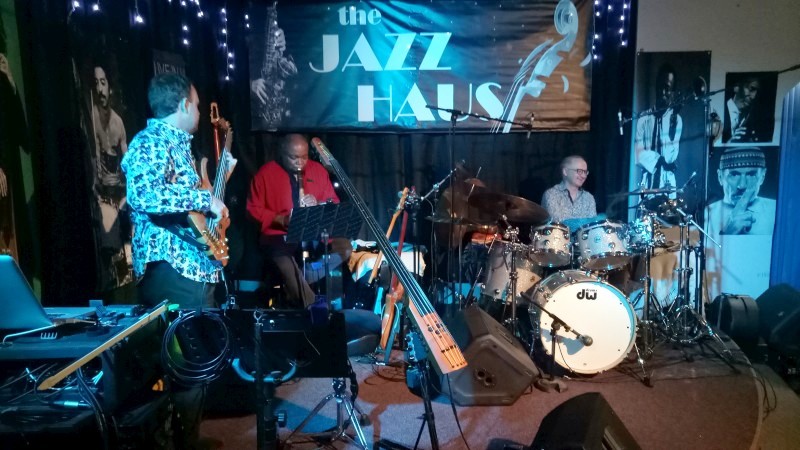
Sandie White appeared at Eric Ajaye's (and Bucky and Jeffro's) new Jazz Haus venue with Eric and Matt McMahon and Jim Piesse. These are all seasoned performers with long experience. And experience together: Eric has played with Sandie for 7 years. He likes singers. I understand. Words are keys to meaning and singers spell out a performance. There's a hierarchy in performance, and the immediacy and meaning of vocals places it at the top. Then variously sax for its vocal qualities or piano for its orchestral qualities, or depending on context, even bass for its combined rhythmic and harmonic qualities. This was a string of standards, some moderately obscure, from Nice work if you can get it and Night and day, through to Ballad of Thelonious Monk and Mr Paganini. And a touch of the last few decades with Sting Practical arrangement. That's one I hadn't heard before but is touching in its wistful theme and desperate longing. Sandie's been singing for long and it's a tribute to her experience and commitment. There's a YouTube video to watch of her at Sydney Town Hall in the 1980's with Chris Qua and others belting out standards. There's still the lilt in the ballads and the animation in the bop lines and some wonderful scatting, if not with with the energy of the 1980's. And the band was the epitome of quiet professional backing: melding with her patter and reading her charts and, especially Matt and Eric, laying down some exquisite solos. This is not the bleeding edge of modern jazz but the essence of supremely sophisticated entertainment and I can come at that very easily.

Sandie White (vocals) appeared with Matt McMahon (piano), Eric Ajaye (bass) and Jim Piesse (drums) at Eric and Bucky and Jeffro's new venue, the Jazz Haus, at the Austrian Club.

18 July 2017

When words speak


I met Sandie White when she came to Smiths to hear the impeccable Michelle Nicole. This was Sandie's return to play the room, on a Sunday afternoon, down from Sydney, with Welsh import Esmond Selwyn on guitar and our own local, Eric Ajaye on bass. When IU listen to jazz singers, I remember that songs have themes, words, meanings that are evident, often sentimental or maudlin, occasionally tender. The songs of the jazz era were like that, but I love it. Sandie sang some lesser-knowns like Peggy Lee I never knew, Lee Wiley Oh look at me now, Nat King Cole Just me just me, along with Misty and September in the rain and the like. All lovely, all poignant, but the jazz improv showed through, too. Sandie sang several scats that rang with jazz movement. Nice. Esmond accompanied with celerity, all staccato chords and lithe, hasty lines and sweeps, and a free take on one-man improv especially over the ballads. And how great to hear Eric again - it's too seldom these days. All smooth and flowing and mellifluous, but quick and endlessly conversational. Loved it. A pleasure to hear in such an intimate, drummerless grouping. Great that Sandie discovered Smiths and came for the outing. Perhaps next time, for an evening with a more generous gathering: it may have been warm within, from heating and an inviting performance, but the sunny arvo had a bitter breeze.

Sandie White (vocals) performed at Smiths with Esmond Selwyn (guitar) and Eric Ajaye (bass).

16 July 2017

Daily duties

It was an orchestral practice interrupted to set up for a Tilt gig. I was sorry for the first, enjoying Mendelssohn and missing a Tchaikovsky symphony (no.2 - it's great). But duty calls in the form of a gig at Mercure Canberra, long known as the Ainslie Pub, for the Canberra Truffle Festival. Truffles in an adjacent room; bar through another door. We had the stately lounge for jazz and it was a blow from the first. Busy, some dancing, easy chatting and a few listeners. We played jazz and standards and blues and some modern with substitutions and polyrhythms and the like, and also some jazz-twisted pop tunes, not least a new one from Daft Punk. At least new to me. I'm a great believer that everyone should have something they recognise: when they do they come onside and are open to standards, Shorter, Miles, whatever. I sometimes wonder how we can get paid to do this, but they like it and so do we.

Then next day, the Smiths jazz blow. Strong on bassists. Brendan Clarke was playing as I arrived. Eric Ajaye was inside to play a gig after the jam session. The house bassist was Jace Henderson with fellow bandsters Josh Buckler, Hugh Barrett and Mark Levers. I played a few tunes with a singer, not least Honeysuckle Rose, then Beatrice again to finish off. Thanks again to Josh and co.

11 April 2017

Family affairs


This was great fun, like a family get-together. Elise Walsh out front, releasing her new Bella Groove album. With her regular band of Victor, John and Steve. With various guests invited for her CD and to play at the release, John, Miro, Eric, Hugh and backing singers Francine and Juanita and Sharon who doubled on vocals and keys. A big performance of a series of tunes from Elise's CD including some originals. Should we (dance) was a love song; City of yes was an ode to politcal involvement; Open your mind was an affirmation; City lights celebrated city life. Also original lyrics to modern jazz tunes and some borrowings from Mike Murphy and even some funky Motown originally from the Messengers. Eric apparently grew up listening to that one on the radio. Nice to hear an old favourite that's not too common, Coltrane's Naima. But this was like family. Everyone knew someone or many others, so some good cheer. So much so, the red wine expired and the local pub was mentioned for afters. And a lovely twist: included with entry was a copy of the CD. What a great idea to get your work out. There was some seriously good playing, too, from some seriously good players. There was good sound and a video recording, but mostly the good cheer of Elise and her wide jazz family having a good time. I'm looking forward to sitting down with the CD. Until then, good cheers and some very nice music.

Elise Walsh (vocals, flute) released an album under her band name, Bella Groove, at Ainslie Arts Centre. With here were her normal band, Victor Rufus (guitar), John Burgess (bass) and Steve Fitzgerald (drums) and guests John Mackey (tenor), Miroslav Bukovsky (trumpet, flugelhorn), Eric Ajaye (bass), Hugh Barrett (piano), Francine Minjoy and Juanita Cucinotta (vocals) and Sharon Robinson (vocals, keyboard).

20 February 2016

Just blown over


It was just the National Press Club and it was just a Friday evening gig. The players were amongst the best, but I didn't expect this, here, now, an after-work outing. It was Wayne Kelly and Eric Ajaye and Mark Sutton. Even so, I didn't expect what I heard. This was hot: burning blows on just two chords, a world of colours, driving but relaxed grooves, solos of inevitable consequence easily passed between seemingly nonchalant performers. Easy for these guys. The vamps were a marvel - as rich and deep as any I'd heard. I thought of my fave albums of the '70s era. Too much for a chatty club environment? Nope. Not too loud, so the chatter continued, but the music's wealth was noted and applauded. They might not have been quietly attentive, but they were cluey enough to realise the years of skills and the informal virtuosity arrayed before them. As good as it comes; at the NPC lounge, on a Friday. Astounding! Too bad about the piano tuning.

Wayne Kelly (piano), Eric Ajaye (bass) and Mark Sutton (drums) played at National Press Club for one of their weekly Friday-evening jazz gigs.

07 November 2015

Eric's fingers all over it


What got me about Eric Ajaye's trio called Phingerprintz was just how big and full was the sound. After all, it was just a trio, and I had just come from a set by a jazz orchestra just down the road. It's a piano trio (loosely described) with Eric leading on electric upright bass and electric bass for the funkier tunes, with Damien Slingsby on a Nord with a range of keyboard sounds and Steve Richards on drums. Steve held it with steady and unflinching correctness and occasional fills. The busy-ness was from Eric and Damien, both busy and full-toned. Eric's slides and embellishments are a dream to hear, low strung and slithery and deft as they are. Damien was busy with comping or active soloing with organ or e-piano or whatever tone, subtly manipulating the Nord for edge and depth. Just three players, but lots to listen to and an implausibly big sound. Eric was a pleasure, too, as the genial host, starting with a "welcome to the living room" and continuing with genial and sincere anecdotes, for the room and also for listeners on the live ArtSound radiothon broadcast. I just caught the second set. I'm presuming the tunes are originals, given Eric's introductions. A '70s sounding Realisations, a swinger called Upside to the downside with a theme of optimism, a ballad called Nowhere. Then a change to electric bass for a slow groove called It's done as you believe, Cannonball Adderley's Mercy mercy mercy with a slap-bass twist, and another slap number dedicated to Bill Withers, Lean. Such a good little trio; I just hope they appear some more around town. Funky and big and with plenty of chops but also with a purpose and the most affable presence.

Phingerprintz was led by Eric Ajaye (bass) with Damien Slingsby (keyboard) and Steve Richards (drums).

03 November 2015

Grooving


James Whiting was touring a new album and his offsiders here in Canberra were a choice group gathered at Gary France's Groove Warehouse. It's the second concert I've caught there, and it's a nice intimate space, surrounded by the paraphernalia of percussion and with a very nice grand piano. A keen little venue. Gary was playing, and Eric Ajaye and Tate Sheridan, all great musicians and too little encountered in recent times following the devastation at ANU. James is a hot vibes player, this his second album was recorded in NYC, he's commencing a Doctorate in 2016 and he's heavily involved in all manner of musics, classical and musical theatre. Impressive. I enjoyed his mostly gentle and thoughtful originals and particularly grooved to an edgy jazz/rock piece with a heavily funky beat and odd twisted melody. Great: this is something I like immensely. He mentioned Gary Burton, as vibes players do, used four mallet for some and two for others, and could lay down some very tuneful solos and effective comping. The rest of the band were no slouches, of course. I particularly enjoyed hearing Eric after some time: smooth and very cleverly embellished on EUB and funky and driving on e-bass (both 5-string, high-C). Gary was absolutely spot on, tight, sharp, edgy and professionally sparing with his fills: nothing overplayed and superbly solid. Tate is a Triple-J unearthling and soon to be touring with Elton John, no less. He's playing with precision and care and some very nice chromatic play. Still early in this career, but seriously notable from the earliest days. They did play some covers: James Taylor, My foolish heart, but mostly originals, mostly from James' recordings, and that superbly funky slap number with fragmentary time and melody was my fave. Great night out, attractive and varied music and a nice catch up.

James Whiting (vibes) led a quartet with Tate Sheridan (piano), Eric Ajaye (bass) and Gary France (drums) at the Groove Warehouse on his CD launch tour.

06 December 2014

French luxe down south


I finally got to Gary France's jazz session at Tuggeranong. Just a trio playing standards but what a great trio and what a luscious location. In the cafe, at Tuggeranong Arts Centre, overlooking the lake. Intimate with low stage fronting a wide room, luxe seating (although I was at a cafe table rather than chaise lounge or curvaceous French settee; where did they find that furniture?). Paul dal Broi, Eric Ajaye, Gary France, three of our best musicians playing for their pleasure and ours. Out of nowhere, How insensitive, Dearly beloved, Tune-up, All the things you are, but also an original ballad by Paul and Coldplay's Pictionary and a discomfortingly heavy take on La Vie en Rose. Was Paul casting a black magic spell with this take? I've missed Eric over the last year, but now I've seen him twice in a few weeks and his luscious, searching, glissando lines were intriguing for the positional moves and guide tones. I was chatting with a classical player after and she was commenting on how much knowledge is required for improv at this level. Of course. This is dense theory and harmonic knowledge, and then enough skills to twist it out of recognition with substitutions and dissonance. Paul was again a master. I was taken aback by one or two particularly clever twists but he's a wealth of this internalised awareness. Gary is just a joy, no doubt as a colleague but also as the MC and outgoing, supportive rhythm machine, ever-present, light and swinging and ready to embellish. This was just a hugely pleasurable outing, intimate, swinging, amongst friends and anyone who attends is that. Enough to get the Inner South boy to make the trip to Tuggers. Gary's series will be recommencing monthly from February. BTW, Gary mentioned a new music service coming to Tuggeranong, the Groove Warehouse, for tuition, gear and more. Keep eyes out for that.

Paul Dal Broi (piano), Eric Ajaye (bass) and Gary France (drums) played mostly standards at the Tuggeranong Arts Centre.

20 November 2014

Aficionado II


This is my second Aficionado launch. The first was at Wang; this one is for the local mates. What pleasure it was to hear Geoff again, but also to hear Eric Ajaye accompanying. I've missed Eric at some recent gigs and otherwise not heard his playing for many months, after the changes at the Jazz School, and this was a rekindling of considerable bass awe. It was particularly pleasant in these surroundings. Just solo bass backing solo voice. Nice, big room; discretely amplified; amongst friends with a few beers and wines. Those gently slurred lines; the comfy sense of latin rhythm; the expressive heads; the dug in pizz and just one passage with dainty cello bow on a tragic poem of Lee Morgan's demise at Slug's Saloon in NYC following a shot from his defacto wife. But Eric didn't just accompany. On the day, Caroline Stacey introduced the event, Eric launched the book, Allison Hasting read on her response to the book (an extended verse on "Why I don't like jazz"; a brave presentation based on Alison's preference for classical and folk)and Geoff recited with Eric's comping. Eric's launch was a recounting of the parallel experiences of Geoff and Eric: the closed-eyes concentration of youth; the commitment and seriousness to jazz as art; the humour and names and the more recent connections in Canberra. Eric described these as perhaps parallel experiences, but also with clear differences: Eric could see these people; wash dishes to get under-age access to venues; question his jazz elders; eventually play with names that Geoff and Australia could only hear on record. Despite many excellent jazzers in Australia, there remains a jazz tyranny of distance. This time I did get to purchase my copy, but I had to rush off and still haven't got Geoff signature on it. That's for another time. But in the meantime, it's great to hear Geoff's poems, Eric's stories and his so-identifiable bass playing again.

Geoff Page (poetry) recited several of his jazz poems with accompaniment by Eric Ajaye (bass). Eric Ajaye did the Canberra launch of Geoff's latest book, Aficionado : a jazz memoir.

07 December 2012

Paganini’s chook

Christian Howes was one I’d been looking forward to. He’s a jazz violinist. It’s an unusual instrument in jazz, so that’s something to explore. And he had a great local band, and it was at Canberra Grammar, so intimate. The gig was moved to a theatre to allow for a larger audience, but there were still beanbags and we could mingle.

Christian came from NYC with accolades. We were not disappointed, of course. He mentioned sitting in weekly with Les Paul, and this comes as no surprise. Pauline had heard him performing at 55 Bar in Greenwich, and that was only 100 metres from where we stayed in NYC, so I felt he was a local. It was Pauline’s invitation that got him to Canberra after his Asian tour. For all the great skills and classical/jazz cross, Christian is a jovial and friendly bloke, and terrifically well received. This was skills plus and unconventionally disparate in styles. It’s the only concert where I’ve heard Paganini (his virtuosic 24th caprice, with flabbergasting melodies in harmonics and heterogeneous bowing techniques) and Wichita linesman (no, not joking) and Jaco’s The chicken played solo on violin (Jaco’s looped bassline overlaid with a guitar chords and wah, then violin fills, all supporting the melody and solo played live; I could only chuckle at this) and a few standards and some originals. He showed us an electric violin (I held it later and it’s a diminutive and surprisingly light instrument) but he played a standard instrument with pickup through a multieffects into a little amp (violinists can travel light) and a borrowed loop pedal for The Chicken (his had blown up in China). So this was entertaining and pleasant and some great, hot play. Violin sounds different, of course: strong, sustained, vibratoed, stratospheric harmonics and big intervals in a very small space. Christian had it all, plus nice jazz feel for time and dissonance and solo structure.

This was a wondrous display of modern mainstream playing with a very decent band in support, to which Christian offered several respectful grins. Michael was his normal explosive self, bashing into the tunes, going hard and then taking it higher still. I marvel at his excitability. None of this was particularly exploratory (this is mainstream) but it’s gloriously skilled and enthralling. Michael’s a blowout every time. Bass is an essential instrument, meaning of the essence of the music. It’s harmonic though not chordal, and it’s relatively clumsy, but Eric was fluent and busy and laid malleable but always driving and embroidered accompaniments and lyrical solos. And Mark, despite some obvious discomfort from his flu, was busy and colourful on brushes and laid into some inexorable but easily syncopated rock and jazz rhythms and solos that famed rockstars could probably not even hear in their dreams. (What is it with this inversion of skill and popularity in our era? Too many people listen with their eyes.) The standards included Nardis and Monk’s Rhythm-a-ning and Tenderly and they played Dave Holland’s The Oracle. There were a few originals with demanding reading, especially one dedicated to an influence of Christian’s, Bobby Floyd, with killer syncopations that must have been a learner. And then a funky tune to end with heavy effects and synth-sounds of portamento and drive.

This was hot playing, friendly and entertaining, for an audience that was all smiles and flabbergast. It’s mainstream and not the arty extremes, but so hot and so well done (after only meeting at 3pm that day, but then that’s jazz). I could only imagine how the jazz violinists in the audience (Pauline and Anna and El and maybe others) would have found it. Expect to hear the concert on ArtSound’s Friday Night Live in coming weeks. Christian Howes (violin) played with Michael Azzopardi (piano), Eric Ajaye (acoustic, electric basses) and Mark Sutton (drums) at Canberra Grammar School.

02 December 2012

Coming together

DRUMatiX presented the first of two nights of performance for its 15-year retrospective. William Jackson introduced it at one stage by noting that percussion is the oldest of musical forms and that’s “inexhaustibly diverse”. I’ve been thinking about both those claims. It’s easy to think that it’s the oldest musical form. Certainly, it’s basic, requires no complex and constructed instruments although it wields a few these days. There’s something essential and would-be prehistoric about slapping or slamming or hitting one thing against another, and there’s lots of timber amongst the instruments and that’s a product that’s been around forever. The other claim is inexhaustibly diverse. That’s more difficult, but this concert showed a vast array of styles and dynamics and tuned and untuned instruments, so maybe it’s true. Here’s the program.

Gary’s France’s Celebration was an exciting and joyous rock drum rhythm, enhanced by three snares/toms and interspersed with a melody on glockenspiel, vibes and other tuned percussion and played by an array of performers across the stage.
Next was Kalabash, the first Nigel Westalake tune, this one played on two wonderfully thuddy and luminous marimba by four players. This was all child-like tonality, bouncy and intriguing as the melody flowed over barlines in what I guessed was some sort of polyrhythm overlaying 4 and 3. It had to reference Africa, but I found that more with the later Westlake piece. Then a blindfolded duet in 3/4 with a rhythmic melody on woodblocks and accompaniment with damped toms, called Blindfold music. Bree van Reyk said she’d arranged this after noting that orchestral audiences were as interested in the choreography of percussion as by the sounds. Then some John Cage music for prepared toy piano, arranged for 4 percussionists. Then a long work of many movements, Transmutations by Anthony Pateras, performed by six percussionists on drums and cymbals and any number of other percussionable instruments laid out on a long bench in front of them, and led by a conductor. Perhaps it was here I noted the dramatic lighting and I had my own choreography moment. After interval, the first movement of Steve Reich’s Drumming, played by four performers with eight mallets on eight bongo drums. I recently gave up on a CD of this after a few minutes, but music works so much better when played live. Then Musique de Tables, by Thierry de Mey, with three women sweeping tables and tapping and clapping to three, dramatically lit charts. What a demonstration of dynamics, as I strained to hear the swishes of hands lightly drawn across folding tables. What a stunner! Then my favourite Nigel Westlake, Omphalo Centric Lecture, again with four players on two marimba, but this time accompanied by two drummers and with some African vocals and thumb piano. There were two further items on the program which maybe they didn’t; perform, or otherwise I merged in my mind with the Westlake composition. Certainly there was no change of instruments or performers.

Then the magnum opus, Coming Together by Frederic Rzewski. Eric Ajaye came on stage in work-house chains to recount the words of Sam Melville, 6 months in Attica and killed in the subsequent riot. This was tense, political, emotional, with repeated lines.
The text was from a letter to his brother. You can read the text on the Net, but some lines stood out “i am in excellent physical and emotional health. there are doubtless subtle surprises ahead but i feel secure and ready” and and “i can act with clarity and meaning. i am deliberate - sometimes even calculating - seldom employ histrionics” and “i read much, exercise, talk to guards and inmates, feeling for the inevitable direction of my life”. Wikipedia suggests Melville was not so innocent but neither was Attica. This was a charged environment that we can only imagine in these TINA days. The music was powerful, incessant. I looked for the steady bass and found it as an unceasing electronic keyboard line, subtly varying and played with mallets. Miro provided an imploring, muted trumpet melody while colour and fills and chords came from a bevy of 12 percussionists. This was stunning and overwhelming and purposeful music.

The final words of the night were thanks given to Gary France, associate professor, obvious friend and open-hearted supporter of the group and “a facilitator of dreams”. This truly seemed a wonderfully effective and creative department. There was obvious love of the form and support and respect for all within it and readiness to take part in whatever projects arose. Great music of considerable diversity, but also an honest presentation of active musical inquisitiveness. What a privilege to attend this retrospective. Let’s hope this retrospective doesn’t mark the end DRUMatiX performers were percussionists Gary France, Bree van Reyk, William Jackson, Steve Fitzgerald, Charles Martin, Christina Hopgood, Yvonne Lam, Anna Ng, Veronica Bailey, Jonathan Griffiths, Bart Haddock, Jacinta Dunlop, Adam Cooper-Stanbury, Wesley Faulkiner, Niki Johnson, Jared Synnott and Thomas Chalker with Eric Ajaye (vocals) and Miroslav Bukovsky (trumpet). Also Josh Chaffey (sound) and Owen Horton (lighting).