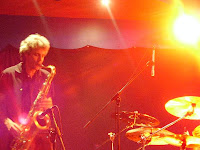
02 August 2006

Luke Sweeting Trio

The Luke Sweeting Trio played for the last of the Jazz at the Gods series last night. LST are Luke Sweeting (piano), Hannah James (acoustic bass) and Ed Rodrigues (drums). Luke and Ed are 2nd year students at the CSM Jazz School, and Hannah is a 1st year student. The quality of the concert is a measure of the output from the Jazz School, and congratulations to both the band and the school.

LST played two brackets of standards. I loved the choice, and I learned the titles of a few well-known but unidentified melodies. Tunes included Lullaby of Birdland, You don’t know what love is, Sandu, Groovin’ high, Stella…, Softly as a morning sunrise, Whisper not (including the rarely-played march in the C section) and Wayne Shorter’s Deluge. It was an oddly conceived but fascinating version of Autumn leaves that they played, and I was taken by a down-home bluesy version of Blue monk. But I especially loved their take on Invitation. It’s a great latin tune and a favourite of mine. They played it later in the night when they were warmed up and more relaxed. It was a complex rendition, with lots of variation, moves from latin to swing and back and plenty of solos passed between the players. Lovely! Then the encore of Bird’s Scrapple from the apple demanded all their chops to finish the night.

Luke played lines from the heart of the tune: always defining the underlying movements, although often enough challenging with moves out of the strict harmonies. Hannah played solid and ever-reliable rhythm section lines in latin and walks, and was always right on the harmonic and rhythmic structure. And despite her obvious concentration against double-time and bebop walks, she continued to mark the tune out clearly. Ed provided a solid underlying rhythm with cymbal colours and interesting solos. He amused me with two solos where he played the tune’s melody by changing pitch of a tom by pressing the skin. Synth for skins?

Another proof of the quality of the Jazz School, and a fine way to end Geoff Page’s Jazz series at the Gods for 2006.

Dave Weckl Band

By the end of the night, cheers are superfluous. I’m convinced, perhaps beaten into submission. I announced this performance on CJ as “not my favourite style, but you’ve got to admit these guys have chops”. But I was enchanted, and overwhelmed, and intrigued. I loved this concert. It could be just the sheer abilities. No doubt they had chops – these are world masters in the style and they displayed their skills in great measures. But I was also intrigued by the style itself. Despite a past love for Mahavishnu, Return to Forever and the like, I’ve more recently thought of fusion as “full of sound and fury, signifying nothing”, just a few chords with lots of predictable busy-ness. But I stopped to analyse the melodies, and they were complex, madly syncopated and plain interesting. The rhythms and harmonies were essentially simple and repetitive, but the interpretations were joyful, complex, playful, rich. I could go on. I’ve since spoken to people in two camps: one group was ecstatic; the other was unimpressed. It reminds me of the battles between modern and trad jazz, or between the modern jazz and jazz-rock people when Bitches Brew arrived, or the folkies complaining when Dylan went electric. Perhaps this demeans the arguments; each side has some validity. But to defy the tenor of our times, I’ll choose not to be polarised, and say I loved this concert (while I also love modern, mainstream and other forms).

DWB was Dave Weckl (drums), Steve Weingart (keyboards), Gary Meek (sax) and Tom Kennedy (bass). They played 2 hours of the most energetic music I’ve seen in ages. The tour was called Multiplicity and presumably they were mostly performing tunes from their new album with this title. Their resilience reminded me of a time I saw Chick Corea playing in Adelaide: he played a long set, then surprised me when he said he’d return after the break. DW didn’t even get a sweat up despite the threshing performance he’d given. I had attended a workshop which Weckl gave years ago at the Southern Cross Club. His talk then suggested he and his mates were fit, clean-living music machines, and this just looked to me to be proof (although Gary was seen smoking outside in the cold Canberra winter air). I won’t comment too much on the performances. Get one of their live albums, but discount the fact you’re not there, or you may be underwhelmed. To me, this stuff doesn’t transfer well to a CD. There seems to be a sterility and dullness to the incessant sheets of recorded notes. But live, it was powerful, fluid and overwhelming.

To see these guys in a little club with only about 150 people is bliss. To be able to chat to them after is additional bliss. Someone said a bomb in the Holy Grail that night would have knocked out the whole Canberra drumming community. I’d add a good few of the other instruments, too. This audience was peopled with musos. There was a rush to talk with the stars after the show. Lots of interesting muso chat about gear and the like. Can’t help but be seduced!

Someone mentioned poor communication between players, but I didn’t see that. Tom and Steve were always musically toying with each other and smiling broadly at the results. Gary would glance over above his sax at key points. Only Dave was locked into his instrument, doing his communication mainly by ear.

Tom was my hero (but then, I am a bassist). He flayed his lovely 5-string Fodera (beautiful quilted maple top; standard B-E-A-D-G tuning). Most of his playing was in lower positions, but then he’d move through higher positions, and above the 12th fret for chords, or do chordal runs up the neck. He played slap, fingerstyle with 2 and 3 fingers, and thumb for various effects. No compression; just a few foot pedals (chorus, EQ and octaver, but they weren’t overworked) and Ampeg amp. He mainly just poured out sheets of notes with a Pastorius-like tone. And what notes? You could identify one or two chords below, but there were all sorts of harmonic, chromatic, whole tone and such movements. At one stage, I realised in the middle of a tune (they had been playing for maybe 5 minutes) that this was a blues. They had introduced it as blues, and this was the first really visible referral to the obvious blues structure. How did they do this and hold it together? Beyond me.

Gary on tenor and soprano saxes was a little more reverent of jazz traditions. He was a Garfunkel-looking character off to one side, doing these difficult heads, and blowing power solos. I felt he was lost in a rhythm-section-heavy mix which I felt didn’t do him justice.

Dave was the ever-busy powerhouse, as expected. Head down, sheer concentration. Great precision and delicacy when required, but mostly just ceaseless power and push. Lots of cymbals, lots of double bass drum work (and little jazz hi-hat), lots of triplets and complex partitioning of the beat, but always this incessant, changing understory of rhythmic energy.

Steve was a pixie, playing then not playing, toying with the sounds, often enough taking a solo, mostly piano sounds, but occasionally synth. He was a back-woods man, moving in, changing things, moving on. Just two keyboards, but through a laptop for effects and midi tones, presumably. Interestingly, perhaps 6 foot pedals.

The whole effect was a writhing reptilian barrage of notes. Not discordant and never still. But intense, challenging, overwhelming, vigorous, fast, and damn good fun.

Top class. Don’t miss them next time around, or anyone else of this level that visits. Regardless of the style.

This is a great topic for a discussion. Just click on the blue "Comments" link below and add your opinions. This could easily develop into a flame war, so think before you write and keep it respectful. As administrator, I'll delete any entries that might cause offence. Add your comments now...

31 July 2006

Missed Jazzabout again...

Jazzabout VIII has just come and gone, and I missed it. If you look back in the annals of CJBlog, you'll see I missed J-VIII too. I missed the promotions until it was too late. It appears to be run out of the pre-tertiary jazz course at Narrabundah College.

J-VIII was held at the Southern Cross Club over the weekend: Fri 28-Sun 30 July. I understand it featured big bands and smaller combos from high school, CIT and jazz preparatory courses around town (perhaps also regionally?).

If anyone has pics, or wants to write a review, please contact CJ. Very welcome.

19 July 2006

Straight Up!

It was a pleasure and a privilege to hear this great Canberra trio last night at the Gods jazz series. Straight Up! have been together for ~18 months. They perform occasionally, especially on the jazz festival circuit, and have recently recorded a CD. Their experience shows. They played with immense energy and a real, close responsiveness between players. The show awed the attentive audience, and the players’ joy in the performance was palpable. It’s hard to describe the pleasure and the deep, searching melodies and interplays and improvisations on the night.

Straight Up! comprise three of the foremost modern jazz players in Canberra at present: Eric Ajaye (bass), Michael Azzopardi (piano) and Chris Thwaite (drums). Eric, of course, is the much admired bass teacher at the jazz school, with a wealth of experience behind him in US jazz (tours, gigs and recordings with the likes of Chaka Khan and Freddie Hubbard). Michael has a history in Sydney with top players, and Chris has long experience around Canberra. Michael and Chris are both products of the CSM Jazz School. Together, they form a powerful and interactive trio in the modern vein, and offer an almost fully original repertoire.

Eric plays an electric double bass most of the time (Steinberger 5-string), although he finished with two tunes on electric (Steinberger headless, but all the sounds produced from a midi pickup feeding a Roland bass unit; the sound was great and seemed responsive to his fingerwork). Eric is always rock solid in whatever style. He uses lots of slides and interprets freely and richly with plenty of solos. He’s a stunning player of the highest performance level (our little bit of New York in Canberra). He also offers a friendly and familial interaction as he talks with the audience between tunes. Michael plays fast and furious, freely changing tonalities from piano to pads and other synths, and voices it all with elegant tone bends as he moves inside and outside of the relevant harmony. Chris displayed great awareness of the tune and to the others’ playing. He has a sharp, strong sound (BTW he uses two snares: one standard and one high pitched) and pushes the rhythm and interprets the melody strongly throughout. His fills are always apt, and his solos are clear in intent. He did several solos against repetitive patterns held by bass and piano (a common modern style), and one interesting drum solo on a ballad – not a common format for a drum solo.

The tunes varied, but all within modern jazz styles. There were latins, hard bops, ballads and more spacey modernist tunes. They related to events or experiences in their lives, eg, 88 keys to happiness (obviously a pianist’s tune), a tune about Michael’s dog, and a tune about St Thomas where Eric’s father had lived. In fact, the personal aspect of the concert was infectious. The trio smiled often and freely. They were gentle and honest in presence, but strong and expansive in playing. They told us of common aspects of their lives - common birthdays, and common wives’ names - but joked about the different personalities of their dogs. I guess I mean their performance was emotionally satisfying. Certainly, that was the impression of the audience after the show.

An intense, infectious and satisfying concert at the highest level. See this band!

ArtSound at work

Here’s Chris Deacon at The Gods Café recording Straight Up! for ArtSound. Keep an ear out for the transmission of this gem of a concert. Chris appears (usually alternate weeks) on Saturday afternoons on ArtSound in Music Works, his jazz/world music show. Keep an ear to Music Works and ArtSound for what’s on the radio, and also news on the arts in Canberra.

Chris has been recording jazz and other music around Canberra for 25 years, so ArtSound holds an immense and valuable resource. BTW, it’s all done with approval of musicians, and rights are strictly respected.

ArtSound is a local gem. It’s a community radio station, run on professional lines with mostly volunteer staff. It provides an intelligent and satisfying coverage of the arts in Canberra and more widely, and records this for posterity. How it can perform such a professional service with limited resources is beyond me. Thanks to sponsors, members, and the ACT Government for support. ArtSound always welcomes new members and volunteers interested in taking part in running the station, so get in touch.

For those who are interested, Chris used 4 direct feeds (stereo piano, bass, PA for stage talk), and 6 mics (bass, stereo on audience, 4 on drums [2 x overheads, snare, bass drum]) and mixed live to stereo. Equipment included Rode and AKG mics, Soundcraft mixer, Sennheiser headphones and Marantz digital flash stereo recorder (PMD671?). He’ll download to a PC, and expects to do minimal processing, perhaps just some compression.

BTW, You'll find ArtSound at FM92.7

  • ArtSound FM92.7
  • 14 July 2006

    First White Eagle jazz session

    Congratulations to the students at the CSM Jazz School who have started this new monthly session. It’s held at the Polish White Eagle Club opposite the O’Connor shops (given the sign on the wall, I infer it’s also the location of the longstanding Canberra folk club, the Merry Muse). Thanks to Ed and Phil who I think organised it; well done.

    The night starts at 8pm, and last night it ran to midnight. The format is a visiting band for two sets, then a jam, mainly featuring students from the jazz school. The band for the inaugural session was Trio Apoplectic (see my other review). Authentic Polish food (interesting and very different) is available earlier in the night. The bar stays open late and beers are cheap. Numbers last night were not too large (there’s plenty of room for more), and it’s pleasing to see they weren’t all just Jazz School students who are naturally in the information loop.

    The jams last night featured 4 groups of players, generally playing 2 tunes each, although the later ones got just one tune as it was approaching closing time. The tunes played were well known standards. If you’re interested in playing, practice tunes like Have you met Miss Jones, Stella by starlight, Nostalgia in Times Square, Straight no chaser – they were all played last night.

    Keep an eye on canberrajazz.net for announcements of future sessions.

    Fist visit includes membership to the Polish Club. $13/$10

    Three apoplectic jazzers

    Trio Apoplectic played last night for the inaugural monthly concert and jam organised by Jazz School students at the Polish White Eagle Club. TA are a young Sydney band, comprising Dave Jackson (alto sax), Abel Cross (acoustic bass) and Alex Masso (drums).

    They played two sets of modern acoustic jazz comprising 50/50 interesting standards and originals. I heard it as post-bop, but perhaps other descriptions are apt. Non-originals included tunes by Mal Waldron, Tony Gorman, Thelonius Monk (BooBoo’s birthday), Ellington (Sonnet for Sister Kate/Coco) and the standard The Blue Room (Rogers & Hart?). The originals included “Details of how to get Apoplectic on your licence plate” (no other band is likely to use that title!) and the hard bop tune Dynamite which finished the night on a high.

    This is a chordless trio, so there’s a open sound, which lets you hear each instrument clearly. It also demands that the harmonies are well defined by the bass and sax, and they were. I love this format, especially because I can so easily make out the bass lines which can be lost in more full orchestrations. I loved Abel’s excellent, lively and communicative bass playing. He was very comfortable when walking and in freer support roles, and he played great solos. He also had a satisfying woody sound, and a beautiful looking bass of a rich mahogany-coloured timber with strong grain patterns; lovely. Dave played thoughtful solos, with lots of clear and well-maintained pattern work and nice structure. He seemed deeply involved when he was playing, and showed a real relationship to the tune at hand. Alex supported, with close interaction with Abel, and increasingly frequent solos (mainly trading 8s, but one or two full solos later in the night).

    I thoroughly enjoyed the playing, and the small crowd obviously did too. It’s great to see more Sydney players coming down, and the opportunity for Canberrans to get to know the products of the venerable jazz course at the Sydney Conservatorium.

    Thanks to TA's press release for the mono pic above.

    13 July 2006

    Triosk tour Canberra

    Triosk played to a full house at Hippo’s last night. How do I know? I was left out in the cold with a changing group of others. Given it was a cold night (predicted -4degC, and it clearly reached it) I didn’t hang around for long. On the other hand, Hippo’s is generous with its sound, and you can clearly hear the band from outside, so I got a good listen for ~30mins, even if not a view.

    Triosk are Adrian Klumpes (keyboards/samples), Ben 'Donny' Waples (bass), Laurence Pike (drums). They are touring to publicise their new album. They have received great reviews in Australia and Europe. They are jazz trained and are talked about in the same breath as The Necks, so I expected a different, although jazz-influenced sound. They have also recorded a CD with Jan Jelinek of Germany (1+3+1), which was interestingly done over the Net, and toured Australia with Jan.

    I heard a gentle, minimalist soundscape. The show started with screeching cymbals from a stick being dragged around a cymbal. Then a slow bass line, with a lovely, biting double bass tone. The other member was piano, playing regular patterns and minimal changes. The drums grew, and over the next few tunes were very busy, with the bass and piano holding steady. There were sounds or effects, I guess from the piano, and later, very high pitched notes bowed on the bass. The drums had lovely loose tones. They seemed to be detuned, so the stick sunk into the skin, and the snare drum was played infrequently, and mostly (at least what I heard) with the snare wires out. I know they perform with laptop/s, and there were some sounds I couldn’t identify – perhaps PC-based digital effects, or sampled sounds interwoven with the performance. Hard to tell without seeing them in performance. And the performance obviously demands a great level of listening between players, as every note counted hugely. What I heard was an intriguing, beautiful and spellbinding performance.

    But it was cold, so I didn’t hang around. I hope they return or I can catch them another time. But for now, a picture of some die-hards outside Hippo’s has to suffice.

    29 June 2006

    Happy birthday, Blake

    Blake Wilner celebrated his birthday and the anniversary of his engagement on Wednesday night at Hippos. Also present at his party were Brandon Allen (alto sax, occasionally tenor), Sam Anning (double bass) and Ben Vanderwal (drums). Blake, of course, is guitarist and leader of the Blake Wilner Quartet.

    BWQ are currently touring Australia. Apparently, the whole band originates from Perth, but they are now spread widely. Blake and Brandon are resident in London (Brandon told me he’s been there for 6 years); Sam is in Perth; Ben is in Melbourne. They played instrumental jazz with lots of energy. I heard Euro jazz in some of the alto playing. There was Scofield in there too (the last tune was a Scofield composition). It was great playing all around. I especially loved the complex unison lines by guitar and alto (a sweet-sounding combination) and the all-in improvisation (reminiscent of 60s avant-guard). This trad-jazz approach of concurrent soloists bouncing off each others’ lines seems popular at the moment.

    Looking up, it seemed like a grunge jazz session. Brandon played, bent over his alto, wearing black t-shirt and moving with muscular, angular motions. Blake played with beanie and t-shirt and looked relaxed but committed. Sam played steadily, and with power when the band lifted, and also played several effective solos. Ben was all over the kit, with complex polyrhythms and lots of rhythmic movement. BWQ gave an energetic and powerful display; a performance that confirms the quality of Australian modern jazz these days.

  • Blake's website - http://www.blakewilnergroup.com/
  • 16 June 2006

    Ben Winkelman stomps Canberra

    Ben Winkelman arrived in Canberra with considerable publicity (posters, and several articles in local papers) and a few weeks after he was originally booked. It was worth the wait. The Trio that performed in Canberra were Ben Winkelman (piano), Desmond White (acoustic bass) and Ben Vanderwal (drums). It was an fascinating night of eclectic original compositions, presumably penned by Ben W himself. The compositions covered a wide range of styles and motifs. There were stomps, rags, tangos and classical flourishes. There were dedications to deceased cats and Jelly Roll Morton, and German literature in the form of Thomas Mann.

    Ben W plays a rich style of piano: big chords, orchestral flourishes, parallel octaves, stride, and more. To me it was a Euro-style (he’s a student of Paul Grabowski) and his classical training was evident. Ben Vanderwal was a fascinating drummer, more an accompanist than a rhythm keeper. He would switch drums and cow bells, rolls and patterns, sticks and brushes and mallets continually, perhaps every 4 bars, perhaps more often. This was a rich landscape of percussive sounds to accompany Ben W’s complex and varying style. There were 4/4 passages and solos in there too, but they would be interspersed with odd added bars or be reformed as a totally different styles. Des White provided lots of bass solos, but he was also a foundation supporting all this variation, but seldom with just a walk or a simple pattern, although there were one or two of these in there too.

    The changes were organic. They were responsive to jazz, latin and other music history so they were self-evident and not jarring. But change there was, lots of it. It was an attentive audience, and Ben commented on it. But I think a large part of that came from the richness of the music on offer, and the calm, friendly and intelligent way that Ben spoke between tunes. This was a night of contemplation, and of rich engagement and exploration from young but surprisingly mature players. So it was a special night at Hippo’s. Ben promoted his new CD several times during the night, and highlighted its success as a runner up in the Bell Awards. Given this show, I expect it’s quite a journey.

  • Ben W’s new CD is - Stomps, Pieces & Variations (Jazzhead)
  • Ben W’s website – http://www.benwinkelman.com
  • 14 June 2006

    Australian Jazz Archive

    Canberra is lucky to be the site for the main research collection on the history of jazz in Australia, the Australian Jazz Archive (AJA) and its sub-collection, the National Register of Australian Jazz Interviews. The AJA is held at the National Film & Sound Archive (NFSA), located near the ANU. It's a national institution which holds many items relating to the history of jazz in Australia: sound recordings, film, videos and oral histories. Here are some links to start your research if you wish to investigate the AJA further.

  • AJA page at NFSA
  • State contacts for the AJA (Jazz Australia)
  • Article by Bruce Johnson on the establishment of the AJA
  • 07 June 2006

    Valdis Thomann Trio

    Valdis Thomann (trombone) led a trio with colleagues from the CSM Jazz School, Neils Rosendahl (tenor and soprano sax) and Michael Azzopardi (piano) at Geoff Page’s Jazz sessions at the Gods Cafe. Valdis joked his way through an evening of excellent music. Neil’s riddle indicates the tone: “Why are pirates so dirty? … Because they arrrrrr.” Hmmm…

    But the tunes were an interesting collection played thoughtfully and with considerable variation. About half the tunes were original (penned by both Neils and Michael) and several interpretations were solos or strongly featured one player. There was also a lovely breadth of styles. Mingus’ Jelly Roll was treated with the respect for, and knowledge of, history that the tune deserves. Contrasting with this was a funky acid jazz original by Michael which ended the show on a high. Non-originals included Some time ago, Wayne Shorter’s Deluge and Neil’s solo on Round midnight. Michael performed a solo rendition of Herbie Hancock’s Dolphin Dance with synth effects that harked back to Hancock’s rhythmic-rich bands, but also was free with time signatures so breaking from the normal interpretation. Neils put on show his freedom with harmonic treatment and wide intervals, his ability over the full range of the instrument, and his playfulness with strained high notes and honking low notes. Valdis played clear heads and inventive solos with that characteristic mixture of bell-like tone and honky blat that is the trombone - lovely! I also noticed the horns blending sweetly with clear and balanced harmonies, which I assume were improvised. Michael provided a strong, dense and often staccato support which propelled all this along, and sizzling solos when he had the floor.

    So, perhaps the music was better than the humour, but, hey, you can’t have everything.

    01 June 2006

    Wonderful Miroslav

    Wednesday was a fabulous night when Miroslav Bukovsky’s band played at Hippo’s: powerful, loud and rhythmic. Three sets of hard-rocking jazz – I guess you’d call it acid jazz or jazz rock or perhaps electric free jazz. The band was considerably bigger than the quartet first advertised. It consisted of Miroslav (trumpet), John Mackey (tenor sax), Arne Hanna and Ben Hauptmann (guitar), Zoe Hauptmann (electric bass) and Mark Sutton (drums). Niels Rosendahl (tenor sax) sat in for the middle set. It was hard, pumping music throughout, ending with a slightly incongruous but enjoyable reggae piece. No mainstream standards here: mostly originals by various members of the band, although there was one by Don Cherry, and maybe one or two other free jazz standards but nothing I recognised.

    They were all stars. As a bassist, my attention first went to Zoe Hauptmann. The Hauptmann family has a great reputation as successful students of the Canberra School of Music Jazz School. Zoe played a driving groove at all times, using a fat and dirty sound at high volume. No solos; just complex, funky, finger-style, syncopated 16th note patterns driving the beat at all times. It was a object lesson in this style of bass playing. Mark Sutton was a worthy companion. I’ve mostly seen him with brushes (he’s a master of the brushes) but his stick work was infectious: polyrhythms crossing over Zoe’s bass lines, complex segmentation of the beat, and lots of work on the bass drum pedal. But the rest of the rhythm section were no slouches either! Ben Hauptmann played a telecaster with some great solos, developing from simple to blisteringly fast and complex. He was using strong effects (something like voice box or autowah) which sometimes made it hard to follow the solo lines (at least for me), but it fitted the sound of the band. Arne Hanna was a new name to me, but apparently he’s well known for his playing with Jackie Orszaczky. He played a strat through an Apple computer for sound effects (interesting and again appropriate), but I was most entranced by his gentle fingering, rich chordal work and deceptively simple but richly melodic solos. I was so taken by the rhythm section that I didn’t pay enough attention to the soloists, but as always John Mackey and Miroslav Bukovsky played interesting and well-intoned melody lines together, and challenging solos. Miroslav Bukovsky’s something of a Miles around town: he always puts together great bands. And it was nice to see Neils sit in, following his recent visit to Asia, and before he leaves for study and performance in UK/Europe.

    Overall, a night of the highest performance standards. It’s not often you see dancers at Hippos on jazz nights, but the groove was so infectious, they were up too. Excellent performance by all.

    25 May 2006

    As Famous as the Moon

    I caught As Famous as the Moon at Hippos last night. AFATM is led by Dirk Zeylmans on tenor sax. It’s a smooth and very competent mainstream jazz band, playing latin, swing and some bebop. Dirk has a sweet sound. He reminded me of the Stan Getz style: in tonality (sometimes) and in phrasing (often). The other players were Chris Thwaite (drums), James Keith (double bass), Paul Dal Broi (piano) and Graham Monger (guitar). Chris is a great player who frequently appears around Canberra with different players. In this group, he traded fours in most tunes. James was solid and swinging at all times, taking a few nice solos. Dirk commented how he loves his long ringing sound and how it’s easy to play to. Graham was similarly competent, providing long and swinging solos. Dirk told me he knows every song under the sun. I thought Paul offered the most challenging solos for the night. They developed well and explored dissonance in the process. I can’t help but love montuno (those repeated one- or two-bar piano figures in salsa) and the lift it gives to latin tunes, so he won me over when they appeared.

    You can see Dirk and friends around town in many locations. They play Babar’s at Woden on Fridays at 6-8pm, and can even turn up to relax the bidders before some real estate auctions around town!

    17 May 2006

    Bernie McGann visits

    Bernie McGann played for The Gods Cafe's jazz series on 2 May. I missed it so no review (reviews for canberrajazz.net are welcome - just email to Eric). Thanks to Alison Hastie for the pic above. It shows Bernie McGann with Lloyd Swanton. Also playing were Warwick Alder, trumpet, and Alec Musso who replaced John Pochée on drums.