11 May 2007
Open mic - influential albums
What are your favourite or most influential albums? CJ’s “Open mic” is a chance for you to write for CJ. Just add a comment below. Tell us your 2 or 3 favourite jazz albums and give us a short blurb on why they are important to you. Make it as long or short as you like. If you are a muso, tell us what you play. You can write as anonymous, but I’d prefer your first name. Over to you.


09 May 2007
Europe visits via Melbourne
Melbourne has imported a few big names for its recent Jazz Festivals, and it’s having an effect on the rest of Australia as these names go on tour. Most of them don’t reach Canberra, but we had Herbie Hancock recently, and last night we heard the Jens Winther European Quintet as the European, or perhaps Scandinavian, contingent. Jens is not a big-name drawcard like Herbie, so (instead of the Canberra Theatre) he performed at the Jazz School for a lot less money. That’s sad, but an opportunity for those who did attend. While the names are not so well known, the performance was spectacular. So thanks go to Miroslav Bukovsky for his efforts to bring them here. This was a great night of jazz in the 50s/60s tradition of Miles and post bop, held in a club-like venue for a small group of students and jazz afficionadoes.
 The line-up of the band was standard for the style: Jens Winther (trumpet), Thomas Franck (tenor sax), Ben Besiakov (piano), Jonas Westergaard (bass), Dejan Terzic (drums). The quintet played two sets, and I noticed how each started on a high with a hard bop melody introducing the set. But this was a night of open, exploratory change. The music was written to some degree, but the players took every opportunity for improvisation and variation. Jens and Thomas, especially, led each solo through huge variations: restrained, pensive, hard swing, free. I also noticed how the rhythm section would also change to follow the soloists. At various times, bass, drums and piano sat out for extended passages, so the tonality of the mix was continually changing. At one stage, we heard an unusual combination of piano, bass and trumpet when drums sat out. Otherwise, piano often sat out, leaving a trio format. At one stage, trumpet played alone, or at least with the help of vibrating piano strings, as Jens played directly into the body of the grand piano, and we could hear the resonances in the otherwise deathly quiet and attentive room.

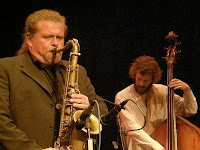

 All were highly competent musicians. I felt both the front line players, Jens on trumpet and Thomas on tenor, played highly developed bop styles, with clear intentions and interesting melodic ideas. There were calls and response between the front-liners, and several sessions of swapping fours and shorter passages. There were beautiful harmonies when they each held long, pure notes. They were fast but not blinding, although they often enough dropped into flourishes or faster passages. But this was considered playing, and thus melodically and harmonically exploratory. The rhythm section was solid and mobile in its interaction with the front line. I particularly liked Ben on piano. His comping seemed more classically-influenced, as I (perhaps ignorantly) expect from European musicians. I loved hearing some long, long lines of ascending or descending backing chords on quarter notes. Ben didn’t play too many solos, but what he played was rich in the way only piano can be: in style, in complex and substituted harmony, in melody. He was also lucky to have a gorgeous piano sound from a Yamaha Grand in the band room. (I noticed later it was one of those pianos with full midi implementation. Perhaps this is the very piano I saw in the National Library playing Oscar Peterson a few years ago, where it seemed a ghost was playing as the piano keys and pedals moved, pianola-like).
The band played two sets over several hours, but there were only 6 or 7 tunes (including a few medleys), so each tune was long, and quite a journey. The tunes were mostly originals. The first was Mercury from Jens’ CD called the Planets and influenced by the Holst work of the same name. This started as a hard bop piece, but like all tunes, metamorphosed through various other styles. I missed the other titles, but there was a lovely original 32-bar ballad by Jens, and a lively post bop blues. As for non-originals, there was Body and Soul during the body of the concert, and a final jam where Miroslav Bukovsky and John Mackay joined in for a sometimes frantic blow on Footprints.
 Again, Chris Deacon recorded the session for ArtSound, so listen out for this over coming weeks. This was an excellent evening of modern acoustic jazz, with a strong influence of Miles and his fellow travellers from the 50s/60s era. Thanks go especially to Miroslav for bringing this excellent band to Canberra, and for the quote of the night: “Drive safely, and if you come to a fork in the road, take it”.
 The line-up of the band was standard for the style: Jens Winther (trumpet), Thomas Franck (tenor sax), Ben Besiakov (piano), Jonas Westergaard (bass), Dejan Terzic (drums). The quintet played two sets, and I noticed how each started on a high with a hard bop melody introducing the set. But this was a night of open, exploratory change. The music was written to some degree, but the players took every opportunity for improvisation and variation. Jens and Thomas, especially, led each solo through huge variations: restrained, pensive, hard swing, free. I also noticed how the rhythm section would also change to follow the soloists. At various times, bass, drums and piano sat out for extended passages, so the tonality of the mix was continually changing. At one stage, we heard an unusual combination of piano, bass and trumpet when drums sat out. Otherwise, piano often sat out, leaving a trio format. At one stage, trumpet played alone, or at least with the help of vibrating piano strings, as Jens played directly into the body of the grand piano, and we could hear the resonances in the otherwise deathly quiet and attentive room.


 All were highly competent musicians. I felt both the front line players, Jens on trumpet and Thomas on tenor, played highly developed bop styles, with clear intentions and interesting melodic ideas. There were calls and response between the front-liners, and several sessions of swapping fours and shorter passages. There were beautiful harmonies when they each held long, pure notes. They were fast but not blinding, although they often enough dropped into flourishes or faster passages. But this was considered playing, and thus melodically and harmonically exploratory. The rhythm section was solid and mobile in its interaction with the front line. I particularly liked Ben on piano. His comping seemed more classically-influenced, as I (perhaps ignorantly) expect from European musicians. I loved hearing some long, long lines of ascending or descending backing chords on quarter notes. Ben didn’t play too many solos, but what he played was rich in the way only piano can be: in style, in complex and substituted harmony, in melody. He was also lucky to have a gorgeous piano sound from a Yamaha Grand in the band room. (I noticed later it was one of those pianos with full midi implementation. Perhaps this is the very piano I saw in the National Library playing Oscar Peterson a few years ago, where it seemed a ghost was playing as the piano keys and pedals moved, pianola-like).
The band played two sets over several hours, but there were only 6 or 7 tunes (including a few medleys), so each tune was long, and quite a journey. The tunes were mostly originals. The first was Mercury from Jens’ CD called the Planets and influenced by the Holst work of the same name. This started as a hard bop piece, but like all tunes, metamorphosed through various other styles. I missed the other titles, but there was a lovely original 32-bar ballad by Jens, and a lively post bop blues. As for non-originals, there was Body and Soul during the body of the concert, and a final jam where Miroslav Bukovsky and John Mackay joined in for a sometimes frantic blow on Footprints.
 Again, Chris Deacon recorded the session for ArtSound, so listen out for this over coming weeks. This was an excellent evening of modern acoustic jazz, with a strong influence of Miles and his fellow travellers from the 50s/60s era. Thanks go especially to Miroslav for bringing this excellent band to Canberra, and for the quote of the night: “Drive safely, and if you come to a fork in the road, take it”.
30 April 2007
Viet jazz
I’ve been incommunicado for the last 2 weeks when we’ve had the two biggest international jazz shows in Canberra for years. But the alternative was perfectly acceptable: travelling in Vietnam with family and friends. But your intrepid jazz reporter for CJ does not return empty handed.
I visited what must be the two major jazz venues in Vietnam: SaxN’art in Ho Chi Minh City (better known as HCMC or Saigon) and a return visit to Minh’s Jazz Club in Hanoi. Both are decorated with bright neon lights, both inside and out, so are hard to miss.
 SaxN’art was disappointing. It was more a light jazz venue, at least at the time I attended, with an air of 50s sophistication. It was early in the evening, and it may hot up later at night. But a chat I had later in Ha Noi suggests most musos are playing this style, in hotels, bars, etc, for tourists and for the money. (Things are the same the world over, or as the Vietnamese commonly say to tourists, “Same same”). SaxN’Art a two story venue with a dress circle. We were upstairs, so the pic looks down on the band. They were competent players, and I especially liked the bassist. There seems to be a lot of opportunity to sit in in VN jazz venues, and the Vietnamese are a friendly lot. In the case of SaxN'art, there’s a standing open invitation for visiting musos. This time, there were several changes in the one set I heard: one sleek guy singing Sinatra style (“New York, New York” et al.), and a Korean guitar-singer sitting in for a basic rendition of Stormy Monday blues. Free entry, but prices weren’t cheap, so limit your cocktails when you visit.
I have already reported on Minh’s Jazz Club following a visit to Ha Noi a few years ago. I think I saw the house band then, and perhaps they were the same players that night. The band on this night was Red River. It comprised Quyen Thien Dac (tenor sax), Le Thoanh Long (bass), Ha Dinh Huy (drums), Vu Duc Tan (piano).
 Red River (=Song Hong) is in its second generation, after the leadership was passed from Minh to his son, Duc. This seems so appropriate in this ancestor aware country. I heard that Duc has studied at Berkeley. Whatever, he plays a lovely, melodic, musical tenor sax. His solos can break into faster runs and flourishes, and can break out of tonality, but he works the chords mostly with beautifully chosen intervals to create oh-so-satisfying, cool melodies. He was a pleasure to listen to. The rest of the band was good support. I understand Long, the bassist, is a classical cellist, and his positional playing certainly looked the part. He played with strong, reliable rhythms and walks, but sadly no solos while I was there. Huy, the drummer, is capable and took several solos, and obviously enjoyed his playing. Again, this was professional, competent playing. Tan played a range of styles, from block chords to more interesting soloistic adventures. The tunes I heard were from the standards repertoire: Autumn leaves, Girl from Ipanema, St Thomas, Misty, etc. I would have liked to hear some originals, and apparently they had played some the previous week when they played in concert at the Ha Noi Opera House. But, regardless, I was enthralled by Duc’s excellent sax throughout. St Thomas was great. I always find it a bland number to play, and usually to hear, but this sax was rich and interesting, as Rollins must have meant it. Same same for the others: Ipanema, Autumn leaves, etc. Minh’s is well worth a visit if you’re in town, and especially if Duc is playing.
 I spoke to the musos afterwards. They remembered visits by various Australians, and repeatedly mentioned the role of the Australian Embassy in promoting tours (here’s an opportunity). They specifically mentioned Scott Tinkler, Mike Nock and Nick McBride, and Neils Rosendahl got a mention too. I visited on the night Herbie Hancock was playing in Canberra, and they pointed out the pic of Herbie playing at Minh’s (apparently he only played one tune). From what I understood, there’s no tertiary jazz training in Vietnam, but there’s interest at the Conservatorium, and Red River comes out of that background.
We have now travelled twice in Vietnam with a great tour guide called Tuan Anh of Insight Vietnam Travel http://vietnamtourguides.com/. I’ll put in a promo here: deal direct, get great prices and intelligent, professional service. VN is the first country where I’ve travelled with a tour guide, and it’s so easy (after exploits in Egypt and elsewhere). But more related to CJ, it also turns out that Tuan’s wife, Hong Dung, is a professional singer on the Ha Noi scene. She knows Minh and the jazz scene, but works more in the “corporate” area. (Ya gotta make a living). As for travel, feel free to contact Eric at CJ if you want a reference for Tuan’s company.
And one last observation. Air Vietnam currently have Miles/Coltrane and Mingus as background music during boarding. On the other hand, JetStar (a perfect example of a commercially successful, modern, low cost airline) has some inane, endlessly-repeating clip from some catchy pop tune with the lyric “fly away”. Sadly, you’re more likely to travel JetStar.
27 April 2007
Herbie Hancock - add your comments below
I'm out of town and I've bagged the quinella. Herbie H is the second international gig to hit Canberra this month, and I've missed them both. Herbie Hancock played with Vinnie Colauita (drums), Nathan East (bass) and Lionel Loueke (guitar). Again, I invite your comments. Over to you. Add your comments below this CJ Blog post.


13 April 2007
Eugene Wright - add your comments below


 "Senator" Eugene Wright was Brubeck's bassist on the Take 5 sessions and a stalwart of the LA jazz scene who played with many other influential jazzers. He's just played at White Eagle with Anita Thomas (reeds), Mike Price (guitar) and Mark Sutton (drums). I couldn't make the gig, so I invite your input. Add your comments below. Over to you. If you have pics, send to me for later publication.
Thanks to those who left comments. More welcome. Looks like I missed a great show. Thanks esp to Luba Thompson for the great review and these pics.
Ivory and apoplexy
White Eagle offered another double bill last night. This is obviously developing as the nature of the event, with audio provided and recorded by ArtSound, and a local band and a local or visiting band as a main act. Tonight’s show featured Ivory Hunter, Daniel Hunter’s band, and the return of Sydney’s Trio Apoplectic.
 Ivory Hunter is led by Dan Hunter (guitar), with Yen Nguyen (drums), Gareth Hill (bass) and Munro Melano (keyboards). I hadn’t heard of Ivory Hunter before but I assume the musos have been playing together for years at the Jazz School. I’ve reported on these players several times on CJ, but mostly they were playing the standards repertoire (very capably). However, Ivory Hunter is a platform for originals. The tunes were penned by various band members and covered a range of approaches. There was one bordering on hardbop, but mostly they were more melodic and tuneful. I particularly liked a couple of tunes from Gareth, a ballad and another tune with a very convulsive melody leading into a hard swing. Daniel’s Act of will was an interesting piece with a sustained quarter-note melody that had my mind drifting. And I have to mention Dan’s Scofeel. It’s an obvious take on Scofield, with indefinite timing, sleezy down-South solos, bluesy organ in the background, and Chambers-style drum patterns crossing the bar lines. So there was quite a range of styles here: floating and relaxed, bluesy, out. I had the feeling these guys were beyond simple exuberance, and were seeking more musical statements.
Daniel always plays in a restrained and careful way, and he did so this night. He plays occasional flourishes but lots of well-considered melodic lines. Gareth also led as melodist on several tunes and played some excellent solos. He’s a strong player, and his tone is also strong: good muscular fingers dragging the strings for a clear, woody tone. Munro played synths at times, along with piano and organ sounds. I particularly liked his comping, especially following his responses to Dan when he played outside. Yen held it all together and played several expressive solos, not least on his own compositions.
As for the band name, Hunter is an obvious reference, but is there some other message? Perhaps. The smooth surface and alabaster colouring of ivory seems to fit the music.
 Trio Apoplectic were quite a change after the more relaxed Ivory. Right from the top, they played with intensity, energy and intelligent interaction. I’ve written about TA before; they played at the first White Eagle session. Their return was quite triumphant. This was modern jazz of a high order. Intellectual, emotionally demanding and satisfying, great playing with great, clear sounds, exploratory. I love this style and I was trying to place it. Perhaps Joe Henderson? I asked them about their influences. Interestingly, they offered Bernie (McGann) and when I further inquired, they suggested other players around Sydney.
TA are Dave Jackson (alto sax), Abel Cross (bass) and Alex Masso (drums). They play a mix of standards and originals. Originals come from the pens of Alex and Abel, especially Abel. They played Monk’s Boo Boo’s birthday. Originals included the oddly named Details of how to get apoplectic on your licence plate (apparently a renowned title at Sydney’s Birdland records). There were soundscapes and free styles, hard swing and balladic styles, bowed bass reminiscent of didjeridoo and sax harmonics. Several of these tunes are on the CD, and were played at TA’s last White Eagle concert. I feel they’ve explored the music much further, and this was the source of such a satisfying performance.
 They all played with intense energy and commitment throughout the show. Noone played too obviously, or displayed the chords too evidently. The harmonies and counterpoint were fascinating. They were also all very balanced, each player providing an essential ingredient and contributing equally to the complexity and richness. This is just highlighted by the open sound a chordless trio. Dave plays alto, and it fit so well: smooth and sinuous, but also intriguing and exploratory. Abel played hot from the top, and played some excellent solos. The underlying chords were interpreted so subtly I wondered if the tunes were modal. A lovely modern style. Alex was mobile and varied on drums: brushes or sticks, cymbals or drums, sparse or dense.
Another great night at White Eagle, in expectation of White Eagle’s debut as an international venue next week, with the bassist Senator Eugene Wright.
10 April 2007
Kevin Hunt records at ArtSound
You may know that Kevin Hunt is the first Musician in Residence at ArtSound. I imagine the relationship is a little ill-defined or at least pretty variable to suit both parties, but it’s an excellent idea, and I saw one hugely productive aspect of it today.


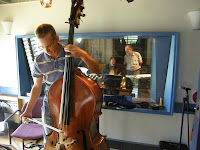
 Kevin Hunt has an interest in classical (especially French) music of the era of Ravel and Debussy. Apparently, his masters thesis was a study of this music and its interpretation in a jazz format. For this, he worked with Gary Holgate (bass) and Lawrie Thomson (drums), and he has recently performed this repertoire at the Adelaide Festival of Arts, and is due for a performance in Canberra (Southern Cross Club, Thurs 19 April). So this is a labour of love, as it would need to be for it is complex music. It must have involved plenty of investigation and reinterpretation to the jazz idiom. I saw some bass charts and they were deceptively simple, but the music was complex and rich, and vibrant in classical, jazz and occasionally blues forms.
The session was the second day of an open house recording session. The first day was spent on setting up mics, equipment and a workable mix, as well as refining arrangements. The second and third days are for recording, and there will be mix-down and mastering sometime in the future. This second day saw the trio recording Kevin’s interpretation of movements 1 and 3 of Ravel’s Valse noble et sentimentale, movements 1 and 3 of Debussy’s Suite Bergamasque (no. 3 is “Claire de Lune”) and Gershwin’s Rhapsody in blue. The interpretations were fascinating. Kevin explained that he maintained the structure of the pieces, but he often rephrased famous lines or reharmonised in a jazz format, or broke into solos sections which were influenced by the original but not just imposed on the original piece. Kevin also showed himself as a great teacher in this process. He explained the approach to the students present, and took a real interest in their experiences and development. So it was much more than just a recording session; it was also an effective training workshop. So, we heard that Ravel’s work comprised 7#9 > min > dom/maj7 movements at one stage; how the flourish at the intro to Rhapsody in blue covers the full range of the clarinet, and how Kevin approached its replacement in this reinterpretation; the extent of the “heavy reconstruction”; the application of jazz minds to classical forms, and so on. It was a fascinating discussion to accompany the engaging performances.
 I was also interested in the recording processes. Tony Hunter was the engineer for the session. The equipment is excellent, and the result will no doubt be professional. Mics included Neumann, AKG, Shure, Rode. The mixer is a digital Yamaha (DM1000) with Cubase SX and Genelec monitors. All top stuff. It was also quite a stunning change to move from the mixing room, with its precise and clinical sound to the live room with a loud Yamaha 7-foot grand piano in action. But all fascinating and educational.

 From left, Liena Lacey (classical piano), Reuben Lewis (jazz trumpet), Olivia Henderson (jazz piano); students at the ANU School of Music.
Congrats to Kevin, Gary and Lawrie for the intriguing, impressionistic music, and to ArtSound for the inauguration of their musician-in-residence program.
The Kevin Hunt Trio plays this music, and JS Bach, Bernstein and Ellington. Thurs 19 Apr, Canberra Southern Cross Club. $22 show only (starts 8.30pm), or $57 incl dinner (starts 7pm). Bookings ph 6283 7288. More info:
CSCC events info


 Kevin Hunt has an interest in classical (especially French) music of the era of Ravel and Debussy. Apparently, his masters thesis was a study of this music and its interpretation in a jazz format. For this, he worked with Gary Holgate (bass) and Lawrie Thomson (drums), and he has recently performed this repertoire at the Adelaide Festival of Arts, and is due for a performance in Canberra (Southern Cross Club, Thurs 19 April). So this is a labour of love, as it would need to be for it is complex music. It must have involved plenty of investigation and reinterpretation to the jazz idiom. I saw some bass charts and they were deceptively simple, but the music was complex and rich, and vibrant in classical, jazz and occasionally blues forms.
The session was the second day of an open house recording session. The first day was spent on setting up mics, equipment and a workable mix, as well as refining arrangements. The second and third days are for recording, and there will be mix-down and mastering sometime in the future. This second day saw the trio recording Kevin’s interpretation of movements 1 and 3 of Ravel’s Valse noble et sentimentale, movements 1 and 3 of Debussy’s Suite Bergamasque (no. 3 is “Claire de Lune”) and Gershwin’s Rhapsody in blue. The interpretations were fascinating. Kevin explained that he maintained the structure of the pieces, but he often rephrased famous lines or reharmonised in a jazz format, or broke into solos sections which were influenced by the original but not just imposed on the original piece. Kevin also showed himself as a great teacher in this process. He explained the approach to the students present, and took a real interest in their experiences and development. So it was much more than just a recording session; it was also an effective training workshop. So, we heard that Ravel’s work comprised 7#9 > min > dom/maj7 movements at one stage; how the flourish at the intro to Rhapsody in blue covers the full range of the clarinet, and how Kevin approached its replacement in this reinterpretation; the extent of the “heavy reconstruction”; the application of jazz minds to classical forms, and so on. It was a fascinating discussion to accompany the engaging performances.
 I was also interested in the recording processes. Tony Hunter was the engineer for the session. The equipment is excellent, and the result will no doubt be professional. Mics included Neumann, AKG, Shure, Rode. The mixer is a digital Yamaha (DM1000) with Cubase SX and Genelec monitors. All top stuff. It was also quite a stunning change to move from the mixing room, with its precise and clinical sound to the live room with a loud Yamaha 7-foot grand piano in action. But all fascinating and educational.

 From left, Liena Lacey (classical piano), Reuben Lewis (jazz trumpet), Olivia Henderson (jazz piano); students at the ANU School of Music.
Congrats to Kevin, Gary and Lawrie for the intriguing, impressionistic music, and to ArtSound for the inauguration of their musician-in-residence program.
The Kevin Hunt Trio plays this music, and JS Bach, Bernstein and Ellington. Thurs 19 Apr, Canberra Southern Cross Club. $22 show only (starts 8.30pm), or $57 incl dinner (starts 7pm). Bookings ph 6283 7288. More info:
Folk fusion?
Canberra stages the National Folk Festival each Easter. It’s now in it’s 41st year, and it’s a big event (17 stages listed in the program).
 I sing tenor in the Dante Musica Viva (Italian) choir. DMV performed there this year, so I got free entry. We also got the biggest PA on the largest stage, although just at a warm-up time. We mainly sang Italian traditional tunes along with several songs of WW2 partisans. The songs are incredibly infectious, sometimes cocky and occasionally emotional, and this choir enjoys itself and lifts in performances. So it was fun.
I roved around the event in the afternoon. There were lots of ethnic dancers (including the jangly Morris Men) and earnest singer songwriters, but several capable blues players interested me. There’s bound to be something for any taste at such a large event. At a previous festival, I remember the find was a very capable Scottish guitarist chatting about Mingus and playing Goodbye Pork Pie Hat.
 This year’s find was a band that announced they were a cross of Irish and Hungarian. This was interesting, especially given they started with a tango. But they were competent and played some original or otherwise well-chosen tunes, and featured two (!) bassists, along with four part harmonies, and the very strong lead voice of Ben Palumbo. The band was Urban eXcentrics. Well worth a listen.
http://www.urbanex.com.au/
 I sing tenor in the Dante Musica Viva (Italian) choir. DMV performed there this year, so I got free entry. We also got the biggest PA on the largest stage, although just at a warm-up time. We mainly sang Italian traditional tunes along with several songs of WW2 partisans. The songs are incredibly infectious, sometimes cocky and occasionally emotional, and this choir enjoys itself and lifts in performances. So it was fun.
I roved around the event in the afternoon. There were lots of ethnic dancers (including the jangly Morris Men) and earnest singer songwriters, but several capable blues players interested me. There’s bound to be something for any taste at such a large event. At a previous festival, I remember the find was a very capable Scottish guitarist chatting about Mingus and playing Goodbye Pork Pie Hat.
 This year’s find was a band that announced they were a cross of Irish and Hungarian. This was interesting, especially given they started with a tango. But they were competent and played some original or otherwise well-chosen tunes, and featured two (!) bassists, along with four part harmonies, and the very strong lead voice of Ben Palumbo. The band was Urban eXcentrics. Well worth a listen.
08 April 2007
Rodriguez, Rodrigues & ... Bill
I caught the Dave Rodriguez Trio today at one of their regular weekly gigs at the Belgian Beer Tavern in Kingston. Presumably the audience was of local apartment dwellers from rapidly urbanising Kingston. They were thirty-ish, predominantly wearing black, and included several parents with well-behaved toddlers or proud dads holding their very young offspring. So it was a pleasant if inattentive crowd for the band to entertain. The beer was authentic Belgian and on tap, and there was a general hubbub of quiet afternoon socialising. And it was a lazy, cool but sunny, autumn Easter Sunday afternoon.
So a trio playing standards was absolutely par for the course, and Dave’s band did the job with aplomb. The tunes were Green Dolphin Street, Darn that dream, There will never be another you, My funny valentine, and the like. It was lovely music, and well played, and obviously enjoyed. They all took plenty of solos, and played with understated verve. But it remained soft and sweet, gentle and restrained, as fits with this audience, and this time.
 The Trio is Dave Rodriguez (guitar), Ed Rodrigues (drums) and Bill Williams (bass). Dave played largely diatonic solos with a clear, jazz sound. He threw in chords in several solos and played plenty of introductory vamps. Mostly good, solid, clear interpretations of the tunes, with occasional atonal explorations. Ed played brushes most of the time, displaying a flamboyant intensity which seems to me to be a trademark of his playing. Bill showed that calm attention which is so valuable in a bassist, freeing you to make all the changes and hold the steadiness of a walk or a rhythmic pattern. So, it was a lovely, restrained gig with much loved standards.
The Dave Rodriguez Trio plays 2-5pm Saturdays, at the Belgian Beer Tavern, Kingston (opp. Green Square). Free entry, interesting beers and coffee.
31 March 2007
Aron’s trio out for Harvest
I caught Aron Lyon and his trio playing at Mount Majura Vineyard for the Wine Harvest Festival. The day was fine and sunny and the wine was good (I had the Pinot and enjoyed it). And I enjoyed the music. The Aron Lyons Trio is Aron Lyon (guitar), Gareth Hill (bass) and Ben Braithwaite (drums). They are all stalwarts around town and graduates from the Jazz School. There were some environmental contrasts at times, as a tractor passed behind the band, or a plane flew low to land at the local Canberra “International” Airport. But mostly it was a lovely, relaxed style of standards, with a quiet, late-night intensity, played to a coterie of amateur wine tasters.
 Aron told me how he enjoys returning to the jazz standards after venturing into R&B and other styles. And he does standards so well. These were richly interpreted, intuitive renderings with complex substitute harmonies and inventive melodies. He often strayed well away from the tune, but there was always a hint of the underlying structure, and always a natural return when he chose it. And the rest of the band was equally strong and comfortable behind him. Gareth moved easily with the Aron’s changes. I chatted with Gareth too, and he was also talking of opening his mind to the music and the rest of the band; how it’s an intuitive rather than logical process when it’s well played. Gareth and Ben formed an unwavering rhythm section in calypso and swing styles, and they each soloed in most tunes. Gareth was fast and comfortable across the full length of the fingerboard with displayed great dexterity and interest. Ben mostly traded 8s, and did one longer solo towards the end.
 I only caught a few sets, and these were of the standard repertoire: St Thomas, Foggy day, Straight no chaser, Stella by starlight and the like. But they were so comfortably played and in such an intelligent and inventive manner. Really an excellent aural backdrop for a very nice viticultural drop!
Sound as art
 Excuse the indulgence. Here's an arty pic I took today of the brass section of the Stanhope Concert Band at the Canberra Grammar School fete. Not strictly modern jazz, but musical nonetheless.
18 March 2007
Tico for two
It was an autumn afternoon, hinting at cooler weather to come, but still and lovely in the beer garden at the George Harcourt Inn. GHI has jazz 3-6pm each Sunday afternoon, and seems to have bands booked for throughout winter (a good sign). There was a largish, relaxed audience, and the band today was Tico Tico.
Tico Tico is the duet made up of long-term local musicians with a history at the jazz school with several albums behind them. Tico Tico are Cecilia Kemezys (vocals, flute) and Stephen J Scott (guitar) accompanied by midi drums and bass. The bass and drums were pretty tame, but the performance by the real players was very satisfying, and at times exciting.
Exciting is a strange word to use for a very pleasant, mainstream duo, but the musicianship was exemplary, and the solos were frequently impressive, and much more investigative than this style of performance would otherwise suggest. These are a competent pair. They have travelled in Central/South America, and recorded CDs under the influence of this genuine latin music. They have worked on a daily basis in 5-star international hotels overseas. So we could expect considerable professionalism and expertise. We got it.
 Cecilia sings with a pure, clean voice, but I also heard an occasional growl. Her pitch is good, her vibrato is satisfying and not overdone, and her singing is multilingual (Spanish I guess, but perhaps Portuguese). She also plays a mean flute, melodically and soloistically. Stephen is a hidden local guitar master. His solos were rich with substitutions, fast and clean, and varied in interval structures. So, despite the workmanlike backing, it was a very pleasing performance, and even exciting at times when a solo lifted it beyond entertainment.
The repertoire covered latin (genuine latin, influenced at the source, and sung in the original language), standards, popular tunes, and the like. Titles included Have you met Miss Jones, My baby just cares for me (dedicated to Bronwyn Bishop?), Perhaps perhaps perhaps, What a wonderful world, Beautiful love, The two of us, Jobim’s Agua De Beber, and the like. So, this was nice, pleasant stuff for a warm beer garden afternoon, and excellently done.
Tico Tico are playing at the George Harcourt Inn on the third Sunday of each month. Free entrance, interesting beers on tap.
Cecilia & Stephen's website
Tico Tico is the duet made up of long-term local musicians with a history at the jazz school with several albums behind them. Tico Tico are Cecilia Kemezys (vocals, flute) and Stephen J Scott (guitar) accompanied by midi drums and bass. The bass and drums were pretty tame, but the performance by the real players was very satisfying, and at times exciting.
Exciting is a strange word to use for a very pleasant, mainstream duo, but the musicianship was exemplary, and the solos were frequently impressive, and much more investigative than this style of performance would otherwise suggest. These are a competent pair. They have travelled in Central/South America, and recorded CDs under the influence of this genuine latin music. They have worked on a daily basis in 5-star international hotels overseas. So we could expect considerable professionalism and expertise. We got it.
 Cecilia sings with a pure, clean voice, but I also heard an occasional growl. Her pitch is good, her vibrato is satisfying and not overdone, and her singing is multilingual (Spanish I guess, but perhaps Portuguese). She also plays a mean flute, melodically and soloistically. Stephen is a hidden local guitar master. His solos were rich with substitutions, fast and clean, and varied in interval structures. So, despite the workmanlike backing, it was a very pleasing performance, and even exciting at times when a solo lifted it beyond entertainment.
The repertoire covered latin (genuine latin, influenced at the source, and sung in the original language), standards, popular tunes, and the like. Titles included Have you met Miss Jones, My baby just cares for me (dedicated to Bronwyn Bishop?), Perhaps perhaps perhaps, What a wonderful world, Beautiful love, The two of us, Jobim’s Agua De Beber, and the like. So, this was nice, pleasant stuff for a warm beer garden afternoon, and excellently done.
Tico Tico are playing at the George Harcourt Inn on the third Sunday of each month. Free entrance, interesting beers on tap.
16 March 2007
Niels & Greg
It was another excellent night at White Eagle. It’s really turning into a great performance outlet for intriguing, challenging modern jazz forms. This night had two parts. First was the launch of a CD by Niels Rosendahl, one of our most capable recent students and now an international export. And a very different performance in a groove-based, fusion style by Greg Stott’s band.
 Niels Rosendahl presented the CD launch. The band was virtually the same as that which appears on the CD: Niels Rosendahl (tenor sax), Michael Azzopardi (piano), Eric Ajaye (bass) and Chris Thwaite (drums), joined on odd tunes by Anna Thompson (violin) and Jono Apps (trumpet). The CD adds Jonno’s brother, Luke Apps (trumpet) on one track. Niels played six tracks from the CD. They were all quality compositions, in a variety of modern acoustic jazz forms, ballad, latin, straightahead post-bop and the like.
Niels’ soloing displays a mature melodic intent these days. Solos seem to grow naturally from the underlying tune, rather than being forced over the top of a chord progression. It’s not surprising that his writing is also strong: melodic, unforced, satisfying. So his playing shows beautiful and fitting melodies with lovely use of intervals; flourishes and fast passages which are not infrequent but never forced; full use of the range and tonality of the instrument. In summary, it was a polished performance with considerable musical depth.
Michael played piano, rather than keyboard, in this context. It was rich and varied and inventive, as we always expect of him. Michael is always harmonically mobile, and his backing harmonies enrich the music no end. Eric is a master, defining and playing with grooves or laying down a fast, rock-solid walk, or soloing with real intimacy and relevance. Chris listens intently and interacts richly with the other players. He seems to set up a rhythmic and percussive sound scape in support of the others, but also solos freely on his own behalf. Anna joined in on two tunes, one where she plays response to Niels’ call. Violin is not a common jazz instrument, but she plays with a jazz sensibility, and it’s hard to avoid reminiscences of Jean-Luc Ponty, especially given her effected tone. Jono joined for a good, solid latin tune, where one or more trumpets was a necessity. It fitted fabulously, created an infectiously danceable salsa beat, and played a good solo to boot.
 I bought the CD. First impressions are very positive. I’ve been immediately impressed by the maturity of both the composition and performance, the good sound, and the general competence all round. Apparently, copies will be available from Abels, or you can contact Niels through his MySpace site. BTW, Niels is returns to London in a few days.
The second set of the night was very different. Greg Stott is a jazz graduate, and is involved in the music training at the Jazz School and TAFE. He’s impressed me immensely in the past, so I was looking forward to this show with anticipation.
 Greg Stott (guitar) led a band comprising John Mackey (tenor sax), Wayne Kelly (keyboards), Jason Varlet (bass) and Mark Sutton (drums). From the start it was full on, fast, capable and fun. The tunes were challenging. The blowing passages and the underlying rhythms were repetitive, but I find that’s the nature of this style. But the playing was supremely competent and the tunes themselves had interesting and well-played heads. This was a first gig of this combination with this music, so the sharp performance was doubly impressive. The tunes were all originals by Greg, including one very altered version of Ellington’s Caravan which still displayed some well-hidden evidence of its ancestry. I loved the title: Campervan. There was one tune that sounded to me like nothing less than a country-blues waltz (although a very sophisticated version). I heard Metheny melodies and West-Coast sounds in there, too.
The musicianship was of the highest order. Greg plays fast lines which generally seemed diatonic, but with variation and interest, and a sweet, pure Strat sound. John played his normal style of intensive solo, although I thought it was a bit less discordant than usual. Interestingly, when I started hearing some more discordant sounds, it seemed to me the band lifted and interacted more. Jason played fast, solidly and proudly on bass, using the whole panoply of modern electric bass styles (slaps, fingerwork, chords). His sound was great, too. His Warwick bass growled with a fat, middly sound and a clear top end twang. I could understand why Jack Bruce played the Cream comeback with a custom Warwick: it’s very much a modern version of the Gibson e-bass sounds of the sixties. Wayne soloed and backed with his normal panache and ease in groove styles. Mark played his role well, as he always does, although his parts were pretty simple and repetitive, but that's what this music calls for.
So there was great playing all around and it was obvious that it was well received by lots of musos and others on the night. They clearly are wonderfully competent players, do fusion fabulously well and play solid original tunes. Fusion's not my cup of tea but this is well done, so don’t miss an opportunity to hear them.
Niels Rosendahl on MySpace
Greg Stott on MySpace
 Niels Rosendahl presented the CD launch. The band was virtually the same as that which appears on the CD: Niels Rosendahl (tenor sax), Michael Azzopardi (piano), Eric Ajaye (bass) and Chris Thwaite (drums), joined on odd tunes by Anna Thompson (violin) and Jono Apps (trumpet). The CD adds Jonno’s brother, Luke Apps (trumpet) on one track. Niels played six tracks from the CD. They were all quality compositions, in a variety of modern acoustic jazz forms, ballad, latin, straightahead post-bop and the like.
Niels’ soloing displays a mature melodic intent these days. Solos seem to grow naturally from the underlying tune, rather than being forced over the top of a chord progression. It’s not surprising that his writing is also strong: melodic, unforced, satisfying. So his playing shows beautiful and fitting melodies with lovely use of intervals; flourishes and fast passages which are not infrequent but never forced; full use of the range and tonality of the instrument. In summary, it was a polished performance with considerable musical depth.
Michael played piano, rather than keyboard, in this context. It was rich and varied and inventive, as we always expect of him. Michael is always harmonically mobile, and his backing harmonies enrich the music no end. Eric is a master, defining and playing with grooves or laying down a fast, rock-solid walk, or soloing with real intimacy and relevance. Chris listens intently and interacts richly with the other players. He seems to set up a rhythmic and percussive sound scape in support of the others, but also solos freely on his own behalf. Anna joined in on two tunes, one where she plays response to Niels’ call. Violin is not a common jazz instrument, but she plays with a jazz sensibility, and it’s hard to avoid reminiscences of Jean-Luc Ponty, especially given her effected tone. Jono joined for a good, solid latin tune, where one or more trumpets was a necessity. It fitted fabulously, created an infectiously danceable salsa beat, and played a good solo to boot.
 I bought the CD. First impressions are very positive. I’ve been immediately impressed by the maturity of both the composition and performance, the good sound, and the general competence all round. Apparently, copies will be available from Abels, or you can contact Niels through his MySpace site. BTW, Niels is returns to London in a few days.
The second set of the night was very different. Greg Stott is a jazz graduate, and is involved in the music training at the Jazz School and TAFE. He’s impressed me immensely in the past, so I was looking forward to this show with anticipation.
 Greg Stott (guitar) led a band comprising John Mackey (tenor sax), Wayne Kelly (keyboards), Jason Varlet (bass) and Mark Sutton (drums). From the start it was full on, fast, capable and fun. The tunes were challenging. The blowing passages and the underlying rhythms were repetitive, but I find that’s the nature of this style. But the playing was supremely competent and the tunes themselves had interesting and well-played heads. This was a first gig of this combination with this music, so the sharp performance was doubly impressive. The tunes were all originals by Greg, including one very altered version of Ellington’s Caravan which still displayed some well-hidden evidence of its ancestry. I loved the title: Campervan. There was one tune that sounded to me like nothing less than a country-blues waltz (although a very sophisticated version). I heard Metheny melodies and West-Coast sounds in there, too.
The musicianship was of the highest order. Greg plays fast lines which generally seemed diatonic, but with variation and interest, and a sweet, pure Strat sound. John played his normal style of intensive solo, although I thought it was a bit less discordant than usual. Interestingly, when I started hearing some more discordant sounds, it seemed to me the band lifted and interacted more. Jason played fast, solidly and proudly on bass, using the whole panoply of modern electric bass styles (slaps, fingerwork, chords). His sound was great, too. His Warwick bass growled with a fat, middly sound and a clear top end twang. I could understand why Jack Bruce played the Cream comeback with a custom Warwick: it’s very much a modern version of the Gibson e-bass sounds of the sixties. Wayne soloed and backed with his normal panache and ease in groove styles. Mark played his role well, as he always does, although his parts were pretty simple and repetitive, but that's what this music calls for.
So there was great playing all around and it was obvious that it was well received by lots of musos and others on the night. They clearly are wonderfully competent players, do fusion fabulously well and play solid original tunes. Fusion's not my cup of tea but this is well done, so don’t miss an opportunity to hear them.
15 March 2007
Hot jammin’
It was the local mates out for a straightforward, hot jam session at Hippo’s. Not as competitive as the mythical cutting sessions of old, but it was intense. Lots of solos were passed around, and the fact that I only noted 5 tunes in two sets hints at the type of event it was. Lots of fun, lots of flash, and an opportunity to loosen up and play hard.
 The Miroslav Bukovsky band was advertised as a quintet, but ended up as a septet on the night. Miroslav Bukovsky (trumpet, flugelhorn) led, with John Mackey (tenor sax), Niels Rosendahl (tenor sax), Michael Azzopardi (piano/keyboards), Carl Morgan (guitar), Eric Ajaye (bass) and Chris Thwaite (drums). I’ve written on all these players before in CJ, so little more to add. I noticed Eric’s machine gun fingers dividing the beat and enriching the groove, and Chris playing a similar role with stabs and fills on snare and toms. John and Michael both remain resolutely manic and harmonically inventive (and we love them for it!). Michael plays a very mobile keyboard sound, continually changing tones and modulating notes, with piano morphing to synth or organ amidst a stream of substituted chords. John’s always just simply flat out, playing fascinating, complex, rich lines with immense intensity. In this context, and recently since his European sojourn, Niels was less frenzied and more composed. So much so that at one stage, I realised Footsteps had slipped into a reggae feel! And Miroslav and Carl were both there with breakout speed on bop and modern lines. Each player impresses in his own way. Their displays are all in individual styles and at a high musical level.
 They saw me coming
Just 5 tunes? Perhaps there were six and I missed the count, but Footsteps was definitely approaching 30 mins. John’s fast bop-style Pantano Drive was much longer than on his CD, and Bronte Café was also much extended. The others were a latin and an earthy, flowing tune with Eric playing a growly bass reminiscent of Buster Williams.
 Oliver and Paik. Ollie studies sax at the Jazz School
As I said before, it was the cream of local jazz talent out for the night on the town.
10 March 2007
Names index for CJ Blog
CJ Blog now has an index of musicians' and band names. Look in the right hand column of the CJ Blog under "Labels".
I've listed each musician who appears in a blog post, and also each band except where the band's name is just "Jo Bloggs Trio" or similar. In standard library practice, I've ignored articles at the start of names, eg, The, A, An. There's a limit to the length of Blogger's labels field, so I've had to ignore many names in posts for jazz festivals. For these, I've added the label "Taglimit". I've also included a label for "White Eagle".
If you're a local modern jazz muso and you're not listed here, invite me to a gig for a review.
Subscribe to:
Posts (Atom)


