




Promoting modern jazz and other arts in Canberra, Australia
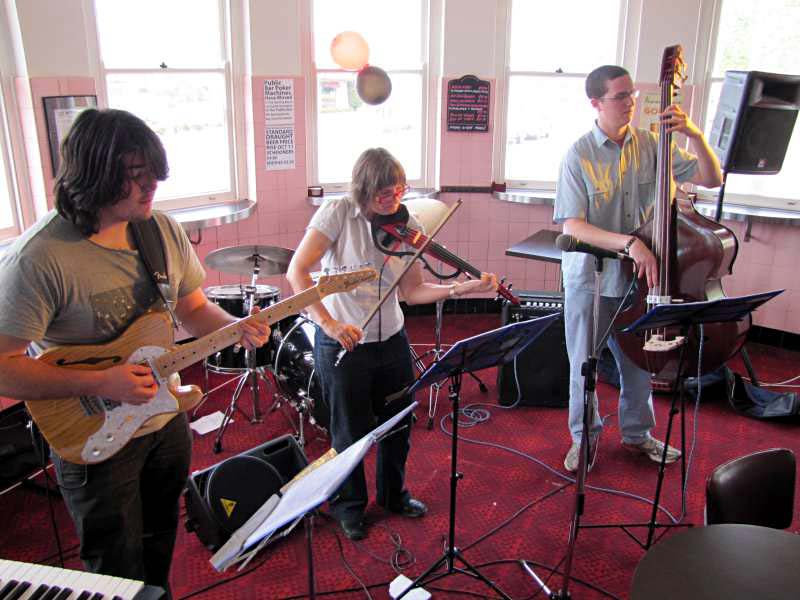
 I enjoyed Moruya as the first outing for one of my bands. It’s primarily formed as a cabaret-jazz outfit, but the singer was not available so it was modernish-mainstream, slightly latin, sometimes smooth jazz that we played, mainly originals, but also a few standards. The others all have some tertiary music education behind them: two with time at the Sydney Con, and one with a single study at Adelaide’s Elder con. I’m the unformed one who’s largely self-taught. Mike wrote most of the music, and I provided a few, including one that got some compositional repairs from Mike. The first set was decent but less comfortable and the second was sitting better, with some good soloing all round and more time to relax. It was good to be out. The non-originals were Out of nowhere, which is just plain beautiful, Joe Henderson’s Inner urge and All the things you are. I heard Things… done several times at Moruya, mostly in 4/4; Mike Price did it in 3/4; we did it with descending time signatures 7/4-6/4-5/4-4/4 and it was a counting challenge. It inevitably reminded the band of the joke about the musician counting in a very square waltz: “1-2-3-and”. The originals were varied: Mike’s were a gently funky film theme called Blue funk, a mysterious Arabic-sounding piece called Al Hallij=Across the gulf, a bebop called Be-Bopped, a latin with a devilish unison line called Tortillas in Heaven, a Chopin flourish as intro (Fantaisie Impromptu) that resolves into Night in Tunisia and then uses a Chopin line as melody called Fred meets Bud. Mine were a Wanderlust-inspired samba called Sambala and my creepy piece with vertical melody, Snakes alive. I did say varied. The Gurus appear in their Cabaret incarnation as The Gossips over the next month or so.
 Maybe my only time on the Llewellyn stage will be to listen to Paul Grabowski give an oration. Strangely, the location was the timbered stage of Llewellyn Hall, and how big it is! Big enough for an orchestra and choir, of course, which is big. The oration was associated with his grant as an HC Coombs scholar (all praise due to Nugget Coombs) along with the Australian Art Orchestra. Paul is an insightful man, and I enjoyed listening to him, especially as he talked of his relationships with Nookah aborigines that led to the Roper River relationships that I reported here only weeks ago. I have a connection with this place around Kakadu: one of my sons did a school tour to Nookah, so it has some resonance for me. But obviously Paul’s is far more significant.
 I’ve known DeeJay Gosper for ages, from the Blues Club and other locations. She keeps popping up, not least for her connections which are widespread and her business-like approach to announcing gigs. I managed to hear her current band playing at the Bite to Eat café last Sunday. It’s a gently entertaining band playing popular, blues-influenced, sometimes soft jazz material, with DeeJay’s great, emotive voice out front. I hadn’t realised just how effective was her singing, but this was a wonderfully emotive performance as she felt every word, changing volume but also vocal tone to fit the songs. Blues people do this, and I felt DeeJay’s performance was particularly effective with just an occasional use of growl and power. I was impressed: this is an authentic blues voice. She plays blues harp, too, as well as having a friendly interaction with her audience.
 Her band included husband Michael on drums. Michael provided the sound at JU2009, so is a particular friend of CJ. Also Mike Dooley, playing left hand bass along with accompaniment and solo piano roles, and Tom Mansfield, a new member on guitar. Mike’s another good friend. I’m playing with him in one outfit (check out Gurus of Groove at Moruya this weekend). The repertoire was classic blues/pop/light jazz: very sellable but also very suitable for Sunday afternoon bars, and well received by the milling audience in Bite to Eat: Perhaps perhaps perhaps, Sway, a few blues, Route 66 with a fun twist of rhyming Routes (63/free, 65/alive, 69/fine and the like) and a few gently swinging originals. Very nice for a lazy Sunday afternoon and well received by a good-natured audience. Well done, DJ.


 Flowers and Floriade go well with the ANU School of Music. I caught the final concert of the Rhythm & Blooms series yesterday and it was varied and grand, with Vince Jones and band as the feature and amix of classical and jazz. The School has been presenting concerts all week at lunchtimes. It's good performance practice for the students, on a big stage with a big PA, but not something a worker can get to, so no reports. But back to Vince and co.

 More guitar from Mike, and very much enjoyed. Megan and I caught up with Mike Price playing with the old trio that we knew so well from seven or more years of playing at the Kurrajong: the trio with Eric Ajaye and Col Hoorweg. It’s a lovely outfit playing the standards. Mike does it so well: smooth, detailed, richly improvised, busy but relaxed, accompanied by numerous lyrical solos from Eric and regular swapped fours with Col. It all sounds very staid - playing the standards, guitar trio and the like - but this has depth of knowledge and richness and chordal bravura. Such a lovely outing. These tunes are standards because they are memorable and they are great to improvise against. That’s the reason for the standards, and this is a band that confirms it. I thought I recognised Just friends, and I definitely heard Crazy after all those years and a few blues in various styles and All of me. It sounds obvious and not particularly inspiring, but when played at this level, it’s anything but. I’m late to visit the National Press Club for their Friday sessions, but don’t miss it. Four different bands made up from the ANU jazz faculty, rotating through the month. It’s a chatty and busy environment on a Friday evening, salubrious but with a gritty edge, and despite that, it’s a place of considerable musical satisfaction. Get there. Great stuff. Mike Price (guitar) played with Eric Ajaye (bass) and Col Hoorweg (drums).
 Mike Price promised us no long sax solos, but then guitarists aren’t innocent creatures. Instead, we got lots of guitar solos and volume, but it was some wonderful and informative playing from a front line of three guitars (jazz Doobies?): Mike with two ex-students, Carl Dewhurst and Carl Morgan. They were supported by Eric Ajaye and Mark Sutton who took some lovely solos at the end, but this was a guitar night and it was educational. Mike and the two Carls took us on a tour of guitar styles from Charlie Christian to current. The names are all quite well known, and even the styles, but hearing them together always clarifies the mind. It was the same with the playing. Hearing these three guitarists together was an ear-opener, making evident the different styles and habits and approaches of each player. So this was a fascinating and satisfying night out.


 Firstly, the history. Charlie Christian: born 1916; played with Benny Goodman; died aged 25; first major amplified guitarist, allowing him to switch from rhythm guitar to soloist; played a Gibson 125 (no cutaway) with a single coil pickup; mate of T-Bone Walker, the revolutionary blues guitarist. The Crazies played 7 come 11, a 32-bar tune with cut time A section and swinging bridge. Wes Montgomery: started playing guitar at 19; died aged 46; fluent style using flesh of thumb (no plectrum), block chords and octaves. [I’ll add that he had an early electric bass-playing brother, Monk Montgomery]. The Crazies played a common Wes standard, Full house. George Benson: Wes M protégé who later moved into pop; again octaves, chords, thumb styles; first guitarist to play with Miles; influenced by an early career in R&B and soul. The Crazies played Thunderwalk, a hard-swinging blues with that moves up a semitone on bar 5. Antonio Carlos Jobim: the great bossa composer. The Crazies played the languid Triste. Pat Martino: born 1944 in Philadelphia; influenced by Coltrane; played with chromatics, lots of notes and passion, lower register playing, chord hits; suffered a brain aneurism in 1936, was operated on and lost all memory including how to play the guitar then re-learnt from his old recordings; still playing. The Crazies played 3 bass hit.
  Cuban music is such joy, with the clacking clavé and the bass that’s anywhere but on the one, and the various sounds of richly polyrhythmic percussion.


 We've just caught Vocal Sampling at Floriade and it’s just that: six voices that are the band. One friend assumed the bass was recorded, and the drums. I knew what to expect but still found the distorted guitar solos a bit hard to believe. But this was all vocal and authentic sounding to boot. They played a few popular rock songs, the Police’s Every step you take and the Eagles’ Hotel California with the recorded solos and arrangements and harmonies and pretty good rendition of the voices. They even played the duelling guitars at the end of Hotel California. That was the pop-shock value and went down a treat. But the beauty was in the langorous latin tunes, the high voices that sang so sweetly, the claves and rich rhythms that got deep into your bones and had you dancing (for the more extrovert) or jostling in your seat (for the rest of us).
  Jim Fuller is a name from the local past. He’s a guitarist who studied in Canberra, played as a student in the early ‘90s with the likes of Craig Schneider, and recorded with the forerunner of ArtSound, Canberra Stereo Public Radio. He renewed his acquaintances last night with a Friday Night Live broadcast from brash, youthful ArtSound, playing in a trio with Lachlan Coventry and Mark Sutton.

 The trio was strong, with drive and energy to spare, playing a range of modern standards, and also several tunes from what must have been Jim’s formative era: from the Benders, an ‘80s Sydney outfit featuring Dale Barlow, Chris Abrahams, Lloyd Swanton and Andrew Gander. Apparently this led to the Necks, but there’s no obvious path from Benders to Necks, at least how Jim played it. Jim’s a wonderfully thoughtful player. My take was that he took melodies and reharmonised and rebuilt them, mostly spontaneously, I expect. Lachlan would hold the chordal structure, although he enjoyed dropping into pedals, and Jim’s tunes would form and reform, through chordal fills or themes that he’d develop in response but in avid contrast to the tune. Perhaps this is just modern technique, bending and reforming and reinventing the most well known tunes, but this band did it with energy and proficiency. Mark was delightful to hear: always strong, in touch, inventive and polyrhythmic in solos, and with the most sturdy of tones on kick and snare. And Lachlan was lithe and mellifluous in his plectrum soloing, finding lovely melodic lines and bursting into flurries of guitar-like speed. The Benders were a unique feature alongside more common Shorter and Monk and Montgomery. Always with verve and a harmonic sleight of hand, and that power applied to slightly unsettling modern interpretations.
CanberraJazz.net's reports & pics
CJ: Promoting modern jazz in Canberra, Australia.
CJ is brought to you by Eric Pozza, long time jazz lover, bassist, and CJ's author, editor, photographer, webmaster, owner and general dogs body.
> Click on pics to view larger images
v See Labels/Names index below
Initials in the Labels/Names index below are for contributors other than Eric
Subscribe


