20 September 2012

The best venue?

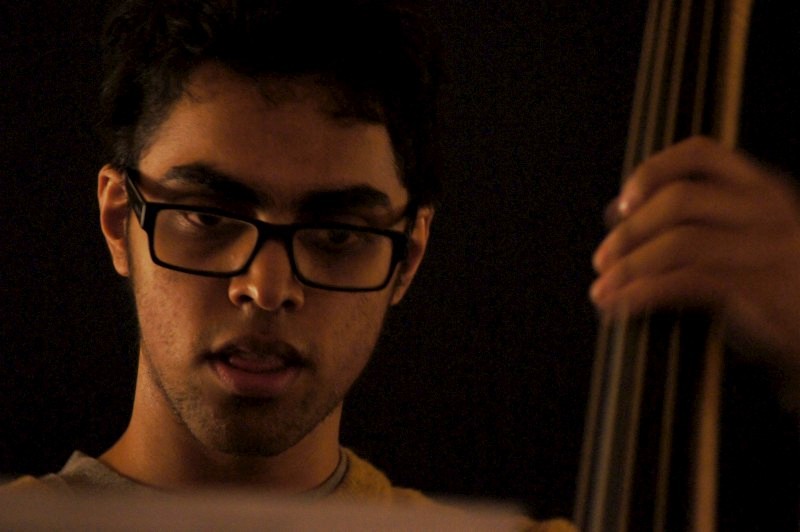
Dirk mentioned it and the travel guides say it’s perhaps the best jazz performance venue in Europe. The Bimhuis is a black box hanging off the side of a concrete and glass performance hall called the Muziekgebouw . The building is impressive: tall and bare concrete walls, overhanging tiers and a glowing, overhanging glass rook, massive heavy timber stairways that run for multiple floors and ridicule a few tiny lifts (there must be others). The Conservatorium is here, too. Inside Bimhaus, it’s red seating in theatre configuration in the half-round in front of a few rows of tables and loose chairs and the gods, a huge timber stage with a mighty grand piano, impressive mix and lighting desks and a fold-back mix-desk that spoke of impeccable sound although no speakers were obvious, lighting hanging above, mostly a black box with the red seats and the timber of stage and some balustrades and an immense window backdrop to the stage with its starry, starry night-lights and long comets of passing trains. It’s a vision that mimics (or is mimicked by) various NYC venues including the Lincoln Centre and Letterman.

I caught a free workshop session which I expected to be an interesting entrée to the local music scene. Several groups of musicians came to stage to play one, maybe two, tunes. A advisor was there to discuss and advise in Dutch and (thankfully for me) some short snippets in English. He sat in on bass, occasionally. As I read it, Jasper Blom of the Conservatorium von Amsterdam organised these sessions, but I think his bassist, Reinier Bas, was officiating this night. I caught four bands. There were some standards here (but few) and I was impressed by a search beyond swing. This was not just lively individualist playing. It seems more intricate and communal to me. One band seemed young and new to this. Another was a pairing of soprano sax and guitar and playing a traddie number but with a modern take. The conversation here was on styles and matching between players. There was a pairing of flute and piano that impressed more as improvised classical sounding like Schoenberg. All discordant tones and repeated and mutated melodic snippets. They were good and the discussion was minimal for this pair. There was an older couple: she singing Round midnight (and was it a temporary segue into Summertime?) and vocally improvising on melody and words and he playing sparse, dissonant, single notes then later chords on piano. They, too, were interesting and creatively impressive. Overall, I was more taken by the creative energy than the musicianship. This was a statement of creative intent more than musical application, although there were some decent skills here, too.

Amsterdam is noted for its vibrant musical life including jazz. I could believe it. Walking to our apartment, I heard trumpet then later harp being practiced. Perhaps it’s just here in the old town where you’re more likely to be skittled by a ghostly bike with no lights as you negotiate bike lanes and streets and train tracks. But away from the canals, the lanes are more like passages and strangely quiet amongst the narrow, leaning frontages. It’s built like Venice, on piles in a swamp, but the feel is different, more youthful and lively. I’ve seen numerous instruments in cases and a running pair of young blokes, one with a guitar bag on his back, the other with a double bass bag. It’s not the quality of the playing that I envy (although I expect I will after the demise of the conservatorium model at our School of Music) but the bustling artistic and street life. It’s just one night and it’s warm and I’m in the middle of the old town, so is likely I’m seeing the height of this life, but then it’s just Tuesday.

14 September 2012

Hot and stormy

I forgot how much I like jazz in noisy, steamy bars. Last night was Hippo with a band pulled together by Rohan Moore and featuring the front line of John Mackey and Matt Handel with visitor Hugh Barrett and returnee Raf Jerjen. I’ve been hearing lots of music recently in quiet environments, often new compositions, all essential and purposeful. Hippo is not like that. It was once our major jazz venue and featured touring acts, then it had a break and it’s back to local performers for the Wednesday night jazz session. But it’s always been noisy and that annoyed many serious touring performers. It’s always been at heart a cocktail bar, so chatty, steamy, sexy, even if it featured serious jazz and accepted the listener audience. But it seems to me that vibrant jazz can thrive in this environment. Performers can let go, play hard or dangerously, make a few clunkers and it doesn’t matter. They can essentially play for themselves and enjoy it. It’s not for everyone all the time, but to let go on the modern standards with a set of admirable players, it’s a blast. So it was with Rohan and mates.

The repertoire’s one I know from many of John’s gigs: hard burning ‘50s/’60s Coltrane and the like. Sentimental mood, Miss Jones, Invitation, Giant steps and the like: all to be expected and all great foundations for letting go. There was one Miles fusion, too, which I recognised but couldn’t name, which changed the feel but was performed equally impressively. These are just great players. John and Matt were like brothers, although quite different in speech. John letting go with streams of 16th note passages teaming over the tune, not particularly dissonant, but disorienting in the extremity and profusion of his fat, tenor notes. He surprised me, too, with a few solos of open, three-note sequences and intervals that seemed something stylistically new and that I hadn’t heard from him before. Matt’s alto is voiced higher, of course. The tone suggests bop and I heard Bird in some, but this is essentially more modern. Still spelling out chords with licks and playing with sidesteps and sequences and dissolving into flourishes. But when the two horns spoke harmonies together, this was another experience. I laughed at a habit they had of tenor playing high and alto playing a lower voice: what a good sound. But how easily they chatted back and forth through their instruments! That’s why I say like brothers: different as brothers are, but essentially in tune. Powerful and fluent stuff. Amongst this, I heard Hugh taking a tempered and traditional path, running chords in long strings of eighth notes with an easy fluency consonant tonality. I was intrigued to hear this quintessential jazz piano style after Tate Sheridan’s richly chordal classical style of the night before. Both these styles exist in jazz these days, but they are worlds apart. To some extent, Raf also provided a jazz/classical comparison with Rohan Dasica (also the night before) but the difference was nowhere near so obvious. Since leaving the Jazz School and indulging in NYC and classes with the likes of Pattitucci and Mraz, he’s playing so, so strongly. There’s a real traditional solidity and confidence in this playing, good tone and presence, rock solid swing, constantly varied walking lines, funky fills and extensive thumb position solos. Really nice and really solid. And there’s sheer joy in his playing: open smiles, jokes with the band and the rest. I’ve noted this with several truly committed players after they’ve left the school. The best settle down to professional life and recognise just how much of a challenge this level is, and they settle in to a lifetime of ardent practice. My guess is Raf is doing that and it shows. Rohan was the one who gathered this band. I’ve heard him on several outings and was mightily impressed by his compositions in his Songbird project, where he moved well outside swing and standards. But he was comfortable and determined in this context, too: a calm and steely presence in the corner and one who could be explosive in accents. His presence reminded me of Art Blakey: eyes and awareness and determination.

Giant steps isn’t something new but it’s classic and overwhelming when well performed. That’s what this concert was like: old favourites, modern standards and a revelation. John Mackey (tenor), Matt Handel (alto), Hugh Barrett (piano), Rafael Jerjen (bass) and Rohan Moore (drums) blew a storm at Hippo.

13 September 2012

Smiling

It was a quiet night at the Loft for Miles O’Connell and that was evidence of the University break. I fear we have to get used to it with the brave new venture in music education at ANU. But for now, the small audience was intimate and a pleasure (more for me than the band).

These were Miles’ compositions: post-bop going on modern ‘60s style, busy and jagged melodies and hard wrung tenor solos, some milder balladic compositions with richer chords, some passing solos on bass and drums, some polyrhythms and changing times, 7/4, 6/4, 5/4, fours, threes, triplets, eights. Miles led but he’s open to change and he reported some tunes which had altered with performance. One original tune idea ended up in just the coda. The band was muttering before how they play difficult charts and make mistakes and recover. There were a few grimaces during the gig, but it’s amazing how unnoticed these things can be. On stage, you feel them all, but as long as the metaphorical train-wreck is avoided, most audience members feel the groove and pick up snippets of melody and that’s entertainment. I’m there often enough myself. The band was also muttering before the gig that the charts are hard and they were apprehensive. I certainly noticed band newbies, Tate and especially Rohan, with eyes glued on charts at various times. Given some odd-time hits, I was most impressed by the outcome. Both Rohan and Tate are well experienced classical players, so charts are their friends, but I guess odd times and syncopations are less so. It was great to see Rohan pop up from a chart with big grin when the groove settled or Luke hit a nice fill or just with respect at Tate’s rich and full-handed chordally-infused solos. And I was in awe at Tate’s comping, too, the way he’d mimic lines from sax, or fill spaces, and in a way they didn’t just fill or support but enriched the tune with another individual but parallel part. I was lucky to be seated near the piano; I might have missed it otherwise. And as a bassist, I’m much impressed by Rohan’s feel for phrasing and his great right hand work. Such assertive tone and tight pizz feels: it’s quite a lesson. Miles was leader and out front for most melodies and he was also a generous composer, giving features to the rest of the band. But when he took the front line, it was sturdy melody dissolving into sustained flourishes and nicely structured from little to lots of notes. Luke was in the previous incarnation of this band and he had charts but was obviously less dependent on them. He’s a humble player, but his swing is easy, his kick is surprisingly assertive (perhaps from where I was sitting) and his snare snap, while not loud, is well formed and sweetly toned. The one non-original was Radiohead’s How to disappear completely. It’s relatively simple but involving tune and made for a quieter spell. Otherwise, the tunes were latin (Green sun), blues-ish (Prism city), polyrhythmic (Zen sickness, dedicated to Miguel Zenon), plaintive 3/4 (Unstoppable, dedicated to Gretchen Parlato), swinging in 7,6,5,4 (Radio silence) and more. Miles was smiling. It was a strong concert and so satisfying; a pleasure to hear but a pain to think of what we’re about to lose. To the cities that absorb our loss, CJ’s greetings.

Miles O’Connell (tenor) led a quartet with Tate Sheridan (piano), Rohan Dasika (bass) and Luke Keanan-Brown (drums).

11 September 2012

Latins sing German

I couldn’t get to Igitur Nos performing Brahms’ German Requiem but I got to the rehearsal the day before. There were times of considerable beauty (and some obviously challenging high notes) and it had me wishing to be there on the day. Matthew was working the choir and visiting singers, so this was interrupted, on-off, “Take it from Bar nn” stuff. So it was interesting but choppy and without the tension and commitment and continuity of performance. The visiting voices were Sydney baritone Raphael Hudson and Hobart soprano Pamela Andrews. The accompaniment was four handed on a Yamaha C7 (I understand it’s All Saint’s new indulgence) by brothers Alistair and Colin Noble. Igitur nos will soon start practicing for Mozart’s Requiem in early November. Here are just a few pics of the rehearsal.

Matthew Stuckings (conductor) led the Igitur nos chamber choir with accompaniment by Alistair Noble (piano) and Colin Noble (piano) and with singers Raphael Hudson (baritone) and Pamela Andrews (soprano). Igitur nos comprises Alison Knight, Andrew Freeman, Bruce Watson, Caroline Kayser, Catherine Hayman, Clara Teniswood, David Harcourt, Gemma Dashwood, Gerard Clifton, James Graham, Jonathon Lee, Karen McKenzie, Karina Harvey, Louise Skelt, Markus Klaiber, Mary Harwood, Meredith Boroky, Meredith Norman, Olivia Denney, Steve Harris, Stewart Skelt and Todd Heather.

08 September 2012

One woman’s songs

I asked Matilda Abraham about her songwriting after the gig. The words and concerns impressed but didn’t surprise me. Matilda’s a mature woman and her interests are those of a mature woman. But I was impressed by the rich complexity of the music. She told me she plays some piano and some guitar chords, and songs start with melody and sometimes with chords. I thought maybe I heard the source in a few bits of her wordless singing or improvisations. They were not scatting in an Ella-sense. The Jazz School commonly used voices (I find I’m already writing in the past tense about the Jazz School) as instruments in larger ensembles, singing with the horns, usually trumpets as I remember. This must impart a sense of instrumental jazz melody and harmonic awareness and I think it this I heard here. It’s melody that’s interesting in phrasing and in intervals. It’s a powerful mix when you include the strength of ideas that words impart. The words weren’t always so easy to catch. Martin was about idealism in relationships. Reubens was inspired by renowned guitarist Kurt Rosenwinkel and was interesting for its intimacy and also for Carl’s guitar which sounded markedly different from earlier tunes on the night: more legato but also more insistent and impatient. There were quite a few other originals: Enough; Entropy, in slow ¾; Breath of warm air; Are you on my side; Keeping up; another in 7/4, interestingly split as 5-2. She sang a few covers, too: Monk’s Reflections, with words she wrote about love and distance; a duo with Carl called Cloud flies (“Do you sit in your office cubicle / Thinking about how life is beautiful”) which ably cut a line at office work; Beyoncé (“You are my temporary high / Sweet dream or a beautiful nightmare / I don’t want to wake from you”); Bjork’s Virus (“Like a virus / Patient hunter / I’m waiting for you / Hunting for you”). These were interesting songs performed in Matilda’s style and voice, which I heard as a firm soprano, high and delicate at times, then dropping to a sure-footed middle register, not flashy but ably dealing both with complex intervallic compositions and sharing a message.

Matilda had a nice little band, too. I know Carl well and he was exciting and lifting as expected. His tone is often chopped but he also played legato for some tunes, more driven and sustained. Either way, his solos lines and structural development are thrilling as he swings from low to high registers in a blink, and I guess it’s pentatonics that give him those essential guitar lines. It’s here I noticed drummer James lifting in busyness and intensity. He’s richly embroidered and assertive on the skins anyway, but the accented snare became snappier and the rolling fills tighter in response to Carl’s solos. Pianist Henry had a different manner. I found his playing obtuse, unexpected, adventurous, cerebral rather than combustible, as he invented responses that flowed one to another and yet departed easily and distantly from the tune. This was more dramatic, rolling, mutating full-handed chords than single note playing, but playing the orchestra is the piano’s forte. Tom was the essential bassist: clear, Velvet toned; carefully selected and formed notes; precise time; ears.

The gig could have done with a decent mix (vocals and PA make much more demand on the mix) but the playing and the writing were both very satisfying and the band’s presence was easy but serious. It’s a pleasure to watch players move through the Jazz School and return as mature performers, and this was one such gig. Too bad there won’t be many more. Matilda Abraham (vocals) led a quintet with Carl Morgan (guitar), Henry Sutherland (piano), Thomas Botting (bass) and James Waples (drums).

05 September 2012

Hornz

It’s been great to hear Luke Sweeting in a variety of outings in recent weeks. Last night it was his Sextet playing at the Gods. I’d heard the Canberra version of his sextet when they were warming up to recording Luke’s charts early this year. Most of that band has since gone to the winds: Berlin, NYC, Melbourne. Luke, himself, now shares time in Sydney and he collected a mostly Sydney band to play this gig. The charts were all from Luke’s pen, other than one from prior-trumpeter Reuben Lewis. There was plenty of space for solos, but the charts felt orchestrated for a larger ensemble, with their movements and variations and changing mixes and tonalities. I could imagine a big band insinuating its fills during solos, or a jazz orchestra playing the moving melodic passages, although the generous space for solos was more like a smaller band. I also felt the feel was quite reined in, at least at the start of tunes, although this was music of big and steady crescendos. Luke presented one tune called Introverts and another called Melancholy and perhaps this was music like this: strongly spoken but not immediately insistent; certainly not blustery. Luke’s Rhodes started the whole concert off, and its sound fits this image. Rhodes are a strange mix of crystalline tinkle and soft underbelly with occasional cracked goblets. The bass and drums entered, but almost unnoticed. Then the horns with swelling, hopeful three-part harmonies into a 12/8 groove. Then solos ending with horns arising underneath, strangely morbid over the end of the drum solo, then back to rising hope. That was the first tune. It was interesting writing. What of other tunes? Avant shard had fractured melodies that were played differently every time, with various instruments playing alone and later a cacophony of all in. Millions of kilometres was a road song with steady sixteenths on drums over 4/4. Chinchilla had mysterious horns and slow plaintive tones and sat at one time with Rhodes chords swelling from no attack and later whale-song trombone. Introverts was appropriately slow and pensive. Loftiness was complex orchestration dedicated to the venue rather than the concept. There were several others.

What I found most revealing on the night, though, was the horns up front. Their solos seemed so different in style one from the other and their ensemble work, composed by Luke, circumscribed the feel and musical questioning on the night. They played harmony of course, sometimes moving fairly freely, voices leading or following like in dance, other times playing more standard harmonies, even bluesy fills, in three-parts or dropping into occasional collective improvisation. They were also quite different solo voices. I always find Matt’s alto is honest and intelligently searching with nicely developed lines and structural growth. This time, I noticed a new and very clever twist, where he’d muddle together notes at one end of a line and recover with a dissonant passage. I wish I understood fingering of the sax and the trumpet, for it seems obvious to me that it affects the lines played by soloists. The sax seems more expansive, more open to morphing harmonies, certainly more honey- or snakey-toned. The trumpet is sharp and proud, assertive and emphatic, and usually more scalar and tonal. I’ve heard personalities interpreted by instruments (trumpeters are the outgoing ones) but I don’t buy into that. I think we usually just take up the instruments we fall into, through a school band or the lessons Mum organises or the available spots in the local rock group. But the playing is certainly different, in the case of trumpet, from the comfortable lines that fall out of three valves. The trombone is different again. It’s brass, but it’s sultry and sinuous like the sax (and luxuriates in it) as well as being deep and rich. When nicely voiced, the combined tone is something to wallow in: a sharp trumpet on top, a smooth sax middle and the clear depth of trom. Lovely. So it was this night, firmed up nicely by with James’ billowing bottom end. This was a gig for the front line. I noted Brendan on bass and Finn on drums, and they each did several nice solos, but they were very much the capable support in this context. The horns and Rhodes had this gig in my ears.

So, it was Luke again with some of the same tunes but this time made more complex and enriched by a three part front line. Nice gig. Luke Sweeting (Rhodes) led his sextet at the Gods with Matt Handel (alto sax), Simon Ferenci (trumpet), James Greening (trombone), Brendan Clark (bass) and Finn Ryan (drums).

03 September 2012

Chitlins and gravy

Party gravy is just a winning name (even if I don’t know what chitlins are). So was the band. Rough at times, but alive and infectious with funereal joy.
Funereal joy? As in New Orleans, with musicians accompanying coffins and the sombre turning to merriment. It’s not as strange as it sounds, of course. Wakes have a way of releasing you from the mundane and renewing bonds and often end in a charming mix of joy and melacholy, and often too much grog. Party gravy may have been playing the New Orleans funeral standards but this was for a modern Australian audience that wouldn’t know such funerals other than mythically. This was Fathers day and there were lots of little kids and the place was busy with swing dancers and drawn beers. Bite to Eat Café is a lively and friendly place that appeals to all ages with its ‘50s laminex demeanor and cosmopolitan vivacity. I only caught the second set, but one hour made my day. This was a place of generous and indiscriminate smiles, as a social venue should be, and the band provided the perfect ambience. Set two, first tune, was the classic Just a closer walk with thee; second tune, Down by the riverside. Then a medley of modern tunes funked up in marching band style: Pumped up kicks / Foster People, Boulevard of broken dreams / Green Day and Mad world / Tears for Fears>REM. Then an original, written just days before, called The Kraken. One more, then Feel like funking it up. By this time, the dancing kids had left the aisles and the adults were at it. Then it wound down and we were off to a quieter night, but joyous and enlivened.

I should just mention one touch of seriousness. I’m not one for the militarisation of the public which has been happening over recent years, but I do feel the loss of one of three soldiers in Afghanistan in recent days. He was from Canberra and was just a year ahead of one of my kids at school. My best wishes to his family. Like any funeral, this, too, had its solemn side. Good on the band for dedicating Closer walk to him. Party Gravy is a New Orleans-style Brass Band comprising Tom Sly and Ax Long (trumpet), Andrew Kimber (alto sax), Tye Langford (baritone sax), Josh Hart and Patrick Langdon (trombone), Sam McNair and Mark Slegers (drums) and Alec Coulson (bass).

PS: Now I know. Chitlins is an abbreviated form for chitterlings: chit•ter•lings [chit-linz, -lingz] noun ( used with a singular or plural verb ) the small intestine of swine, especially when prepared as food. ( http://dictionary.reference.com/browse/chitterlings , viewed 3 Sep 2012).

01 September 2012

Jacam’s conversations

It was too short but very sweet. Jacam Manricks visited again from New York. I look forward to his visits. It’s a taste of jazz that I love. Not just in terms of sheer quality, although there’s plenty of that, but there’s a sincerity and commitment that shows in the skills and contorted but flowing sounds. This is intense and busy playing but the ideas flow succinctly and easily. I don’t feel here any clashes of conception, when someone can’t continue a scale to the top register or can’t carry on a sequence or can’t run the chords without a break and so drops into something that doesn’t quite fit. And there’s a strong sense of conversation between players. Maybe crossed but never of cross purposes: diverse, individual statements but easily stringing together. This is wonder to my ears.

Jacam led with his compositions of intricate melodies and unusual time signatures. He’s an intelligent and cerebral composer. Wandina was in 10/8 and based on a sax exercise in some extreme sax key that no-one ever plays. He mentioned Fb minor. Does it even exist? Enharmonic Emin expressed in flats? No matter. The next was Forbidden fruit which has unison bass/sax and a time signature I think I counted as 19/8 split 9-10. Then a Finnish tune which is a standard played at christenings, translated as Friend of children, but having a meaning more like a Higher being looking over a child. This was slower, Nordic, with bass space and mallets. Jacam had arranged and reharmonised it for his own child, as requested by his Finnish wife. Last was Cloud nine, all easy arpeggios, fluid responsiveness and moves in and out of seductive swing. I admired Jacam’s imbued skills, his ease with all registers, sustained patterns and easy chord transitions: all clear and modern, with awareness of tradition and with no careless atonality. The overall volume surprised me. The whole band played with intensity but with much restraint on the dial. Des’ bass was essentially conversational: that’s the word he used with me after the gig. Rhythmic throbbing in lower positions with occasional ventures to higher and neck positions. Even his solos were more concerned with feel and groove than scalar flair. Very nice and with musical depth. And Jochen was a master. He didn’t seem overly comfortable at this gig, but still this was subtle and vibrant and deceptively busy. I recorded it (with permission, of course) and listening back, I’m surprised by his busy accompaniment. It all looked so restrained on the night. One solo started with just snare and cymbal (and kick, I guess) and intrigued with just dissections of time; then plays with colour over the whole kit; then power and punch.

I don’t do it justice here, but this was subtle and skilled and conversational in the best modern jazz traditions. It was too short, of course, but for the full outing we’ll have to visit Manhattan or maybe 505. There was support, too. The band had run a workshop for Radford College music students before the gig and the Big Band performed as a lead in. The repertoire was Blue monk, Brick house, Moanin’, and What’s hip. Just one pic.

Jacam Manricks (alto sax) led a trio with Des White (bass) and Jochen Rueckert (drums). They were preceded by the Radford College Big Band.