27 May 2013

And now to party

After the period-piece Albert Hall, the final CIMF concert at Llewellyn seemed so big. It was. It was also a big social event. It’s the end of a fabulously successful and challenging festival. Volunteers and attendees and musos were tired but elated. Everyone was invited back for drinks after, but I imagine it’s the musos who are colleagues at a distance who particularly enjoy the knees up. They have done 10 days of many performances with limited rehearsals. It’s a hard slog, but a worthy one.

The final event visited UK and US and linked their democratic institutions to the nascent Canberra. Marion appeared again. Walter appeared to read the words of Lincoln later in the night. We were reminded of Britain’s parliamentary traditions and the US’s federation and written constitution, and how both are represented in our Washminster mix. Perhaps we could say that Australia is an early postmodern democracy, being as mixed as it is.

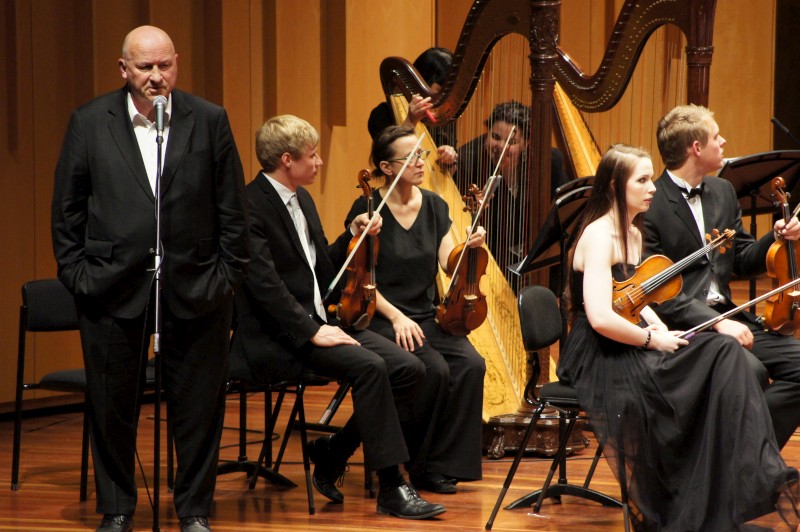
First music was Vaughan Williams’ Serenade to music, written mid-Century. This was an orchestra with numerous voices singing an ode to music but with the common sadness of the period of post Great War and Depression and end of Empire and the intellectual Communist challenge and incipient fascism and the rest. Some great singing here, although only snippets. The comparison of ~10 singers as solo voices was interesting, even if each singer just got a phrase of two. Then Elgar’s Cello Concerto. Pieter Wispelway returned with Roland Peelman conducting. There was some impressive playing here: virtuoso solo cello passages leading to explosive responses by the full orchestra, then back to the quieter solo instrument. Wispelway is all passion and character. There’s obvious huge technique but to my ears he privileged expression. So he should. Quite wonderful.

The second half, the US half, was my preference. First was Aaron Copland’s Lincoln Portrait with our fantasy Walter Burley Griffin reading quotes from Lincoln. Everyone knows some of these; I didn’t know all. They were embedded with introductory lines about his place of birth and similar. What a glorious piece of clear democratic rhapsody. “Fellow, citizens, we cannot escape history” or “That government of the people, by the people, for the people, shall not perish for the Earth”. Lofty thinking. I was wondering how comfortable he would be with the modern US. As they say of history, this is a different world. To finish, John Adams’ Dharma at Big Sur. It’s quite the antithesis to the romanticism of Elgar. This is mysterious and environmental and rambling with the cello like a character in the bush as night. All expressive virtuoso playing against clicks and squeals and pizzicato and swells and occasional dissonance. Pieter seemed to lighten up after this, speaking to the audience, and replaying the 2nd movement. He admitted being uncomfortable with the first take (although impressive). This second take was much stronger and was a pleasing end to the concert and the festival.

Then a few speeches to finish it all off, and all that’s left is to party.

26 May 2013

Marion’s very many children


The theme of this year’s Canberra International Music Festival is Canberra, in its 100th birthday year, and the renowned Walter Burley Griffin and wife and partner is planning, Marion Mahoney Griffin. Marion, or her dramatic alter-ego, introduced he concert, Marion’s child by explaining that, although she had no children, she’s proud of their creation, Canberra, and she thinks of all its inhabitants as her children, grandchildren, great grandchildren… I’ve now seen Walter once and Marion twice, and it’s obviously fabulous (as in fables) but also a delightful pretense. For today, there were very many of her great,great grandchildren on stage doing a wonderful job of singing the song of Canberra, for virtually all the compositions had a Canberra theme.

Firstly, Sally Greenaway’s Auróra Musis Amica: fanfare for Canberra. It’s hard for a fanfare not to stir the emotions and the senses and this one did it with aplomb. I was smiling at the beauty of the dawn soundscape to start then lifted by the fanfare and let down gently by the final bars of colour. A wonderful, short piece of considerable success performed by the Combined Grammar Schools Orchestra. Next was Earth song by Frank Ticheli performed by the choirs of Canberra combined Grammar schools and Burgmann School. These are young voices: not powerful but sweet and pure and high, with just the start of male depth. Lovely sounds. Then Canberra by Stephen Leek sung by the Woden Valley Youth Choir (all girls) accompanied by piano. This comprised two pieces: Where to build a city and Canberra Anthem. This was story-telling in music. Amusing chatter led to discussion of Where to build the city (this was an issue just over 100 years back). They ended with the decision “Canberra / the meeting place of ancient times / Where, where where, where / There”. An effective piece of story telling. Then another by Stephen Leek called Landmarks. This sang of Murrumbidgee flows, Lake Ginninderra and The Brindabellas in three movements that was ancient and expansive and spoke to Aboriginal awareness with glockenspiel providing structure, bass drums providing thunder, congas providing rhythm interspersed with harmonised vocal lines in eight note melodies.

Then the big forces were arrayed for two works by Karl Jenkins. I’d arrived earlier to find many schoolkids in uniform on Sunday, mostly eating sausage sandwiches, not expecting a massed kids performance. This is a wonderful little music hall with a large stage and it was packed. About 200 players, including Canberra Camerata and Song Company for the professional guidance, and a raft of school choirs and orchestral players. Chris Latham introduced Karl Jenkins as a Mozart of music for youth”. I could only concur. These were not massively difficult pieces, but they were serious and interesting. Chris had also added words about Canberra in place of most of the nonsense phonemes of the original, so ti was also historically educative. I wondered what the Sydney-siders of the Song Company thought as they sang of Canberra as the Shimmering City, and I felt uncomfortable with the “great city” reference later, but these were very satisfying and even engrossing works done with surprising maturity. The first was The Shimmering city, a major work in 100-or-so movements including the fabulous voices of Susannah Lawergren, Anna Fraser (sopranos) and Tobias Cole (counter-tenor) with Riley Lee (Shakuhachi) and Ji Won Kim (solo violin) with Woden Valley Youth Choir, Canberra Girls Grammar and Canberra Grammar School Combined Choirs and Orchestra and Radford College Choir and Orchestra, and Burgmann College Choir conducted by Chris Latham. The second was shorter, the Song of the Limestone Plains, with introductory voices then claps for the birthday of Canberra the choir then shakuhachi and brass and more, all against what seemed to me to be a cut-time outback groove. Very nice stuff.

25 May 2013

In the wings

Wagner was on that evening, but we were booked for dinner, so we dropped in on the rehearsal in the afternoon at the Llewellyn. We’d expected to sit in the stalls, but the security guard pointed to the stage door, so, well, so be it. We took seats next to Steinways, listened to four blaring horns that were pointing directly at us, struggled to hear some vocals, watching occasional performers slink in when late, or sneak out to the toilets. It was an amusing hour or so, and interesting for the involvement and odd balance and immersion that is the experience of someone amongst an orchestra. We heard the orchestra practising Good Friday and the Grail music from Parsifal. Just a few pics.

24 May 2013

The faith of one homeless man

“Jesus’ blood never failed me / yeah, never failed me / yeah Jesus’ blood never failed me / yeah, just one thing I know / for he loves me so”. Gavin Bryars conducted his own composition of Jesus’ blood. It wasn’t the only thing he performed, but it was the notable and controversial piece. The concert was called Jesus blood. This was the concert from hell for organisation – every festival must have one of these – but the music was quite otherwise. Firstly, the last, Jesus blood. It was performed by an orchestra with choir; the stage was full at the Albert Hall. It runs for 40 minutes in this full version. The 26 seconds of a homeless man singing this line is repeated, endlessly. Gavin was generous with his introduction and explanations. He’d recorded it twice, in London in the ‘70s when members of a major orchestra refused to have their names on the CD cover as it might ruin their careers. Then again in NYC in the ‘90s when brass from another famed orchestra rang to confirm the spelling of their names. The second was with Tom Waits as a second vocal. Always good for sales. But he also said he treats music with respect, first seeking to do no evil. That was sensible and the result, of Jesus Blood and the rest, was both beautiful and respectful. JB’s orchestra grows, slowly, almost imperceptibly, behind this repeated voice. Everyone asks, quizically, what you thought. Plenty have problems with it. I found my mind wondering a few times. But the effect is powerfully emotional. It brings tears to your eyes. Especially when the xylophone rings then comes to a steady 1-2-3-4- beat. Or when the tubular bells ring through. Especially when the voices come in behind the rough singing. They are supremely touching. Then it fades, the orchestra finishing with the palest of violin notes. Technically it’s 12 bars of 3/4 time (split 8-4) repeated and developed; the orchestra rests of bar 12. Emotionally, it’s a stunner.

The rest was as good but very different. Jesus’ blood was actually the last piece performed. First was a small string group with two guitars and the Song Company voices interweaving in Laude. These are five short pieces with a mediaeval style, two or three voices interweaving over varied orchestration, one with jazz pizz double bass, another with tweeting viola and other strings. But the voices took it for me. A full sounding soprano with counter-teror, or a pure soprano with tenor and baritone, or whatever. Such glorious voices with mingled melody lines. Bliss. Then more vocal bliss. I’m stuck on the singers. This time, Susannah Lawergren, one sole soprano, pure of voice and raising to the stratosphere. Then percussion from Synergy, playing Bryar’s One last bar, then Joe can sing, and Synergy and two pianists playing Percy Grainger’s Blithe bells.

Great composition, fabulous voices, touching simplicity, even jazz bass and Gavin as stand-up comedian covering for some breaks in the program. He seems an amusing Brit. If you meet him, ask him the one about the cricked neck and the celebratory scotch. Another success.

Gavin Bryars (bass, composition) was one composer-in-residence at the CIMF. His group performed his Laude, Adnan songbook, One last bar then Joe can sing and Jesus’ Blood as well as Percy Grainger’s Blithe bells. The Song Company, Synergy Percussion, Roland Peelman and other helped out.

23 May 2013

Skywhale vanquished


It’s a big piece of art and it’s caused considerable controversy and the inevitable ridiculing of Canberra. I originally thought it’s pretty odd but I’m warming to it. I saw it from a distance today, and it’s a little petite thing next to a standard globular balloon. I guess the hot air is distributed horizontally, so it’s lower and wider than other balloons. I later saw it landed, with crowds gathering around, and it was fun and attention seeking. Nobody would pay it much attention if not for the boobs, of course. Symbolism is not my interest, but there must be some subconscious meaning is this. Bring out your Freud. Two things occur to me. This is not designed by a man, so we can ignore those implications. This is the week that Angelina Jolie announced she’d had a double preventive mastectomy, so there’s the breast cancer angle. Also the predominance of females in the political line: designer, arts festival director and Chief Minister, and, being Canberra, we could throw in Prime Minister and Governor-General for good measure. Whatever, ignoring cost (the perennial attack on most things that don’t suit you these days), it’s an odd and cute thing and I’m coming to like it.

Patricia Piccinini designed Skywhale for the Canberra 100 celebrations, under Robyn Archer (Artistic Director).

22 May 2013

Channelling Joni and ‘Runner


“Make me feel good, rock and roll band / I’m you’re biggest fan / California coming home”. So sang Joni Mitchell. Paul Dresher performed at the Albert Hall and he did some things differently. They say they do things differently in California, the home of hippies and Hollywood and Silicon Valley. It also gave us Ronald Reagan and it’s also broke. Jazz looks to civilisation and lives in its undercurrents, in NYC and Berlin. California channels the fresh and new, at least to our generation. So Paul Dresher presented his Double Duo in concert with compositions relating to our sense of the passage of time and to fuel drag racing. Paul himself performed on electric guitar (Strat) so the R’n’R reference has some validity. He also performed on Quadrachord, a five-stringed instrument of 160-inch scale which he bowed. So here’s the new and the quirky together. I didn’t particularly warm to the use of either instrument. Paul doesn’t attempt Steve Vai although he does solo, but the distorted tones were lacking in overtones and seemed to just fatten the mix and get lost in it. It might work better with studio processing. Similarly, the Quadrachord didn’t seem to provide a whole lot more than repeating sequenced arpeggio-like harmonics, although there was an intervening sound each cycle that was maybe a double stop. I was thinking it must have cost a bomb to transport. So much for the R’n’R and the quirky Californian aspects.

But did I like the music? Immensely. This was minimalism, repeated arpeggios and sequences that mutate over time, square structures of four with melody over, brilliant dissonance and consonance switching back and forth, stubborn contradictory polyrhythms, dense clouds of percussion that regularly float over, dull repetition and deep groove with obtuse melody and clashing harmony and splashes of colour from bell-like percussion. It’s a world of dull repetition and enlivening contrast. I frequently remember a murder and chase street scene from Bladerunner as a picture of a possible future: huge diversity of people and clothes and cultures under constant rain and huge neon signs and police in flying cars descending next to Asian street hawker kiosks. To some degree dystopian; to some degree diverse and exciting. I picture both California and minimalism as somewhat like this. I can doubt the mind-numbing repetition of the fours and triplets and two chords and the rest, but I tap my feet with this music and thrill with the incongruity of it all, the unexpectedness of melody and harmony, and especially the rhythms that clash and contradict but are sustained, wondering all along that it holds together and speaks to me. There’s even a sense of soloing here, from distorted guitar or clarinet or expecially from the violins, but it’s written, not improvised.

It’s not surprising that this was one of the smaller audiences at a CIMF concert. It’s new music, although minimalism is not too new now. I’d picked it. Megan’s normally a listener to Bach and Beethoven but she liked it too, suggesting it’s better live. Maybe. It grows and mutates like a living thing and that probably works better live. This was another concert with a Quiros St connection. Our no.2 billet is Graeme Jennings. He knew these players in SF but had never played with them until he played a solo part in Cage Machine on this date. This was a great gig. I felt satisfied and excited and intellectually requited. There’s great tradition in “fine” music and I love it, but this is music for our time and I’m pleased to see it’s so well grounded. Great gig.

The Double Duo is led by Paul Dresher (electric guitar, quadrachord, composer) with Karen Bentley Pollick (violin), Lisa Moore (keyboard) and Joel Davel (percussion) with guests Graeme Jennings (violin) and Robert Spring (clarinet, bass clarinet).

21 May 2013

War and Canberra

Chris Latham led the Canberra Camerata Chamber Orchestra for a performance of the Mahler Symphony no.9 at the National Museum and they did a great job. It’s only a little orchestra and there were times I missed big strings for the sprawling expanses, but how well did they do with what they had? The various winds were there and spot on: flute, trumpet, oboe and others that felt just right, spelling out the lamenting lines with precision and empathy. The strings were just a quartet with the addition of bass. They weren’t big and suffered for that, but they were clear and the lines were evident, so that the intellectual construction was clear. Perhaps the violins suffered most from the lack on numbers, but they smaller and less space-filling. The cello and especially the bass seemed to be nicely present. The orchestra was filled out with piano, accordion and percussion. Piano and especially accordion seem unusual for a symphony. Perhaps Mahler wrote for them, or maybe they were included in the arrangement to provide some body or to complete some parts. Both are instruments that play chords, so each can take the place of several single note instruments, strings or others. That said, I could hear the accordion easily enough, but the piano was kept well back. I only remember noticing it a few times. But despite the smaller scale, this was an immense success. I wallowed in some trumpet parts and gloried in flute and oboe, was excited by percussion and empathised with strings and cello. This is a long and contorted work: about 90 minutes in 4 movements. The program spoke of Mahler’s awareness of death, farewell to love and pleasure. It was certainly a sombre work, and perhaps a premonition of WW1 to follow only years later. The program also suggests that Mahler had faith in an afterlife, but this sounded to me a secular lament. It would be a strange faith that speaks quite so mournfully, even hopelessly. The context of the work was set for us by Marion Mahoney-Griffin, or at least by her alterego. I’d not been quite so comfortable with her husband, Walter’s, appearance the other day before the Sculthorpe piece, but I’m warming to the pretense. This was an excellent touch, setting the context of WW1, the losses and the associated delays in development of Canberra; more specifically, how the planned civic centre at the base of Mt Ainslie became a memorial to the WW1 dead and how the lake was delayed 50 years and how the railway didn’t appear at all. All very relevant and informative. So, set in the context of turn-of-the-century Europe and Griffin Canberra, this work was clarified, if it remained turgid and even indecisive at times. I enjoyed much of the middle parts and even the slow development and denouement, but the endless end had me chuckling quietly to myself. The concert was entitled the last Romantic symphony. The mistakenly described war-to-end-all-wars saw to the end of all that. So, long and even ponderous it may have been, but it was also touching and speaks to its era. Chris and the orchestra did the work proud. Wonderful.

Just a few final words about the venue. It’s a strange acoustic with hard surfaces in strange shapes. Before the concert I clapped and heard a single slap-back. It’s very live, and that’s good for a smaller outfit like this, making it bigger than it sounds. As with many such institutions, it had a noticeable aircon hum that appeared several times during the performance. I was talking to their local sound man, and they seem to have digital 64-track capability on hand. So it’s a unique acoustic environment as well as being a unique visual space.

20 May 2013

What to say of perfection?

What is there to say about someone like Pieter Wispelway performing Bach cello suites? Just a single guy on stage flanked by a couple of reflective panels. He’s an international recording artist who’s known for these very works. The works themselves are profoundly satisfying. Wispelway must have played them a zillion times. They say he knows them so well that every time is a new interpretation. His skills are easy and immense. From the point of view of a bassist, I could admire his thumb positions and his firm fingers and purposeful and changing hand shape and his intonation and some rabidly quick playing and some nicely purposeful vibrato and his memory. I don’t do bow, but that seemed glorious, so the deep notes powered through and any note could be pure and resonant or biting and edgy. We are watching a master and they make it look easy. I was learning of the structure of these works. He played Bach Cello suites no.4,5,6 in Ebmaj, Cmin and Dmaj. He had earlier played no.1,2,3 at another concert. Each lasted about 30mins. Each was structured with a prelude followed by various dance movements: Allemande, Courante, Sarabande, Bouree 1 & 2 and Gigue. Suffice to say the tunes all become inevitable and the interpretation becomes like conversation when played by someone like this, and like conversation it changes. It’s not that his interpretation was without question. He played with time, played with virtuosity. I‘ll give it to him: I don't really know the works well enough to be distressed. But others didn’t come at his irreverence so easily. On stage, he was short and sweet. He appeared, played one suite, bowed, left the stage, returned, played another… finally bowed, left the stage, returned for an encore of the most famous prelude from No.1 in G major then bowed and left. So it was rather business-like as an entertainer/performer, but brazenly virtuosic as a musician. Great to see a master at work.

Pieter Wispelway (cello) performed the Bach Cello Suites no.4 in Eb major, no.5 in C minor and no.6 in D major at the Albert Hall for the Canberra international Music Festival.

19 May 2013

Concert as education and more

Monash University made an appearance this month at St Albans. Robert Chamberlain, lecturer, and Daniel Liston, masters student at the Sir Zelman Cowen School of Music performed on piano. Unsurprisingly, given their connections, this was also an educative experience. They performed music of Haydn, Rachmaninov, Ravel and Bartok, but they also introduced each with a description of key themes and structures of each work, so we understood and associated more easily with each. So this was both learned and artistically satisfying.

Robert started with Haydn’s Andante variations in F minor. This is a dark key, but it modulates back and forth three times to F major, each time becoming busier and more embellished, to then finish on another key. It’s a mature work, written in 1793. I was also enjoying the confident playing of someone who works with music every day: not showy, but steady and wonderfully competent. Then tow prelude by Rachmaninov. The C minor Op.23 no.7 which Robert described as “swirly” and I heard as busy with not much dynamics, but lots of notes in slow arpeggio-like sequences that rose and fell and mutated against a slow upper melody, and the B minor Op.32 no.10 which was more sombre and a “gorgeous buildup” and with a restrained start developing into full-handed chords, but with space and some tentativeness.

Daniel played a Ravel piece with a title translated as the “Gallows”. This was a work in 3/4 time with a constant bell-like high note pair that runs throughout. I mentioned in another post that gondolas are not lugubrious (despite Liszt’s tune of that title) but gallows are. This did seem lugubrious to me with chordal melodies and that ringing boll over all. This impressed me as a knowing response to a ghastly activity. This is an aware humanity, not an ignorant ideology with just a touch of major tonality for hope. Then Daniel introduced Bartok’s piano sonata. He’s writing his thesis on folk influences in this piece, so his introduction was particularly relevant. He spoke of 3 note themes in several movements and motifs and clashes in the second movement, and obvious folk references in the third, imitating flute and fiddle, and a Colinda rhythm (from Romanian carols). I liked this, all staccato chords dissonant, unyielding and slow and sparse in the second movement.

The Haydn was perfectly good lunch-time music. The rest was a much bigger challenge for the ears of this audience, but I liked it immensely and especially liked what I took to be an intellectual, unfussy take on the music: not too emotionally charged, but deeply investigative and informative. I think that’s why baroque is popular these days rather than the emotional swirls of romanticism. We live in a free and rational world these days even if our anger can be easily and ideologically channelled. The good side is the freedom and rationality, as in this concert; the bad side is the two minute of hate. We are well past 1984.

Robert Chamberlain (piano) and Daniel Liston (paino), both of Monash University, performed at St Albans.

18 May 2013

Knowing your stuff


I’d heard Paavali Jumppanen on the Music Show (ABC RN) on Saturday being interviewed by Andrew Ford. I was impressed. Paavali had spent a year at Harvard studying in the Library. He is writing a book on Beethoven and has a musicologist girlfriend and has considered studying musicology or music theory, so he’s well informed. I particularly remember him saying that Beethoven is described as a modern composer writing new styles, but it’s not so clear. He countered that Beethoven’s last sonata was actually written in a style that was old at the time. So he questioned habits of generalisation and stylistic categorisation and specifically whether it’s even possible at this remove to answer some questions about Beethoven. I liked his informed and non-dogmatic stance.

He visited Canberra a few days later to perform at the Finnish Embassy. It’s a fascinating construction, rich in timber and glass and blocky surfaces and leavened with artworks that sprawl over the walls. Performers are introduced by the Ambassador and there’s decent and well-tuned Yamaha grand piano in a room with a bright ambience. I’d heard Paavali in this room once before as well as some visiting jazz players. Paavali played a nicely mixed set: Debussy, Beethoven, Kilpiö and Liszt. The first impression I had was of dynamics and space. Some of his pauses seemed to sit for ages, and while I wasn’t steamrollered by the loud passages, I was impressed by the delicacy of some quiet notes. That fit the winds and the snows and the hills of the Debussy. When you knew the title, you could feel the image that written: slow walking in soft snow or wild winds from the west. The Beethoven Sonata in D major Op.29 “pastoral” was just that - pastoral. More mild, more ordered, classical, with intimations of idyll countryside, except one passage about a minute or two before the end of the fourth movement that surprised me with its harmonic modernity. It seemed out of place to my ears, but fascinating in this context. Then a piece by Lauri Kilpiö called Impromptu transcendental. Paavali read this one. It was masses of notes and swingeing runs. I have no idea how he could have read this chart. Someone was asking afterwards if there’s a division beyond demisemiquaver (there is: hemidemisemiquaver). I’m not sure he needed these, but this was fast, atonal, intense and riddled with notes spread widely over the keyboard. Paavali later told me the composer writes descriptions like “gravelly” and, interestingly, that the notes fall easily under the hand. His hands, maybe. Then Liszt. I expected more virtuoso material but the first three spoke to a romantic, pensive Liszt: Au bord d’une source; La lugubre gondola; Nuages gris. I could picture the grey clouds, but not too sure of the lugubrious gondolas. I just can’t imagine gondolas as lugubrious, although there are some that are larger than the standard, sexy, sprightly model. The final piece was virtuoso Liszt: Mephisto waltzer no.1: expansive, dismissive of difficulty, hands akimbo from low to high notes.

So this was a great pleasure. A capable, informed and interpretive pianist at a unique venue with a quality instrument. I said to Megan I’ll expect playing like that when I come home in the evening, but for some reason she flinched. Paavali Jumppanen (piano) performed at the Finnish Embassy. Thanks to the Finnish Embassy and to Henk van Leeuwen at Australian Northern Europe Liaisons who organised the tour. He brings some great musicians to Australia, and tours some of ours over there.

17 May 2013

Having wits

You have to have your wits about you when you play with Tom Vincent. He’s lively, fluid, ever changing. It’s a fabulous experience for the listener but the hot, intense, mercurial ideas that he throws up are a challenge for his musical colleagues. He’ll change feels, go double or half time, ballad to hard bop, polyrhythms to swing, quotes or medleys. It’s exhilarating and a mark of a musical mind with a rich range of feels and tunes on tap. I’m not sure what plans there are behind this. The first time I saw him was in a relaxed house concert where each set was an extended off-the-cuff medley. Leigh was again the bassist, and Mark Sutton the drummer. Leigh has been the bassist each time since. He’s perfect for this role: satisfying tone and unamplified volume, with a rich repertoire on tap, a strong musical personality, a readiness to experiment and a good natured approach to the ride. We don’t hear this jam-developed fluency much these days. It’s a real buzz. It’s also personal. I can’t help but think of Oscar Peterson and those albums playing for his friends. That spontaneity, warmth, intimacy and as noted by Tom himself, that risk taking, is here too. And it’s always swinging. There’s lots of hard swing here. Despite some rabid dissonance and jagged intervals and zany rhythms, this is deeply underlaid with swing. This is the presence of jazz history. I got that from the hard walks, from Danny’s tone and tremolo and Alf’s driving brushes. Skill that’s influenced by the modern, but richly aware of the swing and pre- then bop years. The tunes were from there, too: standards, ballads, bop, Billy Strayhorn, Bird, Monk. Classic stuff and Tom does it with honesty and a nod to following history. This is rich and challenging and a furious ride and a visit to the great jam sessions. The tunes can be short, although these weren’t all short this night. They can be arranged instantly, bass solo, drums solo. They can end on a dime, unexpected and enervating. Tom was picked for the Opera House and to tour with Wayne Shorter, which he did, but I’ll take his furious brilliance in the small club anyday. Leigh is a constant offsider and a star in the role, not just in his flexibility and knowledge, but in the driving walks and the easy soloing. Saxist Danny is “choppy” (an expression used by a visiting classical player meaning he’s got chops). He certainly is, writhing up front over the tenor, manhandling the baritone sax, but also surprisingly fluid on the bass clarinet and with ne’er a squeak. Again, like the jam session, there’s a touch of competition between Danny and Tom: Tom responding to Danny’s solo lines with florid fills or comping with tangentially rhythmic chords. Along with Leigh, Alf is a steady hand, frequently playing brushes with time-honoured grooves, soloing so as to spell out the melody. There’s a rich history here, great chops, dangerous risks. Tom is always a blast. Fabulously entertaining and this night for a surprisingly suited crowd. Apparently they’d visited a Tassie Senator in Parliament House in the afternoon. She must have been at the Budget, but it looks like her office came to the Loft. Nicely done. Spreading the word. A blast as always.

Tom Vincent (piano) is touring with Danny Healey (tenor, baritone saxes, bass clarinet), Leigh Barker (bass) and Alf Jackson (drums) and they played at the Loft.