05 October 2014

Getting real


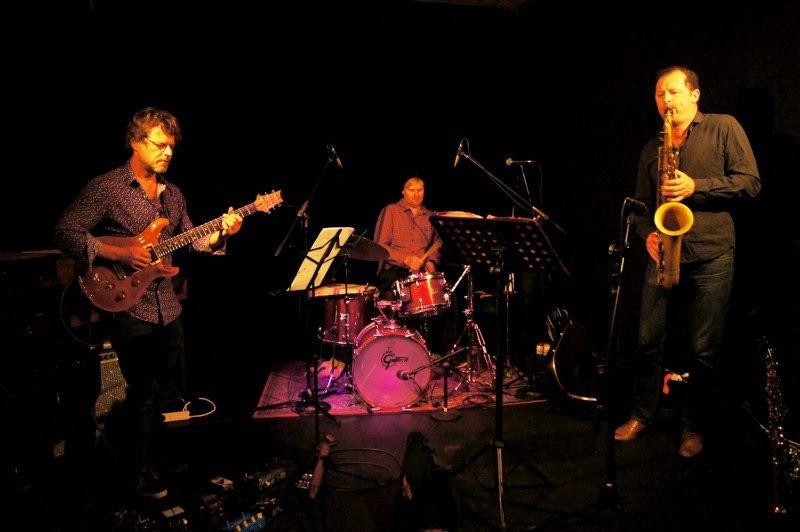
A friend posted to Facebook "Shit just got real" during this gig. She was right. This was the concert of Jamie Oehlers, Steve Magnusson and Ben Vanderwal. These are peak players in the Australian jazz scene. They were visiting Canberra to launch a new CD, Paper Tiger. There was no bassist (Bassless allegations was mentioned as a possible band name, probably in jest), but anomalous lineups are common these days. Steve played some bass lines or fingerpicked and the low notes did the job. Jamie also took an accompaniment role, behind Steve's guitar solos, and this is unusual but given his skills, wonderfully effective. This was choppy music. There was just one swing, as I remember, and one ballad. This was solid even-eights drumming that had me wondering what passers-by would be discovering. Few rock drummers will play with Ben's sharpness and invention. Jamie's solo lines were ever varied. These players were all this way: profoundly knowledgeable of options and thus fresh in their choices. Steve's technique, too, was choppy. Not smooth and distorted and searing but crisp, twangy, staccato and rabidly fast and endlessly varied. I guess these guys, too, have their habits and licks, but nothing seemed too obvious. Their new CD is 15 short tunes and this performance was pretty much that. The shortest was around 90 seconds and they obviously surprised themselves when it suddenly ended. Even the longest was perhaps 7 or 8 minutes. Jamie's known to play extended solos but this was a different experience. There were originals from all members and wit around the stories to introduce them. The music may be deadly serious, but this band's got the banter. Ben ran a commentary on left communitarianism ("We're all in this together") while denying any interest in politics. Was this banter for the Canberra visit? Ben wrote A song to parallel park to and he claimed to dislike it from the start, only to let it loose on his mates. A rocking chair on a carousel (on a cruise ship in choppy seas) was a song title and a story in itself. Then there were covers: Backhand by Keith Jarrett, Word from Bird by Ornette Coleman, Slow boat to China, Hard times come again no more. This was a challenging mix of contorted or pretty melodies that are developed with immense complexity. Jamie's Lament was a lovely ballad although never too obvious. Paper tiger was rubato, experimental with loops. Slow boat is a lovely old tune but was busily embellished. Hard times was in three and played with relative simplicity. This is a peak experience for jazz in Australia, three of the most capable and inventive players together and on record. It certainly got real; the final slice of the sandwich.

Jamie Oehlers (tenor, soprano saxes), Steve Magnusson (guitar) and Ben Vanderwal (drums) launched their new CD, Paper tiger, with a gig at Smiths.

04 October 2014

Sandwiched


Second of three gigs for the day. We'd booked up a year of classical concerts and the Borodin Quartet for Musica Viva at Llewellyn Hall ended up clashing with a startler jazz gig at Smiths so I only stayed until interval. They were performing Beethoven, Shostakovich and Tchaikovsky and luckily the two I most wanted to hear, Beethoven (String Quartet in G minor, Op.18 no.2) and Shostakovich (String Quartet no.8 in C min, Op.110), were up first. My favourite, and the favourite of most who I talked to at interval, was the Shostakovich. The Beethoven was lovely but relatively sweet to my ears, at least the opening movement. It's an early string quartet in classical form and commentary talks of wit and humour and references to Haydn. The Shostakovich had the bizarre of the newer century (now last century) and I'm pleased to see that we are now accustomed enough to prefer or at least enjoy it. It also had a much heavier theme. It was written in three days when he was staying near Dresden in 1960. It's gloomy and melancholic as a response to the Allied bombing that destroyed the centre of that city on 13/14 Feb 1945. I noticed a strange low drone, which is reminiscent of bombers in the sky. I read of references to various works, of chromaticism and key changes but the centrality of C minor, of a four note motif D-Eb-C-B which in German spell out D(imitri) Sch(ostakovich) implying an autobiographical theme. I listened for very different tones from the two violins to match different roles, for the harmonies of violin and viola or viola and cello, for the lines led by whatever instrument, for the undoubted skills of all the players. No doubt a worthy performance but my appreciation of the string quartet format is meagre and my mind was on the Oehlers by this stage. Just to end, a note of activities as we arrived. Jazz band Pocket Fox were playing outside, but the most amusing was a "conduct me" opportunity in the foyer with a genuine string quartet. I'm not sure how influential were the conductors but some, at least, looked the part. A champagne glass in the left hand might not be the go, but there's obvious communication in this pic, even if it's just shared mirth.

Borodin Quartet performed for Music Viva at Llewellyn Hall. The Borodin Quartet comprised Ruben Aharonian (violin), Sergei Lomovsky (violin), Igor Naidin (viola) and Vladimir Balshin (cello).

02 October 2014

Lunchbox

First concert of the day was a Lunchbox concert at the ANU School of Music. These are students, presumably at different stages of their training, performing a varied repertoire on diverse instruments. What's not like. Aaron Chew (piano) started with Fantasia Baetica by Manuel de Falla. This was a substantial work, virtuosic, exciting, passionate. He mentioned the sounds of guitar, footstamps and female vocals (this is Spanish music). Aaron played with confidence the waves of notes with crossing hands and several passages of a quizzical dissonance. I loved this piece and I thought he did an excellent job on it. Then Jelena Mamic (soprano) sang four Canti di lontananza by Menotti with accompaniment by Anne Ewing (piano). This was intense, vibratoed high notes (lyric soprano? dramatic soprano), glorious tone but inevitably intelligible. I wonder why classical singing is so often unintelligible; words seem a key to songs. The passion fitted for Gli amanti impossibili; Jelena lightened up for Il settimo bicchiere di vino; I wondered if Mattinata di neve was a bit heavy. The voice is glorious if the themes are mostly lost, but this is classical vocals. Next was another singer, Jade McFaul (voice) with accompaniment by Tristan Struve (piano) performing Who points the swallow by Alan Tragaskis. This is a modern piece in English. I caught a word or two but may have caught more with more concentration. One stanza ended in "arrogance" so the theme piques interest. Jade has a gentler, less insistent voice: she still enforced and vibratoed some notes, but mostly this was more intimate. Elizabeth Biggs (harp) followed with Krumpholtz Sonata Scene Pathetique Op.16 no.1. The soft, finger-picked tone of harp and the instrumental balance of melody and harmony was a change after the singers. Also the references to lament and pathos that comes with the title; although not miserable or pitiable. Last was Hamish Strathdee (guitar) playing Rodrigo's Junto al Generalife. Again, the finger-picked pluck of nylon strings; again, the Spanish connection. Every guy my age has toyed with guitar, so this had some technical interest. I enjoyed the picking that I could watch so closely, like the thumbed melody against fingered triplets on the G string (interesting if perhaps a common enough classical guitar technique). I heard it as genial and moderate, but it's about a garden (Junto not Junta) at the Alhambra, so that's apt. So this was the concert. About an hour of varied music, varied musicians, varied instruments and tones. Apparently the Lunchbox concerts are returning and now that I have time, I hope to get to a few. A great pleasure.

Aaron Chew (piano), Jelena Mamic (soprano), Anne Ewing (piano), Jade McFaul (voice), Tristan Struve (piano), Elizabeth Biggs (harp) and Hamish Strathdee (guitar) performed in the Larry Sitsky Room at the ANU School of Music for a (free) Lunchbox concert.

28 September 2014

The solo cello

How strange that I heard two performances of the Courante from Bach's Cello Suite no. 3 in C major on the same day. First was at the ANUSoM masterclass. The second was that evening when Anthony Albrecht played at St John's Anglican Church. Anthony was touring a solo performance called Bach to Bush as a return to Australia after studies at Julliard Music School in NYC. Enough said; this was a masterful performance. Anthony studied historical performance at Julliard, aware of the practices and instruments of the era, performing with gut and baroque bow. He said the bow's lighter, for niftier playing. He'd need it. I can think of Bach as ordered, even, but the suites are much freer than that; incredible explorations of harmony and purpose. Anthony played the third (C major), the second (A minor), the fourth (Eb major), the first (G major; prelude only) and an interesting interlude with Chaconne a basso solo by Giuseppe Colombi. The technical feat of the suites is there, of course, with rapid lines and double stops and exposed intonation. Watching his fingers, stretched for performance as they may be, is a massive pleasure for a string player. Watching the range and expression possible in a cello is a massive pleasure for a bass player. Cello is often cited as peoples' favourite stringed instrument. I can understand, with its expressiveness combined with depth and fragility. And Bach and the cello suites hold a special place in the repertoire, with great players known for their recordings. Wispelway played the suites in two concerts in Canberra a few years back. Anthony has studied privately with Wispelway so this is firm continuity. This was a performance of individuality and learned awareness. I sat back to marvel at the beauty, the skills, or closed my eyes to appreciate the genius of Bach's invention. It was only later that I thought of the concert in terms of orchestral or solo playing. An orchestra can be big in sound and varied in tone but written music and the conductor's baton can never capture the complexity of the individual response, so the solo is unique in its communication and Anthony did it proud. Anthony's off to London and further studies but he has family in Australia so he'll return every so often. For that be thankful and take advantage if and when he comes through Canberra again.

Anthony Albrecht (cello) performed several Bach cello suites at St John's.

27 September 2014

So much learnt


I missed the Australian Haydn Ensemble but not the associated masterclass. The two guests with the AHE were Marc Destrubé (violin, Canada) and Neal Peres da Costa (keyboards, Sydney) and they ran the masterclass. This session was open to the public and I can only suggest that any interested listener also attend. This was not just for the performers. This is exposure to advanced musical thinking and I learnt tons. Students from the School of Music played five pieces over 2 hours and received comments and guidance from Marc and Neal. Nothing negative; nothing on occasional mistakes. This was mostly on interpretation and improvements were evident even after just a few minutes of guidance from a trained ear. Here are a string of quotes to give you the idea. [When practicing] "don't always start at the start" [so you learn the whole piece]. "In Mozart's time they played only new music" [so recognise the shock of the new in established music]. "Mozart was primarily an opera composer" [so think of the characters, the contrasts, the speech]. Read performance treatises (CPE Bach, Daniel Torke?) on the meaning of the slur and more. "Phrasing marks duplicate speech". Start with the traditional approach of first beat as dominant if there's no other notation. Your Steinway is "much stronger than anything Mozart had", "think of lightening up", use "lightness of touch" [for Mozart's music]. A repeated note probably means it's more insistent. "Trills serve three functions: add tension, remove tension, or decorative". [In the duet,] the piano is the harmonic instrument: "hear ... the most wonderful blackboard" [did I hear this right?]. When phrasing, "keep tension in the silence". "Be aware of function [contours]": in a duet, who's leading, who's following and when. "Read what people say of G major and any key". Practice playing a lighter sound; strength will come in performance. In the Romantic period, pianists almost always played arpeggiations [in place of chords?]; it's more vibrant. Crescendo with slight acceleration gives energy. "Use imagination to give shape". "Pace the energy" [leave have room to increase volume, etc]. The Romantic period used "lots of markings"; ask why. Scarlatti sonatas are "often from some form of dance"; his chords are "fantastic ... make sure we hear them". Music may be metronomic but still needs "energising". "Early music tries to make difficult [passages] sound difficult; new music tries to make difficult sound easy". "Often, if technically we need time, the music also needs time". "The bass line is the driving force" and "look to the rhythm of the bass line". "They didn't write slurs in the [Scarlatti's] time, because players would have played this way". "There are only four tools of expression in music". [I struggled to catch the four tools. I think they were: weight, articulation, colour, speed]. "Dance is about going and stopping". There was more, especially in the context of each piece. My main takeaway was think of the form and how to play each note or phrase. Also, think speech; imagine the conversation. This was a fascinating two hours. You get the picture.

Marc Destrubé (violin) and Neal Peres da Costa (piano) gave a masterclass to students at the ANU School of Music. The students were Yan Tse (violin) with accompanist (name not on program) played Mozart Violin Concerto no.5, 1st movement. Clara Barrs (violin) and Lauren Giddy (piano) played Mozart Sonata in G, K.301. Ellen Falconer (piano) played Smetana On the sea shore. Andrew Blanch (guitar) played Scarlatti Sonata in Amin, K.175. Amelia Noble (cello) played Bach Cello suite no.3, Courante.

26 September 2014

Playing the Diplomat


It was a night of many concerts in my CJCalendar and I had to give up my ticket to Australian Haydn Ensemble to play, but that's OK. I had a great time. I gigged with Joe Taylor and Alex Carder. I had been expecting to play with Dirk and Graham. Either way; these are all fine musicians. This was a cocktail gig, playing background jazz. Joe blew me out with calm professionalism, lovely melodies and some devastating flourishes. Alex laid out lively and light solos and the swing was easy and strong and he was open to communications and smiles. This was just standards, but with lots of solos, often extended (I don't always take three of four choruses. Remember the joke about how to get people talking: start a bass solo). Two sets. Communications were good and most tunes felt clean and ended neatly. Most tunes. I had a great time. Thanks to Joe and Alex and to Dirk for the initial invitation.

Joe Taylor (tenor), Alex Carder (piano) and Eric Pozza (bass) played at the Diplomat Hotel.

24 September 2014

Boys' own


Shorty & Chow recorded a live broadcast for ArtSound the other day and I was there. It's a while since I've caught Chris Deacon and his Friday Night Live broadcasts. Secret: they are sometimes recorded in the afternoon and broadcast days later. But the playing, the chatter, are live and the effect is live. That's what matters. I caught the first set and Shorty & Chow dropped in to balladry with Luke's dedication to a venue in Newcastle, The Terrace, but it was mostly funky and driving with rock drums and effected, echoed Abercrombie guitar and syncopated bass. Nice. Chris was showing his headbanger side and we were both rocking away in the control room. This was fun, tight, with sharp drums and searing guitars and solid grooves and that alto playfully over the top. Scranky was the name of one tune, and Pignose and Dancing with Gertrude were names of two others. It fits. Dirty, driving, guys' music, a bit impolite, but fun and involving. Takes me back. Shorty and Chow. Enjoy a touch of misbehaviour. Great stuff.

Shorty and Chow are Luke Greenhalgh (guitar), Barnaby Briggs (bass), Julian Fung (sax) and Jonathan Harding-Clark (drums) and they recorded two sets for ArtSound's Friday Night Live with Chris Deacon engineering and producing.

22 September 2014

A notable confluence of pollination

It was called Inflorescence and it was in the Drill Hall Gallery and it was a merging of two arts from one family. Or perhaps two families, because Miro was a ring-in. Reuben Lewis and Miroslav Bukovsky were performing in response to an installation developed in contemplation of pollination by Reuben's mother, Dianne Fogwell. We all know of the crisis of bee populations, more in USA than here, and in a strange concurrence, I had come across a group promoting the issue only a few hours before at the People's Climate march. Dianne's presentation was in white, lit in the semi-dark from behind by LEDs, combining a range of flower shapes and seed linocuts and a lengthy white sheet with indents in the form of staves and music. Reuben and Miro walked along the sheet and through the installation playing trumpets or other, tones altered by mute or tongue, melodies performed and improvised from snippets of the sheet's dots or just interacted by improvisation. Trumpet seems so right for such a performance with its varying tones, controlled attacks and holds and decays, flittering wheezes and slapping valves. These two players understand each other; they were once master and student. Their sounds are rubato, searching, floating, but sometimes setting rhythms or regularly repeating melody and variations. It was only after the concert that I noticed the long white sheet was dotted with staves and notes. It is only now, thinking back, that I grasp the representations of flowers and seed pods that comprise the pollination process. I remain uncertain of the meaning of the long sheet with its musical indents but perhaps it's a portrayal of von Frisch's waggle dance. Whatever, the installation may not need much interpretation and the music certainly doesn't given it's the most abstract of the arts. But this was mesmeric, intuitive, responsive music. Two musicians of high calibre responding and interacting with art and environment and each other.

Reuben Lewis (trumpet) and Miroslav Bukovsky (trumpet, flugelhorn, percussion) responded to the art installation, Inflorescence by Dianne Fogwell, at the Drill Hall Gallery.

20 September 2014

Composition is key


Composition is key to me. I love the standards and they are a great pleasure and terrific vehicles for the individual statement that is the solo but original compositions are special. Calum Builder presented his quintet at Smiths and the music was all freshly composed, virtually all by Calum but one co-composed with pianist Tate. I heard references to floating Coltrane and Jazz Messengers and '60s/'70s so it was grounded in history. This is not music that's unexpected. There are comfortable and satisfying references but it's an individual statement none-the-less. I was impressed. They played 8 charts, including a "suite" (Calum doesn't like to call it that, but he forgot to offer an alternative title) which extended for 23 minutes and ran through a series of conceptual segments. The other tunes were shorter, perhaps 8-10 minutes, often with a core of obligato bass groove and passed solos. The heads were nicely stated by trumpet and alto, or sometimes just by sax or by piano and sax. Tate provided introductions and solos of deep intent and exploration and I'm trying to place the fabulous comping. Tate is noted locally for good reason. I liked Brendan's bass. I've heard it described as melodic by a respected source, and he certainly impressed me with a freedom over bars and through chords. The whole band was a little uncomfortable to start, but settled through the first set and were sitting comfortably into that set. It says nothing to give the titles - Serpent or Narcissus or My Lord or Nebraska. I really enjoyed a beautiful ballad dedicated to Bernie McGann, What if I called again. Apparently Calum spent considerable time on the phone to Bernie. Tate's floating introduction to Narcissus with a backing of bass octaves on 1-3 was lovely. Despite his busy accompaniment, Sean's drum solos surprised me when they stepped out. Eddie provided trumpet parts for heads and laid some effective solos, even hinting at New Orleans in the first blues. This was some capable writing, some superb piano, and when the band settled, some effective ensemble work.

Calum Builder (alto sax) led his quintet with Eddie Bernasconi (trumpet), Tate Sheridan (piano), Brendan Keller-Tuberg (bass) and Sean Connaughton (drums) at Smith's Alternative Bookshop.

19 September 2014

A welcome home


Back to the habits of Canberra. This one is the U3A Jazz Appreciation Group. Most meetings are listening sessions led by members but they include occasional small concerts. This one had a set by Tom Fell and Lachlan Coventry. Tom and Lachlan have frequented this page often enough, but this was a more intimate and exposed performance than usual. Just two players in a small and quiet room with ~20 listeners just after morning tea. They played standards: Alone together, Out of nowhere, Body & soul, a slow burning blues, Softly, Blue bossa and an encore on Have you met Miss Jones. This is stock standard local jamming repertoire but how nice it was! Tom with his big tenor tone playing neat and exploratory from the Lenny Tristano school: West Coast cool, less blues wails, seeking newness by avoiding habits in every line. Tom mentioned Warne Marsh as a recent influence. He also played baritone sax on Softly. Lachlan laying down chordal comps and bass lines then dropping into totally exposed solos with no backing. He mentioned Tal Farlow as influencing some of his voicings. They concurred on a common interest in the blues as the essential foundation of American music. There were questions from audience and much enjoyment. This was total pleasure and, especially given the intimacy and exposure, quite inspiring. Lovely, unpretentious but much prepared playing from two of our local professionals.

Tom Fell (tenor, baritone saxes) played with Lachlan Coventry (guitar) for the U3A Jazz Appreciation Society.

18 September 2014

Last night LA


LA is a big, suburban looking place with huge roads and a Metro that I haven’t fathomed and we are on foot. We were staying just off Hollywood Boulevard and a block away from Sunset Boulevard. It sounds chic but this immediate area is anything but: touristy, daggy, Hollywood walk of fame, buskers dressed as action men and women. Nonetheless, there was a chic jazz club just a block away, Catalina Bar & Grill, and Antonia Bennett, Tony’s daughter, was launching a CD on our last night. This was not the challenges of contemporary but that’s not what I expected and I was there with Megan and Mum and it’s certainly not what they wanted. This was a stroll through the great standards and we all enjoyed it. The band came out first for two of their own renditions: Too close for comfort and Time after time. Both were subtle and well arranged and nicely felt and had an edge. Then Antonia came to stage. The band became a little less challenging, but again, as expected. This is a role backing a singer and singers take priority. Then a lovely scroll of the American songbook, all perfectly well known and nicely presented. Nothing too extended. Think Too marvellous for words, Nice work if you can get it, Embraceable you, But not for me, Let’s fall in love, Pennies from Heaven, Solitaire, Old devil moon, Come rain or shine, Nearness of you, There will never be another you, Taking a chance on love. A few more; I think 18 with Antonia, so nothing particularly long. A range of feels: slow, medium, fast swings, some funky syncopation and cool latin; nicely arranged hits and polyrhythms, although nothing particularly hard to read. The band is all from LA. Pianist Christian is Antonia’s musical director and the rest of the band are local, presumably pickups for the show. Very professional players, these. Neatly reading the charts, nicely unobtrusive and some nicely correct solos. I was most taken by Christian who would move lines across bars with considerable flexibility and invention. Bassist John also took some lovely solos. His first was all in thumb positions, high on the neck. Then a few over the neck, but always melodically elegant and untortured. Drums and guitar were similarly unobstrusive. I could only think studio, lovely guitar chords, only just evident or often enough laid out, and drums that moved the groove, but never in too obvious a way. All unobstrusive but nicely professional. Antonia connected through snippets of her musically significant childhood. She’s toured Australia with her Dad and studied at Berkeley. She told of records brought back by Dad from Japan, of Tommy Flanagan at Village Vanguard, of the man posting letters each day (it was Fred Astaire), of playing for Donald Trump, of the grandson of Jimmy McHugh being in the audience while she sang his song (I can’t give you anything but love). There’s something about being where this is happening, in LA or NYC or whatever, that makes it local, everyday. No scat but Antonia phrased like the jazz singer she is, lines bunched or delayed or moved to express intent. Nice. The great songs performed with history and class.

Then back and past busker Haji Akhbar playing to taped accompaniment at Hollywood and Highland. Confirmation and more bop. Nice to meet you, Haji.

Antonia Bennett (vocals) was supported by Christian Jacob (piano, musical director), Rene Toledo (guitar), John Belzaguy (bass) and Ray Brinker (drums) at the Catalina Bar & Grill in Hollywood, LA. Haji Akhbar (flugelhorn) busked at Hollywood and Highland.

17 September 2014

With NYC outside my window

Our last night in Vegas. I’ve adjusted if not warmed to the place, but I have to admit I loved our last show: The Rat Pack is back. It’s essentially a tribute show to Sinatra’s Rat Pack through recreating a notorious, hugely successful three week season at the Copa Cabana in Las Vegas in 1960. Sinatra, Dean Martin, Sammy David Jr, Joey Bishop and Peter Lawford were the Rat Pack. They were named by Lauren Bacall, wife of Humphrey Bogart. Lawford was brother in law to JFK and Marilyn Monroe makes an appearance, at least in this show, for a notorious Birthday song. They were in Vegas to make a movie and they partied and performed for three weeks and it became a signal of a new generation of cool with reference to race and aspiration and post-war experience. It’s an intriguing story and now dated, but with residual meaning. But it was also a musical feast. These are not the originals, of course, but I could still search for that sense of timing that Miles sought in each new Sinatra release. Or compare the three voices or the songs they sang. Or just feel drenched in the lovely swing of a decent 9-piece band (alto, alto/flute, tenor, 2xtrumpet, trombone, piano, bass, drums). Or experience the closest I’m likely to get to an experience of this era and these personalities. Some jokes were lame and plenty were out of sorts in today’s world. The sexuality was something my kids wouldn’t even conceive of, in these unrestricted days (think panties humour), and the ethnic quips were perhaps marginally acceptable given the background of the Jew, two Italians, a Black and an Englishman who uttered them. It’s all out of time now, but the audience was old enough to recognise it. Marilyn appeared for a visit to the audience to harass some man and his wife and to end by recreating the classic vent-blown dress scene. I still don’t warm to Sinatra but I could deeply enjoy his music. Sammy Davis Jr was the straight man justifying a position for his race, and Dean Martin was the drunk Italian with the lovely Neapolitan repertoire. Someone told me after that he actually didn’t drink, on stage or otherwise – it was all show. This era was like that. Dangerous and brazen and I wonder to what degree it’s influenced modern USA. Whatever, I may still see Las Vegas as one type of cruise or another, but as I write this with a view of (faux) NYC out my window, at least I can say the shows are good. I really enjoyed this and the dry martini to finish the night was just all part of this strange miasma which is this era and this place.

16 September 2014

Cruising in dry dock

We’re here in Las Vegas. It’s a strange place. Not much in the way of jazz (despite a metro population of almost 2 million). We saw a show, Jersey Boys, and it was very well done and I enjoyed it with the songs and that falsetto and those harmonies despite a strangely disjointed script. (I’m told this is because the musical was developed from the recollections of each of the Four Seasons so moves through their points of view). I thought of Michael Azzopardi who was playing in the band for the show in Australia. You must have had fun, Michael. I found a page for the local jazz society and “jazz legend Gus Mancuso” was playing but the dates didn’t work for us. That would have been interesting: he played bop on a baritone horn (not bari sax) and had two LP releases in the mid-’50s and was promoted by Cal Tjader. Otherwise, we walked the glitz of Las Vegas and looked at blank faces and shorts’n’thongs and overdressed young girls. I expected there would be plenty of buskers (no, just beggars) and musos in bars (no, very few live musos but much piped dance music). Here are pics of a trio in Piazza San Marco (but without campanile or even a church frontage). I heard an Asian female gondolier singing quite beautifully. We were off to hear a Rat Pack tribute singer fronting a trio in another casino. The program was changed and we got piano man Dave instead. He was good but didn’t sing much of the “old stuff”. Maybe we didn’t tip enough: it’s not something we Australians understand. His field was Elton John / Billy Joel territory, although he extended to classic rock and Neil Diamond and John Denver and Georgia and Fly me to the moon as oldies. I really admire these guys with decent voice and piano and stage presence. His repertoire didn’t reach to Stella but it was large nonetheless and he entertained well. The best of Vegas for me was the helicopter ride out … to the Hoover Dam and Grand Canyon, landing half way down a canyon that’s virtually a kilometre deep. Difficult to comprehend, but the GC gets deeper than this. This is Nevada and it’s an arid place, surviving on the Hoover dam and they say that’s losing water. Our pollies deny all that, of course, and it will probably fill once or twice again before it’s finally parched, but I wouldn’t voluntarily choose that path. Las Vegas is not really so strange. It’s just corporate consumer capitalism at its apogee. Or like an oversized stranded cruise liner with mega cabins. It’s strange walking narrow footpaths over long distances in searing heat next to 8-lane highways then escaping into huge pomo-ironic spaces filled with gaming and brand-name shops and faux lux (knowing the real luxury is a few floors above). I’d just heard an author being interviewed on National Public Radio here and he spoke of his new book about a person stranded in Dubai (The dog / Joseph O’Neill), "a place you could enjoy if you liked having maids and spending your time in swimming pools and shopping malls". It resonated with me, here, in Las Vegas.