20 February 2017

Lights

We're in Melbourne and we seem particularly unlucky for jazz or classical music. But there's White Night. It's all the rage here, a Saturday night public light show like Canberra's Enlighten, but just one big night (7pm-7am). The roads were closed off in the centre of town, 0.6 million people or so milled around, there were stabbings at one station and a drug emergency at an associated festival, but mostly mild and reportedly well received by visitors. We didn't find too many light shows where we walked, we enjoyed and dodged big crowds and walked the middle of main streets and found a few people to chat to. As these things are, people looked mostly dazed and somewhat under-/over-whelmed. We caught a few bands, not least the John Morrison Big Band. They were playing very recognisable standards with an easy swing - nicely done if not too adventurous (think Pensylvannia 6-5000). I was standing beside the stage (it was loud out front!) and met Alexandra by asking if she played music. Yes, alto sax. How easy it is to recognise lurking musos! Alexandra plays with the Australian Youth Band (concert and big band). We both enjoyed the easy professionalism of it all. Otherwise guitarists or keys with midi, blues feels, Piazzolla, dancers. And lots of people; given the high-rise residentials popping up around town, this is no surprise.

White Night was a city-wide light show entertainment in Melbourne. The John Morrison Big Band performed amongst many others.

17 February 2017

Antipodes


Barbara Jane Gilby noted one of her sayings "No practice is ever wasted". She was introducing the Canberra Strings, a new string quartet formed to visit New Zealand as musical ambassadors. Another earthquake intervened and the tour was called off at the last minute, but at Wesley we got to hear a program of modern Australian music prepared for this tour. The music was from 1912-2002. The composers were Alfred Hill, Peter Sculthorpe and Graeme Koehne. The music was widely varied. I also enjoyed hearing these players, who I've heard mostly in the context of a symphony orchestra, so a big group, in the intimate setting of a string quartet. Each individual with his/her own independent role and leading statement, but all merged into a compositional unity. And each with a clear voice, emerged from the melded symphonic tone. The Alfred Hill was from the Carnival, so light and pleasurable. The Sculthorpe was anything but. His String quartet no.6 was dedicated to Bonny Drysdale, a friend recently deceased. It is sombre, with movements marked Lento molto, Lento and Lento. There was some intriguing harmonic colour here, painful statements from the various strings, some rhythmic interest, but heavy going. I enjoyed the Koehne most, Whirling dance, from his String quartet no.2 Shaker Dances, all odd times and mingling tempos and simple joys. You could feel the interest and raw newness of this group with music that seemed still new and developing and this was part of the excitement. They formed in October at the request of government, so this is a business proposition amongst the artistic purposes, but no loss there (much music is and has to be). I enjoyed this immensely and look forward to future outings, for the players and the localness and the interesting music they unearthed, but also for the exposed musicality of the string quartet format.

The Canberra Strings are Barbara Jane Gilby (violin), Pip Thompson (violin), Lucy Carrigy-Ryan (viola) and Alex Voorhoeve (cello). They performed at Wesley.

14 February 2017

Jazz Club'n'it


We tend to forget that jazz was once the popular music of its day. We went to a Canberra Jazz Club event at the Southern Cross Club at Jamison and you almost felt it still is. Terry Wynn was playing with the Wayne Kelly Trio and guest vocals Angela Lount and the dancers were up and the kids were running around and the swing dancers were at a near table with their natty period outfits and it was busy. The place was swinging. The brackets featured a few bebop instrumentals, there was at least one original, this time from Ben, the swinging standards had everyone in a good mood and at least a few couples were always up on the dance floor. How different from the cerebral sobriety of much contemporary jazz. I love that, of course, but this is music for people, clever and well played, and also for entertainment. So, a different side of jazz and well enjoyed and the beer's on tap, too.

Terry Wynn (sax, clarinet) played with the Wayne Kelly trio, comprising Wayne Kelly (piano), Ben O'Loghlin (bass) and Mark Sutton (drums) and Angela Lount (vocals) was out front.

11 February 2017

SO2017-4

Next day at SoundOut, part way through the late session. First up was a quintet with Luiz and a series of locals, Chloe, Sonya, Gail and Miro on bass, toy piano and other toys, vocals, electronics and trumpet. Again, this was a meeting of musicians, an experimental jam, and it started with some hesitation, leaving space to hear each other. Until Miro spelt some melody and this was cathartic. Miro later said he's a melodist. It seems to me that trumpeters are: it seems to be a function of the instrument. But here were clear notes, spacious, with some relationship one to another. Luiz picked up on this, bowing, plucking, then alternative techniques of tapping, slapping timber and strings, reaction from Sonya, with vocalisations that filled and swelled around them, again Miro's bell-like notes. Lovely. Chloe and Gail were more subdued and ambient, encompassing this with various noises of various toys on the one hand, tapping or sliding or clacking, or using electronics to meld and twist and revisit, or to add processed voice and glass clinks and pats and thumps. Luiz Gabriel Gubeissi (bass), Miro Bukovsky (trumpet), Sonya Holywell (vocal), Chloe Hobbs (toy piano, toys) and Gail Priest (electronics) performed.

Then a stunner. French pianist Frederick Blondy returned for an overwhelmingly powerful final set. this was meant to end with other performers gradually coming on stage for a collective improv, but rather it ended alone, everyone overwhelmed by the power and purpose and sweeping adequacy of it all. Again, he started under the lid, with bow hair on strings and something that looked like a stick with a can on top, a few electronic bows (?) and I expect some other tools for preparation, then moving to the keyboard for growing intensity of handfulls of notes, tone clusters, increasingly flailing and jumping at the piano, this time with rhythm, to an intensity of violence and excess. Then a stop. He seemed a little surprised at that, as we were. Some minutes then applause. My camera gave out so no pics.

After a short rest, the collective improv to finish it all for this year. Most playing their standard style, but amusingly and informatively, right in front of me, was Christian Svendsen dissembling his travel bass as in performance, formal, slow, precise, ordered. I'd wondered how it came apart and now I'd seen it. Amusing. Then a fall to quiet, a packup, a party. The end of SoundOut incarnation no.8. Hopefully to return in 2018. And congrats to Richard Johnson for his drive and effort to make this festival happen every year.

10 February 2017

SO2017-3

Younger locals up next. This was not the hive of virtuosity of the last sets but intriguing and true. Sonya, Rhys and Bonnie on vocals, guitar and drums. I heard dense forest, slightly threatening, rolling thunder of toms and mallets. Guitar played traditionally in place then dropped to the lap for bow and fingerpicking. Unearthly slides and drone voice. A clear and rich voice, more vocal than noise, slow, spreading. Taps on sticks against hardware or string ends, beads on drum skins, tapping, twisting voice. Voices of forests, African finger harp, metal bowl, deadened taps on guitar strings to whoops and cries. A credit card put to good use to damp guitar strings. Then a reprise. More mobile, at times drums verging on a rhythm, fingerpicked guitar that's sometimes chordal if distinctly atonal, structured vocals with hints of repetition almost echoing guitar. The staccato voice, scraped cymbals and, oddly and unexpectedly, some words (bit I missed them!). The band was Sonya Holywell (vocal), Rhys Mottley (guitar) and Bonnie Stewart (drums) out of Sydney.

Then some Euro virtuosos: Irene Kepl and Christian Meaas Svendsen, violin and bass, Austria and Norway. From the top, this was massively energetic. It started explosively, violently with bass and accompanying vocalisations. Christian was all over the bass, feet, hands, knees surrounding and supporting the instrument, even playing with a dance-like step. Bent over, primitive as in some King Kong film. Then a feel somewhere around 6/8, that equally proficient and euphoric violin, bowed harmonics, superb atonal bowed playing, slow attacks and fast releases like some Beatles recording trick. This was a meeting of distinctly virtuoisic equals. Irene Kepl (violin) and Christian Meaas Svendsen (bass) are from Austria (Vienna) and Norway (Oslo).

Then a final collective improvisation to finish the night, Irene and Christian gradually joined by other players, building, swelling, moving, changing, interestingly those two voices of Guylaine and Sonya, till people started dropping out, standing aside and it ended for applause for the day one set two.

09 February 2017

A=440>415

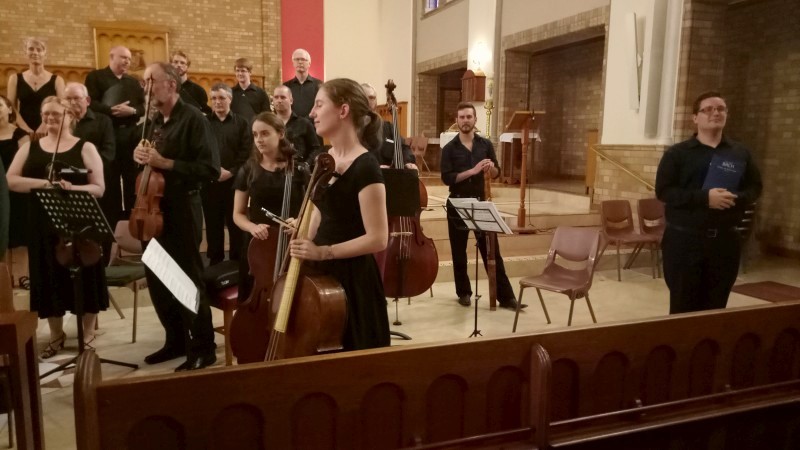
The Canberra Bach Ensemble returned with a program of Nunc dimittis cantatas. I had to read the informative program and a little more to understand the history of all these, of the Canticle of Simeon (Nunc dimittis) and the Feast of the purification of the Blessed Virgin Mary (Candlemass) and Martin Luther's reworking of Nunc dimittis as Mit Fried und Freud ich fahr dahin (in peace and joy I despair). Suffice to say this was nothing like the joyous series of advent cantatas that made up the last CBE concert. All four cantatas were restrained cantatas and one or two seemed to have just one chorus. But this is Bach so there were memorable passages none-the-less. I particularly noticed one with pizz strings in a tenor aria. The program says this "despicts the passage of time like a ticking clock, anticipating the 'allerletzten Glockenschlag' ('very last bell-strike')". Also different is the tuning: CBE had moved from A=440 to 415, standard baroque pitch. Not all instruments were gut, but plenty were, and same with the associated baroque bows. I particularly noticed Dave's huge- but downy-sounding gut-strung bass. A pair of viole da gamba appeared for the first cantata and I was surprised how hushed they were: sounding well under the cellos who were well under the single bass. The first cantata (BWV106) was supposedly written for a funeral; the next two (BWV125&82) were written two years apart for the Purification feast (Did Mary need to be purified? Apparently so.) The final cantata (BWV95) featured those authentic period instruments, cornetto, baroque oboes and the like, and finished with a chorus. Ah, there's a touch of that exhilarating joy that Bach cantatas are known for. The singing was wonderful throughout although I especially noticed the males, not least one duet for bass and tenor. And in some ways, it was a feat of endurance, being a very hot afternoon in Canberra. So a different series of cantatas, a learning experience for those who followed the Nunc dimittis connections, a concert of transition for the CBE and, as ever, a wonderful outing.

Canberra Bach Ensemble performed four Bach cantatas (BWV106,125,82,95) at St Christopher's, Manuka. Andrew Koll (conductor) directed, with Leanne Bear (violin, leader) and singers Keren Dalzell (soprano), Maartje Sevenster (alto), Robert Macfarlane (tenor) and Andrew Fysh (bass).

08 February 2017

SO2017-2

I was interested to hear the next outfit, RHRR Trio out of France, a formed band rather than a meeting of performers without a shared history. RHRR are Frederick, Guylaine and Xavier, piano, vocals and clarinet. Things got seriously interesting here. This was a meeting of minds with history and that history was evident, in their responsiveness, ease, purpose, those things that develop with time together. Various piano preparations, playing under the lid, bow hair drawn across strings for drones, various implements tapping or otherwise expanding sound, later some playing on the keys, sparse and open and with ill-defined time, plinks and bells ringing in the air. At the centre, a voice of unearthly quality and inventiveness. This was really the centre for me: voice is so central to our humanity, so much a product of our core. And what voice! Unearthly, yes, with whistles and squeaks, impossible sounds to imagine from a voice, but here they were. But then animal sounds, sounds of the wilderness, like listening with open ears in a primitive environ for a first time. Approaching, retracting, mobility and movement: very expressive in body and movement, often closed fists or swaying to and from the mic with closed eyes, every movement spelling the sound. Some meaningless words, too, pleading, although language-like voice is a rarity here. And Xavier on clarinet, responding, filling, mobile too, arcs as clarinet sweeps upward, providing structure and conversation. I was hugely taken by Guylaine with her intriguing and virtuosic vocalisations, but the whole ensemble was a gem. RHRR Trio are Frederick Blondy (piano), Guylaine Cosseron (vocals) and Xavier Charles (clarinet) out of France.

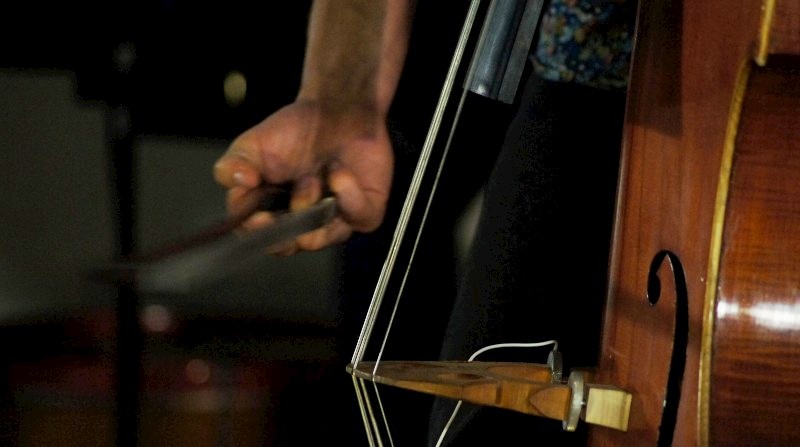
Solo bass up next, from Norwegian Christian M Svendsen. Throughout, his bass playing was strong, unrelenting, physical, visual, using feet and hands and up to three bows. This performance was not different. An unyielding German bow bouncing quavers at 190bpm for about twenty minutes varying in intensity, volume, changing tone through overtones despite little movement of the left hand, a foot to stop a string for one bow while the other hand bows otherwise, another bow played from the mouth. Strange but still those unrelenting quavers at 190bpm. One bow in a back pocket, taking the bass for a walk around that Drill Hall Gallery corridor just built for this purpose, audience listening to reflections from than coffered ceiling, more distant and muffled, then a return to the stage, then polyrhythms played by two bouncing bows, perhaps 5 over four. Still, after 20 mins, those incessant quavers at 190bpm. A feat of commitment, application, strength. Is this painful? Maybe. It's certainly memorable.

Christian M Svendsen (bass) played a solo set.

07 February 2017

SO2017-1

SoundOut 2017 is the eight incarnation of this most intriguing and challenging festival. Every year I contest my ideas over this abandon, this questioning of musical verities, this search for sound, noise, art from standard instruments (they mostly use standard instruments), this abandon on all manner of traditional musical verities (they seldom play standard techniques). It's an intimate festival and considerably international. I spoke to one performer who was touring, asking about her experiences with performing, to small clubs on tour, of the chance of performing around a more dense continent like Europe. But even there this remains a form for a small group of initiates or searchers. Despite the traditional instruments, it's not too often that traditional techniques are used, so you may form an opinion that these players can't play straight. It's true for some. I once asked a player about her performance on piano. In discussion, it turned out she didn't know how to play an Eb scale. Nonetheless, I'd been mightily impressed by her set. But that's not the case for all. I heard some warmups this time that were straight ahead jazz or classical styled and played with great skill. And Brazilian bassist Luiz who stayed with me for the weekend was advising me on how to play bossa. Bossa! That's as sweet as it comes.
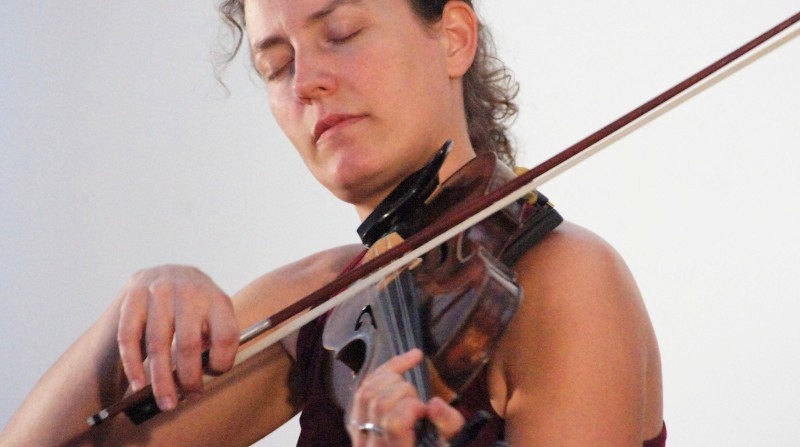
First up was a string quintet of three (!) basses, violin and cello. Bass playing with feet, hands, taps, bow(s), staccato, notes, short snaps, whooshing of air over bows, bow woods on strings or timber, metal winding scraping strings. Cellist Freya pulled it together with some traditional techniques, slow clear notes forming atonal melody of long intervals, double stops, minor seconds with lovely bowed tone. Others found harmonies, then into experimental techniques again, drones, high harmonics, some vocalisation (whistles this time). Cello uses pencils between strings (a common technique) and non-trad techniques with bow. Squeaks of skin dragged over varnish, tappings, slaps, again a climax. Form and movement is evident here. I asked Luiz about starting strongly or tentatively. He consider that it's respectful to enter gently with players you don't know or haven't played with before, to listen better and not to hog the scene. But then the alternative of driving, determinative start can also work. Continuing, some excellent pizz from Norwegian bassist Christian although with strings pulled off the fingerboard for a deadened and edged sound. More form, start low-grow, reduce-deduce, rise-surprise. Loud again, intense, cello again spelling notes that define melody if little rhythm. This music is not a thing of groove: it sets and meditates and sits in time rather than states it. Presumably nothing is dissallowed, even trad techniques, but it's uncommon. People drop out, complete, applause and smiles. Starts and ends are often somewhat indecisive (reminds me of my penchant for getting in the final notes on bass).

Such was the first set, a string quintet comprising Christian M Svendsen, Luiz Gabriel Gubeissi and Ben Drury (basses), Irene Kepl (violin) and Freya Shack-Arnott (cello).

05 February 2017

Musing

Mike and Richard are currently playing fortnightly on Friday nights at Muse Restaurant in the East Hotel, Kingston, so I took the opportunity to visit and sit in for a few tunes. Luiz, one bassist at this weekend's SoundOut Festival, was staying with me so they got 2 bassists for the price of none ($0). But it was fun. I played some jazzers and perhaps one bossa. Luiz played bossas and one or two jazzers. Luiz is Brazilian born and raised so this was interesting. I got some hints on playing bossa more true-to-style (less driving, more relaxed, play the anticipation, perhaps meaning less samba) and all round the outing was a pleasure. Strange to see Luiz, who I know as an experimental player, performing bossa, but then he is Brazilian. Nice. Interesting also to play jazz without amplification. Hard work.

Mike Dooley (piano) and Richard Manderson (saxes) play fortnightly as Aloft at Muse Restaurant. Luiz Gubeissi and Eric Pozza (basses) sat in.

03 February 2017

Physhy


No set list required. Pensive Phish were in their F3 incarnation, meaning three players: Mark, Miro and James. No set list because no key, no changes, no whatever - at least nothing preplanned - other than perhaps some starter drum grooves or crying babies and others (yes, a strange start for one tune). But these are such good players that even when they amused themselves with their indulgences, they were still playing fabulous grooves and wildly delirious tones and the rest. James joked that he had 3 loops going at one time and he had to turn off the effects to stop the last. And what effects! Some obvious ones, if neatly melded with the rest, and some unhinged ones, synths or ring modulators. And with James' rock solid funky feels and lithe fills and the rest. Then Miro with just his one pedal, a wonderfully effective harmoniser, but also percussion and a few mutes (not least the Miles mute, Harmon with no stem), playing some fabulous improvs, moving through harmonies, wistful or determined. And the electronics from Mark: a laptop with a trigger pad and a Mopho x4 synth and feeds from James and Miro and a mic. All mixed and merged and mangled as base and expansion. All fabulous, intriguing, meditative or deeply grooving, playful (always both playful and serious) and entrancing and enveloping. I rocked along with deep grooves and followed solos with appreciation and mischievous tones and tunes with awe and a few smiles. Great stuff and worthy of a few chuckles from the players after given the exhilarating audacity or it all.

Pensive Phish F3 are Mark Webber (laptop, synth), Miroslav Bukovsky (trumpet, percussion) and James Luke (bass, effects). They played at Smiths.