05 October 2018

Local gig


St James’s is becoming our local gig. Lunchtime concerts near Eros, Piccadilly. Central, with a quiet park beside and a market selling some junk but also some nice china. I like China. And with history. Designed by Wren; consecrated in 1684; severely damaged by bombing in WW2; place of baptism of William Blake in 1757. This concert was piano, Mozart Rondo in Amin K.551, Jorg Widmann Idyll and Abyss (a modern composer and schoolmate of the pianist), Beethoven eroica variations op.35 played by Bela Hartmann, Czech-German winner of Schubert and Beethoven Piano Society and other prizes. Relaxed but firm, exploratory in the Widmann, restrained in the Mozart, stirring in the Beethoven with a firm touch, all from memory. How’s that for local. A pleasure.

Bela Hartmann (piano) performed at St James’s Piccadilly.

04 October 2018

Learnings


AAM and Barbican. Purcell and the Aeneid. All big names and that was enough to get us out, somewhat excited. The music was Dido and Aeneas, an early baroque opera from Purcell. That only lasted ~50 mins, in the second half. The first half was a collection of 7 pieces and songs, again by Purcell. The Barbican is big but comfy, arrayed with stalls, circle and balcony. The foyer is busy with lots of stairs (toilets well above and below!) and even a strangely raked floor down low. So it’s an adventure and an experiment. It didn’t always feel right but it’s of its period and renowned. I thought it sounded right. The audience was casual; the seating was similarly comfy and casually coloured. The stage was huge, sometimes noisy with footfalls, jutting into the audience. The AAM was similarly casual, bass and some others on stage early, tuning and warming up. Chairs were spaciously arranged; two harpsichords at the centre with two theorbos adjacent. Plenty of space around for theatricals. There was a surprising amount of theatre, mainly effective white puppetry against black costumes although also an oddly interjected sailors’ dance/ That was presumably for entertainment in the original: I’d seen something similar at the Globe to end Henry IV pt.1. So this was not music alone, but the music was lovely. It was mostly surprisingly simple, often repetitive, even as in contemporary looping (AAM uses the term in the program), several times with odd-feeling repeats. I counted one looping group of 6x¾ bars that was oddly unsettled but very inviting. Then the famed Dido’s lament, a tragic aria sung by Dido over a descending, repeated bass line as she dies. For this is a love story, love thwarted by the gods. Aeneas arrives in Carthage, falls for the widowed queen Dido; the gods forbid the love, call Aeneas away and Dido suicides. Typical ancient lit! The playing was lovely. I noticed a few holes (not least some strangely inexact sparse intro drumming; perhaps it was intended?). The singing was stunning if oddly complex to my ears. I guessed it was various ornamentations and articulations. The feel of time and interpretation was unexpected but these guys are experts in the relevant musics so it’s as close to authentic as we can expect to hear. But there were times that just floored me. Some beautiful and clearly identified individual choral voices and some stunningly together choral passages. Overall, it was pretty understated, fairly quiet in a large hall using period instruments, delicate with gut and harpsichords, with intense individual parts and a few ecstatic communal outpourings. So, a renowned venue and renowned performers and quite a lesson in the style. But one other factoid that stunned me. AAM have released over 300 albums, presumably mostly live. A list of future performances told of a concert that was planned to be recorded. That’s making a job of it, as well as a well-archived resuscitated genre. Much enjoyed and much learned.

The Academy of Ancient Music (AAM) with the Choir of the AAM performed Prucell Dido and Aeneas and more at the Barbican Centre under Richard Egarr (conductor, harpsichord) with soloists Caitlin Halcup (Dido), Ashley Riches (Aeneas), Rowan Pierce (Belinda) and Neal Davies (sourceress). Judith Evans (bass) covered the bottom end.

03 October 2018

Two minds


I was interested to attend the new(-ish) British Library building just next to Kings Cross station. I’d seen the old BL reading room, Panizzi’s dome, but that was decades back. That original building is now the British Museum and the Library has its own, new construction. Purpose built. Megan and I were once librarians. We both worked at the National Library of Australia, so this was of professional interest. We actually attended with some friends who happened to be in London, also ex-librarians. So four colonial librarians, two from our parallel institution, attending a library tour at the BL. The tour was for all comers, so not a particular professional interest, but we got to see the King’s Library in the heart of the building, some work areas and delivery mechanisms, something on the location systems and the treasures and membership. We heard of legal deposit and international collections, St Pancras and Boston Spa, and of 35 millions items on-site (four levels of underground compactuses) from a total collection of 200 million. We asked a few questions about cataloguing and subject headings and browsing. It’s a busy place and books are accessible but not evident, except for the central pillar of the King’s Library which was discarded by Royalty to the nation with the requirement that it remain on display. One thing you learn in librarianship is the ability to discard. Obviously the King was not thus trained. We mused on AACR2 and its replacement (after my time, RDA), LCSH and old catalogue cards and effective locations and physical book sizing (it’s important for efficient storage). At least I wondered about the policy to collect all forms of one item, eg hardback, paperback, Kindle, etc. Mostly pretty basic stuff. Then a coffee and the Treasures Gallery. The Gallery is very textual, bookish but there are some memorable works, not least Codex Sinaiticus, Magna Cartas from 1225 and 1225 (Australia’s copy is 1297, of which three provisions are still in British (English?) law!), a temporary exhibit on Michael Palin and a disappointingly mawkish and self-absorbed display of the Beatles, a collection of musical manuscripts from Bach, Handel, Mozart and more, international holy books and book art. My favourite was the lovely Carmina regia.

But my two minds? One was the building itself. We were shown a model and drawings and told the architect had a year in the navy in his youth so modelled the building on a ship (the ship of knowledge). You could see the resemblance. It seemed a trivial comparison and demeaning for the concept and centrality of knowledge in civilisation. Not a good look in our eyes. But prominent in the foyer was a huge poster that spoke of welcoming and that spoke to our best images and love of the concept of the library. To some degree it’s passing as information becomes digitised. Access is a wonderful thing, so no problems there. The Net doesn’t provide everything, but it provides lots, perhaps most, even if it takes awareness not to be misled. But this statement of openness of knowledge to all was worthy of such an august institution. The best that British can be when it’s not colonialising or Thatchering or Brexiting. It’s the essence of the much-loved British pub writ large. Strangely I can’t find the text on the BL site or online. I question the “20 years of welcomes” at the end (surely it’s more) but here’s that statement.

Welcome researchers on a bit of a mission. Welcome mildly curious people. Welcome person looking up the history of Leicester city centre. Welcome poet seeking space. Welcome midlife entrepreneur wanting advice. Welcome scientists with a theory it's going to take at least 10 years to prove. Welcome local fancying a cup of tea. Welcome teenager gothically in love with Lord Byron. Welcome tourists who thinks we’re the British Museum. Welcome musicologist who will be in the papers with what you discover today. Welcome school learner who really wasn't expecting it to be like this. Welcome students scrolling through Twitter. Welcome person who doesn't want anyone to know what that you're working on. Welcome diligent journalist looking at a cached web page from 2006. Welcome parents in with the kids to see an exhibition (sorry about the tempting shop). Welcome all ten people who think they've got the most niche interests in the whole building. Welcome librarians from everywhere. Together we've got this. Welcome, knowledge. Welcome, curiosity. Welcome, imagination. Welcome, UK. Welcome, world. British Library: 20 years of welcomes.


The British Library is now located in St Pancras with further storage at Boston Spa.

02 October 2018

Age suits


Even a heathen must respond to the dignity and majesty of the best of churches. This was the Holy Trinity Church just off Sloane Square. Not hugely old with design from the period of the Arts & Crafts movement but it’s gone through it own wars or at least suffered serious damage in WW2 and has been rebuilt. The damage is sometimes evident in lunettes or stained glass windows that are left blank or areas of wall in a different hue. But there are also coloured marbles and metal works of the period and voluptuous statues. Church attendance is not what it was, so this space seems pretty large for the few at this service of choral evensong and benediction, but in the modern way, the upside is that you get to meet some parishioners and celebrants. We spoke with the priest/minister as we left. He’d been to Australia twice but not to Canberra. Presumably also not Melbourne as he wanted to visit the site of Dame Edna’s past. He laughs easily at Barry Humphreys, most recently at the Barbican, no less! Whatever, this is just chatter with tourists. We were here for the dignity and beauty of the musical service. One Bach and a chance to sing along for a few other works (I only knew All things bright and beautiful and from the stronger chorusing, I’m sure most other were in that league). But the pipe organ was impressive, sometimes delicate, and the soprano soloist from the church choir, she who was leading the singing, was delicious at best. It was odd to see her out of robes and into street garb with red backpack at the end. It’s all pretty normal outside, despite the dignity and majesty of the occasion and the music. I left with a feeling of serenity. It’s not for nothing that the atheists are recreating something similar but Godless, but you have to admit that the churches have a big head start to catch up on.

Choral Evensong and Benediction was celebrated at the Holy Trinity Church just off Sloane Square, London. It was sung by Harriet Houghton Slade (soprano) with accompaniment by Oliver Lallemant (organ).

01 October 2018

Lazy Sunday afternoon


Sunday afternoon was free so a jazz target. My worthy and seemingly comprehensive Jazz live in London site and app (recommended) offered several options. My choice required a train trip to East Croydon. It’s not really so far, but this is a big town and the Tube doesn’t do it all. I was happy with the choice. A lovely old pub, busy with jazz followers but also locals out to celebrate birthdays, a seat with some of the aficionados up front and a truly satisfying band with serious chops. This was the Stefanos Tsourelis Trio with the addition of Tony Woods. Stefanos leading from oud and acoustic guitar and the composer of the music. Tony on tenor and soprano, Dave on a woody Warwick e-bass and Eric on sharp, snappy drums. The trio had recorded a CD and were selling it. Sit-in Tony was obviously but capably reading. I liked the oud with its snappy picking and sharpness. It’s a fretless neck so tone is softened while chunky and slides are a feature. But most noticeable is the rhythmic play, all quarter notes and sudden sixteenth note fills. It’s a style Stefanos took also on guitar, also acoustic if amplified, also thuddy and prominent. I loved the effect. Dave fitted well with this vibe, mostly finger-funk sixteenth notes with nicely adventurous play over the neck, but also slap to percuss and thumb to cajole and just occasionally some effects, notably octaver. Stefanos also toyed with octaver later. Eric on drums was similarly sharp, similarly ready to snap to quick repetition. And how nicely did his solos develop within accompanying ostinatos. Tony was adventurous if less repetitively rhythmic. Not so much speedy as investigative, if with flourishes every now and then. Intelligent, seeking, touching: this was some beautiful and satisfying playing with real honesty. Nice reading too. I wondered where to place all this. There’s Mediterranean influences with oud and related stylisms, but the bass shouted funk and quick common unison lines sounded of jazz-rock and the sax was pure and deeply satisfying modern. I paint a melange (like much else in music these days) but maybe it gives a picture. Whatever, I was grooving in my seat. It was infectious, too. But then, it was also a nice environment. Low ceiling timbers and local ales on tap and huge plates being brought out for lunch. Tats and tees but also families and aficionados. It was a welcoming and comfy scene as well as a contemporary jazz venue. I was lucky to sit with Richard and Peter and Jean; up front, good view, chatting to the band. Richard was recording so we could chat mics and processing. Peter praised me as an Australian who doesn’t drink lager (ha! but not just me: Australia is reasonably civilised these days). Jean collected for the band and introduced me to the guy who had set up my Jazz live in London app. So this was a community. Lovely. A great afternoon out in East Croydon. At the Oval Tavern. Cheers.

Stefanos Tsourelis (oud, guitar) led a quartet with Tony Woods (tenor, soprano), Dave Jones (bass) and Eric Ford (drums) at the Oval Tavern, Croydon.

30 September 2018

Killers


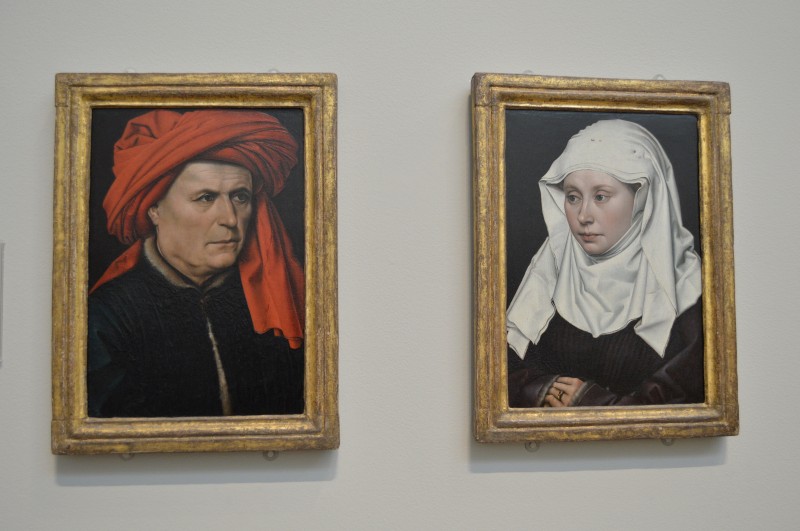
Then some time to kill and a walk to a true European national collection, the National Gallery of Art in Trafalgar Square. No particular intent, just a visit to kill time. We entered at the new Sainsbury wing mainly to see Van Eyck Arnolifini Portrait. I’d happened on it a previous visit and was entranced. It’s small and dark and unpretentious and gloriously touching. It had moved and, in our search, we ran into several Leonardos, Virgin of the Rocks and the Burlington House cartoon. Both hugely known. We found the Van Eyck and followed a guide who was discussing it and some other past masterpieces on panels and walls. There are littler-known gems that attract you amongst the stellar names. Plenty of these. Plenty of stars, too. I was amused by the signposts that list strings of art geniuses, eg, 13th to 15th century / Duccio, Uccello, van Eyck, Lippi, Mantegna, Botticelli, Dürer, Memling, Bellini. There’s a list of must sees and they are interesting and we did come across a few: Hans Holbein the Younger Ambassadors, The Wilton Diptych, Botticelli Venus and Mars. There were others that we saw from a distance, but we preferred other eras or the crowds were just too big. The van Gough sunflowers and chair were just surrounded. This museum was busy but the early halls and impressionists were impossible. Some didn’t make that august list-of-30 online, but were still stars. We discovered a few, like one room with Michelangelo, Bronzino, Raphael and more. All significant works, obviously, and featured, but not in the listicle. This place is a treasure and we just touched the edges in passing but I say nothing that’s not commonly known. Dream on.

One thing that amazed me was how close you can get to art in this museum. The Leonardos and van Eyck were behind glass, but not the Botticelli or numerous others. And there were no constant alarms for intrusion, just foot rails to limit your access, and then just a foot off the wall. I could have touched Botticelli, but of course I didn’t. But I did eye the work up close, perhaps a foot away, looking at brush strokes and edges and colour and the rest. It was fascinating and a huge privilege. Not like V&A with its constant accompaniment of sirens, so frequent that attendants worry little and were seemed relaxed. In contrast, the National Gallery attendants seemed highly attentive, even on edge, and less open to conversation. But then, in the V&A gallery with no alarms, I did see someone caress a bronze in passing.

The National Gallery is in London.

29 September 2018

Bigs and littles

I’ve been to London a few times so thought it would be interesting to look into some lesser-known tourist attractions. Not really so unknown, but not national museums. So off to the Royal Academy of Art in Burlington House. Firstly of Burlington House. It’s imposing for a local residence, Palladian in style, which it was until it was purchased from the Earl of Burlington in mid-C19th. It’s now the home of the Royal Academy of Arts, but also on the Geological, Linnaen, Antiquaries Societies of London, the Royal Society of Chemistry and the Royal Astronomical Society. That last one particularly interested me, but all I found was a locked door opening on the public courtyard. I did get a peek inside when opened for a delivery man, but otherwise, this is not a public site. On to the RA. We just visited the permanent collections which were mainly copies and casts for further copying. But then they do have an unfinished roundel of the Mary and Christ in marble by Michelangelo and some huge copies of interest, not least a Leonardo Last Supper. Again I’d seen the original and again yanks back. It’s in Milan overhead on a refectory wall (a lucky survivor of WW2 bombing). This one was at eye level even if the lighting was none too easy. So interesting. Not exactly a European national collection, but interesting.

The Royal Academy of Art is in London.

28 September 2018

Choices


We had found two interesting choices for a lunch-time concert and dithered a little. The Band of the Grenadier Guards Clarinet Ensemble was playing free in Charlton House and that would have been amusing and colourful and a story to tell some mates in the Duntroon Band but the program seemed consciously light, at the entertaining end of the scale. No doubt it would have been stunningly capable, though. Instead we were pulled by the big names, Bach, Saint Saens and Mendelssohn played on cello and piano. In the end, this too was free (or by donation), in a fascinatingly aged church that I’d passed numerous times, St James’s (sic) Piccadilly, but not entered. To my eyes, brought up as Catholic, it appeared strangely Protestant inside with burial notices on walls and balconies and huge windows allowing the strangely sunny London weather to enter. Europe has just had a seriously unseasonably hot summer (climate change induced, no doubt) and this day was 18C and mostly clear and sunny. Thus the church was much lighter than normal. The performers were from the RCM (Royal College of Music): Ricardo Pes of North Italy and Kumi Matsuo from Japan. All very informal. Ricardo recorded with a Zoom H4N (I know it well!), spoke informally of pieces and teachers and discoveries of unpublished works. His three movements from Bach Cello suite no.3 up front were indicative, strongly spoken in his dialect, firm and expressive and intelligent. And sounding so strong/loud on a new instrument (Edgar Russ, Cremona, 2014). The program changed a little, so a Bach movement disappeared and a Penderecki was dropped and a theme of Italian composition was discussed, not least his teacher at Santa Cecilia, Giovanni Sollima and his father and a final Tarantella to finish. He said that’s apt. Kumi provided a delicious accompaniment, gazing on his playing at times and caressing the keys with such delicacy. We forget that the piano is a percussion instrument so touch changes tone. It was certainly evident here. Such a capable but informal concert. So did we make the right decision, Grenadier Guards or RCM? It’s an impossible choice but had to be made. Either way, this was low key but wonderful.

Ricardo Pes (cello) and Kumi Matsuo (piano) performed at St James’s Church Piccadilly for the Royal College of Music Lunchtime Recital Series.

27 September 2018

Fave

We’re staying in Chelsea, comfy and upmarket, attractive with chimneys and brown brick and the rest. It’s a Mary Poppins view of London to some degree, even if there are many non-English speakers around. It almost seems that overheard speech is mostly some other European language rather than English. Certainly, we’ve heard frequent Italian and Spanish but perhaps we are attuned to these Latin languages. Not least a married couple having pics taken near Eros in Piccadilly Circus amongst much busy-ness and traffic. For a first outing, it’s an old fave, The V&A Museum. It’s an obvious choice but I’m still agog. We started with Europe mediaeval. The first rooms are killers over here, until you adjust to masterpieces by the display-cab load and realise you have to get a move on. Nothing particularly highlighted, but gloriously beautiful, stunningly presented, outrageously special. A fish broach caught my attention amongst the rest. Gold that inevitably glows like new and red ceramic fills in scale-like circles of metal. It’s easy to wonder if nothing is new: certainly it would look the part on a modern wearer. The religious themes are common and perhaps look more out-of-our-era, but at least I understand most of the references. There’s a good deal of saints and torture in this period but also loving devotion and gloriously pretty angels. But you have to get a move on. The attendants were outrageously helpful and probably enjoy the chat. I was entranced by one metal candlestick recounting salvation from Hell (below) to Heaven (above). An attendant came over to discuss it with us and tell the story. In passing she mentioned the Leonardo notebook the level up. We hadn’t known of this but it’s one of the treasures. So, everything is stunning and some more so, treasures to a degree that we just dream of, at least for these European histories. It was a small, squatty leather bound notebook with tiny text, mirror-imaged as was Leonardo’s way, with some sketches, dealing with pulleys and the like. Perhaps 10cmx7cmx3cm. Easy to miss. All small: paper was expensive back then. Another attendant helped and chatted. The V&A had 5 Leonardo notebooks that are rotated through displays. It’s a big museum, so both quality and quantity. I had thought it was for domestic arts, but no, it’s a design museum. Anything new, inventive in its time, is collected. Thus arts with practical things. Drool. Like huge cartoons painted by Michelangelo to guide weavers in creating tapestries for the Sistine Chapel. Owned by the Queen but on display at V&A. There are 5 in one huge room; the other 3 are lost to history. Even the casts are fascinating. Not original, but at life-size, and the selection is informative in itself. We took a free introductory tour and were presented with the David which surprised me for size. I’d seen him before, in the Academia in Florence, but decades back. It seemed much larger now. Then a cafe visit (another innovation of the V&A, apparently) and on to chase works by an ancestor of Megan’s (James Tassie) who appears in the collection (28 mentions in the catalogue for fewer actual works). The V&A is huge and a visit of days or weeks or a lifetime. The guide mentioned 7.5 miles of corridors, 3 million items on display, 2 million (?) items in storage. One secret of good travel is to leave something for next time but how many next times will there be? This was just a touch on the V&A and a return to London, but another full tongue-lolling stunner.

The Victoria and Albert (V&A) Museum is the London.

26 September 2018

One that got away


Megan had done it before, but it was my first international flight out of Canberra: by Qatar through Doha to London. (Mine have always been Murrays to the Sydney International terminal, or just once by flight connection). Exciting, even if a departure from Canberra is via a stopover in a transit lounge in Sydney (both coming in and out) but the customs and security is so relaxed in Canberra and so clear of crowds. We were to stay overnight in Doha at a 5-star hotel offered gratis with some Qatar flights. Seems a good time to fly Qatar, presumably as they prepare for the World Cup. We arrived just after midnight local time, checked in and passed a Jazz Bar with a performing band on the way to our room. I got a quick squiz and planned to come down after dropping our bags but the band had finished the gig and loud hip-hop was in its place by the time I returned. So this one got away. The band was High Times, playing 6 nights a week in this bar, a quintet led by a female singer. I heard just a few bars and it sounded slick and capable as such a band will be. Standard fare playing favourite Billboard hits, old time jazz classics to Broadway headliners.

High Times played at the Jazz Bar at Oryx Rohana.