19 September 2022

Potholing

Musica da Camera had its performance weekend.  This one was under Shilong Ye and with an obscure but interesting list of compositions.  Bartok and Delius, and Volkmann, Glazunov and Nielsen.  The last three are pretty obscure even if the names somewhat ring a bell.  Not impossible stuff, but with its own challenges: some odd counts, an occasional 5/4 variation, some solo bass parts that were important, requiring some conscious counting.   We played the standard local outing in Cook, then our Sunday drive was to Gundaroo.  Our recent country performances have been in Gunning, but given the potholes, the closer town was a gift to the suspension.  There were a few last minute swerves from some very scary water-filled potholes along the way.  And the Soldiers' Memorial Hall is a lovely, dark thing with a cathedral ceiling in wood, so lovely direct reverberations.  Warm in temp (given the gas heaters) and warm in reverb.  We played the Saturday well so the step up for the replay was not so large; both were decent outings.  So a satisfying weekend with some decent, lesser known music.

Musica da Camera performed Bartok, Delius, Volkmann, Glazunov and Nielsen at Cook and Gundaroo under Shilong Ye (director).

15 September 2022

Times of Hope

I think I don't look forward to seeing a series of students from a studio, but I should.  I do enjoy watching the range of skills, the clear development with time and age, the obviously growing awareness and maturity of the emotional responses in performance.  And this is as it should be, of course.  We get better, we understand more through life, we experience the new, until maybe we no longer do.  This is also part of life.  It surprises me that we can watch these developments over such a short time, through a series of performers, of varied but ordered ages, over just an hour or so.  I think they were all schoolies: short and young at one end;  teens at the other.  It goes to show how emotionally mature can be a teenager.  So, is this a duty, to record the several studio concerts?  I have thought so, but now I think differently. Rather, this is an education and an opportunity encouraging optimism.  In a dark time it's a thing of beauty and hope.  Nine players, playing all manner of musics through to Rachmaninov and Haydn and Katz Chernin and Handel and Chopin and Rameau and more.  This studio was Marie Cull's and it was a pleasure.

Students of the school of Marie Cull performed at Wesley.

08 September 2022

Song then and now

They say Schumann Leiderkreis op.39 is one of the great song cycles.  I've listened to leider and found it hard to love, but I did this one.  Maybe it's the grand vision of a larger work (it's 12 shorter songs on the Romantic experience of landscape); maybe it's the wonderful performance.  It wasn't the words, because I didn't follow the German translation.  This was Rachel Mink accompanied by Aaron Chew and they both did wonderfully.  Strong voice, aware interpretation and effective communication from Rachel with delicate pianism and responsive accompaniment from Aaron.  A very classy outing.  And then to get  another song cycle, this time contemporary, in English and variously feminist and amusing, was just icing on the cake.  This was Susan LaBarr Little Black Book with lyrics by Caitlin Vincent.   Written in the last few years and apparently a product of Melbourne, so there's local awareness and it's in English.  I didn't catch all the lyrics but I did most.  Also, we didn't get it all.  The whole is 6 songs, introduced with the song Five, then John, Vince, Steve and obviously two others.  We missed two boyfriends and it's not yet distributed but it's one to watch for.  I couldn't quite work out where to place it, as feminist or comedic or even desperate, most probably with some aspects of all three, although I expect whatever desperation served another a purpose.   So there was modern awareness but also that romantic vision. What a satisfying outing.

Rachel Mink (soprano) was accompanied by Aaron Chew (piano) at Wesley.

06 September 2022

Busy times

I play in a few groups and they tend to group their concerts together, four times pa.  Thus, a week after the Opera Gala, I played with Maruki at Albert Hall.  Now Maruki is just great for playing the repertoire.  This is not a light-on orchestra.   For proof, the program for Sunday was Handel Water Music, Holst St Paul's Suite, Dvorak violin concerto and Beethoven Symphony 6.  Certainly not a lightweight program!  The intonation wasn't perfect and there was a little uncertainty in one B6 movement, but overall it went well and we have certainly learnt something of these works.  There is no substitute for playing them in concert.  The preparation and performance  is something special, drilling your part into your being, unlike any intense listening.  This is a total body experience and an entry into a the mind of a genius.  I liked them all for different reasons, but I'll especially remember the Beethoven for unexpected and tricky intervals (4ths when expecting 3rds) and more.  A pleasure and an education. 

Maruki Orchestra performed at Albert Hall.  John Gould (conductor, violin soloist) led for most of the concert and played violin for the Dvorak concerto; Kristen Simpson (conductor) led the Dvorak.  The bass end comprised Jeremy Tsuei, Jennifer Groom and Eric Pozza.

01 September 2022

And now for something different and not

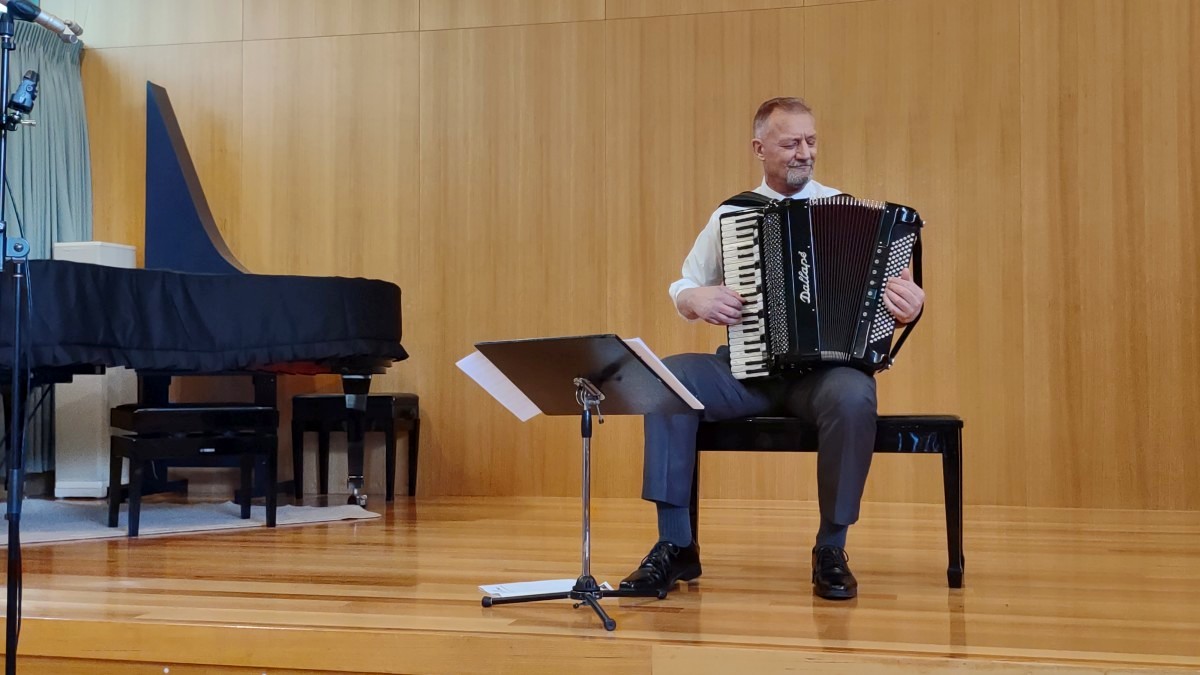
Akkordeon is different but the original tunes that Anton Wurzer played had real connections to jazz and latin and more.  Anton is our our local virtuoso piano accordionist.  I've heard him play classical and all manner of modern and cultural styles.  He played a string of original tunes at Wesley and they had connections with jazz and French and sambas and German folk and gypsy jazz and blues.  And his style of writing is not at all simplified.  These are complex arrangements, changing time signatures and lots of dynamics and tempo movements.  And all played with the sharpest touch, so his semiquavers (would he say 16th notes?) were just spot-on-perfect.  They can be sloppy in many hands, but not on Anton's keyboard.  His left hand, of course, played buttons, chordal-cum-bass accompaniment, and again sharp and correct and nicely distinct from the right hand embellishments and melodies and solos and both hands stopped occasionally for a tapping percussion, again apt and precise.  This is clever music, played with precise fingering and with writing that shows clear awareness of style.  And stories.  So one tune was Lachlan's mood, given a request form co-performer Lachlan Coventry, and Manouche Emma referred to student Emma and Tathra Pub gig referred to a session obviously at the Tathra Pub.  Empress Theadora's dance was a bit further from home, being about Byzantine monarchy and Red samba beans, well, just about food.  So every tune tells a story and all nicely written and quite complex and sharply played.  Not too many really obvious lengthy solos, but the final number, Tathra Pub gig, showed off some classy bluesy improv with quotes from Summertime and American in Paris.  Clever and all round very nicely played.

Anton Wurzer (accordion) performed original music at Wesley.

29 August 2022

Thanks, Nugget

Andrea Keller was in Canberra for her ANU HC Coombes Fellowship and she presented a gig at the Drill Hall Gallery.  Her generosity was evident with its structure, featuring her trio with John and Miro but also with short features from three ANU student pianists, each displaying their skills and works.  The title of her concert says it all: New collaborations.  Andrea's trio played two sets including several new compositions from the Flicker series, Flickers no.2,3,4,5 and Carefree daze, Cobourg  and Hope in the thing with feathers (Andrea) and Peace please (a masterpiece by Miro). These were virtuosic presentations, clear pianistic accompaniments or intros and with clarity in solos truly to die for.  This was lucid with no bass or drums filling space, just master musicians speaking to open and live air.  The Drill Hall reverb worked a treat in this format.  I was taken aback by the beauty of some passages, clear and open as they were.  To hear how John could investigate a tune, calm and searching and occasionally explosive, was a thing of wonder and so evident in this format; the clarity of expression and harmony of Miro and John as a pairing showed their long history; Andrea leading, introducing, accompanying, ever clear and evocative, ever decisive and gently stated.  Then the three younger pianists, students or recently so, from a mix of classical and jazz backgrounds but essentially in a jazz idiom, if more latin than bebop.  Elliot Kozary played Estate and Blue in green.  Caleb Campbell played a his Spinning wheel, an improv on recurrent motion, and a major work, originally written in 11 parts and here reduced to solo piano, somewhat biographical, called Drift.  Ronan Apcar claimed a more classical background, playing an improv on folk Armenian tones, dark and deep, and a take on Brad Mehldau When it rains.  Truly a stunning concert and a thing of great beauty.

Andrea Keller (piano) led a trio with John Mackey (tenor) and Miroslav Bukovsky (trumpet, flugelhorn) at the Drill Hall Gallery.  Elliot Kozary, Caleb Campbell and Ronan Apcar (piano) presented solo pieces.

28 August 2022

Opera

So here's my excuse from the last report.  I was on Llewellyn stage practising with National Capital Orchestra and National Opera for the Opera Gala on Saturday night.  Now it's done, it was fun, I was just inches from some fabulous voices in the choir, the basses and the whole orchestra played well although inevitably with some little slips.  My worst was to count poorly at one spot but quietly enough that it didn't matter.  We managed the hardest works, not least Verdi  Forza del Destino overture which is seriously tricky, in changes of feels and counts and bar placements.  Overtures cna be like that, being a collection of themes from the whole work.  Mozart Seraglio overture was also tricky, but just because it was quick in the delightful, overt presentation.  Mozart is easy to love.   We had three singers, too, although not too well heard from my backline (a la Vienna Phil), and three basses (not tons but adequate).  So 90+ on stage for this collection of tunes from a range of operas, even the hyper-known Wedding March by Wagner no less, and bell and humming and anvil and slave and champagne choruses and a few themed arias and an encore waltz by Gilbert and Sullivan Gondoliers which just bopped along and had everyone smiling madly as we left the stage.  Some tricky bits but overall doable and some delightful singing.  Opera is not something I know too well, but with any luck we might just play some more.  And, of course, our jokey and capable and supportive conductor, Louis Sharpe.


National Capital Orchestra performed with National Opera, the National Opera Chorus and singers Eleanor Greenwood, Hannah Carter and Emma Mauch (sopranos)  for the Opera gala at Llewellyn Hall.  Bottom enders were Henry South, Geoff Prime and Eric Pozza (bass).


26 August 2022

Two settings

I was on Llewellyn stage until the start time for Antipodes at Molly so I only caught the last tunes of the first set.  More on this excuse in the next report.  When I arrived, the band was playing music that was clearly scored, delicately written.  I wondered if they were touring an album.  No, but there was much new material.  Slow pensive melody played unison, exploding into short shared solo passages then back to controlled melody.  Room for solos, including the sit-ins, John Mackey and Miro Bukovsky, joining the core quintet of alto, guitar, piano, bass and drums, all taking their feature but combining to an effective theme.  Antipodes is an international grouping, formed out of a meeting of Luke (Aus) and Jake (NZ) in Berlin (Ger).  So antipodean, if international.  Then a relaxed break and a final set of a few blows on a blues and Stomping at the Savoy and I'll remember April.  Great, outgoing, joyous but intense jamming, but still relaxed and fun rather than the serious, scored first set.  All fabulous playing and inventive composition.  A pleasure.

Antipodes played at Molly with sit-ins John Mackey (tenor) and Miroslav Bukovsky (trumpet).  Antipodes comprised Jake Baxendale (alto), Luke Sweeting (piano), Callum Allardice (guitar), Noel Mason (bass) and Tim Geldens (drums).

25 August 2022

School bells ring

Another of my Wesley Wednesday recordings but when I arrived I was stunned.  There was an orchestra filing into the Music Centre in uniform.  It was the Canberra Girls Grammar School Music Academy, or at least some of it, and not an orchestra but several performance groups: two string quartets, flute, sax, guitar and clarinet ensembles and a Hand Bells group.  Now that was something different.  This is a group playing 52 hand bells, tuned chromatically, so it all makes like a piano performance, but gloriously resonant, sonorous, chiming.  I'd never heard one before.  I'm told there are two hand bell sets like this in Canberra and they cost.  Not surprised; I assume they are individually  tuned.  Each bell has an internal ringer and they can be played with mallets and damped against the body or otherwise.  The Selections from Mamma Mia that they played was one of my faves of the day, but then it's ABBA and so attractive.  There were a few Mozart pieces, which I admired in my more serious frame, and a very apt and touching guitar trio rendition of Paul Simon Sound of silence.  And several latin pieces, mariachi, Tico tico, tango, and even some early jazz, a rag and Rocking roses.  So a varied presentation, but I have to give it to the hand bells for the unique tone and rarity.

Various ensembles from Canberra Girls Grammar School performed at Wesley.

22 August 2022

Premiere

I hold a spot in my heart for the Brindabella Orchestra because they were the first orchestra I played with.  I left down the track after playing Beethoven 5 with Maruki and I've moved further on since.  I like to play the big and challenging works, all the movements, the repertoire.  It's an incredible pleasure and challenge, but I still go back occasionally to Brinda and I did this weekend to hear them playing a world premiere, no less.  It was The old man who loved to sing, a children's book put to music by Mike Dooley, no less,  under commission by Brinda.  A mate and a capable composer.  This was a great pleasure with an intimate and attractive theme, some pretty melody and glorious orchestration and harmonies.  I was mightily impressed.  Brinda also did a run of smaller well-known works:: Saint-Saens Carnival of the animals, Bizet Carmen suite, Borodin Steppes of Central Asia, Nicolai Merry wives of Windsor and Strauss Sr Radetsky March.  There was great pleasure there, not least in the playful or boisterous themes, Radetsky, of course, but also The Elephant or Les Toerdors.  It';s the sort of thing that brings smiles to the faces of some players and I enjoyed watching a few like this isn the cello section.  So a memorable outing for a fine world premier by Michael Dooley and otherwise some popular and joyous works. 

Brindabella Orchestra under Shilong Ye (conductor) performed a world premiere by Mike Dooley along with Saint-Saens, Bizet, Borodin, Nicolai and Strauss Sr in Weston.

14 August 2022

Another next-gen

There seems to be an efflorescence of ensembles recently.  Maybe it's a post-Covid thing.  Not that we are fully post-Covid given that this group's first date was postponed and another was due as I write this, but cancelled for sickness.  This was a different one being very much of a new generation, although the faces are familiar enough, from CYO and community orchestras and ensembles and bands and folk outings and theatre pits and even CSO.  Canberra Chamber Collective also has a neat name with the collectivity inviting a range of styles and groupings.  We heard it last night when their premiere concert arrived after its delay.  They played a range of musics, Mozart and Poulenc and Haydn but also Farkas and Bohme and Lyadov.  A very interesting collection to display various combinations.  In all, they were a sextet of flute, violin, bass, trombone, horn and trumpet.  Perhaps an odd combination and possibly a bit hard to balance with that loud brass.  In fact, Ragnel, on violin, used a pickup and small amplifier for some pieces.  The Mozart and Lyadov had all playing, but there were spots for just the women (flute, violin, bass) and others for just the blokes (trom, horn, tpt) and interestingly, violin taking an oboe line for another piece.   It can be difficult to match instrumentation with arrangements, but a collective can be flexible.  It sounded great in the reverb-washy space of the Drill Hall.  I'd expected it to be too soft, but no, it worked a treat.  There was some capable playing all round.  I especially watched Hayley, having played in a section with her, but otherwise enjoyed all.  I felt there was some slightly nervy reading, but this is new and I enjoyed it immensely and they obviously did too, and knowing how to cover is an essential art anyway.  And the encore of a tarantella says it all.  Deadly serious but fun.  Looking forward to more from CCC.

From left stage to right, Canberra Chamber Collective comprised Serena Ford (flute), Ragnel Jansdotter (violin), Hayley Manning (bass), Dominic Harvey-Taylor (trombone), Liam Brewin Higgins (horn) and Sam Hutchinson (trumpet).

11 August 2022

Elena's studio returns

The kids have done it again.  Some stunning performances on real works from memory.  Just three kids this days, the oldest in Year 10 and sporting an AMusA, no less.  All from the studio of Elena Nikulina.  The Russians must have it as the Chinese do too.  Victor Ni played Bach, Haydn and Chopin.  Hannah Ni played Chopin and Debussy.  The eldest, Eric Wong, played Beethoven and Mendelssohn.  There were were minor lapses which they picked up well but more impressive was the busy fingerwork, the effective balance between parts and hands, the preparation as each sat a little before performance.  I remain in awe.

Victor Ni,  Hannah Ni, Eric Wong, all form the studio of Elena Nikulina, performed at Wesley.

09 August 2022

Almost the hellbender

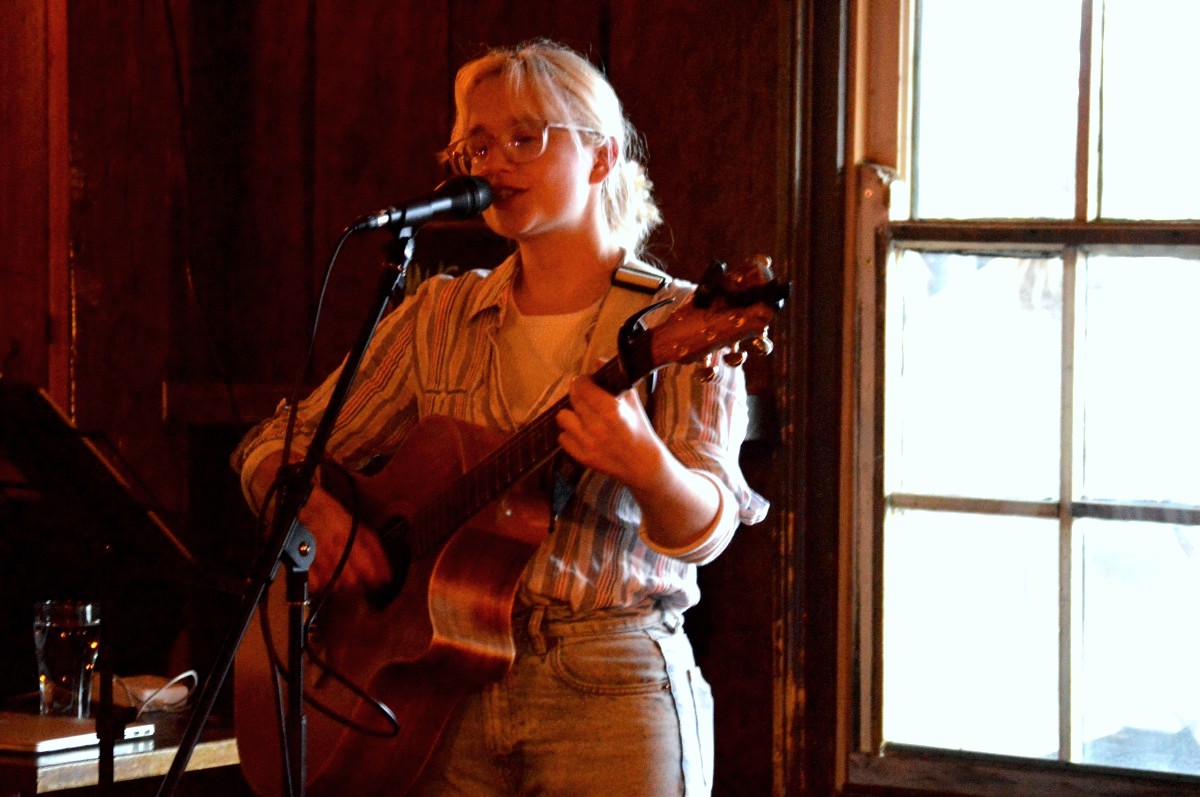
Sal was playing live at Old Canberra Inn on an otherwise quiet Sunday.  I hadn't heard of Sal and the Manders but the band was a guitar trio (Sal on guitar and vocals) and looked entertaining and energetic on YT and the beer's good at OCI.  So that was my outing, and apart from a close atmosphere and fears of Covid, I enjoyed it.  Sal advertises that she was turned on by discovering womens' rock like The Pixies, Joan Jett, Fleetwood Mac. Not close to my heart but pop-rock is always entertaining live.  And true to form, I only recognised some tunes and often needed a line of lyrics to search the title.   Something from Saturday Night Fever done very differently, You've got the love, Fleetwood Mac and I think Florence and the Machine, Amy Winehouse Valerie, and best and most intimate, Missy Higgins Scar, various others.  Much enjoyed.  Sal had classical piano in her history and had studied commercial music at the Con so there was method in her madness.  Just guitar and vocals and sellable tunes open to requests.  Sally Davis, much enjoyed along with the beer.  I must check out Sal and her Manders sometime.

Sally Davis (vocals, guitar) performed at the Old Canberra Inn on a Sunday afternoon.

PS, a hellbender is a family in the order Salamander (caudata) along with 9 others including newts, salamanders proper, lungless salamanders  and mud puppies.

07 August 2022

Reappraisals

Yep, the jazz at the National Press Club is just a lazy Friday evening outing if I have nothing else to do but  that's not to denigrate it.  After all, I know the players and they are some of the best in Canberra and many teach at the ANU.  But they are just locals and mates and it's just a relaxed gig for after work on a Friday.  Yes to all that, but I was still floored last night and by more than the new beer I discovered.  Wayne Kelly was leading in the absence of Greg Stott and Jason Varlet and Mark Sutton were his offsiders.  The music was not just standards and walks (did I hear a standard?  I don't think so although they started with a blues), but great grooves and often popular numbers, not least Strawberry Fields and Message in a bottle and Walking on the Moon.  Then a Poinciana -like groove and latin-ish something and others I recognised but couldn't put a title to.  So the grooves were a delight and contemporary.  Then the solos, Wayne reasonably restrained although always delightful, Jason lively and expansive on his Jazz bass and Mark just a dream at times, sharp and precise and totally unaffected; glorious.  I'm not the only listener even if there's plenty of clicking and chatter too.  That's how a bar gig should be; this is just a classy one with great musicians.  Some of the best in Canberra.  What a great indulgence for such a free local club outing.  As for the beer, it was a Capital All Night Long Dark lager, all rich and chocolate. Check it out soon.  The website says it's only available until September.

Wayne Kelly (piano) led a trio with Jason Varlet (bass) and Mark Sutton (drums) at the National Press Club.

05 August 2022

Degrees of separation

In music your CV is made up of where you have studied and who you have played with.  It goes for jazz and classical, if not quite so much for more popular styles.  I've been one degree from Australian Brandenburg Orch and ACO and SSO and obviously CSO and even Cold Chisel but I'll miss a coming opportunity with Orch of the Age of Enlightenment and Amsterdam Baroque Orch and a string of others because I can't play the Musica da Camera concert in November.  But I got to hear and record the leader for that concert, John Ma, at Wesley and it was special.  I love baroque music and he plays it with an understanding that is clear and immediate.  It's a softer tone, a more joyous and playful interaction, lighter and more dancelike.  And he played a series of lesser known composers, not least Pisendel, then concertmaster of the Dresden Orchestra and a god of the violin and perhaps an influence for Bach's solo works.  And prolific Telemann of the 3,000+ compositions who was considered lesser but has had once-thought-Bach works listed under his name.  And Baltzer (new to me) and Hoffmeister and a challenging etude.  And, as John said, the most prolific composer of all, Anon, this time from Saragossa.  There was Bach too, of course.  John mostly played a baroque violin, but ventured into baroque viola and also viola d'amore with its 14 strings, 7 played and 7 resonant.  I was amused when he questioned the number, but a violinist is used to just four, of course.  But the understanding and connection with the works were a pleasure and clearly evident and his patter was informative, even educational.  So this was a wonderously good Wednesday lunchtime concert at Wesley, booked at short notice when someone else couldn't do it.  So I will miss my closer connections because I can't play that concert, but I expect to hear it and I'm already in admiration for the playing and the player.  And John has returned with family to Canberra so with luck we'll all see him many more times.

John Ma (baroque violin, viola, viola d'amore) performed at Wesley.