12 March 2013

Voice again, but worlds apart


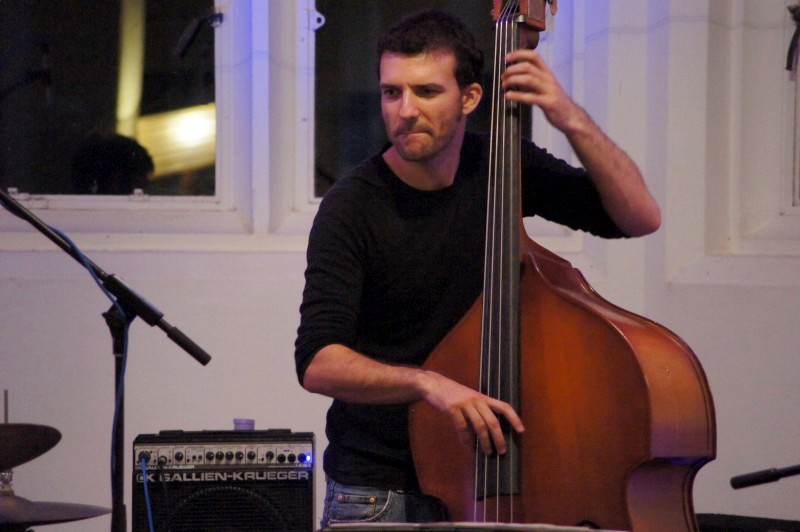
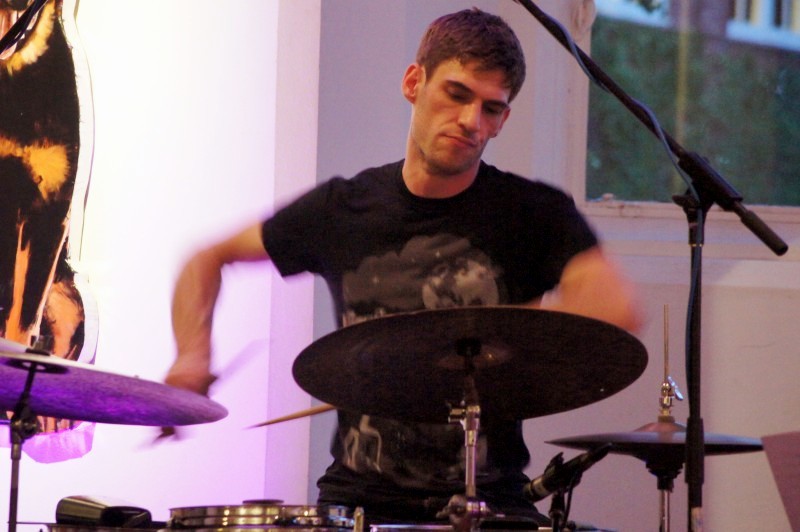
It’s a big weekend for the Canberra 100th Birthday and Michelle Nicolle is performing by the lake for the big day, but Megan and I saw the quartet as they should be, at Vivaldi’s, in a dark-despite-daylight cabaret space, for a Loft jazz audience. I spoke to Ronny and he described the music as chamber. This is right and the venue was perfect. So much more intimate and detailed than the Q Theatre, where I last heard them, or by the lake later today. This was delicate and detailed performance. The songs were communicated, in all their mid-century style and passion and knowing corniness. The interplay between performers was exceptional, especially the front liners, Michelle and Geoff. I loved hearing the words to tunes. I realised I don’t listen to singers often, so the intros to common tunes, like All the things you are or There will never be another you, went unrecognised. But they become important with sung tunes: they introduce the context of the passion expressed within. And I was blown over by Michelle’s richly varied and embroidered singing. It’s what jazz singing is, of course, and this was stunning. All sorts of harmonised lines and unexpected twists and scat over a long range and improvisations and even quiet accompaniment behind guitar and other solos. And such a mature voice of body and range and expression. It’s a joke that she follows Jaap Blonk of the night before, although they are both vocalist and both are masters of their trades. I love to hear words and voice and visit the raw and surfaced emotions of the great era of cinema that these tunes come from. The band was touring their new CD of Mancini songs, so there was some clever, some touching and some just plain silly writing: Moon River (too-common and syrup, but I love it), everyone’s first bass riff Peter Gunn, I love you (and don’t you forget it), Dreamsville. I didn’t know he’d written Days of wine and roses, or that it’s from a film that she described as one of the saddest films, with Lee Remick and Jack Lemon, of alcohol and love and the rest. I must look that up. Then fluff like It had better be tonight (Meglio stasera): “If you're ever gonna kiss me / It had better be tonight … Meglio stasera / Baby go go go / Or as we natives say / "Fa subito!"”. Wow! Or On the street where you live. How to take it seriously? When it’s this good, you can’t not. But not just mid-century. She also sang decent Australian pop: Quasimodo’s dream by Dave Mason and The Reels and Forever now by Don Walker and Cold Chisel. And what nice vocal accompaniment, distant and unobtrusive. I use “nice” for a reason. Nothing out of place. Perfectly fitting, well arranged, Ian Moss solos on bass, odd times and complex unison counterpoint lines on guitar and vocals or bass, such light and crisp guitar, a perfect bass tone, so sparse drumming, open and clear sound and even a flugelhorn when Miro sat in for a few tunes. But always light, delicate, intimate. I’m listening to a CD now as I write this. A CD hasn’t got the same presence, but that intimacy and delicacy are there, along with chops. Calm, understated, richly embroidered but never, never jarring. I liked this gig so, so much. Michelle Nicolle (vocals) played Mancini and more with Geoff Hughes (guitar), Tom Lee (bass) and Ronny Ferella (drums). Miroslav Bukovsky sat in for two tunes.

The sublime and the ridiculous


I’ll let you work out which is which. I caught avant-garde Dutch vocalist Jaap Blonk at Smith’s Bookshop last night, but it was only a short session. I arrived decked out in suit and tie (quite out of place) and left during the first set to play at the Casino, so I missed the later set/s with Jon Rose and Richard Johnson. But what I heard was a wonder. Jaap spoke of sound poetry and of the early composers dating back to the 1920s, so this is not a totally new art form. I wondered at his mouth control. He spoke or sang words in Dutch or Russian or English and presented sounds that were all the world like cars or dogs and riffed with tongue-twister melodic snippets that he’d expand and lengthen with authentic tonality and real musical skills and all done with solid rhythm and groove and poetic metre. I’d never heard the like, although there was some great contemporary vocal improv at SoundOut. This seemed more poetic as well as inherently musical. And the glottal skills (is there such a thing) and musical/poetic chops were clear as break of day. I wish I could have stayed. To me, this was experimental at its most exciting and most skilled and also with inherent humour. Great stuff. See the YouTube link below for what you missed. Then I was off to the Casino. Sublime or what? Jaap Blonk (vocals) performed at Smith Bookshop.


  • Jaap Blonk performs Ursonate
  • 11 March 2013

    Friday night on the town

    Megan and I got out for a few (just two) drinks and to catch some mates playing around town: a nice end of week outing. First was the Hyatt to sit in the garden for a touch of turntablism with trumpet/flugelhorn accompaniment.
    Jonty Hall plays with trackster (am I anywhere near the language?) “Jungle” Jerry Francis as Stereotype in the Möet bar. Möet it was for Megan (pleasant but you can guess one reason why only one drink). But the ambience was relaxed and the shadows of a setting sun were superb. We liked the music, too. Mainly house dance music, minimalist, clean and some R&B female vocals and occasional solos or accompaniment by Jonty that I heard as shades of ‘80s Miles. And some remixed Simon & Garfunkel. Given the music, this was an unexpectedly mature audience, at least this night.

    Maybe they were at Mint. The basement was open as a one-off venue and it was filled with 20/30 somethings. Now, this a strange venue and the sound was pretty, well, industrial, with bare cement and low ceilings. But this was fun, with UV lighting and yellow vests handed out at the door (staff wore red) and reasonable prices on drinks. The band was as good as they come for such a corporate gig around this town: Rachel Thorne, Greg Stott, Mike Dooley, James Luke, Dan McLean, Dan Bray and Mark Sutton appearing as In too deep. Two sets: first jazz; second pop/funk with James switching to e-bass. Triste, Autumn leaves then Midnight hour, Superstition, Cissy strut (?) and a devilishly arranged take on the Beatles’ Money. And it only turned out that Gossips singer Leanne Dempsey was involved in organising the gig, so here’s a pic with Rachel.

    It was an early night but a bit of dry fun. Nice way to relax at the end of a week’s work. Stereotype were Jonty Hall (trumpet/flugelhorn) and Jerry Francis (turntables). In too deep were Rachel Thorne (vocals), Dan McLean (trumpet/flugelhorn), Dan Bray (tenor), Greg Stott (guitar), James Luke (acoustic, electric bass), Mark Sutton (drums) and Mike Dooley (keys).

    10 March 2013

    Cocktail hour

    The Canberra International Music Festival had its launch at the ANU School of Music and Megan and I got an invitation. This is an evening for mooching around, chatting, speeches, a few drinks and just a little music. Not that we knew too many people, so it wasn’t too long an outing. Musical director, Chris Latham, spoke of course, along with a government rep, Dorothy Danta, Robyn Archer and Gary France. I hoped to chat to Robyn Archer (we were at Adelaide University at the same time and I remember her from Uni reviews) but she only passed through. Chris introduced the program, and it looks great. Bach was claimed as the deceased composer-in-residence. No-one will quibble with that invitation. Pieter Wispelway is visiting to play the solo cello suites. There’s lots of original music and premieres and plenty of deliciously obscure music (at least to me). Chris highlighted Jesus’ blood by visiting UK composer-in-residence Gavin Bryars and there’s also a theme of connections to West Coast USA, including performances of (one of two) John Adams.

    These launches always have a musical component. This time it was David Pereira playing his (as yet unfinished) Mt Ainslie rising, which is to be premiered at the festival: a duo of cello and piano (Kimberly Michael?) that I’d locate in the realm of impressionism or tone poems. He later played a piece written for him by Carl Vine 20 years ago and called Inner world. It’s cello played against a recorded soundtrack of mixed and effected clips of David playing cello, so it’s a duo of David Pereira with David Pereira, with the help of electronics. It was quite a contemporary effect with strong rhythms and attractive melodies. I liked it. CIMF is not a cheap outing (Gold pass for all events $590), but it’s intelligently and challengingly constructed and anything I’ve attended has been a joy. Sadly, I won’t get to nearly enough of it but I trust I’ll get to some.

    09 March 2013

    Believing Squealer


    Animal Farm is a fable and storybookish with animals as characters, but it’s also allegorical with parallels to Russian communism and Stalin. It’s also a common school text. I remember some scenes from my reading many years ago, not least the image of the strong and dedicated horse Boxer as he’s taken away to the knackery. It’s obviously still on the curriculum because there was a large cohort of teenagers, not least the Canberra Grammar girls sitting in front of us. For all these reasons, the Q was well stocked with an audience who knew and understood the story and intent. It’s been dramatised by three of the cast of five and won various awards for the shake & stir drama company in the past and is now on tour from Queensland including a 3 mid-week day stay in Queanbeyan.

    I enjoyed it but it wasn’t the emotionally charged experience that was West Side Story a few week back in this theatre. The story is tragic and the evil of totalitarianism is palpable, but I found it far more an intellectual than an emotional experience. That’s probably apt. Emotions can be dangerous things and their abuse is obvious in this tale. There’s also a good deal of narration in this dramatisation and maybe it’s inevitable to tell the story. The small cast plays numerous roles. Various animals are minimally signified by minor props (ears, manes, tails) or just by posture and the actors merge and out of the role of narrator. The story is nicely developed as the seven commandments change over time and finally merge and invert as “All animals are equal, but some animals are more equal than others". The final scene of pigs on two legs negotiating with humans was a disheartening resolution but it fits this essentially tragic view. I especially admired the presentation of the horses and dogs. Boxer’s and Molly/Clover’s gaits were endearing and wonderfully believable and the dogs were truly fearsome. Napoleon and Snowball are essential to the story but I have to give it to Squealer as the consummate wily political hack who manipulates with rhetoric and deceit and rewritten history. The animals have some awareness but it’s the old donkey, Benjamin, who can read and has some understanding of what’s going on, although I imagine he would benefit from the greater depth possible in the book. The cast appear in dank and dirty minimalist clothing and daubed with mud. From the mud, to the mud, ever subject to elites and abuse. It’s a discouraging view of the world but one that’s perfectly at home in the mid-20th century of world wars and show trials and genocide.

    We drove home afterwards discussing the history and its implications: of the Russian revolution through to Stalin and whether totalitarianism is the inevitable result of Marxism or perhaps of any ideology. Certainly there are totalitarianisms of the right, as well, and Orwell, himself, was of the left although often claimed by right. He’s an honest and relevant writer and wonderfully easy to read and openly opinionated (although I don’t share his method for a perfect cup of tea). And this is a fable, if black, but also a historical allegory that’s a little out of time but not without relevance and certainly worth a revisit. shake & stir theatre company featured actors Ross Balbuziente, Nelle Lee, Nick Skubij, Tim Dashwood and Bryan Probets directed by Michael Fulcher. Ross, Nelle and Nick created this theatrical interpretation from George Orwell’s original novel.

    07 March 2013

    Like reading the paper


    Alex described it as like reading the paper. What a good description. We were listening to Dale Barlow playing flute with guitarist Jim Pennell at the Gods. It was an unusual combination of sounds, intimate and tuneful and both lovely and lively at times. The tones were unusual. I rarely hear flute in jazz, and Dale played not just the standard concert / soprano flute, but also the piccolo and alto. And Jim’s guitar was nylons strung and played classical, finger style. But the music was jazz standards and latins, so this was familiar territory. They were well amplified, but they cut through as acoustic tones. The guitar was clear, sharp but not edgy, with a defined and middly nylon twang. I was intrigued by Jim’s fingers, fine and precise, reforming constantly into various contorted chordal shapes or relaxing to make scalar or arpeggiated runs. Jim’s classical fingerstyle allowed range of interweaving roles: a short bass line, then a few beats of chordal accompaniment, then a solo line or a melody or a fill or sequence or turnaround or tritone substitution. All intermingled, a beat or two for one, then a few beats for another. This was an evident tonal exposition of the tune, but neatly expressed with a rich mingling of instrumental roles. Dale’s role was more straightforward: mostly melody and solo, just occasionally a line of counterpoint under one of Jim’s solos. But what wonderful paths he weaves through the changes. It all seemed so inevitable, like reading a paper. Each chord is established on the one then spelt out with tonal clarity and melodic inevitability, although occasionally with some unexpectedness with a flattened note or longer interval to end a phrase. Then sequences of melodic snippets that tonally repeat over the instrument. I was amused to see his manly fingers on the diminutive piccolo, and I was surprised by how pleasantly it sounded in this role. I enjoyed the deeper tones, too, the standard concert flute with its sharper edge and the more corporeal alto. They played tunes from Jobim and the standards repertoire. Triste, Autumn leaves, Bluesette, Alone together. I was taken by Jim’s Venezuelan intro to one tune. He’d studied in South America and had promised it before the gig. Also, a strange entry to another tune that was all Japanese flute and shakuhachi with long, bending tones. There was some great playing here, easy and inevitable (like reading the paper) and just touching on wordly influences. How broad is this thing we call jazz? Some argue there’s no reason to even use the term these days, but whatever you call it, the music’s great. Dale Barlow (flutes) and Jim Pennell (guitar) performed at the Gods.

    BTW, Dale ended by telling us he’ll be playing with Herbie Hancock and other Jazz Messenger alumni in Istanbul on International Jazz Day, 1 April. They are seriously cool connections. Dale Barlow, Jim Pennell

    04 March 2013

    No complaints


    I’ll never complain about the cost of double bass strings again. We saw harpist Tegan Peemoeller with baritone Rohan Thatcher at the Artists Shed at Queanbeyan on Sunday. After the gig, she gave a Harp 101 lecture with harp lore, an introduction to the instrument and a few Q&As. As for the strings, a full set costs $1,000 to $2,000. They are the work of an afternoon to change (masters may get it down to 1 hour). The upper strings are changed every 3 months; the middle strings, every 6 months; the bass strings, every year. This is for a well maintained, professional player. Then there’s the set of tools to go in the purse (most harpists seem to be female) and the annual services. It’s an investment and not for the faint-hearted. Bass strings at $200 a set changed annually seems a doodle; as for guitar strings at $15 a set, baby-food.

    But what of the sound? I hear classical guitar from the nylon strings, and techniques like damping and harmonics and finger plucking versus arm sweeps. Also the sound of piano in the lower registers. But something unique in the harp is enharmonics, which allows those wonderful sweeping glissandi that define the instrument. Tegan explained it’s possible given pedals setting multiple strings to the same pitch, eg, D flattened to Db on one string and C sharpened to C# on the next. This is a playing technique on harp, not just a tuning possibility. Genuinely interesting.

    Tegan played a first set solo: various arrangements and compositions for the harp. Robert Maxwell's arrangement of Rimsky-Korsakov; was it another Respighi; an original tune by Jim Cotter for Leonard Rice called Kasuri, the Japanese dyed and woven fabric; two by Salzedo. I was fascinated by the technique: Tegan's high elbows and flowing style, her plucking that was sometimes sharp but richly varied to draw a range of tones. I noticed her sing finger seemed to play the tonic and she confirmed later that it's a key finger. Strange, because the little finger is at the lowest pitch, on both hands. Also, the thumb that swipes or plucks. I though I could see a common chordal shape in the hands, but Tegan said that's not really the case. Certainly, they create a range of forms to play scales and intervals.

    Rohan came on for the second set and the first piece was my favourite for the concert: 4 of 9 English songs by Hindemith, modern with consonance and dissonance interspersed and Rohan's voice singing in English. The songs were On hearing the last rays of sunshine, Echo, Envoy and The wild flower song. Voice and harp are such beautiful instruments and so unusual to hear together. This was truly lovely and strangely out of time, or perhaps out of our time. Then some choices by Rohan, all poems put to music: John Ireland's The vagabond and George Butterworth's settings for two poems by AE Hausman. Then a final solo harp piece, an arrangements of favourite bits from several version of Robert Maxwell's Ebb tide. Here I noticed several lines that spoke of jazz: the first notes of Misty and other hints I heard but not couldn't name.

    But what a wonderful, tuneful, soft and intimate sound is the harp. And it was just enhanced by the humanness of the voice. Small and intimate and dreamy. Lovely. Tegan Peemoeller (harp) performed with Rohan Thatcher (baritone) at the Artists Shed, Queanbeyan.

    03 March 2013

    Enlightened


    It’s called Enlighten. It’s certainly not Enlightment but it’s entertaining. We enjoyed our leisurely stroll around the Parliamentary Triangle. There were decent crowds, at least in a Canberra sense, although they are spread over a large area. There were more photographers than you could imagine, the serious ones hogging the best spots with tripods. There was lots of varying colour and some gentle and harmless humour. Not much seriousness here. The closest that we saw was an art work by George Poonkhin Khut at the National Portrait Gallery where visitors were invited to measure their body using a finger electrode and watch it on a PC screen and I think listen in headphones. It seemed oddly like auras but perhaps more authentic, or at least scientific. Also serious was standing by the fire at the Aboriginal Tent Embassy, although strangely the fire was attended by a white guy with no ATSI blood but with sympathy for the cause. Otherwise, there was music. We caught just a few Real Book tunes by the trio of Clare Dawson, Caleb Wearne and Simeon Staker. That was background but very capable; I enjoyed the gentle but lyrical soloing. They were playing to a chatty crowd in the foyer of the National Library for their temporary speakeasy called the Red Letter Lounge (the Bookplate seemed to have transformed into a child care centre). We also caught some cajun/bluegrass with Dr Stovepipe who were strangely perched on a stage above the La’ Toush café. All very odd but entertaining and nicely played: two- and three-part harmonies, good rockabilly slap-bass and a jokey presence. They had plenty of kids and a few mums up dancing, although they were fickle and ran off to follow the Group D Creative Collective’s deep sea anglerfish bicycles when they passed by. They were cute (and friendly: no fish I know has ever offered to stop for a photo) but I preferred the Stalker Theatre Company’s Phospori cyborgs: three women on stilts with images projected onto body suits roaming with a distant presence. And I enjoyed the two Apollo 11 astronauts who just moon walked around the place, ignored by more-worldly adults but enjoyed by the kids. And did I mention the cameras and tripods? We managed three hours of colour and projections and idling. Given ee are not ones for public entertainment, I reckon it was pretty decent.

    Enlighten is a festival of projections on buildings and public entertainment held around the Parliamentary Triangle. The bands were the Clare Dawson Trio, featuring Clare Dawson (piano), Caleb Wearne (bass) and Simeon Staker (drums) and Dr. Stovepipe with Jim Sharrock (guitar, banjo, vocals), Gillian Cosgrove (fiddle, vocals) and Ed Radclyffe (bass, vocals). The performers were the Group D Creative Collective and the Stalker Theatre Company and their Phospori. George Poonkhin Khut presented electrode aura portraits at the National Portrait Gallery.

    01 March 2013

    Eatin'


    It’s been a quiet week, but I caught Victor Rufus, Alec Coulson and Sam McNair at Manuka as I walked by. Nice to see some jazz on the streets. Standards done with restaurant gentleness but a few solos all round. We talked of sousaphones. Obviously the coming thing. Victor Rufus (guitar), Alec Coulson (bass) and Sam McNair (drums).

    27 February 2013

    Memorable

    I’ll sneak in another of my gigs, this time for our instrumental quartet, the Jazz Republic. There were many ways that this gig will be memorable. Firstly, Miroslav Bukovsky sat in for our wounded saxist, Richard (nothing terminal). How wonderful to play with a musician of such skills and long experience. It was a surprise when Miro told me after the gig that he’d taught Richard at the Sydney Con years before. How small is this jazz world. We were also playing this gig for the Canberra 100 Musical Offering, which is coordinated by Don Aitkin and Helen Moore. Helen wasn’t there, but Don and Bev, his wife, were. It turns out that Don plays a mean Brubeck piano by ear, having played professionally way back before his days in academia. We also had a mate of Mike’s in attendance, APRA and double-EMMY award winning composer and musician, Art Phillips, originally from LA and now resident in Sydney. If I’d realised he’d written songs for Minnie Ripperton, and played guitar for Barry Manilow and directed music for the likes of Demis Roussos, Dory Previn and John Rowles, I might have been more nervous. But nerves serve little purpose. Enough just to play, even if only one set of a few standards, latins and one of Mike’s original ballads. Good fun and thanks especially to Miro for sitting in. The band appeared as the Jazz Republic with Mike Dooley (piano), Miroslav Bukovsky (trumpet, flugelhorn), Eric Pozza (bass) and Brenton Holmes (drums).

  • Canberra 100 Musical Offering
  • Art Phillips Music Design
  • Don Aitkin's blog
  • 25 February 2013

    As the alembic


    I was recording, and with the first notes I worried that I’d set the gain control too high. This is a band, after all, with drums. You expect some volume. But the Casey Golden trio was playing at a level that I virtually strained to hear. The drummer was Ed and I know his so-subtle stick play, restrained in volume with an uncommonly intimate contact with the skins. And bassist Bill was there, too, clear but understated, each note precise and with intent and absolutely without superfluity. These days, his playing is sparse, although occasionally visited with little fills of teeming lines or repeated notes or dropping into fast passages and walks when required. And Casey himself, bent over the piano, delicately laying out sequences or melodies or standing as foil to a written bass line of simple clarity. The members moved the focus around the band but virtually without signal, sometimes a short bass solo, or piano featuring but unobtrusively, or a mild ostinato and one of Ed’s blisteringly developed solos. Given the restrained presence, I got to wondering about the PA: one wedge as a monitor for Ed and one feeding the audience and balancing the piano on the left of the stage. Chris Deacon was recording; was it ArtSound’s? It turned out to be Ed’s, with mics for bass and piano, presumably placed to ensure everyone, on and off stage, heard the subtlest details. The result was so slight that you hardly noticed, but it’s an indicator of the detail and distillation of this music. Distilled is the adjective I kept thinking: pure, clean, perfected, tight as, shorn of surplus and the low volume level was indicative. These were highly developed skills, playing detail with precision and control, notes when required and only then, everything considered and limited to the necessary. They played Dolphin Dance and a bop head for an intro, but otherwise this was original music by Casey. The progressions were often quite simple. I’ll enjoy listening back to the recording to better understand the melodies and broader structures, like the unison lines and starts and stops of the arrangements. But the effect was pure: delicately formed and subtle jazz. How good is this? Casey Golden (piano) performed with Bill Williams (bass) and Ed Rodrigues (drums) for too small an audience at Canberra Grammar Gallery.

    23 February 2013

    A minor gem returns


    My monthly St Albans lunchtime concert is a little gem that I look forward to. It’s relaxed, intimate, small and features some very capable musicians coordinated by Louise Page. I missed it while in recess over Christmas, but it returned this week with the Lorenz Duo, pianist Wendy and violinist Andrew, performing Blake, Beethoven and an encore by Kreisler. This pair has serious history, performing internationally, leading several orchestras and teaching at conservatoria. They are now living in Canberra and performing with David Pereira in the Trio Empyrean and presumably otherwise.

    The performance was of two pieces. Firstly, Howard Blake’s Penillion variations. This is modelled on a Welsh style of singing improvised verses over well-known melodies. The variations were bookmarked by an attractive folky melody in triple time with the slices sounding of gypsy-folk with double stops, floating mystical watery interludes, piano / violin conversations, rising and falling piano chords with overlaid melody and more. Then the major work, Beethoven’s Violin sonata no.10 in G major. This was composed in 1812 and was his last sonata, following the Archduke. It’s written in four movements: the first is spacious and mature and quite lengthy; the second, classically profound; the third, a fast accented scherzo; the fourth, a series of variations on various folk-like themes. The duo returned for a quick encore on Fritz Kreisler’s Ladies light, a romantic work in 3/4. How pleasant was this chamber concert. The Lorenzes play with vivid intimacy and with interpretation that is romantic and joyous and openly physical. The glances are occasional as they wait to come in together and the smiles are easy towards the end of a successful concert. So it was here. A very nice chamber outing to start another St Albans series. Wendy Lorenz (piano) and Andrew Lorenz (violin) performed as the Lorenz Duo at St Albans.

    20 February 2013

    Where’s Satin Doll

    I bought a CD download for the Marc Hannaford trio after their Loft gig and discovered an introduction by Jason Moran. This is good company. There were not too many people at the Loft for Marc’s gig and the start time was skewhiff due to travel and availability of gear on loan and the rest, but the gig was a great pleasure of abstruse compositions and instrumental vivacity and intimate presence. Marc mentioned that the second set felt like playing in the lounge-room and this was true, but the intensity and complexity were not something for relaxation: this was more for intellectual and emotional stimulation. I’m intrigued and dumbfounded by just how they do this. To my ears, these are the sounds of fine music of early C20 classical, the dissonance and intervals and intensity. I heard bassist Sam playing piano before the gig. His piano also sounded of that era and I asked him what was behind that music. He played a few basic chords underlying his improvisation, just three note chords perhaps based on fourths, and talked of how he interpreted it rather than of scales or harmonies. I talked of it with Paul dal Broi in a break and we decided the notes are clipped (not always true) and the lines tend to staccato, there are sequences and long intervals, and I always think of the symmetrical scales (diminished and whole tones), but perhaps the attack or note formation is one key. It’s not non-harmonic music, but it is dissonant. It’s also composed. The first set was a medley lasting about and hour and when it finished, Marc listed five tunes that they’d played. Similarly, the second set was two tunes over about 30 minutes. The solos merge with the heads in this music. It was only at the end that I became aware of a recurring head, when bass and piano left hand came into alignment, but even then I wondered if this was just particularly responsive improv. Earlier, I’d noticed Sam stop to find charts so that was obviously the start of a tune. It’s easy to just fall into the immensity of concept and energy of performance. I found most value when I did just this: close my eyes and open my mind. The written melody that I caught was quite similar to Marc’s solo lines, but distilled and clarified; but picking these heads is nothing like identifying Satin Doll. Jason Moran was positive but undescriptive when writing of Marc’s music. It’s got reams of influences and references but it’s also complex and challenging and something quite personal in conception. Best to just close eyes and go with the flow. There’s a hurricane blowing outside but it can be calm and revealing at the eye if you go with it. Marc Hannaford (piano) performed with Sam Pankhurst (bass) and James McLean (drums) at the Loft. And just for interest and further astonishment, all three of them were playing on borrowed instruments.

  • Cyberhalides Jazz Photos by Brian Stewart
  •