05 November 2016

Playing it tough


Maybe it's the age of the audience and maybe it's the jazz they started out with but several said how much they enjoyed this gig by the Matt Ottignon and his Tough Tenors. Just straight ahead, blues-infused, heavily swinging, uncomplicated and earthy (which does not translate into easy to play). Median tempos or up-tempo (even the one ballad, Body & soul, was pretty quick), burning tenor sax with two tenors up front. Tonal, bluesy lines, steady swing and walks, neat piano comping, unison or harmony heads and steady drums. Dirty big tones and satisfyingly twisted lines from hot and sweaty tenors. This may be as serious as your life, but you can feel the joy and even humour. The tunes were from several gatherings of two tenors - Eddie Lockjaw Davis with Johnny Griffin, Dexter Gordon with Wardell Grey, Sonny Stitt and Gene Ammons - but also a few singles - Ellington, Diz, Clifford Jordan, Bennie Motin, Lester Young, Coleman Hawkins. All formative players around the era of bebop and its offshoots. The band was pretty much a recent gathering but it didn't show: they were still blowing tight and together, obviously informed by the various traditions of this art as well as supported by their individual skills (these were some good players). Just a hard swinging night of hot playing with some humour amongst the pleasure. It's getting on to 60 or 70, even 80, years old by now, but how good to return to this formative era.

The Tough Tenors were Matt Ottignon and Chris O'Dea (tenors), Andrew Scott (piano), Tom Botting (bass) and Tim Geldens (drums) and they played at the Gods.

04 November 2016

Masterclassing

The Andras Schiff piano masterclass was a continuation of our musicians' theme at day three of the Performers(’) present symposium at the Yong Siew Toh Conservatory of Music in Singapore. Melivia Citraavani Rehajo performed Beethoven Sonata no.28 Amaj Op101. Luong Khanh Nhi performed Schubert Sonata Amin D537. Each played the piece then received guidance from AS. As with the orchestra, it all sounded fine to our ears on first performance, but we could follow AS's lessons and heard better as the time progressed. I was stunned to hear the difference in tone when AS played in demonstration: how he simplified and made phrasing or intent obvious but also how the same instrument could sound different under different fingers and bigger under his. Then, there were the comments, often difficult to hear but indicative. Take care with semiquavers - they are not triplets; don't "parachute" hands to the keyboard ("not like karate chop, never"); on playing a march, the military were viewed differently in Beethoven's time; don't play too beautifully but "chisel" Beethoven's second movement, like Michelangelo; the strength in a march comes from the rhythm; note there's humour in Beethoven even if the jokes are lost to modern ears; imagine ourselves into the tune; balance the hands, sometimes highlight the bass, like a cello, or in one passage, "hear the horn?"; "sing" don't hit; what's on the paper is not music until it's played - look at the phrasing; "the metronome is a stupid instrument, the human being is a breathing instrument"; Beethoven wrote this sonata after he got a new London-built instrument with a longer range and he was deaf already - he wrote some notes which he never heard; "there's a German phrase that all good things are in threes"; "when you play p, don't play slower, just softer"; the art of recapitulation is "don't show it, hide it"; use more upper arm, for gravity; "don't forget to dance" (in context of a Sicilian rhythm); drop complexities and repeating notes in practice to find underlying movements; two hands should never be [exactly] together (in this case, when playing 8/9 notes); there was a big difference between music in Vienna and Hannover - Viennese was more "sloppy". This is all out of context, of course, but it was enlightening and invigourating and the improvements were immediate. Fascinating.

Andras Schiff (piano) led masterclasses during the Performers(’) present symposium at the Yong Siew Toh Conservatory of Music in Singapore. The performers were Melivia Citravani Reharjo and Luong Khanh Nhi (piano). BTW, no pics permitted so this program cover.

This is CJBlog post no. 1700

03 November 2016

Orchestra rehearsal


Day three at the Performers(’) present symposium at the Yong Siew Toh Conservatory of Music in Singapore was more for the musicians in us than the listeners. The first session was an open orchestra rehearsal with conductor Gabor Takacs-Nagy rehearsing Beethoven Symphony no.6 and Piano concerto no.1. I was stunned from the first notes how well the orchestra sounded. It was big (8 basses of the symphony; 4 basses for the concerto) in a lively hall but that was not all. This outfit showed real confidence from the very first notes of the symphony. One example was the basses playing semiquavers at performance pace. This bowled me over but by this time was just a pleasure rather than a surprise. These are capable players and apparently all students. It was not just once that I sat back and luxuriated in this big and confident playing. But conductor GT-N still had plenty to say, about phrasing, interpretation, sometimes bowing (several times he borrowed a violin to demonstrate). This was a man with energy, commitment, obviously a good ear. I was amused how we came to hear more as he highlighted whatever. So, some themes and quotes. Listen and anticipate; supporting others is your role; forget your own part as much as you can and listen; "start to run before you get the batton" (=be on top of the music) "we were alive 9 months before we were born"; "dance with the ball" (he mentioned a youthful love of soccer and highlighted dance and other feels); for strings, many time the left hand should be louder that the right (he got the violins to practice a passage without bow); (about a spot in B6) "here comes the Singaporean storm"; (about a passage in B6 mvt.3) "this is the only 3 1/2 minutes that is not human, really"; much articulation required to be heard in a concert hall; (about another passage) "arrogant and biting: you have to be an angry animal". Then the piano concerto. Piano is percussive, implications for strings playing to fit; follow your interior voice "don't be a violin player, be a singer". There was more and there was plenty we couldn't make out, being behind the back of the voice spoken to an orchestra in a hall. But some hugely satisfying playing and correspondingly huge energy in guidance. Loved this session and learnt a lot.

Gabor Takacs-Nagy (conductor) led an open rehearsal with the Orchestra of the Yong Siew Toh Conservatory in Singapore during the Performers(’) present symposium. They rehearsed Beethoven Symphony no.6 and Piano concerto no.1.

02 November 2016

How many cellists


It’s becoming a numbers game. This time it’s four cellists, as in 4Cellists, playing at the Performers(’) present symposium at the Yong Siew Toh Conservatory of Music in Singapore. This was a funny outing. These guys are pop-stars of the classical scene (not meant at all derogatorily) with a young audience and girls whooping and calling names. Megan suggested the Chinese of the group, Li-Wei, was the local star. That may have just been for the two girls behind us or maybe because we are here in Singapore. The Korean or Swede or Swiss girls may have seen things differently in a different location, but it was a pleasure to be surrounded by such a response to musicians playing this style. The presentation was strangely moderate for such pop-sensations, with the only props being sunnies for an encore rendition of the theme of Mission Impossible and only one short patter. The music was undeniably popular but also eminently worthy – Ravel Bolero, a string of Piazzola tunes and a quieter Monteverdi Pur ti miro. I wondered about the arrangements, for that is key to support this lively and attractive performance. The program names fellow cellist and composer, James Barralet, as arranger for at least some works. Four cellos all have the same range but there was variation in tone, pitch, bowing/arco, chords (sometimes played with what I guessed was plectrums), bass accompaniment, harmonies and the rest. This was eminently obvious in the extended Bolero with its movement of one line between instruments but it carried right through. This was clever use of limited resources with some capable playing to pull it off but this shouldn’t be a surprise: they are well trained players, having met and trained together at the Royal Northern College of Music, UK, and the Sibelius Academy. Good on them. A good niche, an inviting and entertaining performance and screaming girls too. Sounds good.

4Cellists played at the Performers(’) present symposium at the Yong Siew Toh Conservatory of Music in Singapore. The 4Cellists are Song Young Hoon, Claes Gunnarsson, Joel Marosi and Qin Li-Wei (cellos). At least some of their music is arranged by James Barralet (composer).

01 November 2016

How many shades of Mozart


Melvyn Tan was our concert 4 of 6 concerts so far at the Performers(’) present symposium at the Yong Siew Toh Conservatory of Music in Singapore. MT played Mozart and a Mozart-derivative in the Concert Hall with the Conservatory String Ensemble. We were late for the start, missing most of Divertimento K287, played by a smaller string ensemble (2xvln, vla, cello, bs, 2xhorn) without keyboard but then MT came on stage to play fortepiano with this group and the tone changed markedly. One theme that I’ve picked up at these symposium concerts has been the relevance of music despite changes (and some discomfort) over time. Here was one sterling example: a modernist piece referring to this very work of Mozart’s but all minimal and changing time signatures and recurring snippets and truncations of melodic themes. We loved it. I felt it was played with verve and commitment with the influence of a driving and inviting personality at the core seeming evident. No doubt I missed many references – this requires a good knowledge of the piece or an excellent recall from the preceding performance – but anyone could pick up on lines obviously Mozartian (especially on keys) and enjoy the responses that sounded of modernity and movement. The work was called An airmail letter from Mozart: variations of a theme from K287 and the composer, Jonathan Dove, was in the audience and came to stage for a cheer after the performance. (Other works by JD are on YouTube but not this one; it’s presumably recent). Then, after interval, a return to Mozart performed and led by MT from piano (replacing the previous fortepiano) with a larger ensemble (8xvln, 3xvla, 2xcello, bs, 2xoboe, 2xhorn). This was a lively presentation of Mozart piano concerto no.14 K449 and a return to something of the expectation of an orchestral performance of its time. Again, that strong and inviting personality drawing and leading from the keyboard with a responsive ensemble. A pleasure.

Melvyn Tan (fortepiano, piano) led the YST Conservatory String Ensemble in Mozart and a Jonathan Dove Mozart-derivative at the Performers(’) present symposium at the Yong Siew Toh Conservatory of Music in Singapore.

31 October 2016

Sing jazz


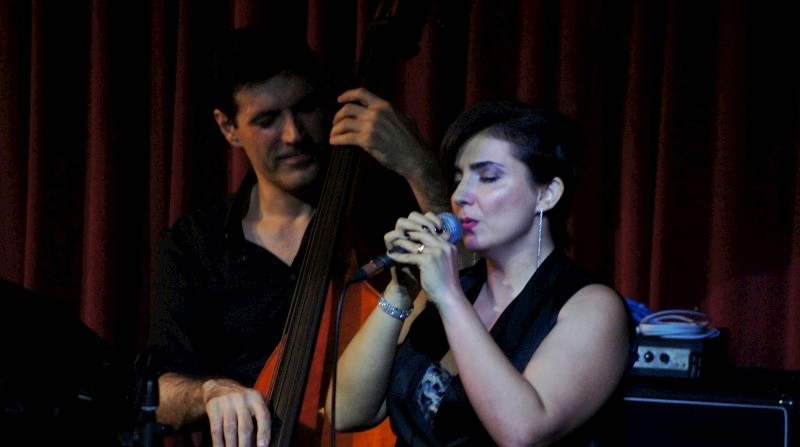
This time in Singapore I found some accessible jazz. The Singapore Jazz Club hangs out at the Sultan Hotel . This night they were featuring Sicilian singer Daniela Ruggieri with a backing trio for their Thursday Vox series. Thursday nights are usually a duo format with pianist Mario Serio and a singer but this night was with a full band, as it turns out, to celebrate Daniela’s birthday (impolite to say which one, but a significant one). Daniela sang a series of jazz standards, Willow weep, Summertime, Ipanema, Route 66, Comes love, Wonderful world (many were requests by friends and family on the night) but my favourites were some Italian songs that I hadn’t heard, Estate by Bruno Martino, but especially Quando (“Tu dimmi quando, quando”, not the hugely-known Quando, quando, quando). Lovely tune. I especially enjoyed Daniela’s scatting, which was lively and clever (she had studied piano seriously in earlier years and I reckon that showed). Mario had a great feel for simple eighth-note lines that spelled out the chords to perfection. Bassist Ivan sounded great and did some lovely solos up in thumb position and stepping down to the lowest notes. I was particularly taken by one triplet line that sequenced down through several octaves. Drummer (and husband) Massimo did an understated and sturdy job both in spelling time and laying out some neat solos. Nice to finally get out to some Singapore jazz and especially nice with the Italian and celebratory connections.

Daniela Ruggeri (vocals) celebrated her birthday at the Singapore Jazz Club in the Sultan Hotel with Mario Serio (piano), Ivan Lombardi (bass) and Massimo Alioto (drums)

30 October 2016

A history in brass


A brass orchestra is a thing of beauty but not often-enough heard, at least by me, all rich and sonorous and smooth and intricate with orchestral complexity at its best. Boston Brass was the next great pleasure of the Performers(’) present symposium at the Yong Siew Toh Conservatory of Music in Singapore. The five members of Boston Brass combined with YSTCM staff and faculty to perform a fabulous evening of brass works, heavily influenced by the American tradition and especially jazz. This is a band to bridge gaps. In fact, some commentary on the way spoke specifically of that: that musicians move back and forth through styles; that they practice “backyard ethnomusicology” (perhaps paraphrased as “do what you dig”). So we were introduced to a seriously good trom player, principal in the local orchestra, who played the solo for a Wayne Shorter tune, and we heard of BB’s tubist picked up by Duke Ellington to fill in on tour for a few months in his twenties and his later two years with the Ellington Band under Mercer. There was a touch of classical here, starting up with three increasingly lengthy fanfares, from Howard Hanson (for the Signal Corps), Bernstein (for JFK) and John Williams (for Fenway). Then a passage through US musical history. Copland’s take of the deliciously simple Shaker song, Simple gifts; Joe Avery Second line, an improv-rich take on New Orleans marching bands; borrowings from two suites, Gershwin Porgy and Bess and Bernstein West Side Story (I had just revisited WSS in flight and marvelled again at the music and the film); John Lewis Three little feelings (third stream classical/jazz crossover: never enough spunk for my ears); Wayne Shorter Aung San Su Kyi (to touch on modern jazz structures); another suite of Duke Ellington tunes. There’s a sweep of American music here, played with life and clarity and chops, some writing to die or cry for (not least West Side Story), plenty of joy amongst a sorry racial history and an inviting performance and patter. Boston Brass play 100 gigs a year, perform workshops at top schools and play with all manner of ensembles, from orchestras through all manner of bands, marching, jazz and whatever. Fabulous and funky and plenty of fun.

Boston Brass performed alone and with various combinations of faculty and students from the Yong Siew Toh Conservatory of Music in Singapore for the Performers(’) present symposium. Boston Brass comprise Jeff Conner and Jose Sibaja (trumpets), Chris Castellanos (horn), Domingo Pagliuca (trombone) and Sam Pilafian (tuba ). Alvin Seville (conductor) led the ensemble for various tunes. Marques Young (trombone) featured for several solos.

29 October 2016

Revelations


Mieko Kanno’s solo violin concert was unexpected and revelatory. We had arrived in Singapore for just a few days and initially our web investigations had uncovered nothing but an opera - not our preference. Then we discovered the Yong Siew Toh Conservatory of Music and a symposium called Performers(’) present and a series of free public concerts that went with this event. We arrived to find a wonderful establishment and this concert in the Orchestra (rehearsal) hall. We were first attracted by the promise of Bach (an easy crowd puller and it certainly works for us) but then we learnt of Mieko’s role in new music in Europe, and then we heard some. Firstly, the JS Bach Ciocona from Unaccompanied partita no.2 Dmin was bliss with stunningly effective spelling on multiple fugue lines and bowing to die for. Bowing was to prove a feature of this concert (just one), not least because it’s something I am discovering. Then something different: Salvatore Sciarrino Caprices no.2, all shimmering like wind and delicate Asian flute-like, again in the bowing, almost unheard, sometimes gripping the strings, but mostly just passing so lightly over. Mieko had asked for no interruptions, no applause between pieces. She then wired up a pickup to a Mac and John Hails La Pastora was strongly formed notes with heavy echo - I thought an initial echo around 5 seconds, then another following after another 3 seconds or so, perhaps more or otherwise - giving notes and snippets of melody that recurred and harmonies that shifted over time. Then, to finish, without processing, strong and precise pitch and bowing spelling out Bartok Sonata for violin mvt.3 and buzzing bees in mvt.4. We were in awe and dumbfounded and blessed of luck in finding music of such obviously international quality here, for fellow symposium-attendees and musicians and welcome public, an intimate concert where you can chat after. Mieko is a master of the form and this was a hugely memorable concert. But as I left, I could only compare the Singapore that’s appearing to me on this visit, vibrant and excellent and challenging, all innovation and the rest that we mumble of incessantly. Amusing as it is to notice the Australian World Orchestra here in early October for masterclasses. Is Australia living on past investments, I wondered. But, relieved of political weight, Mieko Kanno was a revelation for fabulous playing and not least for how music exists and changes over time and stays relevant.

Mieko Kanno (violin) performed JS Bach, Salvatore Sciarrino, John Hails and Bartok in concert at the Performers(’) present symposium at the Yong Siew Toh Conservatory of Music in Singapore.

28 October 2016

Predating the Renaissance I know


It was the Copenhagen Renaissance Music Festival but Sequentia performed music from before that. So be it: mediaeval and Renaissance often go together as early music and this was a great and revealing concert if, sadly, for too small an audience. Sequentia is renowned for its Hildegard von Bingen recordings but they do more with a long discography of well-informed period music. Well-informed is significant in this context, as we don’t know too much about early music: perhaps where it raised and lowered in pitch but not how far, or how time was involved. Like the Vespers we sang the other day, a line might extend so there may be 4/4 then a lengthy period of a single note with changing words. I was enamoured by the voice and the instruments: they were all played so well and sounded with such strong tone in this ex-church performance space (the Koncertkiche). The real commitment to getting as close to the originals as we can is obvious and it’s not just in performance. The instruments are reconstructions of specific examples unearthed in various European sites (Germanic harp from Oberflacht, C7th; triangular harp; transverse flutes, including one made form a swan’s bone, Speyer C11th). Much of the performance was also improvised. I saw the charts, some with symbols indicating rising and falling lines; others with just words. Many languages were represented, from different sources and that early era: Frankish, Latin, German, Icelandic. There were instrumentals with sequence melodies (I guess here we only know the melodic movement, not time or specific pitch). There were stories from Beowulf and Old Icelandic Edda and the Muspilli fragment and the Evanelienbuch of Otfried von Weissenburg and the Prophesy of the Erthyraean sibyl; all old stuff but often new to me. But strangely there were musical figments I recognised. The improvisation and modal approach are obvious jazz references, but there was that end-of-line upsweep that I first noted from Siouxsie of the Banshees and lots of pentatonic-like lines. Benjamin said the 6 note-fretted strings on the harps was one reason. It got me thinking of how much we know, how much we reproduce a product of our own time and how much the original music ideas have come through to our time. But then, that’s the essential question of this period-music study: we can never know finally, but we can limit the possibilities as we learn more. The theme of this concert was the Apocalypse; the title was Fragments for the end of time. It’s an appropriate theme for these days of Trump and Climate change and the rest, and that comment was made by a local as we left. But it also just confirmed to me how this must have seemed so real in mediaeval times. The Church and God were one and all-encompassing, at least in central Europe; life was brutal and short and experience was limited. Occasionally a minstrel arrived with terrifying stories of end-time (as these sounded terrifying and the essence was story-telling; think Bob Dylan as a modern story-teller in this style). It must have been terrifying and unquestionable. So this is what we heard. Two performers of a malleable ensemble performing mediaeval stories with the most informed interpretation that we can manage today. Stunning and woeful stories of end-of-times with increasingly believable references to our times. How lucky were we to catch this gig, one night in Copenhagen.

On the night, Sequentia were Benjamin Bagby (voice, harps, symphonia) and Norbert Rodenkirchen (flutes, harp). They performed at the Koncertkirche for the Copenhagen Renaissance Music Festival 2016.

27 October 2016

One hot fountain


We think of Scandinavian jazz as all sparse and pensive, but this night in La Fontaine, the oldest jazz club in Copenhagen, was nothing like that. The room was on the first floor, busy and ruddy with B&W pics of performers and party lights over the bar. The music was 3 sets from 10-2 and started rhythmically relaxed but hot from the top, with a funky blues shuffle. Head and tenor solo and guitar solo and organ solo and swapped fours then head. Like that for the night and a revelation. Some swing and blues and ballads - Green Dolphin St, Willow weep for me, Love for sale, Stanley Turrentine’s Sugar. Several blues, one that Anders learnt in NYC but without the title; otherwise some I recognised but also couldn’t name. But what a fabulous outing. Tight and a fabulously easy groove on all the tunes, perhaps with solos that dragged way behind the beat, but the tempo remained. The bass was organ foot keys or left hand and the right hand and left variously swelled or riffed or pedalled in solos or accompaniment and solos and the Leslie (he seemed to have two traditional box Leslies, one old and battered like the organ and one newer). The guitar also comped, but choppier, and his solos were wonderfully perfect and inevitable with pentatonics and heavy strings and little sustain and a real blues sensibility. Drums was simple and ever-strong and avoiding lots of syncopations and the time was ever-correct. Then tenor, starting up with well stated and lightly embellished heads (plenty more complexity as the night progressed), then letting go with more of those inevitable pentatonics but also substitutions and some sidesteps and fabulous commitment and floridly rich lines. Tenor Anders was a revelation. Just a fabulous night with wonderful grooves and great fun and volume and commitment and a hot venue (literally so). Nothing like what I expected when I set off in the cold for a Scandinavian jazz club, but so what? Great night out.

Kjeld Lauritsen (organ) led a quartet with Anders Gaardmand (tenor), Bo Moller (guitar) and Frands Rifbjerg (drums) at La Fontaine jazz club in Copenhagen.