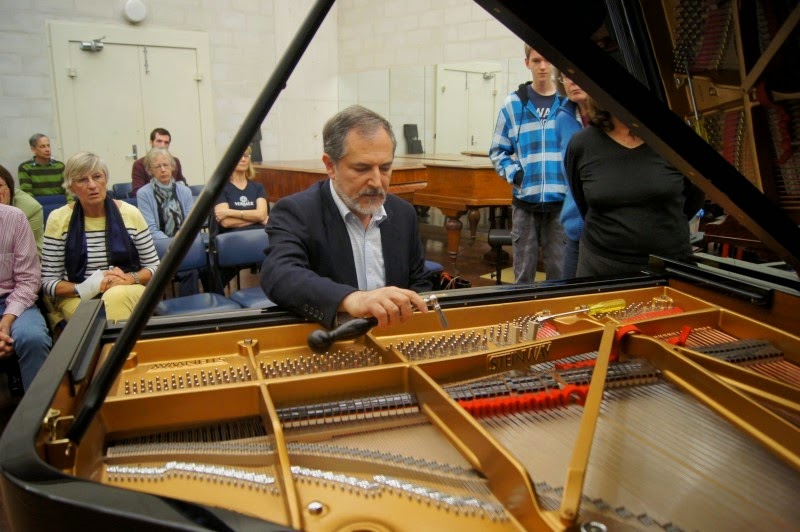
 It's not just the music that fascinates. The piano is a complex and beautiful thing and it was honoured when Ara Vartoukian gave a workshop for the CIMF Fringe yesterday. Ara is a piano technician based in Sydney; he looks after the pianos in the Angel Place Recital Hall amongst others; the session was called the Piano whisperer. He was talking of pianos, especially Steinways, and tuning. It was the tuning that particularly interested me, being myself a very amateur tuner of an old piano. Ara spoke of equal temperament; how it's necessary but scientifically incorrect; how it has a human element (we hear high notes as flat and low notes as sharp); how he uses thirds and cycles and intervals; how he tunes not just for pitch but for maintenance of that pitch (releasing stress with fortissimo staccatos then, unlike guitar, tuning down to a note); how often he tunes and registers instruments; how he stretches the tuning and how different stretches serve different purposes; how to make a piano sound honkytonk. If I got it right, tuning is built on overtones and the beats between intervals: around 0.7 sec for a major third. It all happened quickly with his experience. Firstly the strings are damped with felt, so only the middle of three strings plays; he tunes the middle octave, then spreads over the piano, then removes the felt string-by-string and adjusts the partner strings. It's quick, although I noticed even on an ANU Steinway grand there were a few notes that demanded extra tweaks. He removed the keyboard and the mechanism was laid bare. It's a strange sight: an open mouth on a grand piano and the complex, repetitive mechanism of the keys laying on a table. This is all a mix of craft and art and even some science on the most essential of instruments and the product of a year's training and subsequent experience. Fascinating and aurally challenging.
Ara Vartoukian (piano tuner) talked pianos and tuning at the ANU School of Music for the Canberra International Music Festival Fringe.


No comments:
Post a Comment