11 July 2010

Sad duties

It’s late in the day, but I’ve eventually visited McGregor Hall. It’s an old tiled, fibro workers’ hut from the earliest days of Canberra’s development. When I arrived in Canberra (1985) there were perhaps 5 or 6 around this area, which were even then used for various community activities: theatre, Photoaccess, group offices. This seems to the last of this style left, and so it’s a significant historical relic of Canberra. Sadly, and in the modern way, it’s threatened with redevelopment. The current users are the crew around the Canberra Musicians Club and various dance groups. I saw the Hall devoid of performers, but there was a distinctly pleasant vibe about the venue and also the people there: kids and community-minded adults of all ages. It’s at a location like this where you are exposed to the genuine feel of place. This is art and expression and community for its own sake, not for profit. It's valuable, but fragile. Governments don’t always see it this way, of course, and I can understand their predicament. The land is obviously valuable, and the huts were never meant to be permanent, but community needs encouragement and support and a past. Interestingly, good community and history have their own monetary value, in the health of a city and in tourism that increasingly thrives on uniqueness. McGregor Hall provides all these. It will be a sad day if and when another piece of our memory disappears.

10 July 2010

Third of 3 of how many

There were three acts for the latest of hellosQuare concert at Street Theatre Two. It’s an intimate venue equipped with a nice PA and decent upright piano and it’s a venue I like: intimate, informal, suited to experiment.

The feature act of the show was 3ofmillions. 3ofmillions plays with effects and presents freely improvised musics with few obvious chordal structures or harmonic movements and none-too-obvious compositional forms. They are very competent players who know how to interpret free and atonal forms and who work well together. That’s doesn’t make it any easier, but it does make the effort worthwhile. What do I remember of this? Some fabulous, frantic piano reminiscent of atonal classical styles; intensity that built and broke and passed through the players with ease; some very sweet walking bass (how unexpected!) at the end that convinced me of the sound of Abel’s unusual instrument (more below); some huge drum dynamics that clashed with ears and other performers, although never purposelessly; an arresting pitch bend effect that Abel used on his bass. I enjoyed this set. Just two long improvs, both capable and impressive even if never undemanding. BTW, Abel’s bass was semi-acoustic, a copy of Steve Swallow’s signature instrument (Citron AE5 Swallow). It has a long (36” scale) narrow neck and 5 strings, tuned E-A-D-G-C on the Swallow original. Abel suggested it excelled in chords and high notes rather than low walking styles, but it heard it as beautifully sweet for a short walk in the band context. BTW, Abel also played with a pick, although perhaps not a copper pick as does Steve Swallow.

The openers were Cat Cat and Anonymeye. I presume Cat Cat are locals. Three guitars, some vocals, some harmonica, mostly one chord, a constant 4/4 backing track at about 110bpm (for all but one tune where they did 4/4 at 110bpm without the backing track), mostly with recorded tambourine on 2-4. They are described as kraut rockers, with “drifting guitars, droning keyboards and metronomic grooves”. I heard minimalist, ‘60s Doors-like tunes. Enough said. Then Anonymeye. Anonymeye is Andrew Tuttle from Brisbane, who is touring for Sound Travellers. He mostly played acoustic guitar and just a little keyboard, looped and effected. Strangely, he finished with straight finger-picked guitar piece that was, for me, the highlight of his performance. There were mentions of country and folk musics in the promo, but I heard it more as classical style with some degree of crossover to more popular styles. This was decent playing and the electronics were authentic enough when you closed your eyes. But the style (a solo performer mostly twirling knobs on stage) does seem rather indulgent, even onanistic. Maybe I just need to be better trained. I know others say that about jazz solos, but at least the skills are manifestly more demanding.

The supporting performers were Cat Cat and Andrew Tuttle (guitar, keyboards, electronics) as Anonymeye. 3ofmillions was Adrian Klumpes (piano, electronics), Abel Cross (bass, electronics) and Finn Ryan (drums).

  • Citron AE5 Swallow
  • 07 July 2010

    Out of El Rocco

    It’s several times now that Geoff Page has brought our jazz history to Canberra, and it’s a fascinating and valuable exposure. This time it was pianist Chuck Yates, who used to play at the legendary El Rocco in Sydney in the ‘50s, and Ron Philpott, electric bassist with Judy Bailey in Sydney in the ‘70s. They were accompanied by Col Hoorweg, who I remember through the ‘80s backing big names visitors with John Carrick at the Southern Cross Club, and James Ryan, originally from Darwin but once a student here in Canberra but now thriving in the Sydney jazz scene. These historical performances usually cover the generations, and they are the better for it. This was a genuinely hard-ahead outing exploring pre-modal-era standards. The solos were sometimes rough-edged but hard and committed and fluent from all instruments.

    Firstly the tunes. A few from Monk including Round Midnight. I felt a freshness here. These are overwhelmingly well-known tunes, but they seemed to be closely felt, like they were the tunes of the musicians’ era, which is pretty true for Chuck, and not particularly true for younger musicians. Otherwise, lively swingers and latins: I’ll remember April started the night, Invitation, Daahood, and Kenny Barron’s Tragic magic. James Ryan’s A Date with Yate was the one original of the night. There was one fairly short but beautifully stated solo piano piece from Chuck that was recognisable but which I couldn’t place. And a final blues with Sydney-based Canberran, Dan Junor, sitting in on Alto. This one gelled with harmony horn lines (Dan did some great work here, finding unexpected and challenging harmonies), and very diverse styles of solos from the two saxes out front (Dan more clinical and restrained; James letting go with Coltrane-influenced extravagance). Two sets with ten tunes.

    Despite, or maybe because of, the years, Chuck is in fine form. His playing was diverse and changeable. His best showed simple but lovely phrasing, a creativity that had him moving freely, sometimes ranging widely over the keyboard, sometimes intervallic or dissonant with altered extensions. His face and eyes gave him away as an effective listener, too. Ron interested me as a bassist and as a blast from my past. He was an unusual proposition: electric bass played with a pick, through a JBL powered Eon PA bin with stereo EQ (he told me it was originally for a stereo Rickenbacker - another throwback to that era - that he used to play but which was stolen). I thought of Steve Swallow but there was little similarity to my ears. It was good solid accompaniment, and the one time I noticed a walk, it was swinging and well formed, but he was more a soloist. And interesting and capable solos they were, well up the neck, lovely arpeggiated phrasings that sounded of sax conceptions. I wasn’t too keen on his tone. It was pretty rough, even for electric, and middy, which is common to electric basses but is not the gentle presence of the acoustic bass. But the soloing was great. Maybe it’s just me reading his age, but James seemed more modern to me. He started with some wonderful Contranesque fast and harmonically rich playing on the opener, I’ll remember April, and finished on that style in the final blues. In between, it was less extreme, more bluesy. Either way, the playing was great. But what got me was a big sound with a slight metallic edge. I really liked James’ tenor. From the stage patter, it was obvious that Col had not played much, if at all, with Chuck before, but he presented well. Col has a unique style and sound. He’s got an interest in tonality and percussion that he used for the introduction to James’ original. He’s a solid timekeeper with a unique rhythmic ear: simple and open, often very cross rhythmic, playing long-sustained grooves that set an environment that’s often in contrast with the other players. It’s this solid and sustained contrary sensitivity that define his drumming for me. Dan Junor sat in on alto for the final blues. Obviously he had little time to warm up, but I heard him as very interesting on harmonies with the tenor, and defined and purposeful in soloing. But one tune’s not enough to know.

    So, a historical outing that was both interesting and worthy. Chuck Yates (piano) led a quartet with James Ryan (tenor), Ron Philpott (electric bass) and Col Hoorweg (drums). Dan Junor (alto) sat in for the last tune.

    04 July 2010

    Always a pleasure

    It’s great to have another opportunity to play with Dirk and Graham. I’ve managed a few gigs over recent months. It’s always so relaxed and easy-going but the grooves are solid, the communication is easy, the tunes are good ones, and the solos are generous. Some very nice playing, and a good exercise to hold the groove when the sax drops out for the guitar solo. The audience was small, but we had a few listeners, including one elderly Dutch man who had played swing drums in his days. A very enjoyable little gig. Thanks again to Dirk and Graham … anytime. Dirk Zeylmans (tenor), Graham Monger (guitar) and Eric Pozza (bass) played at the Tradies.

    Drama in the crypt

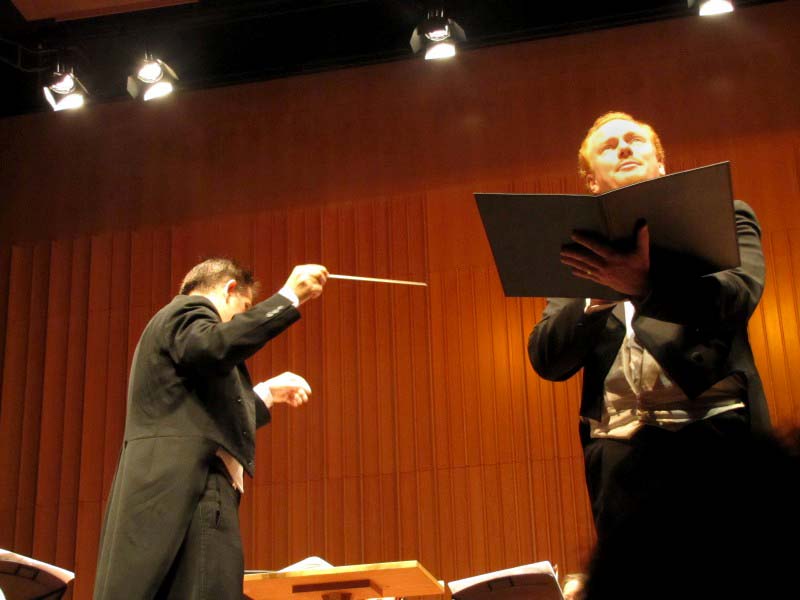
    The Catholic mass is theatrical and the Requiem mass is passionate, but Verdi’s Requiem just didn’t click for me in expressing the earthly loss but religious hope of the occasion. I’d heard Mozart’s requiem a few months before, and it was pained and deep. This seemed theatrical: more operatic in its drama and not unexpected given Verdi’s fame as a composer of operas. But the performance by the Canberra Symphony Orchestra and combined choirs was satisfying and capable: well presented, with four decent voices up front and a confident orchestra. We had seats in the second row, so my pics are more individual than inclusive, but it does let you feel a part of the performance. You hear the pages ruffling; the charts cover the singers’ faces and muffle their voices; the instruments come from a generous stereo sound stage; the instruments become almost individual (I thought I could hear Leigh Miller’s individual bass pizzicato tone, and it was wonderful). But I wonder if I missed some of the effect of the choir because of this. They were down the back, behind rows of strings, and they didn’t seem to have a great presence. It could have been the piece: I didn’t notice many big choral segments of richly moving parts. The choir seemed to provide a support role for the more frequent solo voices up front. We were all thrilled by one loud and dramatic theme that recurred several times. Other spots I noticed were two female voices with flutes behind (at least I thought they were flutes, although the program doesn’t list any flute players) and a passage of nice runs of long intervals from the cellos and highlighted trumpets up front for another segment. Suffice to say it was lush and dramatic and emotional if not a deep work. Stereotypically Italian, as is opera itself: the musical equivalent of flailing arms (which I can say as I am one). But why no list of choral singers in the program? Verdi Requiem was presented by the Canberra Symphony Orchestra, with Nicholas Milton conducting. Tobias Cole led a combined choir made up of the Canberra Choral Society, SCUNA, Oriana Chorale and the Llewellyn Choir. The front line singers were Eva Kong (soprano), Christina Wilson (mezzo-soprano), Warren Fisher (tenor) and David Parkin (bass).

    27 June 2010

    Bassoons & tarogato, everyday for CJ

    It was a very different sound experience for me. I don’t often hear bassoon at close quarters, and I’d never even heard of a tarogato. But Niels had mentioned this to me, I’d got a Facebook invitation and it piqued my interest. It was nothing like what I’d expected, but then I really didn’t have expectations.

    The session started with a Piazzola arrangement for bassoon, tarogato and soprano sax. I felt at home with this, especially with the bassoon playing what was essentially a bass line. Apparently, it was pretty much the baritone sax line from another arrangement. Then two Bach inventions for bassoon and tarogato. They were short but comfy enough. Then we started getting adventurous. Firstly, a difficult work in several movements by Ross Edwards called Ecstatic dances. The first movement was tarogato and soprano sax bouncing fast rising lines back and forth. Thereafter, some neat counterpoint. The Ross Edwards I’ve heard before sounds of the Bush, and, at least the first movement was nothing if not like flittering birds. Then another Ross Edwards called Water spirit song, this time on solo bassoon. Bassoons don’t lend themselves to bird flight, but this was bouncy to some degree, although more of an inquisitive animal than birdsong. Then two compositions by Ian Blake. The first was bassoon and female vocals (both by Zoey Pepper). Zoey had previously multitracked layers of voices and bassoons, against which she performed live bassoon and vocal parts. I had trouble with the balance and the recording didn’t match the purity of the live sounds. Also, I know no German, so the Rilke poetry just flew by me, as did the underlying story of Orpheus and Euridice. But some of the vocal work was particularly beautiful and I found it an eye-opener to the modern possibilities of echo and tracking and effects. I know of all this, of course, but to hear a classical acoustic instrument next to richly effected recorded instruments and voices obviates the new sonic possibilities we now have to play with. Then another Ian Blake composition for bassoon and tarogato. The concert ended with more modern effects: Col on effected percussion and Miro on trumpet improvising with tarogato.

    Sound Bites were performed by Zoey Pepper (bassoon), Ian Blake (feature composer; soprano saxophone), Nicole Canham (tarogato; clarinet), Niels Rosendahl (soprano saxophone), Miroslav Bukovsky (trumpet) and Col Hoorweg (e-percussion). And in case you’re still wondering, a tarogato is a Hungarian wooden wind instrument with conical bore using a single reed, and sounding somewhere between a soprano sax and an English horn.

    This is CJBlog post no. 500.

    Motion underscored

    I thought the three piece format - drums, sax, keys; no bass - was intentional, to underscore a different mix of players and a different sound. But _motion usually performs with a bassist; he’s just not been well and had to drop out of the tour. Their music, though, still ranged widely. They mention influences from jazz, contemporary classical, experimental rock and minimalism. The music was clearly from the jazz world, but there was evidence of more, especially the minimalism. The first tune on the ArtSound broadcast sounded common enough – a lively up swing of the 60s era with nicely striding solos from sax and piano then into thoughtful sax against a piano pedal, then out on a melody. Very nice. But then a minimalist balladic piece, and another piece with sax and melodica out front and soloing together. There was some bass backing here, perhaps a left hand on the Nord, but lack of a bassist was evident here. Then a few with piano that said 20th Century classical to me. The first was an original, but then a rendition of You are my sunshine, with a very nice, unadulterated melody on sax. Lovely. The second set returned to open balladism then a lively rocker called “Liberty stole my shoes” (interesting title). I was in the studio for this, and the band and especially drummer Hugh was obviously letting go on and there were some cheers of encouragement within the band at the end of this one. Then another ballad, and some impressionist piano to finish, clearly benefitting from the Yamaha grand in ArtSound’s studio. Pianist Berish commented on the piano, noting that it was nicely in tune. Knowing my battles with an acoustic piano at home, I can appreciate his pleasure.

    Andrew Brooks played with watery alto tone that fitted nicely with the ballads and the introspection. Berish Bilander had Nord and the grand piano at the ready. I particularly enjoyed his gentle solos that took advantage of the clarity of the grand. Hugh Harvey was more widely interpretive than I’ve heard him before and also let go with rocky energy on a few tunes. Interestingly, the band has Perth connections. I think I’m right to say they all (other than Hugh) met while studying at WAPA in Perth. They are now resident in Melbourne, and doing a short tour to promote their first CD, Presence. They return for two concerts next week: Tuesday at Front Café with Austin Bucket, and Wednesday at Trinity. These concerts feature Abel Cross of Trio Apoplectic filling in on bass. Catch them if you can. It will be interesting to hear, this time with bass.

    For the ArtSound broadcast, _motion were Andrew Brooks (alto, soprano sax), Berish Bilander (keys) and Hugh Harvey (drums). Normally they include Nick Abbey (bass).

    24 June 2010

    What a news day!

    Ben Panucci was a restrained interlude amongst all the other happenings of the evening, although I didn’t realise it until afterwards. I arrived home after one set to find there was a Labor Party spill in progress. Megan arrived home to say she’d been at a restaurant in Kingston with Bill Shorten at the next table and that something had obviously been happening: TV cameras waiting outside, and Shorten and mates with mobiles to their ears, even one mobile per ear. Thus is the way of Canberra on these big political days: you can often catch the action if you’re out for dinner in Kingston or Manuka. Also, the story of McChrystal being rolled by Obama after his very unfortunate comments getting through to Rolling Stone mag. And then the Australian World Cup Final game against Serbia to come at 4.30am the following morning. And overnight at Wimbledon, the longest tennis game ever! It was 59-59 in the fifth set when it was stopped for the day, after over 10 hours. The final set alone was over 6 hours by then. All go!

    Ben Panucci was relaxed and comfy next to all that. Ben’s style is pretty quiet and thoughtful anyway. Clear tone, lots of chordal work including on solos, quite a few fast lines, mostly diatonic, although occasionally descending to the nether regions of dissonance. Sam Dobson was clear and solid in support, and had a good run of generous solos. Trios leave plenty of space, of course. I enjoyed his clear chordal statements in solos, mostly against standard harmonic structures. He was strong, too, loud and out front. That was partly because of Jodi Michael’s quiet drumming. She was busy filling the spaces and adept at a percussive patina that enriched the sound and I particularly enjoyed a later solo when she drastically mashed the time, but I didn’t hear her as particularly driving or forceful. That may be the style that Ben’s seeking: a crisp guitar, neo-swing style, if there’s such a thing.

    There was some very mainstream swinging, but “I’ll be seeing you” developed into a passage with bass pedal and busy, ethereal drums supported a very dissonant guitar. Benny Carter’s “When lights are low” was just plain delicious swing. They also played originals which were again restrained but more modal in style and interpretation. I remember one that started quiet and spacey with staccato guitar notes leading to a chordal solo passage. Less commonly, they also played a Bob Dylan tune. I like to hear pop tunes treated in jazz - after all, the standards were pop tunes of their era - but I found these I-IV-V chords just too limited. They band played with time and interplays, but there wasn’t much underlying complexity to work with.

    So it was quite a memorable night when Ben came to play in Canberra. Ben Panucci (guitar) played with Sam Dobson (bass) and Jodi Michael (drums). Bill Shorten, Kevin Rudd, Julia Gillard, Barack Obama, Stanley McChystal, Tim Cahill and others had bit parts.

    19 June 2010

    Guitars in the cold

    I feel for guitarists in the cold. It wasn’t too extreme, but Dave had heavy ski gloves ready to don at the end of the set. Comfy! Dave was playing with Stuart King. I enjoyed the playing of each of them, although they present very different styles. Dave is more the calm, fatter-sounding, more melodically-concerned player; Stuart is more crisp, fast and fluid. I just heard part of Wes Montgomery’s Four on six and the ballad Sonny while waiting for my cappuccino, but then they stopped for breakfast. Nice playing from both guitarists, a richer interplay and presumably a more chatty and entertaining gig for Dave who otherwise plays solo. Dave Rodriguez (guitar) played a duo set with Stuart King (guitar).

    17 June 2010

    Out of the West

    It was cold outside, and it must have kept most punters away. Too bad, because the Tom O’Halloran Trio were hot – complex playing, lots of fast unison lines, interesting solo passages but supported with the fluidity of a band of equals who bounce freely off eachother. The members of the trio have been dispersed recently (Tom in Sydney, Peter in Perth and I think Daniel was in Hawaii) but they had the feeling of musicians who know eachother well. Their history includes a few CDs and lots of playing together in Perth. The tour must have refreshed their musical relationships, and it was impressive.

    This is a modern piano trio, so there’s lots of space for each member to perform. Style-wise, I heard 1960s Corea several times, but there was a fabulously exciting and authentic latin dedicated to Gonzalo Rubalcaba and some piano mates were hearing a range of influences. The first tunes felt calm and undemonstrative in their steadiness and ease of performance, but there was still an underlying liveliness and intensity. By the time of the latin at the end of the night, the masterful control and musical freedom was still there, but the band was hotter, the volume was louder, the interactions were more intense and sharper. But it was always the intense interaction and the group performance. Also impressive was the composition. The tunes were presumably all originals. There were a few simpler chordal structures, but more common were the devilishly difficult unison lines from piano and bass, and the complex ostinatos behind drum solos that must have been written. And no charts on show, so the tunes were all well assimilated.

    Tom was easy and inventive in his improvisations, ranging widely, sometimes toying with the keys with scalar runs, sometimes playing the most complex of extended chords, but responsive and malleable in his statements. I noticed how he watched the others, obviously comfortable without needing to watch the keyboard. Peter was accurate in intonation and sharp with melody lines right into the thumb positions. I noticed some beautifully formed classic handshapes on the fingerboard (bass players stretch the index finger up from the other fingers which are perpendicular to the fingerboard, although jazz players are more lax than classical). There were some excellent solos with lines that were considered and not too fast. Daniel was busy, supporting but also highlighting or contrasting with sharp snaps or soft cymbals and rich dynamics. He also showed a readiness to play across and through the beats: I was stunned by some sustained polyrhythms. His solos seemed to become more common later in the night, culminating with a beauty on the final latin tune with snare off for a timbale effect. The small audience may have been a bit dispiriting and Tom was easy-going although not particularly talkative, but there was good cheer in the band, and they was happy to chat in the breaks. So, it was serious playing and a seriously impressive performance, but a casual event. It was a beauty; too bad if you missed it. Tom O’Halloran (piano) played with Peter Jeavons (bass) and Daniel Susnjar (drums).

    15 June 2010

    Fever in the freezer

    The predictions were for a cold weekend (Min -3C, Max 12C. Fine, early frost) and we were playing outside, even if undercover. I was dreading freezing up with cold hands on my double bass. But in the end it was sunny and free of breezes and the fingerless gloves did their job. Quiros Street Collective played Adore Tea with a singer this time. I like playing with a singer. The tunes settle better, the less that is more is much easier to achieve, and the message or wit of the song is manifest. It just feels as it should be, voice being the personal and human thing that it is. It suits gigs like this, too. The public connect with a singer in a way they don’t with instruments. Instrumentalists have their own technical fascinations and a closeness to pure sound and can forget that most people don’t share this fascination. They see the band as just the support for the story teller, the singer. And fair enough too, if they are your interests. Of course, venues often feel the same way, because their customers like songs, especially ones they recognise. So it was when we played.

    Monica Moore was singing. Peter plays with Monica in a local pop band, but she also enjoys the jazz standards and the malleable structures of jazz. Musicians sometimes reject standards in the search for originality. That’s OK, but the standards remain huge markers in the jazz tradition, examples of the very best of song-writing, and people who play them seriously argue for their capacity as training vehicles. Whatever, I just melt with the beauty of some tunes, even if their ubiquity can make them seem kitsch. Nothing particularly unusual, but we had a great time playing tunes like Georgia, The look of love, Secret love, Recordame, Summertime, You don’t know what love is, Joyspring, Fever and the like. Nothing unusual, but every one a long established work that was closer to its original purpose due to the vocals. Thanks, Monica, much enjoyed. We’ll do it again.

    This time round, Quiros Street Collective was Monica Moore (vocals), Peter Kirkup (piano), Eric Pozza (bass) and Brenton Holmes (drums).