20 May 2014

A German-Australian synthesis ... despite wars


I admire Chris Latham's CIMF and this was his last. Unfortunately, we had clashes and couldn't be so involved this year. Chris gathers some fascinating batches of musicians to play varied music around festival themes. It's the discovery that's most interesting about this festival - new music, composers, musicians - and it suits the educated nature of Canberra. Journalists take care here; as Jack Waterford says, there's always someone who's an expert in Canberra to provide corrections. This week was busy for us so we only managed 3 concerts (and one workshop) and they were the blockbusters: not quite the adventure of CIMF but a treat none-the-less.

The final concert was Brahms Australian Requiem. Actually, it's his German Requiem, but sung in English as it was first performed in full in Australia in 1898. This was the biggest concert of the three we attended this year, with perhaps 200 performers including choir, orchestra and two soloists. It's a grand work, classical in conception, in seven movements, deep with cellos and basses and variously mournful and recovering. The choir was big in the wet environment of the Fitters' workshop with all the voices nicely merged into one. We were up front, on the aisle but nearer the cellos and basses, and we strained to hear the violins and various woodwinds and organ, although I heard gentle harp later when the chart was sparser. It's a feeling of being involved but perhaps not the best balance. This is a great space for choirs and power and passion if less so for clarity. But what a passion and volume this work has. The two soloist, bass-baritone and soprano, were big voices. This was in English but I didn't catch more than a phrase or two, from chorus or male soloist. There was a transcript (good on CIMF!) but I chose to listen. This was a big and passionate work in a big-sounding space.

To finish was a simpler composition, a song arranged by local Calvin Bowman, To Gratiana by W Denis Browne, a composer-soldier who died in WW1. It was a fitting, simple and touching ending for the festival called The Fire and the Rose, with twin themes of the 100th anniversary of WW1 and the 75th anniversary of the start of WW2. Then some short speeches and introductions and a last post, minute of silence and reveille. Mmmm. You can't fault the music in this festival. The little we heard this year were just the big works and they were revelatory. I hope we can be more involved and more adventurous next year, under the new CIMF musical director, Roland Peelman.

Brahms German Requiem was performed in English by the Wallfisch Band, ACO2, Canberra Festival Chorus, Simone Riksman (soprano), Alexander Knight (bass-baritone) under Roland Peelman (conductor). W Denis Browne To Gratiano was arranged for voice and orchestra by Calvin Bowman (arranger), with Christopher Saunders (tenor) and the others above.

18 May 2014

Lesson for an amateur

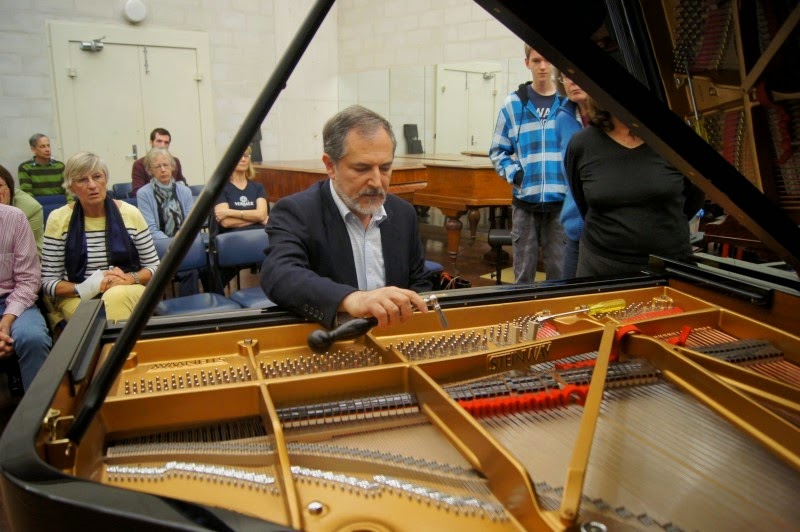
It's not just the music that fascinates. The piano is a complex and beautiful thing and it was honoured when Ara Vartoukian gave a workshop for the CIMF Fringe yesterday. Ara is a piano technician based in Sydney; he looks after the pianos in the Angel Place Recital Hall amongst others; the session was called the Piano whisperer. He was talking of pianos, especially Steinways, and tuning. It was the tuning that particularly interested me, being myself a very amateur tuner of an old piano. Ara spoke of equal temperament; how it's necessary but scientifically incorrect; how it has a human element (we hear high notes as flat and low notes as sharp); how he uses thirds and cycles and intervals; how he tunes not just for pitch but for maintenance of that pitch (releasing stress with fortissimo staccatos then, unlike guitar, tuning down to a note); how often he tunes and registers instruments; how he stretches the tuning and how different stretches serve different purposes; how to make a piano sound honkytonk. If I got it right, tuning is built on overtones and the beats between intervals: around 0.7 sec for a major third. It all happened quickly with his experience. Firstly the strings are damped with felt, so only the middle of three strings plays; he tunes the middle octave, then spreads over the piano, then removes the felt string-by-string and adjusts the partner strings. It's quick, although I noticed even on an ANU Steinway grand there were a few notes that demanded extra tweaks. He removed the keyboard and the mechanism was laid bare. It's a strange sight: an open mouth on a grand piano and the complex, repetitive mechanism of the keys laying on a table. This is all a mix of craft and art and even some science on the most essential of instruments and the product of a year's training and subsequent experience. Fascinating and aurally challenging.

Ara Vartoukian (piano tuner) talked pianos and tuning at the ANU School of Music for the Canberra International Music Festival Fringe.

15 May 2014

Music for my funeral


People have music at their funerals and I've often thought what I might wish to have at mine. We heard Mozart's Requiem tonight at the Albert Hall for the CIMF and it's profoundly melancholy and touching, but who would have the self-regard to think they justified it? Who could deserve it? We've heard a performance before. Everyone knows it. It was played here on period instruments (A430Mhz). It's tragic; it's truthful; it's redemptive and ecstatic. How can you respond to the choir singing ever-rising sequences? With tears or with unhinged laughter? It's just too profound. It's mostly choral, but there are passages of four solo voices: soprano, mezzo-soprano, tenor and bass. They sometimes sing individually, but mostly with entwined voices, perhaps the tenor appearing through, or the soprano soaring, or the two women in harmony. This version was shortened from the commonly performed one. It was a version by Richard Maunder that's missing three passages (Sanctus, Hosanna and Benedictus) that appear to be Süssmayr not Mozart. Süssmayr was the student of Mozart who was supposed to have completed the work when Mozart died. I'll check our CD later to hear the missing passages, but there were more than enough renowned and deeply affecting passages here. This is music that you wish won't end. I heard it as a little rough in the orchestra at times but very nicely performed by both choir and soloists. The string sections were led by seasoned performers, but these were young players and they were apparently playing on gut strings for the first time. I know gut on a double bass and it is a very different experience so I feel for them; a baptism of fire. Mozart's Requiem was performed by Simone Riksman (soprano), Hannah Fraser (mezzo-soprano), Christopher Saunders (tenor), Andrew Fysh (bass), the Wallfisch Band with ACO2, Elisabeth LeGuin (cello), Albert-Jan Roelofs (organ), Song company with the Sprogis Woods Smith Young Artists and Roland Peelman (conductor).

Preceding the Requiem was another work of death and immense sadness, a Stabat Mater. Stabat Mater is a 13th Century Catholic hymn of Maria dolorosa standing under the Cross of Jesus. You can only imagine the depth of sorrow in this image. Stabat Maters have been written by many composers. Pergolesi's is the famous one; this was by Luigi Boccherini of Lucca. This version was a new edition by Elisabeth Le Guin for three voices. Elisabeth ventured from the US to play cello for this performance. I enjoyed this performance but was a little non-plussed by Boccherini's work. The first notes are appropriately mournful, but then the music becomes merely dignified, then perhaps dramatic, sometimes almost light and danceable and not sufficiently pathetic to my ears. None-the-less it's a worthy work, Elisabeth's work is admirable and I loved the three voices, tenor and two sopranos. I particularly enjoyed the tenor, although intertwined sopranos were also luxurious. Boccherini Stabat Mater was performed by Susannah Lawergren and Anna Fraser (sopranos), Christopher Saunders (tenor), the Wallfisch Band with ACO2 and Roland Peelman (conductor).

  • The painting is Pietro Perugino, Mary at the Cross (1482) National Gallery, Washington DC, USA. Click on pic to view larger
  • 12 May 2014

    Just perfect music


    There's so much that goes through your head after a decent concert. This was the Canberra International Music Festival and the concert was Bach (with some ring-ins) and we could only leave with beaming smiles and a rollicking gait. Firstly, we were talking of the Albert Hall as a concert venue, and how it's so good for chamber work of this size with an audience to sop up the reverb: live but not soppy; clear voices and ringing baroque trumpets; perhaps a little bass heavy (Max McBride was alone but filled the bottom end). And the experience is so European concert hall with an architectural experience that is so out of place in our new metropolis, with the large windows and suggested columns with Ionian scrolls and hinted flowers. Then the music. A jazzer said to me in passing that "he sure can write", meaning Bach can compose. It's an ironic throwaway line, of course.

    I'd read that the Magnificat was originally written in Eb (the current version is D major). It was first performed at Christmas 1723 with two other new works. Bach had arrived in Leipzig in May that year and had already written 30 cantatas by Christmas. Genius. Magnificat (D major, BWV243) is ~27 mins in 11 movements for 5 voices and 5 instrumental parts. It starts with a joyous, vibrant canon on "Magnificat anima mea Dominum" (My soul magnifies the Lord), through various solo sung parts; two very different sopranos, perhaps over oboes or strings; bass over a ponderous but amusing accompaniment of cellos and double bass; countertenor and tenor with lyrical melody over violins with pizz bass and short cello. Always the lanky but sinuous Roland Peelman conducting by feeling every nuance. I can understand the value of a conductor when I see this man. Through more choir with a sudden stop (on 1+?) and an end with baroque trumpets and timpani; a 3/4 introduced with violins and cello responses, and again that neat, square and brisk bass; then countertenor with pure flute tones; three females singing over one cello and organ; a vocal canon starting elephantine and rising through male to male to female to female, dignified, then into an exultant final Gloria with trumpets and timp. This is not all, but an impression. Half an hour of the most perfect of music. I'd first thought this is the most perfect music during the final movement of the previous work, Bach Concerto for violin and oboe in Cmin BWV1060. This is three movements, instrumental with two solo melody instruments, with a middle movement in 3/4. It is fabulous and beautiful and unrelenting and sequenced, but it's also a piece I've heard a billion times on ABC RN LNL so it has the advantage of being ridiculously familiar. Elizabeth Wallfisch was to solo, but had fallen off a bike so was replaced by Matthew Greco at short notice. He did a great job, although he was often a bit quiet for the oboe. A fabulous work and very well done. I'm thinking European familiarity with this music, now. Albert Hall suited the baroque with intimacy and acoustics, but also the informality, reminding me of unexpectedly casual canteens at the Amsterdam Concertgebouw and the Berlin Concerthouse.

    What else? Before the interval was a short fanfare, Handel Battaglia from his opera Rinaldo, all trumpets and timpani and suggestions of battle (I missed this) and agitation and ferment. Then a change to the program due to Elizabeth's bike accident. Another Bach was replaced with an oddly unexpected but fascinating duo playing 900yo Armenian music of Gurdjieff and the Silk Road. These were two tunes played on duduk and organ: Grigor Naretski Fowl of the air was a mutating scale over a single note organ drone; Khatchatur Taronetsi Mystery profound had a more complex duduk melody over small organ chords. I heard lots of long notes; (I guessed) flat 3s and 6s but the scales changed; slithering legato and strangely Mid-Eastern vibrato. Lovely, diverse and meditative. Then one more Bach, his Cantata Es erhub sich ein steit (There arose a war) BWV19. It's magnificent but I don't hear the war reference without reading the German. As for performers, I couldn't help but love the baroque trumpets and timpanis when they let fly. I admired all manner of instruments - strings, oboes who had several featured passages, the lovely baroque organ, the cellos and bass that also had their features. But most of all I loved the voices. This was the Song Company presumably with a friend or two and they were glorious, as solo voices or intertwined in a canon. Precise and beautiful voices, both men and women. So, this was a huge pleasure and more coming.

    The various Bach and Handel were performed by the Song Company with guests Sonya Holowell (soprano), Susannah Bishop (soprano), Tobias Cole (counter tenor) and Richard Butler (tenor). Musicians included Elizabeth Wallfisch (violin, unexpectedly not soloing) and the Wallfisch Band, Elizabeth's replacement Matthew Greco (violin) and Leo Duarte (baroque oboe). All around Roland Peelman (conductor). The Armenian players were from the Gurdjieff Folk Instruments Ensemble: Emmanuel Hovhannisyan (duduk) and Levan Eskenian (?) (baroque organ).

    10 May 2014

    New to me


    Contrafact was a new one on me, but it's there, in Wikipedia. It's a new melody over existing chords, a common compositional technique in bop because melodies are copyrightable but chord sequences aren't. I'd never hear the term, contrafact. Alex Raupach introduced it for a few tunes at his gig at Smiths, with Steve Barry, Alex Boneham and Mark Sutton. This was one great band. Again a winner. Alex is playing with much maturity with unrushed lines, often extended, nicely structured and unpretentious. Steve's lines can be like a column, unrelenting, long, hinting at quotes but not quite, with solos building from even but sparse, doubling time then doubling again, always logical, sequenced, neat but also intriguingly bent. Alex will be swinging or ostinato, mobile over the neck, low to high, wonderfully formed strong tones from a firm right hand technique (see that finger bent over a string, feeling the weight, taking the pressure) and solos that spelt out clear sax-like intervallic melody, not easy on the doghouse. Mark a powerhouse, driving, brushes, sticks or flipping the stick to mallet, attacking the fills or driving the rhythm. I often find I concentrate on one player ona night. Mark was that for this night, although I did take a few glances at the others. The music was not too practiced, but their skills and reading drove through it. They soon get the feel of the tune and the ability shines. They'd played a standards night at Hippo the night before; apparently this was loud. Smith's was more the concert performance, original music, contrafacts from Lee Konitz (Thing-In on the chords of All the things you are) and Alex R (Tower condition on Isfahan). Ron Carter's 81. A range of originals by Alex R, often melancholic, and one by Steve Barry, Sahara. Interestingly, a few references to poet Dorothy Parker "Some beautiful things, even in change, wondrously remain the same". Alex sang some lines against the final tune. It's an interesting expansion on instrumental jazz; I like it lots. An involving night with some wondrous playing and substantial tunes. Last visit was in February. I can only hope this becomes habit.

    Alex Raupach (trumpet) led a quartet with Steve Barry (piano), Alex Boneham (bass) and Mark Sutton (drums) at Smiths.

    08 May 2014

    Symphony or concerto?


    This was another great success for the Canberra Symphony under Nicholas Milton. I wasn't so taken by the first half: Mozart Overture from Marriage of Figaro, a light and recognisable piece to start the night, and Beethoven 4th piano concerto with pianist Clemens Leske. I think I prefer symphonies to concerti: more democratic, more balanced and internally consistent, whereas a concerto, even with a 9' Steinway (which I presume they were using) is still unbalanced between solo instrument and the strength of even smaller orchestra, and essentially more an individualist, even competitive event. Maybe it suits the times. The Beethoven was all long chromatics and weighty left hand melody and the lines felt not so even and not too obviously resolved so this didn't so much appeal to me. Then interval, another wine and a return to Mahler Symphony no.1. The first notes were quiet and I wondered if this was indecisive. Not at all. Phrases were soon appearing, from different instruments, even from trumpets off stage, appearing then decaying. Hints. A passage of threat. Then busy, interacting, layered themes, pulling together for a joyous, outgoing, vibrant country fair. Flutes as birds; strings answering; single note harp tacking; deep slurred notes bowed on bass. Then on through layers of melody, and an explosion of percussion and horns and brass. This first movement was richly layered with a touch of rural idyll. The second movement was a strutting 3/4, a lone horn, into a smoother, seductive waltz, then a return to the strutting 3/4. The fourth movement started with a solo bass playing Frere Jacques (kid you not) then a canon through cellos, violas and the rest, melding in and out with another Yiddish-sounding folk song. Nicholas Milton is flailing; he's an effusive conductor, calling for dynamics that an orchestra of undemonstrative Australians is a bit loath to give him. I reckon he's good for the CSO; they could have a little more abandon. Then into the final movement, perhaps revisiting the first, explosive from the start, then through various rises and falls, of volume and intensity. Big with tubas and standing horns and timpani and brass; swingeing bass lines. I thought I judged the finale, but it came and went and came again. Perhaps for a first time, I followed the symphonic structure with some understanding, but I still don't know why the combinations of complex layers then that odd 3/4 second movement with the sandwiched waltz, then Frere Jacques and the folk tunes, then the complexity and energy of the finish. In such a big space, Mahler could have done with a larger orchestra and extra dynamics, but we loved this nonetheless. Very interesting and attractive and satisfying. The orchestra again did the night justice, Clemens Leske did an good job, the combination of works was impressive, even if I had a clear preference for the Mahler symphony, and Nicholas Milton was ever the fine host and vibrant leader. Congrats to our locals.

    The Canberra Symphony Orchestra performed under Nicholas Milton (conductor) at Llewellyn Hall. Clemens Leske (piano) soloed in the concerto. The program was Mozart Overture from Marriage of Figaro, Beethoven Piano concerto no.4 and Mahler Symphony no.1.

    07 May 2014

    Studio to stage


    Blow sounded more like a recording than a live band. The horns merged into notes like brothers and the whole was unhurried, unfrantic, even though there was plenty of energy and action. Peter's sax had a tone that was full and he'd sit long on notes then respond with a simple line or a flourish, but never, ever out of place. His phrasing was a lesson in modernity. Ian's flugelhorn could blow like bop and it did sometimes, but it could also drop into rubato and verge on free. The era suited this, modern cum post-bop, some fairly obvious changes, some ostinato-based tunes, some standards of the era, You don't know what love is, Naima. I immensely enjoyed a Jobim tune, known as Double rainbow or Childrens' games or Chovendo na Roseira (it appears under all these names on YouTube). Also a final tune that was floored me with understated beauty, a floating rubato feel with closely felt melody played by the front line. I've never called anything spiritual here (too new age for me), but this was pretty darn close. The first set was more solid, post-bopish, ostinato bass; the second more open and perhaps adventurous. Their You don't know what love is started as a tenor ballad with a bridge of Coltrane swells, then moved to flugelhorn playing fleeting staccato against drums and piano. Bass entered and the band moved through various feels - swing, cacophony, rubato, double time swing, some latin comping and more - finally into a final piano solo of octaves and another cacophony. All right on the night, I expect. All very comfortable but musically daring. Ian explained he had played with James for 25 years, sleeping on floors, playing daily for hours. Ted and Bob had played together longer. Our Canberra intern, Gareth, is the newbie but was neat and evenly solid toned and often unobtrusive and modally exploratory in solos. Ted's drums were deceptive; open your eyes and they seem unspectacular; close them and they sometimes writhe, otherwise sit with intent. Bob's piano was probably the most bubbling, irrepressible instrument on the stage, not so much with comping, which was wonderfully rich in colour and modal movement, but more in solos or some single note backings that were as much concurrent soloing played busy and mobile. I liked this band. It's an era I love and I could close my eyes and it sat with studio-like discipline but also artistic intrigue. It takes years to sound this comfy. These guys had it.

    Blow are a Melbourne institution. Ted Vining (drums) leads with Bob Sedergreen (piano), Peter Harper (tenor), Ian Dixon (flugelhorn) and Gareth Hill (bass).

    06 May 2014

    Beware the memory hole


    It was in everyone's school bags when I went to school and it was about Stalinism, not about our world, but there's something in common and we're talking of it now. We've been talking of Orwell for decades and he's claimed by right and left. We'd seen this very company, shake & stir theatre co., doing Animal Farm sometime last year. We caught them last Saturday with 1984. It was not an easy night. The performance was without interval. The story was close to what I remember. Room 101 and the prior torture were excruciating. The love scenes were hopeful. The perverted response of one character whose 7-yo daughter had dobbed him in for thoughtcrime (supposedly talking in his sleep, "Down with Big Brother") was agonising. He could only agree that thoughtcrime comes uninvited. And we shivered with the commitment of youth who will dob in a dad for an ideology. An imposed ideology at that. There are warnings here, of course, for all manner of politics. Memory as the basis of truth, and how it can be manipulated. Think our constrained media and our life of pleasurable immediacy. There's a line about wars that can't be won but must continue. The obvious recent case is the War on Terrorism that is without end, but Abbott said just in recent days (paraphrasing), that we can't win the War on Drugs but we can't cease it. No way do I think he's expressing tyranny, but the thinking is inherently Manichaeistic and dangerous; in Bush's words, with us or against us. How much are we influenced by Orwell: newspeak, thoughtcrime, doublethink, Big Brother, memory hole, Ministry of Truth, Room 101, unperson. The spin that is expressed in the label, Ministry of Love: we see it every day, even in the naming of legislation. The two-way telescreens that are everpresent are parallelled in our big data, surveillance-rich society. We haven't come to 1984, yet, but this is a parable of warning. It's frightening but worryingly familiar.

    shake + stir theatre co was established in 2008; they are a youth theatre company; they tour with Australia Council assistance; they are convincing and the works I've seen have youthful intelligence and wariness. Long may that last. They are annually seen by an audience of 180,000. The cast were Bryan Probets (the central character, Winston Smith), Nelle Lee (Julia, his lover), David Whitney (O'Brien of the Inner Party) and Ross Balbuziente and Nick Skubij. Michael Futcher directed. This was a terrifying and uncomfortable night of premonitions and warnings.

    This is CJBlog post no. 1200

    05 May 2014

    Bush baroquing


    It's strangely apt to go off to the bush to hear baroque. It's quiet and that seems right, although baroque towns would probably not have been quiet. Richard and Joan Milner have a suite of period instruments in their music room and are generous sponsors of concerts for charity. This one was Peter Hagen on harpsichord and a lovely little baroque organ with Jane Downer on baroque oboe and oboe d'amore. JS Bach was there, but also son CPE and students, Krebs and Homilius, and Homelius' student, Tag. It's interesting to hear the various composers and get some sense of change through their styles. Peter started with a Telemann Prelude, not on the program, in memory of the organ builder who had died recently. Telemann lived contemporaneously with Bach but this piece felt earlier, with single note lines in counterpoint on a lovely chamber organ. The tone was small and delicate, soft at the lower end and flut-ish above. Then Bach's Fantasia Jesu, meine freude, with long oboe notes over more chordal keyboard. Then two pieces by his student, Krebs, in the JS Bach tradition, but clearly lacking his brilliance to my ears. I liked Krebs' second piece, a chorale on Jesu, meine freude, which was again single note counterpoint. Homilius was another student of Bach's. His Sonata à oboe solo col basso in F major was longer and more complex, comprising four movements. Then CPE Bach's Fantasia for keyboard. Interestingly, it's in C# minor (an unfavourite key in this household). To me this was showy; played with heavy chords, whispy runs and pensive passages in response, overt emotions. Then JS Bach Trio in D minor BWV527 in 3 movements. Apparently CPE had said that music like this would forever be popular, but Beyoncé is more popular now; music always passes. Then two Krebs to finish with. Baroque is always a pleasure and we are hearing it increasingly on original instruments, paler but more intimate than their concert cousins. It's a lovely way to pass an afternoon in the bush, with young Aussie bush in the background and old European sounds in the foreground.

    Austral Harmony are Jane Downer (baroque oboe, oboe d'amore) and Peter Hagen (harpsichord, baroque organ).

    Catching up

    Only a quick visit to M16 Artspace in Griffith. I remember this as the Griffith Library and before that it was Griffith Primary. Now it's a gallery with artists' studios and this was my first visit. It just shows you how much can go under the radar in a vibrant community. The event was an open day. Artists were in residence and displaying and chatting. There were coffees (of course) and sausage snags (superior: from Griffith Butcher) and local school bands. We caught Melissa Beowulf, portraitist, painter. Melissa has been hung in the Archibald shortlist and her painting of the White Mouse (Nancy Wake, New Zealand born, Sydney resident, served as an agent for the Brits in France during WW2, someone for whom you could seriously use words like courage and hero) is in the National Portrait Gallery collection. Also Thor Beowulf, bonsai expert and academic. Good to catch you both. (Di, sorry we missed you).

    04 May 2014

    Bass indulgences


    Andy Irvine was in town for a bass workshop for Warwick. These workshops are commercial events, of course, held at a store and telling good stories about whatever products, but they can be informative and they get you up close to a decent player. Andy Irvine is an experienced studio muso with an obvious pedigree as a working muso with chops and a range of styles under his belt. It's something I admire. And Warwick instruments are deserving of some good press. I came latish so ended up sitting front row, very close. Australian audiences tend to be quiet, so Andy ended talking lots but with a philosophy that I can only agree with. Here are some ideas. Musos are sometimes like horses with self-imposed blinders (thus limiting themselves - it's a great image). Respect traditions, know their strengths and play them right ("Do what it calls for"). Blues and country are often denigrated; it's hard to resist temptation but embrace simplicity, have discipline. True masters are master listeners. There's synergy in parts, so music requires compromise; it's a fine art of collaboration. Collaboration requires etiquette. It's a team sport and we can only effect out part ("Take care of our side of the street"). Every style has its own sophistication, is equally valid; what matters is to "feel the muse". Tone is available through technique, and these are dialects of the language (slap, thumb, fingers over neck, pickup, bridge, etc). And to end: Learn the rules, of course, but then break conventions ("rage against the machine") because that's how you get innovation. All good advice. I would have liked to heard him play more. He has big hands that pretty much smother a Warwick Thumb bass and he delivers great tone with slap and finger and thumbs nicely merging. And Warwick, of course. He mostly spoke of the factory. Son of Framus (that's interesting); located in East Germany; the importance of wood and some of the processes; the approach to Chinese build for the Rock bass series; interestingly, their respect for the environment. I didn't know that the bright yellow frets are bell bronze and it's very hard so long lasting. I also learnt about tigerstripe and black ebony for fingerboards and I can now recognise wenge. Also that they produce 80-100 basses per month in the German factory, so it's not a behemoth producer. All interesting and entertaining, at least for the collected bassists at the event.


    Pic by Alec Coulson for Andy Irvine

    03 May 2014

    What is it about geologists


    What is it about geologists that makes them question climate change? It seems to me that about the only scientists who question cc seem to be geologists. I've mulled over this one. I suggest (my hypothesis) is that they know of great changes in climate over lengthy periods (6 billion years, I guess) so they don't see climate change as unusual. The problem is, though, that human kind has only been around a small part of that time, and civilisation is only dated at 10,000 years ago and climate change is very rapid and it may not suit humanity. Even if people are around, civilisation may not be. (Think: NYC has flooded already and it cost $60b; the floods in Qld cost $6b and a tax levy; when does this become uneconomic). See, I actually like civilisation. There have been a few that have come and gone (around the Euphrates; in the Americas; in SE Asia; once verdant Sahara), so it does happen. Now we're one big civilisation and climate is changing fast and the mechanism of greenhouse gasses has been known to science for 150 years or so, and we're at 400ppm and adding another couple each year, and 2 degrees warming (guessed to come at 450ppm) is a rough estimate of where runaway climate change could happen given various feedback loops (the ubiquitous "tipping points"), and we've got buckley's of staying within 2 degrees. And I'm pessimistic.

    So, why did I bother to attend Matt Grudnoff of the Australia Institute talking about the Renewable Energy Target the other night at Politics in the Pub? Glutton for punishment? FWIW, here are a few points he made, if I got it right. RET was set at 45K kwh by 2020. RECs (Renewable Energy Certificates) were bought. They were popular (I thought, to what degree from subsidies?). RET was created by Howard in 2001 and was successful, perhaps too successful. Not as efficient as the carbon tax, but better than most other approaches. RET was initially supported by fossil fuel industries, but became unpopular when electricity use dropped due to reduced industrial use (GFC and industrial closures) and improved energy efficiency (buildings, appliances) thus threatened stranded assets (excuse me cutting out swathes of the argument). Most income from electricity is from wholesale prices that soar with peak demand (25% of profits come from 36 peak generation hours each year!) but peak demand was limited by strong generation by renewables (wind, solar) at peak times (aircon, etc). As for carbon tax and electricity prices, carbon tax makes up ~9% of electricity costs; ~55% is network costs. Existing power stations were build by government and sold off after depreciation, but building new generation capability is too costly for private industry when capital must be depreciated, or at least would make this electricity uncompetitive. And recent studies (in the paper last week) suggested downward pressure on electricity prices from renewables, given no input fuel (coal, gas) required and increasing efficiency with an expanding industry. There was more argument and it was pretty dry, if important. Whatever, it may all be crap like climate change is said to be. But I don't think so. I'm not so cocky as to think I should have an opinion on science. Science seems a pretty good tool to me. So, my thoughts? Be very, very worried.

    02 May 2014

    Hey Shorty


    Ah, that was fun. It was just a bit of jazz-funk-fusion. Locals Shorty and Chow were playing. But those 16th notes can enliven things and the funky beat on the one makes for so much energy that this playing was pretty relentless. They played originals, too. There were just a few standards (Alone together, Cissy strut, Softly as funk, Ladybird as swing for an unexpected encore) but these were mostly originals, by guitarist Luke or by bassist Barnaby. Barney was a monster with some solos, playing lightly with two finger pizz, plenty of chromatics and some impressive fast ascending picked slides and some massive descending lines that I guessed mixed chromaticism with seconds. Great fun. Luke was comfortable somewhere in Scofield with distortion and echo and often dropped into this sound, but just sometimes played straighter. I thought he was nicely contained and structured his solos well, changing tones, maintaining long eighth-note passages, perhaps going heavy with chords, often against drums. Jonathan plays pretty straight and swinging and driving drums and can build up a head of steam. He did this tonight for several solos, but also building very strongly behind guitar solos. Julian was more the individualist soloist, often restrained, slower, thoughtful as sax is, sometimes with a deep water bubbling tone, other times with a thinner, straighter alto voice, often venturing into interesting dissonances. Nice again. The final tune, Barnaby's Dancing with Gertrude was my favourite for the night and obviously a feature, laying out the melody in nice unison against odd timing, then strangely dropping tempo and speeding up again then playing a 16-th note funky feel in four for the solos. Luke's Suspension was quirky and busy unison lines for all parts, again 16-th notes and bass ostinato. Barney's From both sides was another ballad, this time with bass playing melody against swelling guitar chords. The other ballad was Luke's Terrace with guitar strumming that reminded me of 50s Hawaiian guitar. His Subtonic counted as a steady 7/4 with an angular melody, then into solos in three. So, local fusion with decent chops and some original themes. Good to see, and well enjoyed.

    Shorty & Chow are Luke Greenhalgh (guitar), Barnaby Briggs (bass), Julian Fung (sax) and Jonathan Harding-Clark (drums).

    30 April 2014

    Unexpected blues at Woden


    Caught busking at Woden today. (Robert) Owen Campbell playing slide guitar and singing. I enjoyed the little I heard. This was satisfying blues, slide guitar, authentic confident voice, firm playing, strong sound and with some nice dissonance from Middle Eastern scales in the instrumentals. Owen is playing with his band at the Abbey in a few days. He's on tour promoting a new CD, but I guess he's a local. I've caught him before busking at Woden. Who would expect the blues at lunchtime in Woden? Sunshine but a cold breeze mid-week so the blues are not totally out of the question.

    29 April 2014

    Naming a new ensemble


    It's good to see the birth of any new ensemble. This one is the Foray Quintet and it's done it first tour with two piano quintets by Fauré. The lineup is piano with two violins, viola and cello; five women from a Canberra / Melbourne association. The name obviously refers to foray as in new undertaking and to Fauré, the composer who they played it on this tour. I'm told we can expect to hear other composers and other combinations, but these two works by Fauré were lovely: modern but with a melodic bent, attractive and thematic. Kimberley introduced the first work, Fauré Quintet no.1 D minor Op.89 with a few observations and associated musical samples. About how the first quintet is bright; the other darker and more complex. About how the accompaniment moves harmonically, how the passages "travel". I understood in diatonic chords rather than in single line phrasing. Kimberley suggested a jazz awareness. Also how the rhythmic movements were more "circular" than "square" as in marches. Again I thought jazz and swing, at least a softer feel. Strange, this, but the final movement of the Op.89 was almost the theme of Fly me to the moon with its falling, rising, falling phrase, starting initially with the pianistic simplicity of a music box. Felicité introduced the other work, Fauré Quintet no.2 C minor Op.115, with descriptive impressions: first movement period drama and obscure moments then Alice in Wonderland; second movement slow man running on beach; third movement dreamtime, end of a busy week, tired reflection that the "viola keeps in check"; fourth movement another musical reference, to the Game of Thrones theme, or perhaps the tango. We all have our own visualisations for music; it's interesting to hear someone else's. This was very beautiful, dignified music, nothing like the extremes that modernism was to develop to, lyrical and sweet but with honest straightforward connection. I was amused to see in the program that Fauré has been called the St Francis of music and was variously described as modest, timid, grateful, content. It's not flamboyant music but immediately comprehended for its with honesty and depth. This is just the second performance of the first tour, but the ensemble was comfortable and convincing and the music seemed well suited. A lovely outing and looking forward to another down the track.

    Foray Quintet played two Fauré's Quintets. They comprised Kimberley Steele (piano), Elyane de Fontenay (violin), Felicité Heine (violin), Sarina con Walter (viola) and Anneliese McGee-Collett (cello).