22 August 2014

Latin as a language


We went early for Blue Note for the Lain side of Horace Silver led by Conrad Herwig with guest Michel Camilo to get decent seats at the bar and we got the two best. There was some waiting outside, but people watching is interesting in this busy entertainment area. The band came on very casually and played a string of tunes by recently deceased Horace Silver. The playing was exemplary and the tunes were memorable. Conrad chatted with the audience, but the crowd didn’t catch his discrete humour and his references for the au courant. This was great playing but something was missing. The crowd sat as in a concert; the band stood and read. At one stage saxist Craig Handy turned a little and bopped along. I was thinking this, but the arrival of Michel Camilo for the last few tunes just confirmed it. Suddenly the place was alive. Fast, earthy, fleshy. The music showed it, alive with clave forming the beat and the flailing keys on piano and the dense polyrhythms from the congas. This is not at all a comment on musicianship. All the band was impressive and I was blown out by solos before and after Michel’s arrival and alternate pianist Bill O’Connell’s solos were intelligent and played with intriguing dissonance. This is about culture and the difficulty of visiting someone else’s. Michel just had it in his blood and the groove exploded in his hands. The band lifted immensely and immediately, pushed and cajoled and seduced, as were audience, and we were south of the border and it was warm and the music was irresistible. But what of the tunes? There were seven in a set of about 80 minutes. The band played the first one unannounced then Filthy McNasty, Peace and Doodlin’. Michel replaced Bill for Gods of the Aruba, Song for my father and Nutville. The arrangements were great, with those three horns out front. The rhythm section did its latin duty and I was particularly taken by Ritchie Flores on congas for some blow-out solos of enthralling rhythmic complexity. Solos from the horns were stunning. Conrad’s trombone playing was diatonic and to die for, hugely fluent and perfectly phrased and intoned. Alex Sipiagin on trumpet spoke well with Conrad on the heads. I was taken by saxist Craig Handy and his broad palette and inventive soloing. Michel was just volcanic. He introduced his first tune with an unexpectedly gentle passage of piano and trombone duo, but then it was all flailing fingers and hammering hands and floods of notes. The life of Latin. We went happy into the night.

Conrad Herwig (trombone, arrangements) led his Latin side of Horace Silver at Blue Note. The band comprised Conrad with Alex Sipiagin (trumpet), Craig Handy (saxes), Bill O’Connell (piano, arrangements), Ruben Rodriguez (electric bass), Richie Flores (congas) and Robby Ameen (drums). Guest Michel Camilo (piano) replaced Bill O’Connell for the final tunes.

21 August 2014

Do as Harlem does


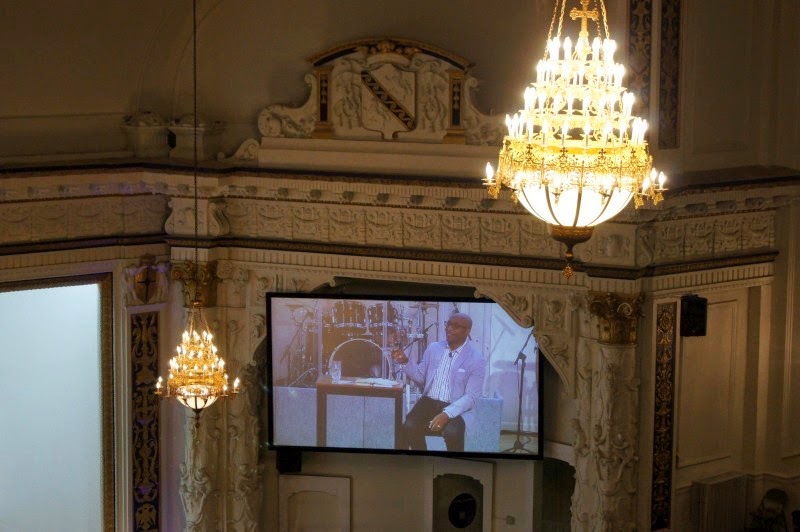
First Corinthians Baptist was the church we ended up in for a Harlem Gospel service. It was an experience but suffice to say I am not converted. There was a strange level of control for tourist visitors, but probably this is required. I did notice some visitors sneaking in videos when they were asked not to, but pics with no flash was OK. The hall was a tiered theatre with decorated roof, boxes, stalls and gallery, and complete with steep stairway to the tourists’ gallery. There was a stark white stage with Proscenium arch and timber floor, a six-piece band (2xkeys, piano, bass, drums, perc. Amusingly the drummer was housed in a booth and the bassist played a very pretty Ken Smith 5-string), eight dancers, eight singers, a preacher. The sermon was long, on depression / suicide using quotations from Job, in the light of the recent suicide of comedian Robin Williams. This was interesting, a lesson in rhetoric and firm voice, with four rallying emotional peaks, laying hands on a grieving parishioner, denouement with soft piano, hands raised by parishioners in approval. I fear such emotional control but this was in good service and the parishioners really were impressive, joyous, open after the event. I found the occasional disrespect from tourists more troublesome. The music and singing were decent and nicely unassuming. The sound was problematic in such a large and reverberant space. The accents were sometimes difficult to catch. I wondered if, as a tourist outing, this is a little disrespectful, but it’s a common one on the NYC visit and at least we could leave a donation and act with dignity when we were there. I wonder just how it goes down for the community but they allow and manage it, so not all bad. And I was impressed by the themes of Social Media / Social Justice Sunday which included discussion of decent pay and even (a current-day heresy) the rights to form workers’ unions. Not thrilling or successfully evangelising of this recalcitrant but informative.

18 August 2014

Reacquaintancing

There was not too much new here, but son Rich and I went out to visit West Village in NYC. It’s an area I’d stayed in three years before and written up on CJ. We are in Brooklyn this time around, so we cant just go out the door and walk to a mass of jazz clubs, but our Bkln is quieter and more refined. We are in Park Slope and I’m told it the current or recent home of several Australian ex-pat musos here in NYC,, but it’s getting dearer with gentrification. But the Subway is nearby (7th Av, F line) and this line goes to W4th Street, which is where we went for this night.

It’s a warm summer evening and the weather’s as good as ever and this is near Washington Park and NYU and the place is throbbing. First stop is around the corner from Blue Note at the little basement club Bar Next Door. I notice that Andrew Swift was playing here recently. Ben Monder is playing this evening with a trio. Excellent. We just catch 30 mins at end of the first set and it is vert good and Ben is quietly spoken, in speech and playing, but is spectacular. Offsiders were Gary Wang (bass) and Jochen Rueckert (drums). I’d heard Ben with Paul Motion; Gary has played with PM; Jochen had visited Canberra with Jacam Manricks. It’s a small and Smalls world. Some searing or quietly spoken guitar, loops, overdrive, gentle technique and tunes; unyielding drums and perfectly intoned, slowly spelt bass solos. Truly a treat.

Then off to Smalls (at the time, sold out), 55 Bar (more blues-funk this evening, next to the historic Stonewall Inn), Village Vanguard (sold out) and Jazz Garage (bluesy this night). Outside Smalls, we met Smalls’ resident artist and viewed some drawings. Sadly missed his name, but here’s a pic. Off to Fat Cat with its odd but intriguing mix of local social club and music with $3 entry. Lawrence Clark Quintet were playing a take-no-prisoners set of hard bop with lengthy solos. There were listeners, drinkers, socialisers, players of various table-top games. It’s a young scene, busy and harmless and inviting and unique in my experience. Lawrence Clark (tenor) led his band with Josh Evans (trumpet), Keoh Hill (piano), Kush Abadey (drums) and Dean Torrie (bass) was sitting in this evening.

West Village was still stomping, but I’m not over the flight yet, and so this was the night. Nice to get back to this locale. Just some pics.

15 August 2014

NYC meets Oz


It was Sydney for the night and the choice was Post-bop or New York. It’s annoying when you have a choice like this. I chose NYC. Mike Moreno (of Bar 55 and more) was playing guitar with some mates: Alex Boneham and Ben Vanderwal. These are amongst the best of the locals and Mike was a revelation so this was an absolute pleasure. And I got to visit a new club, Foundry 616. It was also a shorter walk and perhaps this was the decider. I can only rave about Alex and Ben. They are truly inspiring. I was amused to see Ben perusing charts as he played, throwing in little fills of considerable complexity but he’s such a capable and playful player. Alex was strong, firm, playing incredibly long intervals. This stunned me: Alex was all over this fingerboard. I guessed he was playing 10ths and 11ths and 13ths on one string: long moves, precise, in tune. Alex seems to have a closed-hand technique at times, at other -times, a perfect, neat, spread of the left hand. Either way, it’s a revelation when he plays. But it was Mike who came from the mythical NYC. He was deceptive: melodic, lyrical, then sometimes dropping into the lightest of fills and licks, clearly presented but with a modicum of echo, perhaps increasing during the night, and … and th like. This as light playing, not distorted, spelling the melodies and playing with harmonies but not too daringly. They played had just played together once. Alex mentioned that they were reading, so less comfy but it didn’t particularly look that way. This was hot. There were some originals. Ruby my dear was a favourite standard, but there was also Wayne Shorter and more. I just sat back and took in some fluent playing. Mike fingerpicked with pick under his index finger, or picked with a pinkie for stability. He dropped into discrete sweeps and florid clusters of notes that were stunning, but more notable was a breathtaking ease over the fretboard: fast but not blinding and always expressive and malleable in his phrasing. Despite only playing once together once and concentrating on charts (they were practising as I entered the club ~40 minute early), this was still nectar of the gods. Otherwise, they played Sonny Rollins Airegin, a ballad Time for love, Miles’ Miles ahead, one or two others and some originals. I noticed a common theme of vamps to end the originals: this is a guitar band, after all. A great night. Top NYC meets top Australia. Magical.

Mike Moreno (guitar) led a trio with Alex Boneham (bass) and Ben Vanderwal (drums) at Foundry 616 in Ultimo, Sydney.

11 August 2014

It does not explain everything, nor does it explain nothing


At Julia Gillard's first speech after losing the Labor leadership and the Prime Ministership, I was particularly taken by these words: "... the reaction to being the first female prime minister does not explain everything about my prime ministership, nor does it explain nothing". I think we will think much more highly of Gillard in future than we did a year or so ago. I didn't agree with all her policies (she was often too conservative for me) but she did good work and instigated decent legislation from well founded policy in an incredibly difficult situation, dealing with two oppositions (one within her own party) along the way. I fretted about her communication and it seemed to me that she failed as PM for that is perhaps the key skill, to bring the Australian public with her. But I recognise how strong and brave she was, and how difficult were her circumstances. So with this in mind and intrigued by other views, I attended a book launch of Gravity by Mary Delahunty in conversation with Chris Uhlmann at Paperchain Bookshop.

Mary worked in Gillard's office for a year and has been a politician (State, Labor, Victoria) and journalist. She first talked of Gillard's last day, and how, even on her last day, she had asked of Joan Kirner, who then had serious health issues. Also, how the tone of her office, calm, working, told of her leadership. She considered how, as Deputy PM, she was seen as the most effective in Parliament, but how this had so quickly changed with her accession to PM, so she lost legitimacy and was reviled ("nice girls don't wield knives"). She recognised mistakes, but noted Gillard's strength and competence despite the personal attacks. She observed that "Australians are comfortable with the notion of female power" (think early female suffrage) but Gillard experienced a breakdown of decency (Ju-liar, Bob Brown's bitch, etc) that left the field open for the "nutters". Think Alan Jones' notorious remark that her father "died of shame" (not to forget the "Chaff bag", carbon tax "borders on the treasonous" and "Bring back the guillotine!" comments). Mary observed that Malcolm Turnbull was one of the few who came out against this "vicious and destructive public discourse". Mary thinks this all got to Gillard (not surprisingly; she is human) and at Joan Child's funeral, a few weeks after her father's death, Gillard appeared to be "shrinking". Then that famous Misogyny speech. The strength of that, and the meek response from Abbott and crew were one point of real, emotive, informed communication with the Australia people, and internationally with women. I'd forgotten this, but Mary recounted that it followed a line from Abbott making veiled reference to Jones, that "This Government should have died of shame". I just wonder how Keating would have responded over time to the bitter personal attacks that Gillard received. Mary suggested the three requirements for a good politician are Policy, Purpose and PR. There was talk of that lovely photo of Gillard, taken by 12 year old Sophie with new camera and Down Syndrome, and how it showed her humanity. And talk of more viciousness. Apparently there have still been no apologies over the obnoxious Quail menu. And of the tweets on her 50th birthday, where some rugby league player (Robbie Farah, who's he?) suggested "a noose" for a birthday present and later tweeted that he was not talking of suicide and that people should "lighten up". Again, think licence to nutters. At least he has apologised. Then discussion of the effectiveness of some policy implementation (education as "sector blind / needs based"; I also think climate policy). But also of some failures, like Conway and his media reforms and the State of Palestine vote. Mary reminded us of Gillard's quip that there are 3 people in this marriage (meaning Gillard, Abbott and Rudd). Mary again, that Rudd was "pretty shocking" (and more that I won't quote here) and that Abbott was the most "pugilist" opposition leader in recent history. Questions were about whether the 9 month announcement of the election was wise: "No, I don't think so". Why did her communication change so spectacularly when she became PM: a "great tragedy" but that's not to deny some political errors. Is there less respect for PMs here (vs USA, UK, etc) and what's the role of media and Australian culture: amongst discussion, Mary noted that Gillard "parked her gender" but that her opponents used it. In this gender context, Mary said Julie Bishop has done an excellent job recently on MH-17 but that she is a "protected species" as the one woman in Cabinet: a Liberal members told her "we can't touch her, she's a shiela". Caringly, the last question was about how Gillard is faring now: she's heavily involved in a Global Education project and frequently in Washington DC and Geneva; she has "ups and downs", is sensitive to writings about her and misses policy work and colleagues (there was some mirth and incredulity following the mention of missing colleagues).

This is a complex story and much more will be written of it all and it's too early to see what views the historians take in the end. It's just one policy, but I can only imagine that Gillard's climate policies will be praised and Abbott's removal will be pilloried. As it should be. She had her weaknesses and made mistakes, but, as happens with many women, she was quietly capable beyond many men of her times, but too quietly.

Mary Delahunty was in conversation with Chris Uhlmann at Paperchain for the launch of her new book: Gravity : Inside the PM's office during her last year and final days / Mary Delahunty. Richmond, Vic. : Hardie Grant Books, 2014.

09 August 2014

One for the band


It was the same band, just without a singer (other than Rachael who sang one song). This was the teachers at the School of Music, the local aristocracy of jazz, and they were playing their compositions and a few favourites and it was great. Mike, Miro, Wayne, Mark and new bassist Alec were playing a storm. Right from the start, the tunes were friends. There were two from the Wanderlust stable: Delicatessence and Bronte Cafe, both immensely attractive and infectious. Miro also offered another, Happy world, a new composition seeking a happier place than the current distressing daily news. [I can understand: it's strange how friends and acquaintances volunteer a feeling of despondency these days, but that's for another blog]. I thought of his Peace please; it's another Miro masterpiece that speaks to our common humanity. Then Mike with several of his originals: Standard time and Young guns (he joked of renaming this to Old diggers, given the nature of the tune and that the young guns are now playing Radiohead and the like, rather than the jazz changes), and a lengthy exploration called Contessa Sabra Dalziel (?). Wayne offered a catchy hard bopper called Optimism. Rachael sat in during the second set with a take on the Billie Holliday's heartbreaking ballad, Crazy he calls me ("Like the wind that shakes the bough / He moves me with a smile / The difficult I'll do right now / The impossible will take a little while"). Mike also offered a favourite standard, I'll remember April, and Kenny Wheeler's Kind folk and a blues he'd transcribed that he called Emily's blues. The playing was first-rate. Wayne excited with his broad concepts; Mike's guitar was sharp and genuine and often thrilling in solos; Mark just held it all together and Alec was certain and obviously enjoying the outing. Nice to see some broad smiles and rhythm section mobility on Wanderlust grooves and more. Miro was purposeful and strong and gloriously melodious. Especially during Rachael's ballad, I noticed some wonderful fills but also how Wayne and Mike and Miro didn't step on toes, presumably from time together, but also from just plain class. One friend hadn't come the night before - he steers clear of vocals - but I thoroughly enjoyed them both. Two excellent nights from the best locals.
Mike Price (guitar), Miroslav Bukovsky (trumpet, flugelhorn), Wayne Kelly (piano), Alec Hunter (bass) and Mark Sutton (drums) performed in the Band Room for the ANU School of Music Winter Jazz Week. Rachael Thoms (vocals) sat in for one number.

07 August 2014

If you go


Trish Delaney-Brown was a founding member of a great Canberra - and School of Music - product: the Idea of North. They are a wonderful vocal quartet that I've heard many times on radio but seldom live. They visit often; the hip response is "my bad". This gig was Trish playing for the School's Winter Jazz Week. Trish was singing by herself out front, backed by faculty and friends. The tunes were jazz and popular, standards, latins, ballads, a few originals. Nothing unusual but beautifully done, and collected with a sense of entertainment as well as art. This is the mark of a working musician. My favourite things is from Sound of music so ridiculously well known. So is Hey babe ain't I good to you. But they weren't all like that. Out of this world was a swinger and So what if I don't was slowly swung and Better than anything was 3/4 but with a fast melody and swift triplets and dotted quarter notes over the three beats of the bar, bop-styled. Senor blues was a latin blues with life and The Frog was 32-bar AABA with latin feel and Impressions changes (if I got this right). But a few slower numbers mostly took my attention. Blue in green from Kind of Blues was played as a duo with Trish and Mike; Jobim's Dindi was a thing of floating beauty; best was a glorious take on a delicious but tormented ballad, If you go, as arranged for Shirley Horn. So, these were interesting tunes and some were lesser known; straight-ahead, lively music, not too daring, but so wonderfully played and swung with much drive. Miro's soloing on this straighter material was a revelation, on flugelhorn or trumpet, phrasing modally, moving through scalar degrees and anticipating and leaving phrases hanging. Mike's guitar was sharp and unaffected and simply expressive. Wayne ventured into dissonance most freely. Alec took just one solo, this one on double bass, with clear phrasing and beautiful tone. Mark was in good cheer, inviting Trish on stage at the start with a classic intro, settling then driving the rhythm with incredible solidity throughout, taking just a few solos that sat with aplomb. I guess Trish is alto. I was taken aback when she dropped to a low note with such perfect tone and technique, by classy articulation on fast passages and by some mobile scat. Such technical competence must be a requirement for a vocal quartet like Idea of North so I was mightily impressed but not surprised. But beyond technique, there was personality and purpose. This was a wonderful, hard swinging, nicely arranged and sometimes beauteous concert. Great stuff.

Trish Delaney-Brown (vocals) performed at the ANU School of Music Winter Jazz Week with Miroslav Bukovsky (trumpet, flugelhorn), Mike Price (guitar), Wayne Kelly (piano), Alec Hunter (bass) and Mark Sutton (drums).

04 August 2014

Alternate Pärts


It was a strangely busy and noisy environment for Arvo Pärt but that's what we heard. Coro were partaking of an open rehearsal on the Grand Stairway at Hotel Hotel in New Acton as promotion for their next concert. We will be out of town, so can't make the concert, so this is it for us. For those who can attend, it sounds intriguing. A blend of Bach's Magnificat with Pärt 's seven antiphons and his Magnificat. The Bach is sung by three voices for each of the 5 parts with chamber orchestra accompaniment; the Pärt antiphons and Magnificat are sung by ~18 unaccompanied voices. This rehearsal was for the antiphons and had some interruptions, repeats, discussions with conductor and was out of order, but the performances were still impressive and the music cerebral and unearthly. Apparently this is described as his "holy minimalism" and that seems apt. These were beautiful voices singing minimal changes but moving consonance and dissonance with small chromatic steps. Intriguingly, the writing does some odd things, like the parts being written in different key or in different time signatures, but to a modern ear it all sits with great meditative beauty. Coro's voices are a pleasure, too. They audition voices for the intent of the choir, then choose voices for specific roles, so the three altos in the Bach Magnificat were chosen to sing that specific role together. I wondered over the beautiful high sopranos singing a sustained high A and noted some incredibly beautiful control in various voices; a tenor comes to mind. This choir can hold a note and this note is precise and unforced. Quite beautiful. Passers by noticed the impact, even if they were there to demo some swing dance of attend the adjacent theatre. Pärt and Bach will be much better served in concert but even in the midst of a hip establishment with goings on and passers by, this was performance of beauty and profundity. Coro are a wonderfully impressive choir doing very intelligent work.

03 August 2014

Pre-dinner drinks


Rachel Thoms was singing with Paul dal Broi at the National Press Club and they are two of my favourite local performers. The NPC is a bar event so there's chatter at the end of the workweek and some dancing and the rest, but there's also a grand piano and a corner and weekly performances of the best around town. We heard a range standards sung with grace and ability. To my ears, Paul was unusually adventurous. I love his take on harmony - he can convert the most plebian of songs into performances of worth. Here he was busy and playful with all manner of variations, rhythmic, harmonic, stylistic, and it was an eyeopener. Rachel is never other than wonderfully controlled in voice, dropping into slurs and vibrato at will and always aptly, with that clear and firm soprano voice. This is just a note, but also a reminder that NPC has our most capable local jazz performers playing each Friday 6-8pm (and blues on Thursdays). Free entry for members and friends.

Rachael Thoms (vocal) and Paul dal Broi (piano) performed at the National Press Club.

01 August 2014

Strange sights


It was the strangest thing to attend a concert and see ... nothing much ... a bare altar. We were at concert of pipe organ and cello with performers James Porteous and Clara Teniswood. The concert was in St Paul's, Manuka, a nice lofty stone church with genuine tuned bells and an impressive organ. But the organ was in a loft behind us and Clara was there with James so the visuals were not too special. But the music was lovely. James performed four tunes and Clara played on two, including Vierne Symphony No. 2 and Bach's Prelude and Fugue in G major BWV 541 and Bruch's Kol Nidrei arranged for cello and organ. The third was by Saint-Saens, but I've lost the program. The organ is lofty, big, satisfying, seriously deep, so I was surprised that a single cello was so effective, although the tunes with cello were more subdued. Despite the strange orientation, the sound was good and full in the nave. The Bach was attractive and grand and intellectually satisfying as Bach must be. The Vierne was big, impressive, sometimes loud, utilising the organ and its various stops and diverse pipes and tones. The Saint-Saens was more delicate, quieter, essentially a cello piece with accompaniment. The final Bruch was melancholic with cello and organ. All this happened behind us but I like to close my eyes so little lost there, but odd none-the-less. A lovely concert of church music from the concert program of a group I had never heard of, the Royal Society of Church Music, ACT Branch. Well, I'll be! They keep coming out of the woodwork! And they have monthly recitals on church organs around Canberra.

James Porteous (organ) and Clara Teniswood (cello) performed at St Paul's Manuka

31 July 2014

Phishing for the groove


The band was Pensive Phish. Not a serious sounding name and a good deal of good natured presence but the playing itself was serious. PP was James Luke, Miro Bukovsky, Mark Sutton and one-time student in electronic music at the School of Music, Mark Webber. Mark performs on laptop, so there's processing and contemporary approaches here. Then Lachlan Coventry also along for the ride, playing both Fender VI bass and Fender tele guitar. All that with the minimalist change of Miles of the jazz rock era. Determined and central drums from Mark S and firm and steady bass from Lachlan or James formed the intense rhythms. James might solo, all effects and processing, up the neck, against a riff from Lachlan. There was one riff that passed from Bass VI to James' fatter JB and that was a revelation in variation of tone. I liked Lachlan's firm resolve in bass; James was more playful, so different, but both held strong grooves. Mark S was there, always, solid, inventive when called for, but a rock in laying the foundation. The rhythm section is often all-important; perhaps even more so here. These were great grooves. And was Mark W in there with more grooves? I thought I heard some background percussion: this may have been loops on Mark S's percussion pads. He certainly was with a range of processing, echoes and loops, I guess. Lachlan picked up guitar for some passages, clean and reiterative, sometimes with a blues edge (blues scales made an appearance), even driving and distorted for some rockier sections. It was loud and the audience was following all this. Interesting to see the response to a rock-take on jazz, along with the electronics to make for the contemporary. Miro would fly over on trumpet with luscious modal phrasing, ending on all manner of scalar degrees; not dissonant but inquiring. Then leave the trumpet and enrichen groove with various latin percussions. This is incessant music, flowing and probing, demanding of space to listen and a good ear to follow, even when sitting 4/4 on A or whatever. The room was unusually entranced by a side of jazz we seldom here these days and in these places. There were times where it was a touch lost, but that's the nature of extended grooves, searching for that magic. So, great music and great band name, too.

Pensive Phish was James Luke (bass), Miroslav Bukovsky (trumpet), Mark Sutton (drums), Mark Webber (laptop) and Lachlan Coventry (bass, guitar).

27 July 2014

Let's hope it remains this way


There are times when you realise the professionals are playing and you sit back in awe. This was one of those times. It was a group from the Music School Faculty. Mostly old mates: John Mackay with Miro and Greg and Mark and newcomer bassist Alec Hunter. Other than Alec, I've seen them all many times and often enough been similarly taken aback. This night was pretty open. They played a few tunes - Straight no chaser and Footprints (on request) and Body & soul. Greg's guitar in B&S was a stunner (as he was for the rest of the night, blaring with overdrive or clear and rapid for solos or laying down modal colours behind melody or solo). But the major works on this night were not so ordered; maybe sketches of melodies but mostly open and improvised. Miro and John were both in great form. I was taken aback by one melody snippet late in the night that came unison out of nowhere, but otherwise they were conversational when playing together or strongly independent when playing alone. Alec plays all manner of musics. This time, he was sturdy but quiet and understated. His solos took the band in a different direction, less brassy and outspoken, more quiet and meditative, often rhythm-based rather than lyrical, and I think it was his riffs that precipitated many of the changes in the longer tunes. And they were long: one lasted 32 minutes. But unmentioned is Mark. He was a stunner on the night, holding grooves but also enlivening with ever precise fills and polyrhythms. He observed after that his era has drummers holding the groove. Much contemporary jazz passes that responsibility to bass and leaves drums to percussive colour and cymbals. Horses for courses; all good. Mark was great. I've seen these guys many times, but they remain eye-openers, doubly so on a good night. John mentioned form stage that Canberra has plenty of good musicians. Let's hope it remains this way, but for now there's quality around, in jazz, other musics and all manner of other interests. Capital cities and academic centres are like that.

John Mackey (tenor), Miroslav Bukovsky (trumpet), Greg Stott (guitar), Alec Hunter (bass) and Mark Sutton (drums) played a stunner at Smiths.

26 July 2014

Ah the dilemma


They are essential and central to the process of politics but they have a bad name. These are the professional political campaigners that Stephen Mills has written of in his book (The Professionals : Strategy, money and the rise of the political campaigner in Australia / Stephen Mills. Melbourne : Black Inc., 2014) and which he spoke of when he launched his book at Paperchain. He may have launched elsewhere, but it's appropriate there be a launch in Canberra, and apt also that it be in Manuka. This book is the product of a PhD thesis at USYD but it's also a product of Canberra and largely formed here, through interviews and other investigations. This is the story of political campaigning becoming professional and moving from state-based to national, from uncoordinated to nationally managed. Stephen outlined the main stages, from Labor's Federal Executive of 1915, Liberal's national secretariat of 1945, past Cyril Wyndham, Labor and the first paid political operative in Australia, the first marginal seat strategy of 1951, through funding issues and the first real national campaign, Mick Young's "It's time" in 1972, the first public funding, again under Mick Young and introduced by Beasley, through the alignment of policy with electoral strategy in the 1980s (I'll have to read the book to understand this one) and into the digital / social media age and microtargetting ("big data meets door knocking" with a threat of Big Brother). The core concerns of all this are to "centralise, strategise, fundraise". Are these developments good or bad? From voter-land, the message is disillusionment; but from Head office, it's seen to be working. After all, it's their role to win elections and someone does; the pollies can deal with the policy. I think everyone recognised the dilemma. Stephen suggested three remedial actions: changes to public funding, perhaps placing conditions on parties; implementation of an independent commission of leaders' debates; implementation of John Faulkner's proposals for spending caps. [Good first steps, but I imagine more might be required, and the whole schmozzle is a function of the electoral system, and that wasn't up for discussion here]. There were some questions. Is honesty and prerequisite and can we legislate for it? Apparently the High Court knocked down legislation attempting this in 1990. Marginal seat strategy. Stephen noted it was first used (not with sophistication) in 1951 and Bob McMullan has said "Nothing's changed" although things are better and new tools are used. Is party membership so important? No: policy is too complex for amateurs (example: a Labor member boasting that the white line on a beer glass in a pub was a result of a member initiative but things are mostly more complex than that); the role for members is different now. Stephen mulled over union membership requirements for Labor, but suggested a loosening of party discipline on crossing the floor may be more beneficial. Should parties contest every seat? The major parties have to for Senate implications and to show they are major parties. An interesting aside was that hardened rules for party registration may suit the major parties but may be going against the flow of history. All interesting. Then wines and cheese and chatter. I wondered if all this was a view from a 2-party system where someone must win; do the PUPs represent a real challenge or change or is it just another temporary factor? I also noticed some questions were Labor-oriented, perhaps from the location or the (assumed?) fact that Labor voters are more cogitant. The Jocks would just play the man and put it down to the lattes.

Stephen Mills launched his book The Professionals : Strategy, money and the rise of the political campaigner in Australia at Paperchain in Manuka.