14 September 2018

Kilt?


James couldn't play this gig but Wayne could help us out. He's one of the best, of course, so we had a great outing with a nicely professional PA and the rest. But this is not Tilt; it's not James. Dave suggested Kilt (obviously from Kelly) and it works although we weren't dressed for it. The alternative for that might be Wilt, but that didn't work in any way. Wayne is a master so to Wilt is not in his vocabulary or awareness. It's times like these that you most admire jazz training: that lets people play together with minimal specific preparation; where the interactions and resulting arrangements just fall out of your hearing and communication; where a simple chart is enough guidance and even that's not required for the regulars including Wayne. I doubt he used a chart throughout the night despite Dave calling plenty of tunes. Wayne has a decent voice, too. So a different Tilt for this night. Yeah, I like Kilt, even if we weren't dressed for it. And thanks again to Wayne.

Tilt / Kilt performed with Wayne Kelly (piano, vocals), Dave McDade (drums) and Eric Pozza (bass).

This is CJBlog post no. 2000

12 September 2018

Canute gets a bad rap


King Canute was misunderstood at this latest Climate Rally but it's a common misconception. Canute actually wanted to show he couldn't stop the tide. So he wasn't the denier but the man of science. Denialists and self-servers might win in politics but they don't win in physics and he was just demonstrating it. But because of that politics, we'll just all lose even if some get short term benefits. This was my second climate rally in three days. It was a nice outing, sunny, clear, well intentioned, but pretty much as disappointing as the last. I got an email from AYCC (Australian Youth Climate Coalition) about it, but most of the hair I saw was grey or at least greying. Greenpeace was there on their flagpoles but it all seemed predictable. IPA was there with a bus with anti-tax slogans. I'm still uncertain as to why they were there: in opposition to the climate gathering or perhaps just promoting tax cuts for the opening of Parliament. I saw the permission form to park the bus and was about to photograph it but the driver said no, and a cop concurred saying it was for their eyes and had names. The driver promptly hid it away out of prying sight. So much for approval by the People's House that allowed his bus to be parked there. There was also a young-lib-type guy in a suit with a busy tie, obviously running cover for IPA. So be it, I guess. He has work to do but I did wish he would question his conscience in the light of the science. After all, climate is starting to have effect and it's his kids who will suffer. But I don't know where he gets his info from - perhaps not NASA, BOM, ANU, US EPA, IPCC, etc *. The speeches were admirable, two by farmers, one by an Aboriginal elder as welcome to country, one by an ANU academic in climate (interestingly about wildfires and the involvement of upper atmosphere and the first of this type in Peru), another, as I arrived, by a woman, I think from AYCC. The vibe was good; the demands were good; the likelihood of Scomo man-of-coal listening was infinitesimal. It's a nice opportunity to meet with people of like mind but the numbers at these events are trivial and success remains distant, at least in Australia. It's better to be on the side of history and science than to be in delusional, but while the deniers or non-actors hold power there's little for which to be hopeful. Oh, and one other thing that annoyed me. There's an ongoing attempt to show non-partisanship in climate and more, to claim a pox on both their houses, but it was Labor/Gillard who put a price on carbon and LNP/Abbott who removed it.

The Break the Drought on Climate Action rally was organised by Farmers for Climate Action with involvement by AYCC and Greenpeace. IPA was also present.

  • *http://www.opr.ca.gov/facts/list-of-scientific-organizations.html [A starter list of] Scientific organizations that hold the position that Climate Change has been caused by human action
  • 11 September 2018

    Fight for the floor


    Somewhere between Monteverdi and Miles is jazz of the '20s and '30s, variously styled as ragtime or Dixieland or New Orleans or trad, often played with banjos and sousaphones and plenty of brass (common instruments left over from the civil war) and with cut times and group improv and the like. Then into Satchmo solos and swing and big bands and off to bebop and the modern styles. But that early jazz, and later jazz played in a vintage style, remains immensely popular, not least with dancers, and Zackerbilks is a great local exponent. We caught them today at the Canberra Jazz Club's monthly event at Southern Cross Club, Jamison. It was packed. The dance floor didn't last 10 seconds before the swing dancers were up. Namesake Zach was in fine form, blowing a call of introduction (less sedate than his roles in CSO) then into song and dance. The dresses were full and bouncy, the guys wore waistcoats and the colour was on cheeks and lips but also in the lively, flouncy music. This is entertaining, fun, warmly welcomed. Not the steadfast seriousness of the jazz I normally attend, although still played with demanding skills. And was not just 2-feels. There was swing, too, but all pretty early in style, all bustling. Great fun from a great band. Much enjoyed by very many.


    Zackerbilks played at Canberra Southern Cross Club, Jamison, for the Canberra Jazz Club. Zackerbilks are Zach Raffan (trumpet, vocals), Miriam Miley-Read (vocals, uke), Robbie Mann (piano), Christopher Harris-Scott (banjo), Thomas Manley (or Thomas Azoury , clarinet), Rob Lee (or Matt Ricketts, trombone), Scott Temby (bass), Simeon Staker (or Jamal Salem, drums).

    10 September 2018

    Not many to save the world


    It's not the time of demos. The '60s were those times. The Moratoria achieved something, although they took time. Even the '80s international marches of millions (I was on one in Rome) were significant despite no direct outcomes. But the Sorry Day Bridge Walk (Corroborree 2000 was big: ~250,000 in Sydney; ~500,000 around Australia) did nothing for Recognition. We're still waiting. It's no surprise that that was Howard's time. The modern Tea Party conservative is really right radical rather than conservative and has inflexibility in its blood. But even so, it was disappointing to see so few at a 350.org demo on Climate Change. I expected few but remain disappointed. Not just few, but also grey. At least amongst this group, the boomers weren't the problem. The street theatre of dinosaurs costumes and a filmed story of the ravages of civilisational collapse (I guess that's what was being created: I only saw group cheers then a scene of dinosaurs revering a lump of coal) may have artistic effect and may deflect from the poor turnout (it worked for Abbott's "Convoy of No Confidence" 22 Aug 2011 which was widely known for the Ditch the Bitch / JuLIAR protest despite a turnout of ~300*). Maybe the young'uns are attending on Monday, when AYCC joins with Farmers for Climate Action for a rally and truck procession. Sat/Mon? Mmm, keep up the pressure if not the numbers. It should be a more youthful and possibly less employed, gig workforced, crowd.

    350.org convened a rally for Climate action at Parliament House.


  • * http://www.abc.net.au/news/2014-03-16/protesters-march-in-march-across-australia-against-govt-policies/5324048, viewed 8 Sep 2018
  • 09 September 2018

    Everyone loves Bolero

    Except musicians. And supposedly Ravel. It is involving but tedious. The basses play two notes then stand ready to miss the quick end. There's a joke on the Net that has the whole bass line (all 20 minutes or so) expressed in 2 bars. On the other hand, I still can't sing that oddly unexpected melody without a slipup. Even after hearing it numerous times. The CSO did it justice and I thought the alto sax soloist played it more convincingly than some others. He also played solos on Debussy Rhapsody for alto sax and orchestra and Milhaud Scaramouche suite. Apparently they are both standards of the alto classical repertoire (I guess it's not so big). He'd played the Debussy in various chamber combinations but never with a full orchestra. That was an interesting revelation. Then there was Copland Fanfare for the common man and the very substantial Berlioz Symphonie fantastique that was long, seemingly endless, with 6 movements. It seemed an odd piece to my ear and I was hugely surprised when Megan said it had been written just after Beethoven. So early; so inventive and different. And with some devilish playing requirements. The CSO did it with considerable panache. I was impressed. The latest in the CSO series.

    Canberra Symphony Orchestra performed at Llewellyn under Nicholas Milton (conductor) with soloist Nick Russoniello (alto sax).

    08 September 2018

    Morning tea


    It was about that time. It's an odd time for a jazz gig but this U3A Jazz Appreciation Society invites performers occasionally at this time. Irrespective of time, Brendan and mates were stunning. They had played the night before for Geoff Page. They were missing their sax so just performing as a piano trio, but regardless, this was breathtaking. partly because we were up close and there was chatter with the music. Partly because the room sounded so clear so inviting the quietest playing along with some letting go. Brendan said he might have played acoustic, but goes electric with any other amplified instrument and the piano was electric. It was relaxed although probably somewhat prepared from the gig the night before, but even so this was casual. One tune, Stardust, was requested and they played that without needing charts. Otherwise they were standards and jazz tunes - Straight no chaser, Invitation, Body & soul, Anthropology. One was a bass feature with Brendan playing melody, There's no you, in homage to NYC big toned gut bassist, Dennis Irwin, who Brendan used to hear weekly when in town. There was informed chatter about how they go about the art. One intro, indicative of the nature of this improvised art, had me amused. Brendan was introducing Invitation to be played with an AfroCuban rhythm but it was obviously left pretty open: "we'll probably swing in the bridge ... maybe". Brendan mentioned Aaron's prolific quoting. I caught a few before and after but I'm sure plenty slid by. He did a great job of using them as thematic ideas for development. Tim played quietly and just a few times loudish and was notably inventive with techniques. One was snapping at one stick laid over the snare with another but I'd heard that before. I hadn't heard the rolled brush over snare, perhaps brushed with the other hand, or the stick hit on the front kick skin. These are guys playing in friendly environment, early and relaxed. It showed, like in a mutter when Aaron didn't quite manage a tricky line. I like that they were pushing it. That's the best. This was a peak of playing. Immensely satisfying.

    Brendan Clarke (bass) led a trio with Aaron Blakey (piano) and Tim Geldens (drums) for a morning gig for the U3A Jazz Appreciation Group.

    07 September 2018

    Suffer the children

    For the sins of who ... Music in the ACT has had a bad run for the last few years. Geoff page once said we will probably look back a previous time as a high point. The latest is the defunding of the H-Course, previously the Prep (=Preparatory) course. This was an advanced course for music performance, funded by the ACT government, for Years 11&12 students, preparatory for tertiary music studies. I knew of the jazz stream but there was also a classical stream and that is also being defunded. But trust the kids. They gathered an activist group and a petition and today staged a jam session outside the Legislative Assembly. What's the outcome? Signatures aplenty, which don't always have the sought effect. But there's an election on the way. We'll see. I'm not sure that the main movers particularly care and they have a big expenditure program to fund and budgets to find and high rise to promote. But trust the kids. They are strong and they are knowing. They are not just children, of course. That's just a joke. They are the future. And their playing was OK, too.


  • Sign the petition before 30 Nov
  • 03 September 2018

    A muso's dilemma


    It's an old story and common. Is this music getting harder or am I just not practising enough? It was harder and we can always practice more but this was a doozy. Maruki truly takes on the big repertoire programs. I like it for that but it is a challenge. This day it was Wagner, Mozart and Rachmaninoff. The Wagner was his Rienzi overture, the overture that launched 1,000 proms: it was the first work played in the first London Prom concert in Queen's Hall, London, 1895. Not lightweight. The Mozart was more relaxing as this delightful classical music is. Mozart just has it. John Gould played the solo. He may not still be with the London Symphony or the Carl Pini Quartet, but there's a history that you can believe in his playing. It's a pleasure to play with such a master and the Mozart just rings so sweetly and so true. Then the real challenge to finish off. Rachmaninoff Symphony no.2, all triplet and 2 feels, variously switching, and that renowned pop melody, Never gonna fall in love again, that appears in the first notes of the third movement. That's the relaxed movement. Otherwise, there's tricks a'plenty here. Fabulous and virtuoisic and great fun with occasional great fear. Maruki always does its best in concert - I guess all orchestras do. No claim to prof status here. This was tricky and demanding. There were some surprisingly successful passages, often amongst the most difficult so most practised music, but also some perhaps less readied. Whatever it's great to take this music on and this was a program to savour. A doozy.

    Maruki Orchestra played Wagner, Mozart and Rachmaninoff at Albert Hall. John Gould (violin) soloed on the Mozart concerto as Elisha Adams (conductor) directed. Otherwise, John Gould (conductor) directed.

    22 August 2018

    AWO, ANAM, CGGS

    It was a rushed job to get there and record (after a night in Yass with Bassano) but I enjoyed Forrest National Chamber Orchestra's concert in the CGGS Chapel. It's a mixed group of experienced players and young students. The music is always satisfying. This program featured Albinoni, Elgar, Haydn, Vaughan Williams and Bizet. The Haydn was his Cello concerto no.1 CMaj performed by Samuel Payne, now a teacher at CGGS (Canberra Girls Grammar School). He's youthful but a graduate of Sydney Con, ANAM, a performer under Zubin Mehta in the Australian World Orchestra and a CSO member. His performance was graceful and firmly spelled out and played from memory. I like that determination in performance: neat and precise. The Greensleeves was a lovely thing, with some piano. The Bizet was one I know well as I've played it. The Elgar was his Elegy for strings op.58 was fairly short and pensive. The other piece was Albinoni Sinfonia Gmaj, all baroque dignity and danceability. FNCO was variously conducted by Gillian Bailey-Graham and Shilong Ye. Nice one

    Forrest National Chamber Orchestra performed in the CGGS Chapel under Gillian Bailey-Graham and Shilong Ye (conductors) with soloist Samuel Payne (cello) playing Haydn.

    20 August 2018

    Bassano ... del Grappa

    Bassano is a town in the Veneto in North Italy. It's renowned for the distilled drink grappa, for asparagus, for Napoleon's stay for six months-or-so, for a famed bridge designed by Palladio which was destroyed in WW2 and rebuilt. It's a place I know moderately well, having had family there and visited a few times. Bassano is the name I've taken for my solo bass gigs. Solo bass? Sounds dull. I played a test gig at a friend's birthday party the other day. It felt a little dull playing while others were busily drinking and chatting for a cocktail party. It can be lonely playing solo without mates but it's good practice and it went off well enough. All pizz. Mostly jazz with piano/bass accompaniment (which I just heard but others didn't given my dismissive sound system), heads and walks and solos, some pizz Bach. The venue was very cool: Tootsie Not a Gallery, Fine Art and Design, in Yass. It worked well enough to try again. Not sure it's worth what it might pay, without mates to chatter and drink with in the break. But it's a gig.

    Eric Pozza (bass) played solo bass as Bassano at Tootsie Not a Gallery in Yass.

    16 August 2018

    Discovering Schubert

    Despite their reputation, I hadn't warmed to Schubert's songs before but this was different. Australian Haydn Ensemble came to town with guest singer David Greco. The ensemble was restructured at the short notice after a death in the family meant leader and first violinist Skye couldn't make it. Simone moved from second to first violin and Rafael sat in on second. Otherwise the team was James and James and Jacqueline. The program also changed with mostly alternating Schubert songs and miniature string quartets from The Four Seasons by Felicien David. FD was also new to me but generally much more light and joyous than the Schubert. The whole was presented as a single set with no interval and with discussions and translations of Schubert's songs ad backgrounds by David. Delightfully and unexpectedly, the concert went off with no applause until the end. This was a pleasure. I've come to dislike clapping for jazz solos and the response here was blissfully uninterrupted. It may leave the performers a little lost between tunes but it carries the flow of music purposefully. The playing was neat and involved as always. Jacqueline was solidly tested in a later song, the famed Der Erlkonig, but her presence was rich and full throughout. So were the others. I wondered about balance at one time as passages passed between strings, but it's relatively trivial, and the commitment, especially from Simone, was captivating. David's interpretations were stunners, with big, rich voice, clear enunciation (although given that it's German, I didn't catch much anyway) and emotive, even dramatic, presentation. His tonal formation was to die for. My choir does nothing of the sort: I'd love to hear the choirs he's appointed to, given this sample (Westminster Abbey and Sistine Chapel, no less!). It was a short program given the last-minute changes but deeply satisfying so the repertoire change was no disappointment and it taught me the impressiveness of this Schubert song repertoire. So, it went well. Our condolences to Skye.

    David Greco (baritone) sang with the Australian Haydn Ensemble at ANU University House. Tonight AHE comprised Simone Slattery and Rafael Font (violins), James Eccles (viola), James Bush (cello) and Jacqueline Dossor (bass).

    09 August 2018

    Entrees


    Again I heard Gravy 'Trane as openers. GT are a quartet of students from the Jazz School, obviously a formidable group. Here they appeared with a different drummer as Hugh was to play with the main band. They laid down some seriously capable solos against Bird, Steven Scott, Coltrane's Naima, Miles' So what, Sonny Rollins' Oleo and one original. I particularly liked Caleb's floating chords in various spots, Thomas' and Isaac's fluent and purposeful solos and Alex also laid down some committed fours and eights and the like. The original was interestingly more floating, calling naturally for those more meditative sounds of Caleb's floating chords. But then he could also move through different feels with considerable ease. Sometimes, perhaps I felt some over-excitement in grooves or fills, but the student life is a settling period to do just that settling. Nice chops and melodies and ideas evident. GT are very satisfying now and only promise more.

    Gravy 'Trane were Thomas Coleman-Bell (alto), Caleb Campbell (piano), Isaac Said (bass) and Alex Wanjura (drums).

    08 August 2018

    A visit from Graz


    This was one of those times you realise it's good to have a music school nearby. In this case it was visiting saxophonist Julian Arguelles, professor of sax studies at the relevant jazz school in Graz. This was particularly interesting as we saw and heard a matchup of two master sax players, Julian with our own John Mackey. Two vastly different interpretations, different sounds, different approaches, both impressive and fascinating. They were joined the local jazz and jazz school community: Hugh Barrett, Brendan Clarke, Greg Stott, Hugh Magri-Bull and Alex Manjura. It was essentially a jam, these people just meeting Julian in recent days, I guess. The tunes were standards: After the rain, I hear a rhapsody, Sophisticated lady, Stella, Bye bye blackbird. But with such players we expect fireworks and/or depth. We got both at various times, highlighted by two tenors soloing in conversation at various times, or listening and responding otherwise. Then a delicacy of guitar in several solos by Greg and some laid out fours by Hugh and Alex and Hugh's intriguing explorations and Brendan's melodicity and plain virtuosity. It's not something people outside jazz really get - that these players can do it so neatly, impressively but immediately. I was about to say unpreparedly, but it isn't that. There are years of preparation and listening to be able to interact so easily and fluidly at first meeting: this is no trivial pursuit. The two tenors spoke and conversed, even if almost in different languages. Julian was fat, rounded, mostly tonal, fast, from bottom to top of range; John was more atonal or substituted (how? pentatonics?), more edgy-toned, again extended ranged, more bucking. Both master, but different. Two views of the same standards. But a great and informal community concert.

    Julian Arguelles (tenor) performed with John Mackey (tenor), Hugh Barrett (piano), Brendan Clarke (bass), Greg Stott (guitar) and Hugh Magri-Bull and Alex Manjura (drums, percussion).

    06 August 2018

    Cello

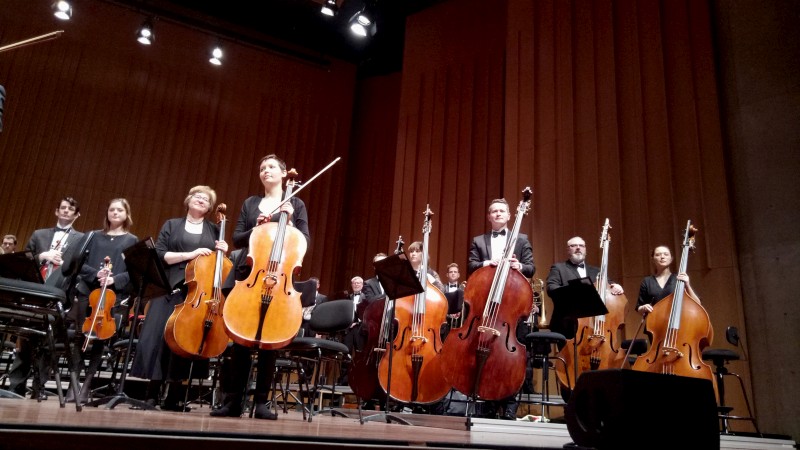
    Cello was the theme of this NCO concert. The feature was the famed Elgar cello concerto in the nice key of Dmin played by Canberran international and SSO member, Christopher Pidcock. Suffice to say, it's fairly difficult given its breath-like timing, in/out, fast/slow, but Lenny was there to follow and he's a master of the prompts so it mostly went well. Chris did a great job, virtuoisic and expressive, played from memory, obviously superbly imbibed. It was the last item of the night, other than Chris' encore of a movement of a Bach cello concerto (4th?) which was done with far more solid time than the concerto, even more steadily than I might have expected. Before the interval things were different. First up was Holst Somerset rhapsody, apparently Holst's first success and a rendition of several English folk songs. I liked the war-like steady bass runs most, but that was our feature. Then a world premiere from Chloe Sinclair called Autonomy. It was fairly short and an easy read other than for the timing: 3/2, 3/4,2/4, some 4/2. It looks tricky but that timing became self-evident as we played it and I liked this one. Then the hard one. Counting was an issue with Elgar, but the Vaughan Williams symphony no.8 Dmin had everything: space, speed, urgency, all manner of changing keys and syncopations. Lots of accidentals (how often do I play Fb?); odd timings like notes on 3 and 5 of 6/8; hazy interleaved themes; sudden accelerations. Even a movement that's just winds, then another movement that's just strings. It was modern, written just in the mid-1950s. I liked the complexity but it's this very thing that takes time to appreciate and double time to learn. Sometimes you never quite get there. Depends on skills and practice time and even memory for the particularly quizzical bits. But so it was. A few errors and a few passes but mostly acceptable and hugely satisfying to have studied and performed. This was at TheQ, a favourite theatre, under Lenny Weiss, a favourite conductor, to a full house. Megan got the last seat, only available after a no-show. And we played as a full, 4-member bass section. Great. Thanks to all.


    National Capital Orchestra performed Holst, Siinclair, Vaughan Williams and Elgar at TheQ under Leonard Weiss (conductor) featuring soloist Christopher Pidcock (cello) and a world premiere from Chloe Sinclair (composer). The bass section was Roger Grime, Kate Murphy, Geoff Prime and Eric Pozza (basses).

    01 August 2018

    4>8


    The Mendelssohn is a classic of the form and the Spohr is a prelude to it. These are two pieces for 8 string players. Spohr's was written at age 40 when he was well respected; Mendelssohn's when he was just 16. Spohr's is a double quartet, inventive but essentially two string quartets playing together. Mendelssohn's is more a work for 8 players playing together, soaring, lyrical, intricate, as the program says, with exuberant joy. Famous enough that you're expected to remember the first time you heard it. I remember, at least, hearing this group do it some time back at Tuggeranong Arts Centre. The group is a relatively new one, eight strings, professional players from the Canberra Symphony Orchestra, led by BJ Gilby, with various faces mostly from front desks. Impressive. And well presented. Quiet and effective entries and bows. Barbara likes that: you have to be the musician people expect, confident in performance. Her style shows in a presence that's engaging. This was another in the High Court foyer, so a large audience, well versed, frequent attendees, listening with that reverberence of concrete and marble. And the black against the bright, sun-lit, tree-blown windows. Professional, serious but relieved, well punctuated music; phrases and scales dropped from strings like honey; busy and intricate in the passing of passages through the members. I found it fascinating to follow some of these passages, starting with one cello then to the other, through violas to violins and a final exhuberant embellishments on the first violin. Wonderful music in a wonderful space with wonderful local musos. Much enjoyed

    Canberra Strings comprised Barbara Jane Gilby, Doreen Cumming, Pip Thompson and Isobel Ferrier (violins), Jack Chenoweth and Lucy Carrigy-Ryan (viola) and Matisha Panagoda and Julia Janiszewski (cello).