22 July 2019

Roots


My visits to the Blues Society jam session are rare these days but they are fun. Plenty of grey hair and historical rockers; memories of Hendrix and BB and Dr John; good gear and decent PA and adored guitars. Stevie Ray is a hero. It's somewhat like the Moon landing, I guess, like Apollo 11, this very day 50 years back. It's aged, but aged well because there's some truth in it. One band played Beatles While my guitar gently weeps then Billy Thorpe Most people I know think that I'm crazy then Hendrix Red House. I must admit I loved that (and sang along with Thorpie), but it's not quite the real thing. The real thing was 12 bars, in C or B (!) and shuffles and sleezy, funky swampy blues. They were the tunes my collection played and it was genuinely fun. Of course, the one band I played in doesn't have a pic, but that's how it is. The others do. There were several other bands, not least the host band, The Drivers (once the Backbeat Drivers), with Mike and Steve and Dean and Doc playing a storm. Some great vocals and thrilling guitar. There are some nice musos through the jams, too. People who've been through a string of bands and still playing this after 30/40 years. I got to play with a mate, Leo Joseph, this time on guitar, and Dan, Dan, Josh and Chris. Known only as names on a board. They do it well and with integrity. And it's a nice, relaxed venue, Harmonie German club, and there are a few dancers (mostly girls, of various ages). Get along. $5 entry and a club bar in the room. And a string of mates, getting down and dirty. Not the intellectualism of jazz or the beauty of classical but down to earth and real and goes well with a beer. The Canberra Jazz Society meets the last Sunday of each month (not Jan?) for a jam session at the Harmonie German Club.

The Canberra Blues Society holds a jam session last Sunday of each month (not January) at the Harmonie German Club. The Drivers were Steve Hartnett (vocals, guitar, harp), Michael Hardy (guitar), Dean Edgecombe (bass) and Doc Rennie (drums).

21 July 2019

Wander at will


I did just see them passing by - I have a few times - but I was blown out as always. Miro got Wandlerlust together for a gig at the Jazz Haus and it was a stunner. From the first bars of a lengthy, adventurous piano solo from Alister to open up, through the renowned Wanderlust songbook and a few newbies and a delightful standard by Duke Ellington called Wanderlust, no doubt, this was a thing of wonder. Bronte Cafe is famed not just for the band but for its incarnation as a theme on ABCRN a few years back. Dakkar just sits luxuriantly. There a good bit of Africa here, with one from Jeremy (missed the title) and Miro's Pressure makes diamonds (a fabulous title dedicated to Nelson Mandela). And deep grooves with Delicatessence and the latin/New Orleans Mumbo Jumbo. And that deliciously beautiful tune, again by Miro, Peace please, which they played as an encore and profound ending. This was Wanderlust as lustful as I've ever seen them. Gloriously tight and intoned heads that sit over infectious rhythms; James with his ever-gleeful presence and deeply satisfying solos; John and Brendan as the local visitors and insanely effective; Alister as deeply, harmonically investigative, Fabian all infectious latin, Jeremy often unobtrusive then guitar clean and melodic. Megan asked about some of the background, where these overly capable musicians on riffs spelling complex African grooves. Backing solos or backing out completely for solo bass or drums or guitar to play genuinely alone. Just so good. Great players know when to talk and when to sit. And again, those perfect heads. Someone mentioned there's not much ensemble playing. No, not written. These are mostly infectious grooves with gloriously melodic heads and space for improv that they leave to these great players. Did I say I enjoyed it? Hugely enjoyable tunes from the best of players. What's not to like?

Wanderlust appeared at the Jazz Haus. Wanderlust were Miroslav Bukovsky (trumpet, flueglhorn), John Mackey (tenor), James Greening (trombone), Alister Spence (piano), Jeremy Sawkins (guitar), Brendan Clarke (bass) and Fabian Hevia (drums).

18 July 2019

Prep no.2


And next week came and it was also great. Aaron Chew returned to preview the other half of his PhD recital, die in a few months. This is the warmup: a warmup to virtuosic and beefy music. Aaron is reading on Busoni and presumably some relation to Liszt, as his compositions feature. This concert contained several arrangement by Busoni of Liszt. A student at PhD level is interesting for the intellect as well as the performance, so Aaron introduced each piece with a short but relevant presentation. So, Busoni was more faithful to the original in his Mephisto waltz, but also featured "beefed up: harmonies and more drama and spice. Or the delicate bells of Liszt in La Campanella became harder and more sculptured in Busoni's version. Interesting, especially effective with the colourful and indicative descriptions. Again Aaron's concert gave wonderful renditions and a satisfaction of real musical intimacy. For the record, the program was Liszt-Busoni Mephisto waltz, Liszt Reminiscenes de 'Norma' and Liszt-Busoni Etude no.3 C#min 'La Campanella'. A great pleasure. Now we can all await Aaron's recital sometime in October.

Aaron Chew (piano) performed more Liszt with reference to the pianism of Busoni at Wesley.

14 July 2019

The unexpected


We had Friday evening off and that's National Press Club jazz evening. The unexpected was that Sally was playing with Lachlan rather than Brendan. Nothing unpleasant, these being consummate players, just unexpected. Somewhat different, too, being vocals&guitar rather than the unusual combination of vocals&bass. Lachlan does a good line in bass, too, so there was bass awareness accompanied by the more evident harmonics of the guitar. [Excuse the digression, but Beethoven himself said: “The guitar is a miniature orchestra in itself”.] The tunes were much the same, deliriously lovely and often-enough somewhat touching. The songs of the American songbook are like that: discrete but straight to the heart and mostly of the heart. Nothing unexpected: Softly, Paper moon, Witchcraft, Our love is here to stay and the like; transposed. Unexpected but no surprise and just lovely.

Sally Marett (vocals) performed with Lachlan Coventry (guitar) at the National Press Club.

12 July 2019

Touch the Moon


Not jazz or even the arts, but it is of historical and scientific interest and this is the 50th anniversary of Apollo 9. It always amuses me to touch something of extraterrestrial origin. We can argue that we do that every day with everything we touch, given that our atoms all come from elsewhere, formed in the Big Bang and converted to more complex elements in various stellar processes. But it remains something exciting to touch the Moon or Mars or otherwise. We've had a piece of Moon rock here at the Tidbinbilla tracking station for years. It's nicely glittery but it's behind glass. We now have a piece of polished Apollo moon rock to touch in the foyer display at Geoscience Australia. There's also a piece of Mars, some more moon rock, meteorite pieces and tektites, too. But only one piece to touch. (BTW, Mars rocks arrive here as meteorites, often found on the surface, black against white, in Antarctica). I've touched pieces of Mars and the Moon in museums in Washington DC but not here. There are meteorites at Stromlo that you can touch (if I remember correctly). There must be other remants around town. I've also got a few tektikes and a piece of the Henbury meteor in my rock collection. They are not so rare or expensive. Tektikes are a dime a dozen in rock shops. But it remains a special pleasure to touch any new bit of space. There's something special about touch: just watch how people surreptitiously touch items on display in galleries and museums. As for Geoscience Australia, its foyer display is a thing of wonder, of rocks and minerals and crystals and little known and free and open 9-5 M-F. Well worth a visit.

Touch a moon rock and explore much else geological in the foyer display of Geoscience Australia.

11 July 2019

Prep no.1


It was perhaps the most responsive and intimate rendition of piano music that I can remember. Maybe just because this was Aaron and I know him and we've heard him before, many times; or maybe the intimacy of a small venue and front row; or maybe that he's studying the pianism of famed virtuoso Busoni and playing Liszt and that just demanded it. Dunno, but this was an eye-opener. The pauses and dynamics and rich complexity were legion but everywhere apt. I was left feeling I understood piano performance that much more. Maybe Bach wouldn't be played quite so, but this felt intimate and personal and heartfelt and so apt. Aaron is running up to his PhD recital and this is one of two concerts at Wesley in preparation: there's another next week. We are blessed. This week it was a full Liszt program: Hungarian rhapsody no.5 Emin; Valse a capriccio sur deax motifs ... de Donizetti; Polonaise no.2 Emaj; Hungarian rhapsody no.13 Amin. Richly emotive music played with deep purpose and understanding. I don't know how or when it gets better, although Aaron did mention he's still working on Busoni. So be it and give me more. Till next week!

Aaron Chew (piano) performed Liszt with reference to the pianism of Busoni.

09 July 2019

Our fave Beethoven

ABC ClassicFM has its annual Classic100 awards and this year it was for favourite composer and Beethoven won it. Probably you could have guessed the outcome, but Bach (no.2) and Mozart (no.3) were always runners, too. So it was opportune for the Llewellyn Choir to stage a Beethoven program. The main work was his Mass in C major; the others were Egmont overture and Choral fantasy. It was a great program and wonderfully performed. I hadn't heard the mass, but a mass is inevitably recognisable and thus familiar comprising the same run of titles, and, I guess, text. After all, the Catholic mass is a standardised and repetitive thing with a long history. The Egmont overture is well known but perhaps my least favourite on the night despite the effective performance. The Choral fantasy was new to me and a strange thing harking to the ninth symphony. It's solo piano for the first adagio movement, then into piano accompanied by orchestra and the choral section with two vocal soloists for the last few minutes. Odd and somewhat amusing but with some nice lines and several passages that clearly lead to the choral symphony. Renowned local piano accompanist Anthony Smith appeared as a piano soloist and did a great job. Four soloists appeared in the mass and their voices and interweaving harmonies were a great pleasure. I especially enjoyed Greta's soaring soprano and Paul's firm and strongly enunciated tenor. The Llewellyn Sinfonia was a nicely capable outfit and a great pleasure, obviously brought together for this program but featuring a string of CSO and such players. Nice to see the bass section of Max McBride and Dave Flynn. So, this was a great performance and a huge pleasure and, from the drinks and congratulations after, widely seen as a success. Wonderful and inspiring.

Llewellyn Choir and Sinfonia performed a Beethoven program including his Mass in C major in Llewellyn under Rowan Harvey-Martin (conductor) with soloists Anthony Smith (piano), Greta Claringbould (soprano), Jennifer Bennett (soprano), Ellen Malone (mezzo-soprano), Paul McMahon (tenor), Peter Ellis (tenor) and Christopher Richardson (bass). Lisa Stewart (violin) was concertmaster and Max McBride and David Flynn (basses) filled the bottom end.

08 July 2019

Instructive

It was a busy day so I only managed two of three groups in the masterclass, but what I saw was instructive. This was a masterclass arranged by the Canberra Chamber Music Players, the Canberra branch of the ACMS, at the ANU School of Music, with violinist Kristian Winther as the instructor. First up was a string quartet of Joy, Kathryn, Marilyn and Justine playing an arrangement from Playel's op.48 no.2. Next was Thea and Hang playing Franck violin sonata mvt.4. I missed the Faure piano quartet Cmin movt.1 by Thea, Suzanna, Terry and Heng. This is somewhat like family. I've played with virtually every player here, in various incarnations. Thus is the classical music scene in Canberra. Masterclasses are for players who already play, so the guidance tends to interpretation rather than technique. So we heard of ideas like "who's the boss" meaning who is the leader at any time (it moves); how to express notes and lengths and melding and joining phrases; sharing ideas and interpretations; how notes are bowed and formed and attacked. Nerves were mentioned and one suggestion was to squeeze toes to avoid tension in the hand when playing soft (mostly a joke!). There were stories of famed musos and descriptions of composers' "schtick". And further, of telling a story and having to make the journey to earn the end; creating, even exaggerating, each twist and turn; of coordinating phrasing between different instruments (here, piano and violin, very different). The comments are a thing of the moment and of the performance, so it sounds vague here but is relevant in context. There's still stuff to learn even at this level. Revealing and informative.

Kristian Winther (violin) instructed a masterclass for the Canberra Chamber Music Players. Instructees were Joy Searle, Kathryn Collins (violins), Marilyn Moir (viola) and Justine Gibbings (cello) and Thea Lau (violin) and Heng Lin Yeap (piano). I missed Suzanna Powell (viola) and Terry Neeman (cello).

07 July 2019

Talking dirty


A political book launch in Manuka will bring out the political actors, Canberra being the heart of federal government. Perhaps more-so when it's a surprise tell-all with attributions and the author is a journo at the Australian who had worked in the office of Liberal treasure (Costello). It's a fascinating experience in some ways but also revealing. One thing I notice is that the revelations are usually not too surprising. Being somewhat a political junkie, I hear much of this and it is mostly available in print or on radio. Another thing is that I'm not too good on the personalities. It was Megan who commented that the old bloke we'd shuffled our seating for was Tony Eggleton. I hadn't recognised him. Nor others. We did get to chat to journo Paul Bongiorno about a great uncle of mine who used to sell pasta to Paul's father's grocery store. But that was about personal matters not politics. This was the launch of Niki Savva's new book on the Turnbull putsch. It's particularly interesting for her connections and especially for the attributed comments that were given before an election that was then considered lost. So apparently the rashness was rife ... or should we say honesty? The title is Plots and prayers : Malcolm Turnbull’s demise and Scott Morrison’s ascension and it follows her success with The road to ruin : How Tony Abbott and Peta Credlin destroyed their own government. Henry Rosenbloom, publisher of Scribe press, started the evening off, then Laurie Oakes launched the book proper. He introduced with references to a current love, crime fiction. The discussion was quite damning of current politics; "a depressing book" . He spoke further on despair and current politics; the current "embarrassing ineffective rabble" and comparisons with Hawke's time; the wrath of the DelCons which was felt by Niki for her previous book; Corman quoted as the "ultimate seducer and betrayer"; an ability to "utter inanities" as one of Morrison's strengths (but not that he's the first!); that the media has some responsibility for being so close and caught up in the games; finishing with the observations that "all political careers end in tears". The observations were damning, and that from such a long-standing and admired political journalist, but particularly telling as it came after a few years outside Parliament House. I hate to talk of the "bubble", for that's just served as an excuse for Morrison to avoid discussing LNP failures and scandals, but there is some truth in the term (not that there aren't many other "bubbles", in politics and out). Niki Savva then got up to give thanks. She spoke of how she had been shocked by the revelations of these interviews; shocked by Corman's sudden change; predicted it will end poorly for Morrison, seeing him as clever but cold blooded, joking that Divine intervention would have been from an Old Testament God; how the moderates had sacrificed Julie Bishop; how Dutton is more liked by mates of left and right than Morrison (this seems a surprise to many, including me); how several had literally shed tears after the stress of the Turnbull affair (although I could only wonder where the tears are for New Starters or RoboDebtees). Like I said, such a booklaunch is always interesting and revealing and to some degree confirming what we read daily, if we read. And some free wines and party and paper spotting, too, so quite good fun.

Laurie Oakes (journalist, retired) launched the new book by Niki Savva (journalist) at Paperchain Bookstore, Manuka. Henry Rosenbloom (publisher) introduced them all.

05 July 2019

A hopeless case and a great dane


Barbara's title for the concert was so good I could only steal it (as in "Good artists copy; great artists steal" or thereabouts - see link below). Barbara Jane Gilby was playing with Katherine Day and Emma Rayner. The hopeless case was Theodore Kirchner, a German who led a dissolute life of drink, gambling, affairs and inevitable money problems and lost friends, suffering a strike, losing his sight and dying early while being cared for by a student. Schumann and others had raised money to settle his debts, but he just returned to his ways. He was a great arranger and wrote mainly miniatures. We heard his Zwei terzetti for violin, cello and piano. The great Dane was Nils Gade, Danish, well known and influential, living in Germany then returning to Denmark due to war, teaching Grieg an others and writing much including symphonies, concerti and sonatas. We heard his Sonata no.2 Dmin op.21 played on violin and piano. The stories and the contrasts were interesting; the playing was wonderfully capable; the concert was a pleasure throughout. Barbara told how she wishes to present concerts of interest rather than youthful display and this was just that. A great pleasure.

Barbara Jane Gilby (violin) performed Kirchner and Gade with Katherine Day (piano) and Emma Rayner (cello) at Wesley.
  • Quote investigator on "Good artists copy; great artists steal"
  • 04 July 2019

    Challenges


    It was Geoff's Jazz@Lab outing, this time at AlterEgo, with the most incredible band comprising some of our most renowned Aussie performers: Sandy Evans, Andrew Robson, Lloyd Swanton and Hamish Stuart. Stars in their own right and a work of bliss together. The room wasn't the best - the smallest of stages split a long room in two - but the fabulous playing and compositions defeated all that. I was amused to watch passersby passing the door behind the stage where you could hear all pretty well. Some noticed and responded, perhaps challenged or perplexed; some just walked by; a few came in. This is not the stuff of commercial radio and this was the commercial heart of Civic. Andrew's compositions channelled Ornette to my ears: spiky and twisted but also an inevitable fit. Sandy's works went off, but in a different way. I was all smiles and admiration listening to the group dissolve into free then recompose itself just before the interval on one of Sandy's tunes. This was Sandy with Andrew's trio but these people are friends and have played together forever so it's a knowing coming together. As often, they featured one tune by Sydney jazz mentor Bernie McGann, Salaam, inviting Miro to sit in. His solo was different again. As were Hamish' and Lloyd's, on their different instruments, both setting down the most delicious and inevitable extemporisations. At this level, it all sounds so right, not fast or flashy (although speed makes its appearance when it fits) but with that feeling of continuity, inevitability, correctness that the great improvisers display. This was a great concert with intimacy despite a difficult room. Maybe that even helped, as challenges can. I missed Ornette at the Opera House so this will have to suffice, and suffice it will, with ease. A fabulous display. Many thanks.

    Sandy Evans (tenor, soprano) played with Andrew Robson (alto, baritone) and his trio comprising Lloyd Swanton (bass) and Hamish Stuart (drums) at AlterEgo for Geoff Page's Jazz@Lab series. Thanks to Bob Howe for some pics from the night.

    02 July 2019

    Jazz messages from Brussels


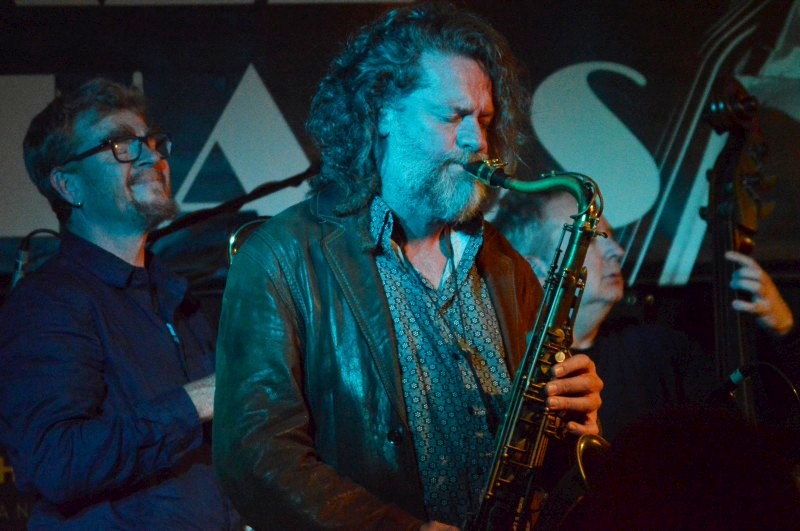
    Our CJ Belgian correspondent is at it again. As if the election wasn't exciting enough for him. Neal and Anne are in Brussels at the Music Village bar (not far from the Grand Place) to see a tribute to Belgian sax. That's apt given that Adoph Sax, the inventor of the modern saxophone, was Belgian. The band comprised four saxes, bass, drums and piano, playing Jazz Messengers, swing and the like. He says it's damn hot in Brussels; presumably the jazz is too. Thanks to Neal. I'll check it out soon enough.

    Pic by Neal Gowan