14 April 2022

Unexpecteds

This was a student choir and I could fully expect Bach.  But the other two works were not so obvious.  But then Tobias Cole was directing so maybe not so unlikely.  The unlikely matters were firstly a premiere but one member, Rebecca Hilliard.  Not every concert has a premiere and this was a very satisfying one, putting the words of a friend, Silvia Canton Rondoni, to music.  And it was very good with clear harmonies leading to dissonant extensions so tension then release.  Pleasing and interesting.  Secondly, an improv.  Now that is unexpected at a classical concert, especially when you are asked, as audience, to join in, if you wish.  No-one much did but the choir was lovely, testing, creative, first in voice and long notes then leading into clicks and whistles.  Wow.  The major work of the day was advertised and expected enough (being JS Bach himself) and mightily difficult.  Jesu, meine Freude BWV227, a good half hour of unaccompanied voice with text from Johann Franck and Romans, with parts soprano 1,2, alto, tenor, bass and rich and moving harmony and occasional fugue.  Difficult but Bach is always a work of genius and pleasure and challenge and they did it well.  So both unexpected and a pleasure.  That's to be expected from Tobias and a bunch of students.  A great pleasure.

ANU Chamber Choir performed Hilliard, an improvisation and Bach at Wesley under Tobias Cole (director).  The work by Rebecca Hilliard (composer, alto) was Even if for a short time, with text by poet Silvia Canton Rondoni, was a premiere.

11 April 2022

Lean times

It's been lean times for a while what with Covid and all and then I had a clash.  Not just two but three.  Sadly, I missed Maruki for National Capital Orchestra and NCO for Tilt but we ended up with a great little gig at the Reid Tennis Club, about as old venue as is possible in Canberra, at least post-Capital-decision.  It's a cute little building in a glorious park with tennis courts and recently renovated for its 100th anniversary soon (next year?).  I've lived in Rome and that's a different sense of history, of course, but this was pleasant and the rains left for the day and all was well.  We played well too, and that's nice.  Too bad about Brahms 2 and Dvorak cello concerto and the rest, but if that's the worst of conflicts we experience in our lives, we are lucky.

Tilt Trio played at Reid Tennis Club.  Tilt are James Woodman (piano), Eric Pozza (bass) and Dave McDade (drums).

09 April 2022

Revisits

I've been to Knossos and Delphi and Mycenae and more and plenty of the famed museums that hold ancient Greek treasures but I still get excited to see such old stuff and those places have been off the agenda anyway given Covid.  So we got to the Ancient Greeks exhibition at the National Museum and I really, really enjoyed it.  It's not huge, but there are a range of life-sizes statues and stunning heads and tons of pottery of course and some gold and iron.  The two carved heads of Archilocus (?) and Euripedes were wonders.  The votive offerings were fascinating, as was any written language we saw.  The stele Apotheosis of Homer was spectacular (although even better in the professional photos with lighting) and the head of Dionysos was a gloriously beautiful face even to our contemporary eyes.  The Aphrodite throw, a little stature of two women playing knucklebones was beautiful and gloriously intimate and maybe the star of my visit.  We used to play knucklebones with much the same rules, 2,000+ years later!  The statue of Aphrodite took on a particular interest given it was acquired by Byron in Athens.  Ya gotta hand it to the British Museum for its connections!  The frieze of Greeks vs Amazons was another intriguing marble relief.  But possibly the most stunning item for me, something the likes of which I'd never seen before, was a decorative fitting of warrior supporting a wounded companion on the battlefield from ~330-300BCE.  Something new.  I enjoyed this exhibition more than I'd expected.  It's not overwhelming like those other galleries, but the objects were of real quality and diverse.  Don't miss it if you have any interest.

Ancient Greeks is an exhibition of objects from the British Museum on display at the National Museum of Australia.

04 April 2022

Spain

The theme was obviously Spain and related but I felt it was jazz. This was the Australian Chamber Orchestra and the program was called Sketches of Spain which says Miles to me and a track off Sketches of Spain, Solea, was on the program and so was Chick Corea Spain. But the first half had Iberian references from Debussy and a Ravel take on the Blues, which seemed strange and perhaps a bit unsatisfying even if Ravel was quoted as promoting this "popular music" and its players with their "frightening virtuosity". And there was Boccherini with a tune about the streets of Madrid and Bizet Carmen arranged by Rodion Shchedrin for his dancer wife Maya Pilsetskaya. But the jazz was confirmed in the second half by the presence of jazz literati Matt McMahon, Phil Slater, Brett Hirst and Jess Ciampa and that program of Miles and Chick, joined by a short Ave Maria in 8 parts played by the jazz quartet and four string parts and written by Tomas Luis de Victoria. I'd enjoyed the first half, especially for the Carmen, but I just grooved to the second half. Phil Slater's take on Miles was very satisfying and the Ave Maria was lovely (I like him: I did a de Victoria piece on The Pots Going Viral) but Spain had me blissed out. That fabulous theme, the complex and lengthy arrangement originally performed by CC with the London Symphony to win a Grammy award. I laughed at the string sections passing around and authentic jazz solo (in unison and not improvised obviously) and the rich and often dissonant harmonies in piano and a lovely long bass solo that obviously intrigued the ACO low end and Brett's effective pizz accompaniment and Phil's lines out front. The string accompaniment was a pleasure even if the improv that's at the heart of jazz was missing. But this was crossover and I admire musicians who are daring and exploratory enough to do it and the ACO felt the part. So I ended walking out with a smile on my face. Some classical mates were somewhat nonplussed but I thought it worked and, perhaps only in a jazzer's book, I thought Matt and mates were the heart and authenticity of it all. Not putting down the classical, but jazz and classical are different mediums requiring different skills, the hottest chops and reading in classical and the invention of improv and the feel of a groove in jazz. Different and both worthy but this was jazz territory and Matt and Phil and Brett and Jess blew a storm to my jazz ears. But nice all around and deeply fascinating.

The Australian Chamber Orchestra under Richard Tognetti (director, violin) played Miles Davis and Chick Corea and more at Llewellyn Hall with Matt McMahon (piano), Phil Slater (trumpet), Brett Hirst (bass) and Jess Ciampa (percussion).

03 April 2022

To sit or not

It is one of the great skills of musos to just sit on a beat, I reckon.  It takes the most capable to just do less and enjoy the intensity of the groove.  This was probably my biggest takeway for Mr Ott (it's nothing new), but not the only one by far. Mr Ott is obviously Matt Ottignon, Sydney saxist, who's appeared several times in CJ.  His band is a sextet with influence from Africa (Ethiopia was mentioned) and the Americas North and South (jazz, of course, but one tune was very much of Cuba or Mexico or thereabouts).  Otherwise, solid grooves, odd times, neat heads played on bari or tenor sax and trumpet, thumbed and fingered bass, chords and all, sustained odd drums and times and lots of strange effects, dropping damped chords played with rapid strums and beat-aligned wah and echo and more wah and odd-sounding guitar solos, that 5-string P-bass thud softened with thumbs and the like, more strange sounds from keys, occasional grand piano but plenty of clavinet and dissonances and lovely synth noises, all playful and oddly placed but always fitting.  And always those grooves in difficult-to-count times, although plenty of threes or sixes but syncopations and added notes.  There were a few fours towards the end.  And the prancing and good-natured pleasantries.  Matt often brings a tray of single shots on stage, he said, but not available on the night.  Sad, that.  But he's lanky and jaunts around; someone suggested Peter Garrett as a teacher.  And the smiles and laughs as they moved out of the way of solos.  Nice to see the array to the right for the drum solo and the laughs and leading fills.  And the interval (strange, that, and so unlike a formally staged gig) and  the call for dancing in the aisles at the end of the night (standing at tables with a dance floor and beers would much better suit this band) and just the joy of it all.  Good sound at the venue, too, as noted (Thanks Street Theatre).  Not to mention the seriously satisfying playing throughout.  And back to the ability to just sit on a beat.  They had it and that's something special.  Yep, I enjoyed this one and I wasn't alone.

Matt Ottignon (tenor, baritone sax) led Mr Ott comprising Matthew with Ellen Kirkwood (trumpet), Ben Panucci (guitar), Daniel Pliner (keys), Jann Bangma (bass) and Carlos Adura (drums).

02 April 2022

The divine French

I got the call to record, this time for Oriana Chorale, a lovely, moderately-sized  choir in Canberra, led by Dan Walker.  I'd been fascinated that Dan had just done a concert (vocals/synth accompanied by piano) of songs by Suzanne Vega, Laurie Anderson, Paul Simon, Philip Glass and David Byrne.  Now that did sound of serious interest.  Oriana weren't singing that style, but interesting noen-the-less.  They were presenting a truncated history of Chansons Francaises, divine French choral music.  It ran from Beatritz de Dia, a troubaritz (female troubadour) from days pre-polyphony.  Interesting. Then through Janequin and Passereau and Trad. and Rameau presenting with choral music that explored nature and more.  The Janequin Chant des oiseaux was all imitations of birds.  Then to more modern times, with trois chansons each from Debussy and Ravel and huit chansons, settings of troubadour/troubaritz melodies, from Poulenc and to C20th with Edith Piaf.  Quite a journey.  Some lovely explorations, capable leadership, nice intonation and expressiveness.   What a nice recording call!

Oriana Chorale (mixed choir) sang chansons Francaises under Dan Walker (director) at the chapel of Canberra Girls Grammar school.

30 March 2022

Visuals

The theme of this year's Canberra International Music Festival is "Pole to Pole".  The link to Schumann, Roland's favourite composer and not featured at all in the CIMF program, is that he suffered bipolar disorder.  Apparently there was much difficulty in his experience and his family but the music is the height of the romantic and Roland's fave.   Schumann was writing at the time of Chopin and Liszt.  Roland played three works, Phantasiestücke (Fantasy pieces) op.12, Arabesque op.18 and Waldszenen (Forest scenes) op.82, and I could see why Roland was so impressed, even if the era is not my fave.  This was complex and satisfying music with considerable visual presence, as in the various named scenes in the forest (Hunters on the lookout, Lonely flowers, Friendly scenery, Wayside Inn and the like).  You could feel these pieces of music as authentic recreations in a way that you often can't visualise even much modern visual art.  Funny that.  And it wasn't just the compositions that impressed.  I love Roland's annual outing before CIMF.  He is such an intense and involving player, playing here from memory and with true commitment and dynamics.  I imagine it as the product of European training, but maybe it's just Roland.  Dunno.  Impressive either way.  Just great stuff.

Roland Peelman (piano) played Schumann at Wesley.

27 March 2022

Triumphs

This as a new experience, performing in the Australian Centre for Christianity and Culture, on behalf of the Australian War Memorial, through Chris Latham, currently (musical) artist in residence, doing early work towards a later recording, playing virtually all new arrangements, with soloists from the Army Band and the School of Music.  Some of those things we, as Musica da Camera, have done before but not all together like this.  The program was called Triumph of the Imaginationn and it recalled the experiences of POWs in war, especially WW2.  It was profound at times, telling of fellow support, with one piece from a Jewish internee shipped to Australia and several tunes by FS Kelly, our renowned composer (and Olympian) who survived Gallipoli but was lost, still young, on the Somme.   Our soloists were Edward and Stephanie Neeman on piano and Jaime Grech on soprano sax and Chris himself on violin.  We invited several males to chant for the first piece, a movement of a symphony by Schulhoff, all march-time and bass drone.  This was not a concert to take lightly.  The fast stuff can be relatively easy, but the delicacy required for such quiet or pensive works is a challenge, if satisfying to perform.  So a deep, thoughtful concert helping Chris in his work towards another musical memorial and musical recovery project.

Chris Latham (director, violin, arranger) led Musica da Camera (string orchestra) in a POW memeorial concert, Triumph of the Imagination, at ACCC, with soloists Edward and Stephanie Neeman (piano) and Jaime Grech (soprano sax).  PS. Obviously not my best pic!

26 March 2022

Kids out

There have been few demos during Covid time but I was hopeful about SS4C returning for a pre-election run.  Doubly so with the clarity of floods and GBR bleaching and +30/+40degC temperatures in Ant-Actic-a.  But it was not to be.  This event was at Kambri at ANU and there were as many enjoying the sun and eating pleasant lunchies while Grace railed and swore over the dangers of climate and the irresponsibilities of our woeful Federal Government.  Two reliable elders presented, both admirable and frequent speakers, Mark Howden, Director of ANU Inst for Climate, Energy and Disaster Solutions, IPCC author and more, and Tim Hollo, Greens Candidate.  They both gave short but strong speeches.  Grace returned with chants that I found too screechy.  Oh, well, it's civilisational collapse after all, not comfy and well deserving of anger even if it hurt my damaged ears.  But then, not concerning enough for many, young and old.  In fact, there may have been more retirees present than students.  This is often the way of demos these days.  We have seen demos ignored over recent times which goes some way to explain a lack of faith in community action.  '60s/'70s Moratoria had influence and thus a generation of marchers persist, but seeing the results of Bridge marches and more, I can understand youth taking a different path.  I just hope they are taking some path, rather than just mental anguish, which is so widely reported as growing.  As for the pollies, Labor is not perfect but they are not "all the same".  That's a myth that suits the Right.  Think Gillard-era climate policies then dismantled by Abbott, or even the Greens convinced not to support Rudd in his attempt.   I just can't understand Right intransigence on climate.  State capture, corruption, influence and the rest, yes, but this is big and quicker than we'd expected and will effect our own kids and, well, it's an end.  Apocalyptic religiosity, perhaps?  Surely not.  It should be criminal - it is acting against humanity - but the law isn't quite so clear cut.  As laws often are not.  So, I didn't manage so long at the SS4C event.  I had an afternoon tea to run to: the way of a foolish Australia with blinkers and none but today's worries. 

SS4C (School Strike for Climate) was held at Kambri at ANU.  Mark Howden, Tim Hollo, Grace ... and others spoke.  The next is the Election Climate Strike, Parliament House Lawns, 11am Fri 29 April.  That should be bigger.

24 March 2022

Across eras

Robert was one of the first classical performers I recorded so he's in my memory.  He hadn;t p.ayed for a while, with interruptions by Covid, but I recorded him again at Wesley.  The theme was three ages, being Bach, Chopin and Bartok.  It was stunning.  From the top I was hugely impressed by his take on Bach, his evenness of the phrasings,  the subtle pauses and big rits at the end of movements, the volume dynamics and long crescendos.  Just lovely and right, to my ears.  But then he played Bartok.  Now, this was different!  20th century, Hungarian with French relationships, 12-tone at times, folk elements at times and a "transparent style" as introduced by Robert, meaning less heavy on harmonics.  Different but easily convincing.  And then the middle era, Chopin, the epitome of romantic music, free of much structure, once described as "the experience of a lifetime".  It was his Ballade no.4 Fmin.  As Robert said, "top of the pops" for piano competitions.  And then a reference to today's horrors with an encore by Ukrainian composer in Russian Romantic style, A dream by Sergei Bortkiewicz.  I've quoted Robert here but not much time was wasted with an impressive program of great variation and considerable length, given available time.  A time of learning from diverse styles and a time of satisfaction with a great performance.

Robert Schmidli (piano) played Bach, Bartok, Chopin and Bortkiewicz at Wesley.

21 March 2022

Just one Sunday arvo

A gig like this just floors me and reminds me of the best of jazz, the chops, the intensity and invention, the commitment, the unpretentiousness of it all.  Some pretention might be deserved, given the quality of playing, but I've seldom seen it in jazz.  Despite the immense harmonic and rhythmic knowledge and huge but ever-developing playing skills.  But jazz musicians are always learning, even the greats, so humility is common.  So it was with Waveteller, despite a breathtaking gig.  This was just a Sunday arvo gig at Smiths, to too few audience, but I for one just chuckled with the devastating playing and interplay and interesting, tangled compositions.  This is music written by bassist Michael, played with Casey and Ed.  They did 11 tunes in two sets, all originals, some from their first CD and others coming out soonish on another.  It had me counting (as in 6-6-6-4 or 6-6-6-6/6-6-6-6-2// or 10/8 as 4-4-1+2).  Then the harmonic movements, some lovely bass solos and devastating, razor-sharp polyrhythmics throughout (ah, that's Ed on drums!) and playful and sustained lines of long and longer intervals on piano.  Not sure what more to say, really.  Checkout Waveteller on Spotify or Bandcamp, but I doubt they will be the same on record.  I find live is just something beyond.  And this was: a devastating furnace that had me chuckling at the audaciousness of it all.  Fabulous.

Waveteller are Michael Mear (bass), Casey Golden (piano) and Ed Rodrigues (drums) and the played one Sunday afternoon at Smiths.

17 March 2022

Two and still hushed

I'd heard the program before but not quite.  Last time Ariana and James were playing within Limestone Consort, with a string quartet and I found the harpsichords, quiet as they are, even raised on the Wesley stage over the strings on the floor below, were still quiet, sometimes lost.  This time, the harpsichords were playing alone, or together, and their volume was theirs, quiet, plucked, perhaps edgy, lovely in that Mediaeval-cum-baroque chamber sound even if still restrained.  They even played much the same music.  The main work was a Bach concerto for two harpsichords (BWV1061), but also a full Krebs Concerto for two harpsichords (I think they only played two movements at the Limestone concert).  The Krebs was written for teacher and student, with one part obviously more difficult.  At one stage in the first movement Ariana was playing semi-quavers, so James' doubled notes must have been demi-semi-quavers.  I know of such a thing (even if I don't have to play on bass).  The other was a strange new/old thing, Thomas Tomkins Fancy for two to play.  James introduced it as an early piece for four handed keyboard, seemingly simple on the page but difficult to put together. They played it on two harpsichords, but close enough.  There were many smiles and maybe some slips but this was a thing of joy, quiet and restrained as harpsichords are, but also challenging and delightful.  I'd dread the tuneups though.  As I arrived, Ariana was tuning then mulled over a retune.  Thus goes period music.  Lovely stuff.

Ariana Odermatt and James Porteous played a double harpsichord concert of Krebs, Tomkins and Bach at Wesley.

14 March 2022

Broad ways

We were at Smiths for a musical theatre gig and it was sold out.  We got in when a few tix became available, but still it surprised me to hear that Canberra is strong on musical theatre.  Kaitlin Nihill said this.  She was the centre of the show, but there were appearances of numerous friends and students and even her mother, a singing teacher at St Claire's.  Kaitlin and partner were up from Melbourne and various audience members were from wherever, but it was mostly Canberra.  I asked someone about this claim for musical theatre in Canberra and I was taken aback by the string of companies she could reel off that have presented over the years.  Then I realised I knew of plenty of them.  I'd even played in Sound of Music at TheQ so perhaps I shouldn't have been surprised.  I like the open and listenable voices of musical theatre, more than the refined unintelligibility of opera.  We heard that, and plenty of forceful highlights and strong vibratos, and ironic and telling lyrics.  Again I like that, even if my experience weakens after West Side Story, great that it is.  One song was of Michael in the bathroom, sadly alone, avoiding a party.  Very NYC, recent, from a short term Broadway show called Be more chilled.  Not one I knew!  There were tunes from Wicked and Phantom of the Opera and Disney and Sister Act and lots of others.  Various and varied voices, male and female, all well trained if at diverse levels, with piano accompaniment.  This music can also be yankee and maudlin or self-centred but it's the show and it must go on.  Kaitlin was an inviting host and the whole was a far-flung survey of the art.  We liked it.  Plenty in the audience knew it.  A small local take on Broadway and the West End.  Well done and much enjoyed and a mega-change from hiphop the night before.

Kaitlin Nihill (vocals) presented a group show of musical theatre at Smiths.  Some other names included Thomas Currie (piano, vocals), and Daniel Steer, Lauren Nihill, Sammy Marceddo, Nathaniel Patterson, Karen Murphy, Edith Lome, Kellee Hand and other names I missed (all vocals).

13 March 2022

Raps and rhythms

It's just a coincidence or a community affectation, of course, but Volodymyr Zelenskyy also has repeating letters at the end of his name.  Funny to see, that's all.  I had an itch to see a hiphop gig.  I know little of it.  The YT videos I'd seen were produced not live, so I know the singing style, but not the musical support, or at least the live accompaniment.  How much was recorded; how much performed?  And this gig had 3 performers so it provided a survey of the scene.  First up was Jedbrii backed by a drummer and another.  I still don't know what the other was playing, but there was always bass and often I could hear other instruments, electronics, etc.  I searched hiphop instuments on the Net and the range was everything from DJ kits to drum machines to loopers and more.  Intriguing.  And those intense drums, clumsily timed (in jazz terms, of course, not in its own terms), drunken perhaps (a style of drumming, not a level of inebriation).  And various descriptions I didn't fully understand like freestyle and rap itself   I think I now understand the difference of rap vs hiphop. Anyway I'm learning.  Jedbrii was busy, interesting, rhythmic, interactive.  I liked his set.  Those odd comments, real sick, etc.  That traipsing back and forth across the stage.  Those tunes that sat then just stopped and those drum explosions whereever.  Rhythm is all here.  Then on to Kirklandd.  The same drummer stayed on, but no third performer.  There was a mention of Viktor Rufus being unavailable, replaced by a cutout of Dave Grohl.   Lots of recorded backing, lots of traipsing, but I found this less satisfying, more poppy, less open and authentic (some may disagree).  I felt Freddie Mercury.  Maybe it's the various rock-star affectations: the neat cut and dyed tips, the personalised jumpsuits, the audience participation, the mounting of monitors, the bared chests later in the show (yes, he could get away with it).  And music that seemed as much pop as rap, despite the rhymes and rhythms.  My bad perhaps but I was left cold.  Then Citizen Kay.  First up I watch a different drummer setting up.  Very professional: fast, neat, ordered, changed cymbals and snare, adjustments, sound checking each drum, methodical and efficient.  I noticed one new bloke at the desk interacting with the drummer.  I expect CK had his own mixer: it would explain a tighter bass sound, better sound overall.  I'd noticed this with Dave Holland at Wangaratta JF and how the sound was so, so different with his own sound man.  Then a suite of neat and attractive tunes, nicely structured, more richly embellished with solos and voices and chordal patterns in the background recording, and that drummer, sharp and tight and purposeful and beautifully toned but also not excessive in performance.  Again, that professionalism.  It particularly showed when CK did his first single as an encore, which he admitted he wasn't too prepared for.  Good on him to be so playful and uncautious.  It was nowhere like the sophistication of the show, just demonstrating how we grow into skills.  And he obviously had.  Citizen Kay was loud but he was also a great pleasure to hear and see.   So, an informative show for me, reaching out from a jazz cocoon with much pleasure.

Jedbrii, Kirklandd and Citizen Kay appeared at Transit Bar.

This is CJBlog post no. 2,450


01 March 2022

No basement at Pizzagate

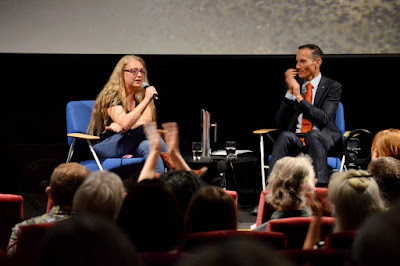
I'd seen Van Badham on a Webinar but still I went to her Meet the Author session at ANU and I'm glad I did.  At one stage she mentioned watching flat faces over Zoom.  I know what that's like.  It's more intense and immediate being there.  You can't break it up to get a coffee so the listening is different.  Colin Steele introduced the session and thanked the ANU Security Team who were in attendance.  Security team?  As we heard more, we understood that VB is targeted and threatened for her stance.  She was speaking to her new book, QAnon and On: a short and shocking history of Internet conspiracy cults.  So we heard of the appeal of conspiracies after distress and of the ego boost of secret knowledge.  Of pathways (including divorce) and especially health movements, yoga teachers and the like, apparently big in Australia.  Of "fusion paranoia" where upset people unite through common causes.  Of rabbit holes and algorithms.  We learnt that the Pizzagate pizzeria didn't even have a basement!  And of Van's relationships to Bonobos.  And of robot dogs used by the AFP and streaker from the Deep State at our recent Canberra demos.  That was new: I'd only heard of the sound cannon.  Of group delusion creating orthodoxy and then loyalties.  Van suggested that we'd been lucky in Canberra, not least through sophisticated policing.  All new and interesting.  She spoke of a long commitment to fighting fascism; of being called a "communist dyke Jew whore" (quite common observations in some circles...).  Of her respect and commitment to democracy; of her family's Union background; of participation and support for democracy being a sacred duty (not a theme I'd expected, actually).  There were stories: Sean Hannity calling Trump a "Blue collar billionaire";  private planes being flown to the 6 Jan attack at the US Capitol.  She spoke of Trump supporters as "overwhelmingly middle class", small business and the like, whose position was threatened, rather than the downtrodden poor as envisaged by the Left.  There was humour but seriousness in her (borrowed) description: "lumpen bourgeoisie".  I liked her preparedness to question both sides.  Then onto her pessimism about US politics, how there was "total capture of the Republicans in the US" by populism, but how some neo-Conservatives of the Reagan era were anti-Trumpists.  There were questions on FB, language and trigger words, the role of feminism in this context, conspiracy thinking in the Canberra protests and its role in the coming Federal election.  She expanded on how techniques in political misinformation are common around the world, with even some statistics shared between US and Australia in one campaign.  I know of much of this: I read about it often enough.  Our exceptional rate of vaccinations suggest that mostly Australians are somewhat immune but she remains deeply worried and so do I.

Van Badham (author) was speaking in relation to her new book, QAnon and On: a short and shocking history of Internet conspiracy cults, at ANU.  She was interviewed by Andrew Leigh (Academic, ALP MHR).