22 August 2022

Premiere

I hold a spot in my heart for the Brindabella Orchestra because they were the first orchestra I played with.  I left down the track after playing Beethoven 5 with Maruki and I've moved further on since.  I like to play the big and challenging works, all the movements, the repertoire.  It's an incredible pleasure and challenge, but I still go back occasionally to Brinda and I did this weekend to hear them playing a world premiere, no less.  It was The old man who loved to sing, a children's book put to music by Mike Dooley, no less,  under commission by Brinda.  A mate and a capable composer.  This was a great pleasure with an intimate and attractive theme, some pretty melody and glorious orchestration and harmonies.  I was mightily impressed.  Brinda also did a run of smaller well-known works:: Saint-Saens Carnival of the animals, Bizet Carmen suite, Borodin Steppes of Central Asia, Nicolai Merry wives of Windsor and Strauss Sr Radetsky March.  There was great pleasure there, not least in the playful or boisterous themes, Radetsky, of course, but also The Elephant or Les Toerdors.  It';s the sort of thing that brings smiles to the faces of some players and I enjoyed watching a few like this isn the cello section.  So a memorable outing for a fine world premier by Michael Dooley and otherwise some popular and joyous works. 

Brindabella Orchestra under Shilong Ye (conductor) performed a world premiere by Mike Dooley along with Saint-Saens, Bizet, Borodin, Nicolai and Strauss Sr in Weston.

14 August 2022

Another next-gen

There seems to be an efflorescence of ensembles recently.  Maybe it's a post-Covid thing.  Not that we are fully post-Covid given that this group's first date was postponed and another was due as I write this, but cancelled for sickness.  This was a different one being very much of a new generation, although the faces are familiar enough, from CYO and community orchestras and ensembles and bands and folk outings and theatre pits and even CSO.  Canberra Chamber Collective also has a neat name with the collectivity inviting a range of styles and groupings.  We heard it last night when their premiere concert arrived after its delay.  They played a range of musics, Mozart and Poulenc and Haydn but also Farkas and Bohme and Lyadov.  A very interesting collection to display various combinations.  In all, they were a sextet of flute, violin, bass, trombone, horn and trumpet.  Perhaps an odd combination and possibly a bit hard to balance with that loud brass.  In fact, Ragnel, on violin, used a pickup and small amplifier for some pieces.  The Mozart and Lyadov had all playing, but there were spots for just the women (flute, violin, bass) and others for just the blokes (trom, horn, tpt) and interestingly, violin taking an oboe line for another piece.   It can be difficult to match instrumentation with arrangements, but a collective can be flexible.  It sounded great in the reverb-washy space of the Drill Hall.  I'd expected it to be too soft, but no, it worked a treat.  There was some capable playing all round.  I especially watched Hayley, having played in a section with her, but otherwise enjoyed all.  I felt there was some slightly nervy reading, but this is new and I enjoyed it immensely and they obviously did too, and knowing how to cover is an essential art anyway.  And the encore of a tarantella says it all.  Deadly serious but fun.  Looking forward to more from CCC.

From left stage to right, Canberra Chamber Collective comprised Serena Ford (flute), Ragnel Jansdotter (violin), Hayley Manning (bass), Dominic Harvey-Taylor (trombone), Liam Brewin Higgins (horn) and Sam Hutchinson (trumpet).

11 August 2022

Elena's studio returns

The kids have done it again.  Some stunning performances on real works from memory.  Just three kids this days, the oldest in Year 10 and sporting an AMusA, no less.  All from the studio of Elena Nikulina.  The Russians must have it as the Chinese do too.  Victor Ni played Bach, Haydn and Chopin.  Hannah Ni played Chopin and Debussy.  The eldest, Eric Wong, played Beethoven and Mendelssohn.  There were were minor lapses which they picked up well but more impressive was the busy fingerwork, the effective balance between parts and hands, the preparation as each sat a little before performance.  I remain in awe.

Victor Ni,  Hannah Ni, Eric Wong, all form the studio of Elena Nikulina, performed at Wesley.

09 August 2022

Almost the hellbender

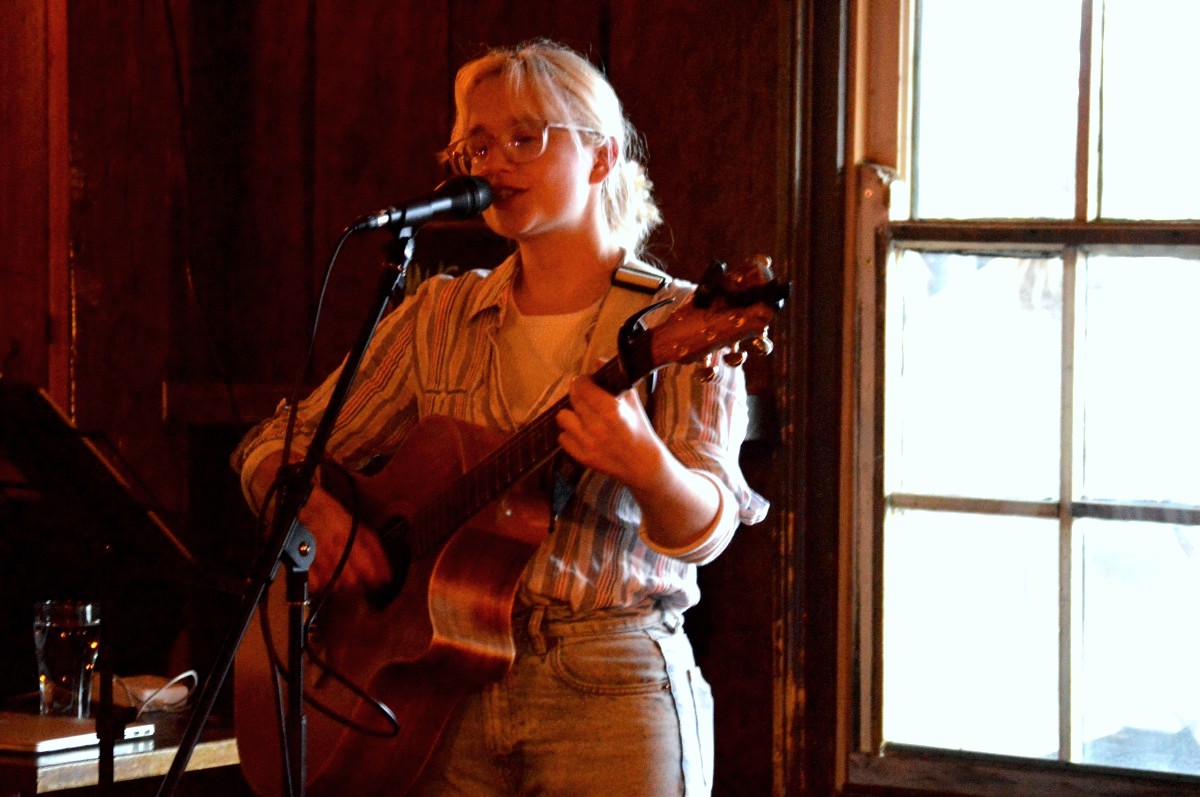
Sal was playing live at Old Canberra Inn on an otherwise quiet Sunday.  I hadn't heard of Sal and the Manders but the band was a guitar trio (Sal on guitar and vocals) and looked entertaining and energetic on YT and the beer's good at OCI.  So that was my outing, and apart from a close atmosphere and fears of Covid, I enjoyed it.  Sal advertises that she was turned on by discovering womens' rock like The Pixies, Joan Jett, Fleetwood Mac. Not close to my heart but pop-rock is always entertaining live.  And true to form, I only recognised some tunes and often needed a line of lyrics to search the title.   Something from Saturday Night Fever done very differently, You've got the love, Fleetwood Mac and I think Florence and the Machine, Amy Winehouse Valerie, and best and most intimate, Missy Higgins Scar, various others.  Much enjoyed.  Sal had classical piano in her history and had studied commercial music at the Con so there was method in her madness.  Just guitar and vocals and sellable tunes open to requests.  Sally Davis, much enjoyed along with the beer.  I must check out Sal and her Manders sometime.

Sally Davis (vocals, guitar) performed at the Old Canberra Inn on a Sunday afternoon.

PS, a hellbender is a family in the order Salamander (caudata) along with 9 others including newts, salamanders proper, lungless salamanders  and mud puppies.

07 August 2022

Reappraisals

Yep, the jazz at the National Press Club is just a lazy Friday evening outing if I have nothing else to do but  that's not to denigrate it.  After all, I know the players and they are some of the best in Canberra and many teach at the ANU.  But they are just locals and mates and it's just a relaxed gig for after work on a Friday.  Yes to all that, but I was still floored last night and by more than the new beer I discovered.  Wayne Kelly was leading in the absence of Greg Stott and Jason Varlet and Mark Sutton were his offsiders.  The music was not just standards and walks (did I hear a standard?  I don't think so although they started with a blues), but great grooves and often popular numbers, not least Strawberry Fields and Message in a bottle and Walking on the Moon.  Then a Poinciana -like groove and latin-ish something and others I recognised but couldn't put a title to.  So the grooves were a delight and contemporary.  Then the solos, Wayne reasonably restrained although always delightful, Jason lively and expansive on his Jazz bass and Mark just a dream at times, sharp and precise and totally unaffected; glorious.  I'm not the only listener even if there's plenty of clicking and chatter too.  That's how a bar gig should be; this is just a classy one with great musicians.  Some of the best in Canberra.  What a great indulgence for such a free local club outing.  As for the beer, it was a Capital All Night Long Dark lager, all rich and chocolate. Check it out soon.  The website says it's only available until September.

Wayne Kelly (piano) led a trio with Jason Varlet (bass) and Mark Sutton (drums) at the National Press Club.

05 August 2022

Degrees of separation

In music your CV is made up of where you have studied and who you have played with.  It goes for jazz and classical, if not quite so much for more popular styles.  I've been one degree from Australian Brandenburg Orch and ACO and SSO and obviously CSO and even Cold Chisel but I'll miss a coming opportunity with Orch of the Age of Enlightenment and Amsterdam Baroque Orch and a string of others because I can't play the Musica da Camera concert in November.  But I got to hear and record the leader for that concert, John Ma, at Wesley and it was special.  I love baroque music and he plays it with an understanding that is clear and immediate.  It's a softer tone, a more joyous and playful interaction, lighter and more dancelike.  And he played a series of lesser known composers, not least Pisendel, then concertmaster of the Dresden Orchestra and a god of the violin and perhaps an influence for Bach's solo works.  And prolific Telemann of the 3,000+ compositions who was considered lesser but has had once-thought-Bach works listed under his name.  And Baltzer (new to me) and Hoffmeister and a challenging etude.  And, as John said, the most prolific composer of all, Anon, this time from Saragossa.  There was Bach too, of course.  John mostly played a baroque violin, but ventured into baroque viola and also viola d'amore with its 14 strings, 7 played and 7 resonant.  I was amused when he questioned the number, but a violinist is used to just four, of course.  But the understanding and connection with the works were a pleasure and clearly evident and his patter was informative, even educational.  So this was a wonderously good Wednesday lunchtime concert at Wesley, booked at short notice when someone else couldn't do it.  So I will miss my closer connections because I can't play that concert, but I expect to hear it and I'm already in admiration for the playing and the player.  And John has returned with family to Canberra so with luck we'll all see him many more times.

John Ma (baroque violin, viola, viola d'amore) performed at Wesley.

31 July 2022

Reflections

I once worked in the National Library and I was amazed by the microfiche collection, particularly one large set of the works of Isaac Newton.  What a resource it was; a treasure of multiple editions of his works available on this side of the world.  It's old tech now, and probably weeded from the collection assuming availability over the Net but these were pre-Net days (surprisingly only a few decades ago) and such materials weren't so available.  So it's nice to see the word still in use and a joy to hear the improv group memorialising the tech.  Microfiche the group came from a class on classical-improv for jazzers at the Sydney Con.  The lineup is fairly standard: piano, bass, drums, trumpet, alto and just a little skewed with clarinet/bass clarinet/viola.  They played two medleys in a single one hour set, each medley comprising two original tunes with an improv bridge.  The tune structures or melodies weren't too obvious, so the moves through tunes and improv was gentle and left pretty undefined and that suited the free style beautifully.  I was entranced by glorious harmonies that sat so purely at times, rippling intervallic piano, busy drums and occasional smiles from drummer Holly to bassist Alex, Nick just sitting on stage at the end and taking in his own composition (after some stunning solos).  There was much listening, closed eyes, gentle testing noises then more confident statements.  But the whole was not explosive or ecstatic like some free music, but big-eared and comradely, and if I can say it, intimate.  This is one to close eyes to, open ears and enjoy the freedom and colour and interplay.  Very much enjoyed.

Microfiche comprise Nick Calligeros (trumpet), Phillippa Murphy-Haste (clarinet, bass clarinet, viola), Sam Gill (alto), Novak Manojlovic (piano), Max Alduca (bass), Holly Conner (drums).

28 July 2022

Top brass

This is one of my favourite Wednesday lunchtime concerts each year.   A bunch of professional players with the sweet tones of brass playing a mix of styles, entertaining and competent and interesting.   And pretty loud, too, but that's the nature of brass.  Loud at top and bottom: first up a medley of John Williams film marches because an Army band should shart with a march after all. Raiders and Star Wars and Superman and more, delicious and inviting and rollicking.  Then a chorale for Covid and a Bach prelude and a Bruckner piece written for his mother.  This is already a massive range of styles but the Bruckner must have been the most out of this ordinary, quiet and calm and pensive, nonetheless well received.  Then Bach again, this time in two harmonisations.  The common one was the best received and I thought it worked best anyway, the other being more dissonant and really not Bach to my ears.  Then a polka and Selections from West Side Story.  I love anyone who plays West Side Story.  Something coming... Then What a wonderful world  with a soloist out front on flugelhorn, somewhat a noisy big band tune to end on and not actually my favourite, although the flugelhorn was beautifully played.  Brass played with the classical tone is a huge bliss.  The concert was programmed and conducted and introduced and occasionally played by Sgt Nick Salter.  Much enjoyed.

The RMC Brass Group performed at Wesley under Sgt Nick Salter (director).

22 July 2022

A uniqueness of the French

Sam Row has a penchant for C20th French music and it's a killer.  He played Ravel Gaspard de nuit with strange themes and 10,000+ notes in six minutes.  I'd believe it: huge rippling screeds of notes with a melody over, in left or right hand.  I'd hate to see the written music, but then he played it from memory so he doesn't need to read it on stage.  I can only admire his memory.  So what were the themes?  Ondine, the water spirit, sings to seduce a man into her underwater palace and finally turns back into water when he rejects her in favour of a human.  Le Gibet, with a man hanging from a gallows in a desert at sunrise with the sounds of bells in the distance.   And Scarbo, a goblin flitting around a bedroom until he disappears.  Strange stuff, sometimes grim.  After this, a lovely Chopin nocturne was a great relief, beautiful and restful and well known.   And a melody from Ukraine to finish as a short encore.  Again, a beguiling and challenging concert from Sam.

Sam Row (piano) performed at Wesley Music Centre.

14 July 2022

Much to learn

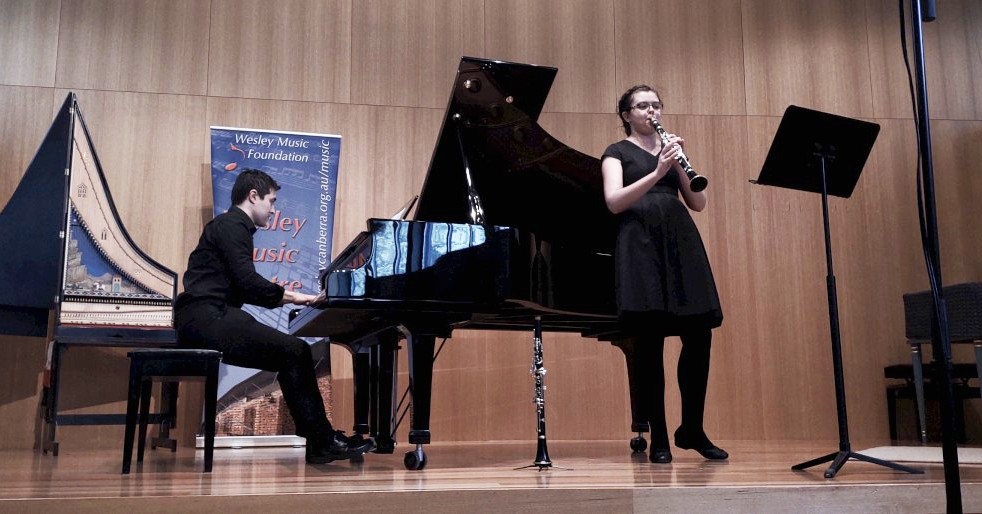
Clarinet's an intriguing instrument for me, I'm told different in fingering from the seemingly similar sax family and definitely different in tone.  They both use single reed mouthpieces, the clarinet has a cylindrical bore in wood and the sax a conical bore in metal.   It was a standard of early jazz, but I don't think I've ever played jazz with a clarinet, other than in a big band.  I play with clarinets in orchestras, tut they are big too.  So gear to hear Helena Maher playing clarinet with Lucus Allerton on piano.  the classical was expected, this being Wesley, and the Mozart movement especially so, but Andy Firth was not.  Andy Firth is well known as a jazz player.  Helena played two solo movements form his 3 pieces for Solo jazz clarinet, a rhapsody and a blues.  The blues might be mistaken for classical, but the blues was obvious.  I enjoyed following it for the bass lines he plays with, mostly common for me, too.   The other music was all duet with piano.  The Mozart was the second movement from his well known clarinet concerto, calm but questioning to my ears.  They opened with a Canzonetta by Pierne, bouncy and filmic then into a passive response.  They ended with a Poulenc piano sonata.  Three movements described by Lucus as of "too many ideas" and movements "screaming British murder mystery", discovery of the body and the chase.  Not sure, but I could feel a story-telling nature to it.  Maybe it was the music or maybe the instrument, but I felt flourishes and quick runs leading to settled notes were a feature of the clarinet and also the piano here.  So I learn something of the instrument even if I remain ignorant of its fingering.  So bit it; well done.

Helena Maher (clarinet) was accompanied by Lucus Allerton (piano) at Wesley.

13 July 2022

Gorgeous

I usually don't write up private gigs but this one was something special.  No names.  We were booked to play a 50th birthday and it looked like much fun for some very friendly people.  Just don't play too loud, don't scratch the lovely, restored timber floor.  An afternoon party gig, playing 3-6pm, pleasant but not unusual.  But then it was more.  We arrive to be told the hosts would be marrying at 4.30.  They'd been together 18 years and had decided just 5 days before to marry.  Lovely and touching.   Much was outdoor, in the back garden, which we saw through a window, but bands are always something special at a party.  Then the announcement to many surprised guests, then the wedding.  Then getting cold and the guests moved indoors and we played more funky.  All a great pleasure.  Great thanks to our unnamed hosts and our best wishes.  Thanks to N and M for including us in your wonderful day!

Tilt Trio played for a private 50th birthday that ended as a last-minute-announced wedding.  A thrill and quite touching.

10 July 2022

Christmas in July

Chrissy in July is not a thing for me but Handel Messiah is usually something we hear at Christmas but this was winter, unseasonably cold outside.  Canberra Symphony Orchestra put on Messiah with its Messiah Chorus auditioned and convened by Tobias Cole.  The numbers were not huge, ~35 instrumentalists and ~40 chorus and four soloists.  The program didn't say, but the solo singers were Chloe Lankshear and Andrew Goodwin and Adrian Tamburini along with Tobias.  The basses were old mates Kyle and David and Hayley but only Kyle and Hayley on the night.  Kyle played most as solo when the front lines played.  The work is a dream, of course, and well known and loved and it's deserved.  Quite a few fugues (I love a fugue) and plenty of rich choral passages and those soloists with harpsichord or organ or solo violin or often a smaller ensemble, but the extravagance and delirium of the choral passages and full orchestras are what really does it for me and most.  We duly stood for the Hallelujah chorus, but we had to be goaded / invited.  I was not the only one who'd forgotten that rite of passage.  And the choir was good.  First up I thought the women were good, but the lower voices are always less appreciated or obvious but they showed their colours and impressed.  So impressive all round.  The trumpet passage (aptly in The trumpet shall sound) was lovely; the solo violin was satisfying, the parts were convincing.  I felt just a little discomfort in timing or perhaps some rushing in the tricky bits early on but that settled.  As for the bass, I was surprised by some tricky parts and look forward to printing the part for a gander. Anthony Hunt from State Opera of SA was upfront and led comfortably.  And that lovely scalar semiquaver stuff by voice (paralleled by instruments, too, of course), is demanding and tricky and a real test.  I was surprised how capably the chorus carried this out.  We expect it from the soloists, but it seems more difficult for massed voices who are perhaps less trained.  So we all left with joy and excitement and satisfaction after 2 hours and interval for a pretty long night of music.  Just such a pleasure: nicely done and such joyous music.

Canberra Symphony Orchestra with the CSO Messiah Choir under Anthony Hunt (conductor) with soloists Chloe Lankshear (soprano), Tobias Cole (countertenor), Andrew Goodwin (tenor) and Adrian Tamburini (bass).  Kyle Ramsey-Daniel and Hayley Manning (bass) played the low end.

08 July 2022

Tenor of our times

Murray Jackson plays alto but had time during Covid to explore the tenor sax and we saw the outcome the other night at a Geoff's jazz night at Smiths.  It was a very satisfying night of playing.  Mostly post-bop-sum-hard-bop field, so tunes by Murray and Aussies Bernie McGann and Dale Barlow, but also the internationals Jackie McLean, Donald Bird, Joe Henderson, Horace Silver and Stardust by Hoagy Carmichael as somewhat an outlier.  I was particularly taken by Nica's dream by Horace Silver with Murray playing Hank Mobley (or Junior Cook?) on harmony with the melody on piano (the original has trumpet playing the melody).  That was a particularly fascinating line and a pleasure to hear so clearly live.  Murray has studied well.  There's a clarity and purposefulness in all his playing, clearly from a good listener and plenty of transcriptions.  The whole band was pretty much that way, too, clear and expressive.  I enjoyed Wilbur Whitta's plain-talking lines and Tim Geldens spelling the rhythmic bass and especially Brendan Clarke's sometimes deliriously fluid solos, but then I'm a bassist and I admire Brendan's playing.  There was directness in this integrity and restraint, not to suggest it was easy to play because lots wasn't, but you didn't feel the richness and history and admiration that underlaid this presentation.  Murray mentioned the good sound of the room, too, both acoustics and Bevan's sound and that only helped this sense of clarity.  And it was Murray's first outing on tenor, I think.  One other thing to note: Wilbur Murray and Brendan are all products of our local jazz school, presumably from its early days at Manuka, so nice returns.  Very much enjoyed.

Murray Jackson (tenor) led a quartet with Wilbur Whitta (piano), Brendan Clarke (bass) and Tim Geldens (drums) at Smiths.

07 July 2022

Kids today

Well not all kids can play piano like this crew.  They are students from the piano studio of teacher Jinbo Huang and they played a Wesley Wednesday lunchtime concert.  It's amusing how they go on stage, all of 10 years or so, but ranging in age, all dressed to the nines, looking very presentable, very young and quite small, at a grand piano, perhaps paired for a four handed duet, then you listen.  They were good, some very good.  I still notice adults with their depth of emotions, but the older ones here are showing that and the younger still present very satisfying youthful compositions (titles included The puppet and T-Rex hungry, no less!) through simpler Brahms and Beethoven and Strauss Snr to the movements from the Pathetique and Schubert Impromptu.  This is a mightily impressive crew and a pleasure to hear.  We can only look forward to some lovely playing around town.

Charles Huang, James Jin, Arabella Lu, Frank Huang, Naomi Feng, Angelia Lee, Khloe Chen, Charlie Sanoubane, Damien Ruan and Michael Anufriyeva  from the studio of Jinbo Huang played at Wesley.

01 July 2022

Returns


Nice to hear a group return so soon.  This was four ANUSOM guitar students, Abel Lawson, Hong Anh Do, Benjamin van der Niet and Shane Campbell.  They each played solo then those other than Shane played a trio.  All musicians play Bach and several also did here but otherwise the music was mostly of a Spanish tinge, a standard style for classical guitar.  Perhaps the choices of Hong Anh Do were outside the norm, with titles in French and Italian and perhaps also stylistically different.  I enjoyed the trio given the more complex interplay of lines and the longer solo piece by Shane, three movements from Antonio Jose Suite Compostelana para guitar.  I expect you learn Spanish language as well as musical styles when playing guitar.  Nice outing.

Abel Lawson, Hong Anh Do, Benjamin van der Niet and Shane Campbell (guitars) performed at Wesley.