18 October 2022

Bonnets

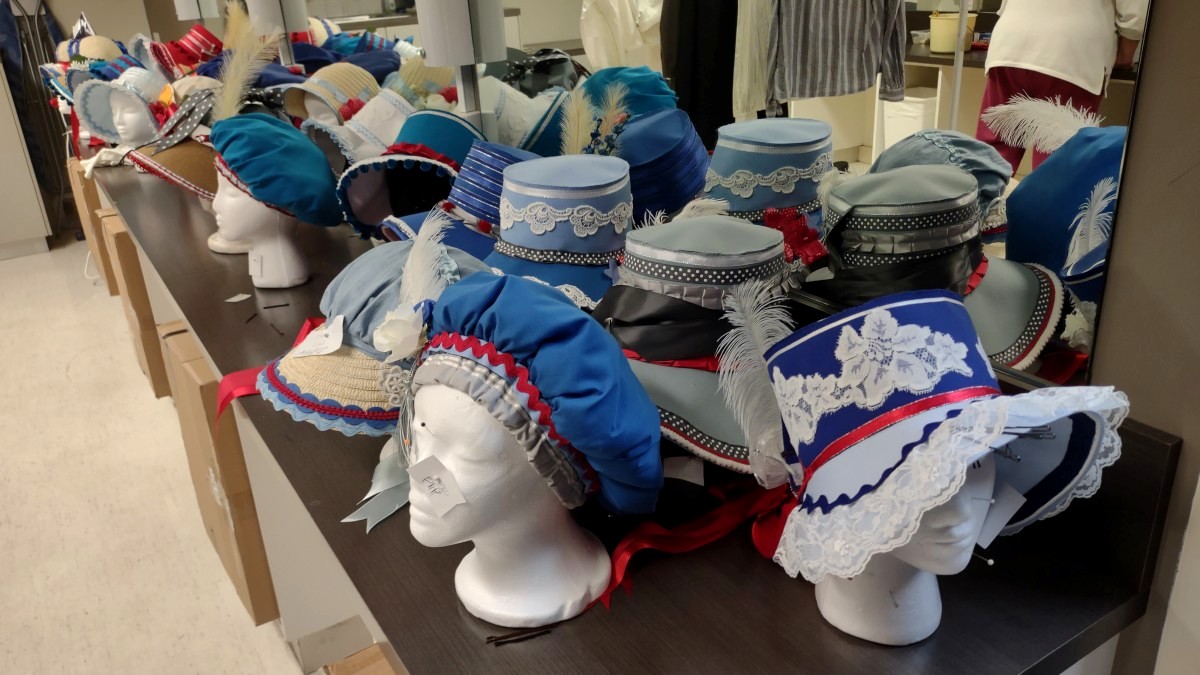
Life has made me cancel my musical commitments over November: jazz gigs and preparation and performance of a few classical outings.  So when I got the opportunity to fill in over 9 days of HMS Pinafore I was thrilled and jumped at it.  The timing was perfect and I love pit work even if I have no time otherwise to partake.  It's four sessions to relieve bassist Mel Fung under MD Matt Greenwood for Gilbert & Sullivan's well known operetta presented by the Queanbeyan Players at TheQ.  Too late for rehearsals so it's a sight reading job with a instructions and changes over the phone and before the first performance.  The last 20 minutes before the first performance were busy moments!  But it's not too hard and the music is often recognisable.  My main preparation was just to listen to the music while following the score.  So far, it's 2 down and 2 to go and getting to be more relaxed.  Perhaps the strangest thing is interval: characters in gaudy costume and wireless mics eating sweet treats and the musicians in black.  It's a world of its own and a blast.  Great fun and thanks to Helen for the contact and Matt for the opportunity.

Queanbeyan Players presented HMS Pinafore at TheQ.  Eric Pozza (bass) covered for four performances under Matt Greenwood (musical director).

17 October 2022

Sound and light out

I just caught a snippet of the long set, but it was intriguing.  This was a SoundOut gig located in the middle of Civic in an ex-hair salon (sounds the part!).  Bright lights and colour outside through the glass; colour projections inside from a series of film projectors of 8mm variety.  Authentic analogue, Interestingly complete with authentic analogue film loops.  Two projectors mostly, sometimes superimposed, otherwise side-by-side.  Seven musicians responding to this, in lines seated at the opposite walls.  The whole was noise, repetition, squeaks and sparks, drone noises and the like.  Two guitarists, trumpet, three winds of various persuasions.  There was an intriguing home-built synth, too, with pitch and modulations controlled by hand movements and a chip to respond to it all; small and mounted on a rough timber stand.  Unique.  This is the nature of SoundOut, that experimentation and noise that makes music with closed eyes for inquisitive audiences.  Sadly, not too many of them.

SoundOut presented Louise Canham (experimental film projection) with the Noise Floor Ensemble comprising George Kay, Jamie Lambert (guitars), Rhys Butler (alto), Richard Johnson (wind instruments), Rory Villegas (trumpet), Tom Fell (saxes) and Brian McNamara (invented electronic instruments) at Antics Hair in Civic.

16 October 2022

What borders

I'd seen Hilary Geddes a few times before so I'm not sure why I was so surprised and impressed by her at Verity Lane the other night.  She was the guest, leading the band, mostly playing standards, perhaps one of two of her originals, playing with the house band, Chris Pound and Mark Sutton.  And John Mackey and Alex Raupach who sat in  later in the night.  Her presence was a clear influence, with abstruse solo lines and deliciously dissonant chords which twisted and distorted the backing, so what might be a standard solo just needed to be altered to fit.  Just what those were, I wasn't always too sure.  And she was such an influence despite a relatively low volume.  I thought too low, so sometimes a bit lost, but maybe that's another of her influences that made for a different music.  It all brought out strong, rudimentals-oriented drumming from Mark which is something I love to hear.  And Chris with a wonderfully strong, upper-mid-rich tone, quick lines, plenty of chordally aware playing through the range was a dream, even if he sometimes seemed a little reticent in the context, even while he was playing a storm with glorious tonality to my ears.  John responded too, although the colours and sheer speed of his cellular playing was an overwhelming storm of its own.  Alex was more lyrical as trumpets often are, but again explosive at times.  But that harmonic colour and abstruse soloing did it for me.  I spoke with guitar Greg after and we were musing over where the influences were from, from jazz but also from rock band exploits that Hilary indulges in.  I increasingly admire work across boundaries, within music and further afield, so I remain hugely impressed if a little perplexed about the whole, this night of standards in a noisy bar with a most intriguing new player.

Hilary Geddes (guitar) visited Verity Lane to play with the House Band comprising Chris Pound (bass) and Mark Sutton (drums).  John Mackey (tenor) and Alex Raupach (trumpet) also sat in.

12 October 2022

Tilt-ish

Tilt was booked but could only provide one member for this Molly gig, so it was Eric with Ross Buchanan and Mark Levers.  I'd played with both before on different gigs and they are immensely practiced around town, so other than getting a list of tunes and perhaps some approaches (eg, Giant steps as a bossa) this was no big deal.  It was fun though.  These are standards so I'd played most before and if you can do a latin and a walk and you confirm the key you should be right (I was caught out once on the key this night but only for a few bars).  And do your chare of solos.  In the end, all was well this night.  Pretty loud, outgoing, energetic, responsive to suggestions from Ross, tight and playful.  Ross decided to use his e-piano rather than the house grand, for tuning and projection and varied sounds.  I enjoyed the Rhodes and the rest and was somewhat surprised by an organ for one blues.  Nice.  And I enjoyed occasional stops to listen to a drum solo.  Also picking up a few riffs from ear.  Along with the relatively lively audience, this was fun.  Two long sets (2 x 90 mins; 90 mins is what I think of as a rock gig), a decent break, a few pics and a video and a chat with some heavy metallists, no less, and this was a fun night.  Thanks to Ross and Mark; much enjoyed.

Tilt appeared at Molly, this night comprising Eric Pozza (bass) with Ross Buchanan (keys, birthday) and Mark Levers (drums).

09 October 2022

Revisiting the Duke

Bowie died a few years ago, aged 69, just 2 days after his final album, Blackstar, was released.  Liver cancer.  I remember him from his earliest days of fame, as Ziggy Stardust, released 1972.  It was just an amusement, I thought, when I suggested to Megan and a few similarly-aged mates to attend The Thin White Ukes at Smiths: a trio (1xfemale, 2xmale) performing Bowie and specifically the Ziggy Stardust album on vocals and 3 ukeleles (!)  Well, just derivative perhaps, but the video was an amusing outing live at a fair with interactions and good harmonies, so why not.  In the end, I found it a much more intriguing affair, as I entered into some Bowie I didn't know, and listened more intently to words.  The band did an amazing job: first set was the album in order, even marking the end of side one with clicks and pops (after track 5).  Then a break and a second set of 11 songs, one lesser known, at least to me, Slip away, but lots of renowned tunes: Fame, Let's dance, Sorrow, Rebel rebel, Space oddity of course, Heroes, The man who sold the world.  Just hearing the list makes me realise I know more of Bowie than I thought.  A few faves that I might have requested (funkies  Young Americans and China girl) didn't even get a mention.  And they put on a great show.  Costumes, especially on Betty, and patter, wry but not too much.  Some history.  Really impressive harmonies that channelled the originals with real respect.  Surprisingly effective instrumentation from just three ukes (oh, and one Stylophone solo, $50 on eBay).  Even the funky tunes worked; Fame was great if Let's dance was more a challenge.  I'm told they  also play with a drummer but he couldn't make it to Canberra.  That's too bad.  I was air drumming throughout (mostly snare on 3, syncopated kick, hi-hat on the beat = rock); it was duly  immersive.  I was touched by some of the lyrics; blissed out by the harmonies;  intrigued by the performative nature of the music; several times intrigued by some wonderfully effective and unexpected chord changes.  There was much to this man, Bowie, as a performer but also for his stories and themes.  It's got me looking into Wikipedia for his history and life changes (what's your name, what's your name).  All this through a band with authentic presentation and glorious harmonies with due respect for Bowie's genius.  So this guy was more than I'd expected and this band reminded me of that.  Great night and thanks to the Thin White Duke and the Thin White Ukes.

The Thin White Ukes performed The rise and fall of Ziggy Stardust and the Spiders from Mars and 11 other Bowie songs at Smiths.  The TWUs are Robert Stephen, Betty France and Michael Dwyer (vocals, ukelele).
06 October 2022

Twists

It's another jazz jam, really, but it's a modern twist with groove and minimalism in place of standards and changes.  I love them both, of course, but the newer form sounds more '70s Miles-cum-rap 1-3 minimalism and embraces electronic sounds and it's playful and at very non-bop tempos.  It reminds me of a comment by Rich Beato about his time in a "jazz coma".  I can understand that and I've been there.  Jazz is such a complex and intellectual form that it can be its own world to be lost in, perhaps missing the ebb and flow of musics.  A once popular form established, perhaps like opera or the classics.  But I digress.  Last night was Victor Rufus Möbius at Sideway.  Five players on stage, improvising to instructions jotted on a board by Victor, occasionally responding to his conducting.  I spoke with keyboardist Hayden and he said it's a favourite outing.  I could imagine it. The sounds are electric, synths and e-bass; the rhythms are syncopated, jumpy, modern, perhaps on- rather than off-beat.  No swing that I remember.  Mostly all in together, layered and insisten, although there was one notable, sharp passage with just Victor and drummer Micah.  Inventive, exploratory, playful and skilled music with some knowing audience to imbibe.  Victor does this with various invited players.  I've seen another outing at Transit Bar with others and still that whiteboard.  Perhaps with invitations to rappers.  I did one stint of spoken word to the amusement of the audience and the band was a fabulous backing, steady then challenging and quickening.  It's not jazz coma but it's still jazz or a product thereof and I love it all.  Nice.  Synths are cool, too.

Victor Rufus (guitar) led another incarnation of Mobius at Subway with Mark Wilson (guitar), Olivia Faletoese (e-bass), Hayden Kinsman (keyboards) and Micah Heathwood (drums).

03 October 2022

From Preacher's haunt to Preacher's


We'd had a jazz gig to attend - tenor, guitar, bass in a bar - but our dinner went too long and they'd packed up. I said hello to the bassist as he left but that's a small satisfaction. But we did catch a classical gig in Hobart. We'd been walking the old Battery Point, the old area with its tiny Georgian houses and large St George's Anglican Church on the hill. This was at St George's. The group was the Hobart Chamber Orchestra of ~35 players from TSO and otherwise, presumably organised as a community orchestra, comprising strings and various wind instruments, even with timpani on the day. Very much in the tradition of MdC and of a similar age (est.1987). The concert started with Nielsen Suite for strings no.1. We'd played it only a few weeks before so this was much on my mind and I love hearing pieces I've played, following along the bass and other lines and the overall interplay and watching the conductor. This was a bigger presentation than that Musica da Camera and I just melted with the lush tone of it all, admired the restrained tempo, enjoyed the tricky quicker lines even if there are not so many. Very nicely, quite professionally done. Then Saint-Saens Intro and rondo capriccioso. Again it's one I'd played so I enjoyed following it. Miranda Carson was solo violin and she played with an earthy, fat tone, quick and proficient. Well done. She's a TSO player. Then a short break and two I didn't know: Shrecker Intermezzo no8 and Chabrier Suite pastorale. The Schrecker was attractive if fairly straightforward. The Chabrier was more trickey, not least a strange waltz to end and various brass throughout. So, a hugely pleasant and impressive outing with the locals. And to top it off, we ran into the remnants of the orchestra celebrating at The Preacher pub after-gig. How's that for shared thinking?


Hobart Chamber Orchestra performed at St George's Anglican church in Battery Point, Hobart, under Gary Wain (conductor) and with soloist Miranda Carson (violin).

28 September 2022

Changes

I'd been avoiding potholes while driving or otherwise in a damp and slippery cave all day, so a beer in Smiths went down very well.  I noticed it described as boho and it's spot on.  It could only be better with a seriously satisfying jazz trio, this time led by guitarist Harry Tinney with Paddy Fitzgerald and Nick McBride.  I arrived a few minutes early and they were preparing for the gig.  Harry and Paddy are friends from University but they'd just met NIck that night.  You wouldn't know as you listened, but, as Harry said, it takes lots of personal preparation to be able to just play with new people like that.  The prep on the day was walking through the charts with explanations and short plays to instruct or get some practice on the harder lines.  Then into the two sets, I think all originals from Harry.  Several mentions of Lockdowns (he was in Melbourne, after all) and effects on various people and coffee and cars.  All instrumentals.  A few ballads and a string of jazz numbers.  All sharp, clear, virtually uneffected  guitar tones.   He had a pedal board at his feet but mostly seemed to use a volume pedal, other than for one tune at the end with loops and delays and perhaps more.  But such lovely, intervallic playing, exploratory and intriguing.  Paddy was all syncopations touching on groove, softly toned with an array of synthetic core strings, intriguing in solos and also playful with long intervals.  Nick is back from many years in Shanghai, renowned and admired on any visit.  His chops and inventiveness were a huge pleasure but also his quick intuiting of the song and its requirements.  I noticed him marking his charts before, so there was preparation involved in his creativity, too.  Just a fabulous outing of three wonderfully inventive players with unique charts to carry the event.  And certainly a change after an afternoon of concert bands in a cave.

Harry Tinney (guitar) led his trio with Paddy Fitzgerald (bass) and Nick McBride (drums) at Smiths.

26 September 2022

Caving

We'd never got inside Carey's Cave.  It's a smallish cave but part of a larger cave system just out of Wee Jasper on the shores of Lake Burrinjuck.  Not the sort of thing anyone but a local knows of.  We'd visited Wee Jasper a few times, but the cave had always been closed so I was happy to be asked to record inside.  This was several concert bands, from ANU, Tuggeranong, Young and Yass, variously playing their own numbers perhaps with the better readers sitting in with another group.  Of course, it's slippery and muddy inside, so cables and all manner of other stuff need a clean after, but this was a unique experience.  Finally, Carey's Cave.

24 September 2022

Revisiting a rethink

For me, this was a revisit for the soloist and for the work.  Canberra Sinfonia played the Max Richter classical uber-hit Vivaldi Four Seasons recomposed and Helena Popovic played the solo violin part.  They did it with precision and involvement and perhaps just a touch of humour.  It deserves a touch of humour.  Richter must have grinned all the way to the bank.  Not that I demean it.  I like this minimalist, post-modern, looping stuff, especially when they get into rhythmic plays, dropping beats and contrasting polyrhythms and the like.  I particularly liked the program, guiding us through the four seasons, each with three sections, so Winter I, II and  III.  All different, all quoting and playing with Hardel's original.  No conductor; this was performed as in chamber with Helena leading and the orchestra feeling its way.  Well done.  We occasionally lost Helena's solo part amongst and excited orchestra, but we were also excited so of little matter.  I walked out with various friends commenting positively, even ecstatically.  We'd enjoyed it no end.  So congratulations, Helena and Canberra Sinfonia.

Helena Popovic (violin) soloed and led Canberra Sinfonia in Max Richter Vivaldi Four Seasons recomposed at Wesley Church.

19 September 2022

Potholing

Musica da Camera had its performance weekend.  This one was under Shilong Ye and with an obscure but interesting list of compositions.  Bartok and Delius, and Volkmann, Glazunov and Nielsen.  The last three are pretty obscure even if the names somewhat ring a bell.  Not impossible stuff, but with its own challenges: some odd counts, an occasional 5/4 variation, some solo bass parts that were important, requiring some conscious counting.   We played the standard local outing in Cook, then our Sunday drive was to Gundaroo.  Our recent country performances have been in Gunning, but given the potholes, the closer town was a gift to the suspension.  There were a few last minute swerves from some very scary water-filled potholes along the way.  And the Soldiers' Memorial Hall is a lovely, dark thing with a cathedral ceiling in wood, so lovely direct reverberations.  Warm in temp (given the gas heaters) and warm in reverb.  We played the Saturday well so the step up for the replay was not so large; both were decent outings.  So a satisfying weekend with some decent, lesser known music.

Musica da Camera performed Bartok, Delius, Volkmann, Glazunov and Nielsen at Cook and Gundaroo under Shilong Ye (director).

15 September 2022

Times of Hope

I think I don't look forward to seeing a series of students from a studio, but I should.  I do enjoy watching the range of skills, the clear development with time and age, the obviously growing awareness and maturity of the emotional responses in performance.  And this is as it should be, of course.  We get better, we understand more through life, we experience the new, until maybe we no longer do.  This is also part of life.  It surprises me that we can watch these developments over such a short time, through a series of performers, of varied but ordered ages, over just an hour or so.  I think they were all schoolies: short and young at one end;  teens at the other.  It goes to show how emotionally mature can be a teenager.  So, is this a duty, to record the several studio concerts?  I have thought so, but now I think differently. Rather, this is an education and an opportunity encouraging optimism.  In a dark time it's a thing of beauty and hope.  Nine players, playing all manner of musics through to Rachmaninov and Haydn and Katz Chernin and Handel and Chopin and Rameau and more.  This studio was Marie Cull's and it was a pleasure.

Students of the school of Marie Cull performed at Wesley.

08 September 2022

Song then and now

They say Schumann Leiderkreis op.39 is one of the great song cycles.  I've listened to leider and found it hard to love, but I did this one.  Maybe it's the grand vision of a larger work (it's 12 shorter songs on the Romantic experience of landscape); maybe it's the wonderful performance.  It wasn't the words, because I didn't follow the German translation.  This was Rachel Mink accompanied by Aaron Chew and they both did wonderfully.  Strong voice, aware interpretation and effective communication from Rachel with delicate pianism and responsive accompaniment from Aaron.  A very classy outing.  And then to get  another song cycle, this time contemporary, in English and variously feminist and amusing, was just icing on the cake.  This was Susan LaBarr Little Black Book with lyrics by Caitlin Vincent.   Written in the last few years and apparently a product of Melbourne, so there's local awareness and it's in English.  I didn't catch all the lyrics but I did most.  Also, we didn't get it all.  The whole is 6 songs, introduced with the song Five, then John, Vince, Steve and obviously two others.  We missed two boyfriends and it's not yet distributed but it's one to watch for.  I couldn't quite work out where to place it, as feminist or comedic or even desperate, most probably with some aspects of all three, although I expect whatever desperation served another a purpose.   So there was modern awareness but also that romantic vision. What a satisfying outing.

Rachel Mink (soprano) was accompanied by Aaron Chew (piano) at Wesley.

06 September 2022

Busy times

I play in a few groups and they tend to group their concerts together, four times pa.  Thus, a week after the Opera Gala, I played with Maruki at Albert Hall.  Now Maruki is just great for playing the repertoire.  This is not a light-on orchestra.   For proof, the program for Sunday was Handel Water Music, Holst St Paul's Suite, Dvorak violin concerto and Beethoven Symphony 6.  Certainly not a lightweight program!  The intonation wasn't perfect and there was a little uncertainty in one B6 movement, but overall it went well and we have certainly learnt something of these works.  There is no substitute for playing them in concert.  The preparation and performance  is something special, drilling your part into your being, unlike any intense listening.  This is a total body experience and an entry into a the mind of a genius.  I liked them all for different reasons, but I'll especially remember the Beethoven for unexpected and tricky intervals (4ths when expecting 3rds) and more.  A pleasure and an education. 

Maruki Orchestra performed at Albert Hall.  John Gould (conductor, violin soloist) led for most of the concert and played violin for the Dvorak concerto; Kristen Simpson (conductor) led the Dvorak.  The bass end comprised Jeremy Tsuei, Jennifer Groom and Eric Pozza.

01 September 2022

And now for something different and not

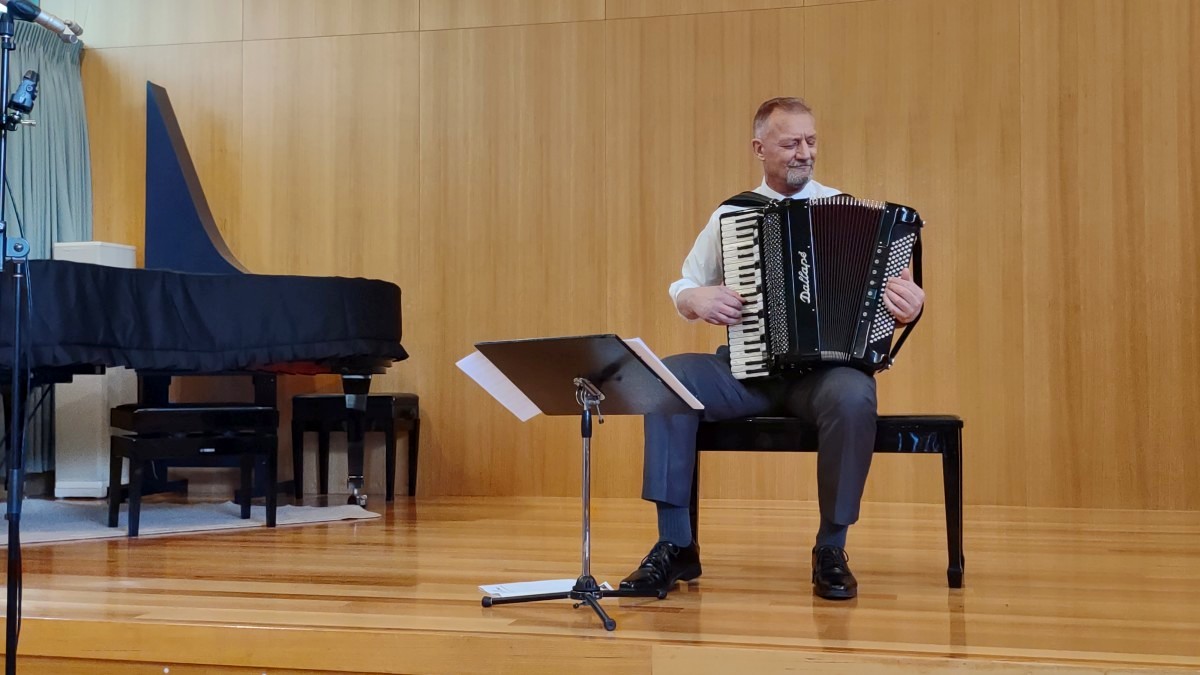
Akkordeon is different but the original tunes that Anton Wurzer played had real connections to jazz and latin and more.  Anton is our our local virtuoso piano accordionist.  I've heard him play classical and all manner of modern and cultural styles.  He played a string of original tunes at Wesley and they had connections with jazz and French and sambas and German folk and gypsy jazz and blues.  And his style of writing is not at all simplified.  These are complex arrangements, changing time signatures and lots of dynamics and tempo movements.  And all played with the sharpest touch, so his semiquavers (would he say 16th notes?) were just spot-on-perfect.  They can be sloppy in many hands, but not on Anton's keyboard.  His left hand, of course, played buttons, chordal-cum-bass accompaniment, and again sharp and correct and nicely distinct from the right hand embellishments and melodies and solos and both hands stopped occasionally for a tapping percussion, again apt and precise.  This is clever music, played with precise fingering and with writing that shows clear awareness of style.  And stories.  So one tune was Lachlan's mood, given a request form co-performer Lachlan Coventry, and Manouche Emma referred to student Emma and Tathra Pub gig referred to a session obviously at the Tathra Pub.  Empress Theadora's dance was a bit further from home, being about Byzantine monarchy and Red samba beans, well, just about food.  So every tune tells a story and all nicely written and quite complex and sharply played.  Not too many really obvious lengthy solos, but the final number, Tathra Pub gig, showed off some classy bluesy improv with quotes from Summertime and American in Paris.  Clever and all round very nicely played.

Anton Wurzer (accordion) performed original music at Wesley.