06 June 2019

Good hands


One week Wesley scholars; following week ANU Open School. I caught a selection of Open School players at Wesley. These are the H-course/prep students, so Year 11/12 on a range of instruments each playing a short chamber piece, two with professional accompaniment. They are keen: so keen that one had to have rush off to an exam and the program order was changed to allow him to play. First up, a Doppler rondo played by Luka and Jenni on two flutes with Geoffrey on piano. I think it was Luke who had the exam. Lovely, tuneful piece with strangely different flute tones. I guess flutes do have diverse tones, as any instruments do, but I seldom hear tow together like this. Then a movement of a Mozart Oboe concerto by Gudrun with Anthony in accompaniment. Mozart can only be a pleasure. Then a seriously challenging work, Joshua playing Scriabin Sonata Fantasy no.2 G#minor (what key is that!). Stunning and daring and well done. The flautist Jenni returned to play a solo piece, Clarke Great train race (1993), that so obviously spelled out the sounds and tempos of trains. Played from memory. Then Rohan on trumpet with Anthony accompanying on Turrin Caprice for trumpet and piano, strong and toneful. And to finish, Isaiah playing a solo violin Bach Partita no.1 Bmin. A great range of materials, all well played, all showing the seriousness of the kids doing this. My favourite was the stunningly challenging Scriabin (G#min?) but I enjoyed it all immensely. It seems our musical future is in good hands.

ANU Open School of Music students played a concert at Wesley. The performers were Luka Ruwette (flute), Jenni Pittock (flute), Gudrun Drake (oboe), Joshua Clift (piano), Rohan Heffernan (trumpet), Isaiah Bondfield (violin) with Anthony Smith (piano) variously providing accompaniment.

04 June 2019

From Forrest to the nation

This was perhaps my favourite concert by FNCO, the federally named Forrest National Chamber Orchestra. They played so well and the music was so lovely. First up, Corelli Concerto grosso op.6 no.4. It's well known and a great pleasure and was nicely done. Then Nimrod from Enigma. I remember playing it within the whole Variations and its presence stood out on arrival with its glorious gentility. Then a few Piazzolla tunes, Oblivion and a tango. For me, the Ortona Porteno tango had more complexity and thus more satifying, but both were inviting and latin rhythmic. Then Fantasia on a theme by Thomas Tallis which seemed very complex and subtle and difficult to pull off, but I thought they did a great job. And to end, Metallica (!?) as interpreted by Apocolyptica (a cello quartet) and arranged by FCNO member, Duncan McIntyre, for this format. The amplification didn't quite do it justice, but the effect was intriguing and the whole was surprisingly melodious. An unexpected end to a very satisfying concert by our locals in Forrest.

Forrest National Chamber Orchestra (FNCO) variously were directed by Gillian Bailey-Graham and Shilong Ye (conductors) with soloists Rebecca Lovett, John Dobson and Shilong Ye (violins), Elisha Adams (viola), Nicky Philipse, Frances Stevens and Duncan McIntyre (cellos).

03 June 2019

Diversity


Bob Sedergreen is a Melbourne jazz piano name that we know well but I've only caught hima few times. The latest was at Eric Agaye's Jazz Haus playing with Eric and Mark Sutton. Bob has a long history so it was apt that he presented a history of jazz piano. Well, really only a string of tunes by various pianists in jazz history with a little commentary and some very nice playing. The whole band was great. The style easily suited Mark and Eric. Fourteen tunes, one each from Earl Hines, Fats Waller, Monk, John Lewis, Horace Silver, Bobby Timmons, Duke Ellington, BIll Evans, Herbie Hancock, chick Corea, Keith Jarrett, Jo Zawinul, AC Jobim, Abdullah Ibrahim, and, as an encore, an original by Bob himself. It was a romp. Plenty of known tunes - 500 miles high, mainden voyage, Waltz for Debbie, Mercy3, Django, Jitterbug waltz, In a mellow tone, others. Some interesting stories, about Cannonball Adderley's pianists, Monk's Australian visit , Ellington's band selections, Herbie's interests in maths and engineering, Rocky Mountain music. Eric told a great story of meeting up with Stanley Clarke as a teenager and being invited to the first gig of RTF at the Scientology headquarters. I particularly enjoyed the story of Aldullah Ibrahim's (once Dollar Brand) music and how phrases have meanings. So a fascinating night for the stories and the great playing all round, especially from Bob who had to play such diverse pianistic styles.

Bob Sedergreen (piano) introduced and played the music of a string of famed jazz pianists with Eric Ajaye (bass) and Mark Sutton (drums) at the Jazz Haus.

02 June 2019

Now for the dance


The intellect was satisfied and the feet were to come. Eamon Dilworth was touring Austrlaia and New Zealand playing and singing his much-loved New Orleans joy and calling on his many mates to accompany him. So this was Eamon with some of our locals: John Mackay, Brendan Clarke, Wayne Kelly and visitor already on the stand from the previous band, Ben Vanderwaal. This was joy personified but with that black melancholy that permeates the American South. First up was a joyous second lines blues, as would be played by NOLA marching bands at funerals. Then a string of frolicksome songs, Bye and bye, When I grow too old to drink, His eye on the sparrow, Just squeeze me, and the more sombre St James Infirmary or the country twangs of Jumbalaya or the story-telling original, Livin' the van life, or the upbeat Ilo Iko. All done with joyous trumpet and some capricious responsive virtuosity form John and immense steadiness from Ben and Brendan and Wayne's facetious light-heartedness on the Duke. The name says it all - Crawfish Po' Boy - spelling out huge joy amongst deep emotions, all a great mark of respect to the tradition. Huge pleasure.

Crawfish Po' Boys is led by Eamon Dilworth (trumpet, vocals) with invited guests John Mackey (tenor), Wayne Kelly (piano), Brendan Clarke (bass) and Ben Vanderwaal (drums).

01 June 2019

Blowouts


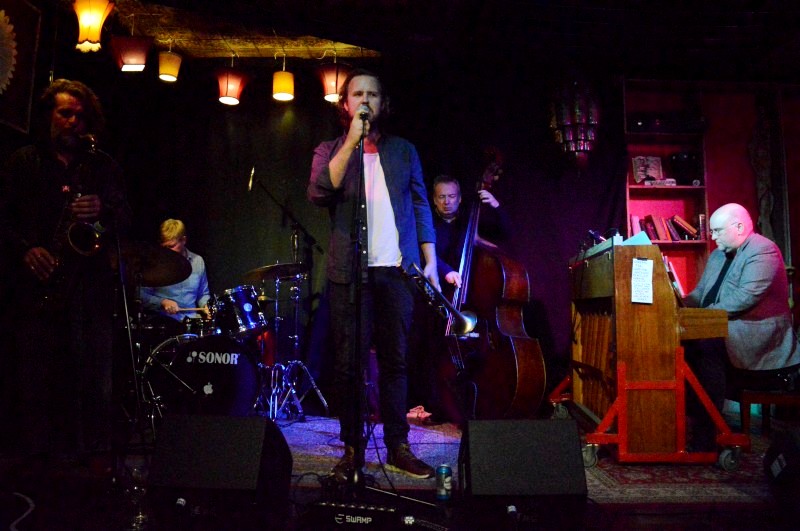
What of a CD release by Jamie Oehlers? He's a supremely exciting tenor player, renowned for prizewinning and now just extravagantly virtuosic and writing great material. He was joined by Ben Vanderwall, a deliriously fascinating, busy, intriguing drummer, always ready to explore percusson sounds and deeply polyrhythmic when he chooses that or rabidly funky too. The other three were unknowns to me (other than Ricki Malet who I'd seen in a big band context) but they were wonderfully satisfying. Bass Zac was all deeply funky syncopations on a PB, playing with fingers or thumbs for that thumpy dub sound. Ricki was a great pleasure on some demanding heads and satisfying solos. Harry was playing Nord but it was all Rhodes tones and perhaps ring mod, absolutely the part for this sound, widely different from the abandon of Jamie but also so suitable as a contrasting style, two hands widely spread across keys, chordal left hand and richly arpeggiated right. Not music for the fainthearted, though. This was very complex and hence demanding but a huge source of pleasure. Style and preferences differ but the best stands monumental. This was fabulous. Drummer Mark commented that Ben is the best and world-worthy (the drummers were obviously awe-struck) and that the difficulty in his playing is not obvious. Not sure I agree. I was basking in drums and sax and speculative keys and deep grooves and trumpet and intrigued by the ease of it all, those grooves, those intricate rhythmic embellishments, those odd syncopations that sat so deeply, those rich, delicate phrases that came so easily but demanded such harmonic wit. What else to say when you hear such stuff. A blast.

Jamie Oehlers (tenor) led his band with Ricki Malet (trumpet), Harry Mitchell (piano), Zac Grafton (bass) and Ben Vanderwal (drums) at Smiths.

28 May 2019

Time to fret

They are coming like blowflies, if only blowies were around like they once were. We're bombarded with end-of-world warnings. Just listen to shock jocks and they are complaining. And Angus Taylor. Trouble is, it's the scientists making the warnings now, and er, they've been somewhat right in the past and, like, physics has laws, and er ... time to fret. This was an update given to Canberra U3A by Francisco Sanchez-Bayo, variously over time, of USyd and various lectureships and doctorates and the rest. It was basically a report on his paper, published this April, reviewing a string of peer reviewed publications on declining insect populations. It fits with various warnings on the sixth great extinction and the parallel issue of climate change. NYT Mag had a nice summary that was mentioned. Then, of course, there was the IPBES Global assessment report saying "1,000,000 species threatened with extinction" amongst other comments. Read this and more(from reputable sources, of course) and you'll know more, but what did I learn? That entomofauna are insects; that insects are rapidly declining in numbers and biomass; that this decline is recent (we saw a graph of the US bee population decline starting in the 1950s, coincidentally with DDT); that "the planet is doomed without insects" for insects provide tons of essential services to humanity and to the rest of life on Earth (specifically pollination, nutrient recycling and food sourcing); that China doesn't have bees now and pollinates by hand (presumably with lots of very cheap labour); that studies show annual declines of ~2% (eg, loss of insect biomass in Germany 1989-2016 was 76%); that extrapolation predicts only 1% of insects will survive 100 years from now; that it's now often less healthy to live on a farm than in suburbia, due to chemicals; to top it off, that Integrated Pest Management, which uses lower rates of chemicals, is more productive. And the reasons for insect declines? FSB listed habitat loss, chemical pollution, biological factors and climate change. The main cause is identified as habitat loss through subcauses intensive agriculture 24%, urbanisation 11%, deforestation 9% and wetland/rivers changes 6%. And chemical pollution accounts for 26% including pesticides 13%, synthetic fertilisers 10% and so on. I didn't get all the figures and can't be bothered recounting them all here. Go to the primary sources (below). But suffice to say, we are in a pickle for insects as well as the rest of life and climate and for civilisation. Insects are OK and necessary, but I fret mostly for us. Like Greta says, "I want you to panic".

Francisco Sanchez-Bayo spoke on the worldwide decline of the entomofauna (insects) to U3A Canberra.

  • Worldwide decline of the entomofauna : A review of its drivers / Francisco Sánchez-Bayo, AG Wyckhuysb. IN Biological Conservation, vol.232, Apr 2019, p.8-27
  • More than 75 percent decline over 27 years in total flying insect biomass in protected areas / Hallmann et al. IN PlosOne, 18 Oct 2017
  • Global assessment report / Intergovernmental Science-Policy Platform on Biodiversity and Ecosystem Services (IPBES)
  • Integrated Pest Management for Sustainable Intensification of Agriculture in Asia and Africa / Pretty & Bharuka. IN Insects 2015, 6(1), 152-182
  • Greta Thornberg speaks truth to power
  • 27 May 2019

    Big Day Out


    Another big outing for Maruki at Albert Hall. This concert featured two symphonies as well as an overture and another piece. Maruki is never one to cop out! The symphonies were Beethoven 4 and Dvorak 8. The other pieces were Wagner Meistersingers Prelude to Act 1 and Saint-Saens Dance macabre. Nothing too easy and some big and satisfying blowing. But my thoughts went more to some delicious slower movements. Beethoven mvt.2 and Dvorak mvt.3 were gloriously beautiful even if we may not have done them their full justice. Listening back to my recording does not quite match my preparatory listening to Berlin Phil or Tafelmusik but that's the nature of a community orchestra. And that's is not to say it's a wasted play. Maruki is a wonderful opportunity to enter into the scores of a range of repertoire works and there's nothing like playing a work to get close to it. And such a pleasure when something just clicks, like the introductory trumpets in the first movement of Dvorak, or a perfect horn solo line that appeared, where?, somewhere in Beethoven. And it's a good laugh to take on the challenging lines and perhaps cover a not-quite-perfect performance. I chuckled over several in the first movement of Beethoven and some rabidly quick repeated phrases in the forth movement (they ask basses to play this?). But, on the other hand, there's great joy in our quick, prominent and extended melodic lines towards the end of Meistersingers, or the power and stability that underlying rhythmic basses can give to an ensemble, as in Beethoven mvt.2. Maruki gives exposure to some very great music.

    Maruki Orchestra was directed by John Gould (conductor) with Melvyn Cann (concert master) and Peter Ellis (violin) as soloist on SS. Maruki played Wagner, Beethoven, Saint-Saens and Dvorak at Albert Hall. The bottom end was Jennifer Groom and Eric Pozza (basses).

    25 May 2019

    Returns


    I first encountered Carl Dewhurst when he was a student at the School of Music, then at Manuka, playing around town with Cameron Undy at bars and even a plant nursery. He was impressive even then; he's mammoth now. That's getting on 30 years ago. He left Canberra in 1990, stabled mostly in Sydney, but with time in London, perhaps elsewhere. He plays all manner of musics. I've heard experimental from him in the Opera House. This night was clean and clear and fabulously inventive with the standards repertoire, like All the things or Wes Montgomery or Out of nowhere. Of course, he was with the best, Brendan and Mark, so it was a shared inventiveness. Solid swings with crystal clear and hugely varied and easy improvs; melodies that spell themselves but easily extended; chordal play with melodies interpersed; just one time that I remember as dissonant, laying back with minimal notes; plenty of accompanying solos, especially from bass but drums in there too. All easy and rich while still tonal and clear. It's a mark of knowledge and experience. Masterful. Just a huge pleasure.

    Carl Dewhurst (guitar) played standards with Brendan Clarke (bass) and Mark Sutton (drums) at the National Press Club.

    24 May 2019

    Finally

    It really wasn't as difficult to achieve as I'd made it (I could have just emailed), but it was only recently that I got my name on the RSCM ACT Branch mailing list for their monthly concerts. The RSCM is the Royal Society of Church Music, its Australian incarnation, and there's a branch in the ACT. They run an monthly lunchtime organ recital series around the church organs of Canberra. This one was David Franks playing Buxtehude, Bach, Wesley and some 1950s compositions from Sumsion and Bush at the City Uniting Church. The organ is a Geo. Fincham & Sons dated 1925, originally for St Andrew's Presbyterian Church, Goulburn, installed in its present location in 1988 by David Hudd and rebuilt in 2011 by Australian Pipe Organs. I've found that church organs commonly have histories like this, often moved from church to church with openings and closures, and Fincham is certainly a name I've heard often. For lists and descriptions of organs, see the Organ Historical Trust of Australia site (below). The turnout isn't vast but the pleasure is certain. This wasn't an organ to blast with deep bass pipes, although we did hear the pedals at times. But it was pleasant, each work was informatively introduced and the playing was informed and duly capable. Various preludes and fugues and chaconnes and dances and ground bass with toccata flourishes above. David has a string of qualifications up to Trinity College of Music, London, and a matching string of performances on various organs through Sydney and beyond. Organists have to move, but the flip side is they experience diverse instruments. It reminds me of a jam session I used to attend. I experienced so many nice and different e-basses until I realised I was expected to bring my own! But a huge pleasure while it lasted. As was this: a great pleasure to hear the music and to discover another organ.

    David Franks played Buxtehude, Bach, Wesley, Sumion and Bush on the Fincham organ at Canberra City Uniting Church for the RSCM Australia ACT Branch.

  • Organ Historical Trust of Australia
  • 23 May 2019

    Workout


    Stuart Long said he's been fascinated by variations and it showed. Variations are works of musical exploration, so a composer looks at a theme, perhaps just 32 bars, then delivers a string of approaches to that set of chords or melody. Stuart mentioned that melody and rhythm and the rest are essential, but interestingly, that the movement of variations and their resolution is key. It's easy enough to take in the early variations, but they can become more tangential before the return and all this is fascinating in a musically playful and exploratory way. Stuart played three sets of variations for this concerts. Firstly by Brahms and Mendelssohn and these were variations on their own themes and busy and full handed in form. The last was certainly tangential. Muczynsky Desperate measures (Paganini variations). It's a modern work (1996) and shows it. Initially more relaxed and open and playful with blues and jazz tonalities and idioms, but increasingly intriguing with varied harmonies and intervals and dissonances of last century. So a great concert of deep exploration and huge musical commitment by Stuart: fascinating and unrelenting and a work out of both physical and musical vigour. Emotionally and intellectually fabulous.

    Stuart Long (piano) played variations by Brahms, Mendelssohn and Muczinski at Wesley.

    20 May 2019

    Gloria!


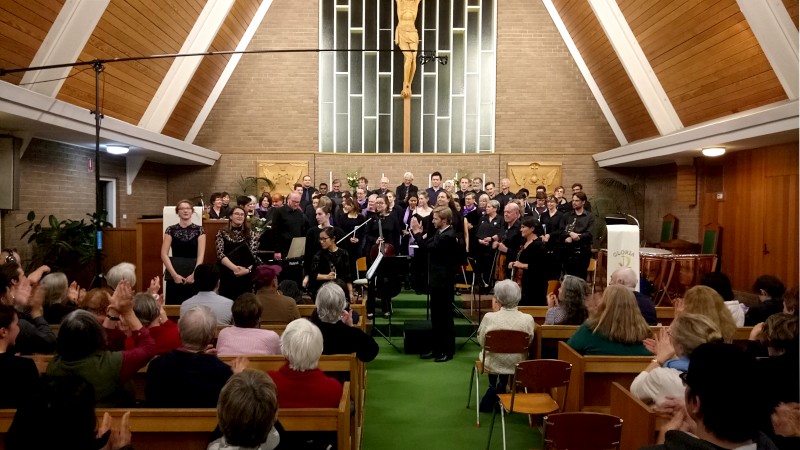
    We were celebrating the day after the election ... at least the death of Queen Mary but also her birthday and, I guess, Jesus. This was SCUNA, the amusingly named choral society hinting at inebriation, and they had their orchestra (virtually all players from NCO) and two solo singers, soprano Veronica and mezzo AJ under Lennie. The tympanis were out for the renowned and hugely memorable funeral march. I'm told the tymps were added later and this arrangement was used in the renowned '70s film, Clockwork Orange. "He cometh up and is cut down like a flower" / "of whom may we seek for succour" / "who for our sins art justly displeased" / "deliver us not into the bitter pains". It's a heavy feeling. This was perhaps the most intense and stunning work but not the Gloria of the program. That was Vivaldi's. First half Purcell with the Queen's funeral march and Come ye sons of art, written for a birthday of Queen Anne (royalty was presumably good for commissions; these days I guess it's the mining industry) then Vivaldi Gloria in D major after interval. So a generous program to raise the spirits or, with QM, to delve into depths. Glorious music throughout. The two soloist vocalists were great and fitted neatly together in duet passages. I especially enjoyed AJ's solos. The choral singing was generous and the musical passages nicely presented. Evelyn on cello was busy and did a particularly satisfying job. Lenny led it all and even doubled on trumpet at one time. I know of harp and carillon and he was toying with a violin in the break. What else does he play? So, a great comedown from election weekend. Who needed it?

    SCUNA (ANU Choral Society) presented Purcell and Vivaldi at St Peter's Lutheran Church. Leonard Weiss (conductor) directed with soloists Veronica Milroy (soprano) and AJ America (mezzo soprano) and accompaniment by Anthony Smith (keys, organ) and the SCUNA orchestra with bass provided by Evelyn Andrew (cello).

    16 May 2019

    Mozart and mates


    They were a civilised bunch, sitting together in a chambre, playing stately, amiable music with attractive melodies placing never-too-excessive demands. One movement was introduced as written for quick sale, by a musician seeking to monetise his fame. Nonetheless, this is Mozart and it's lovely stuff. The performing group was also made up of friends: two pairings of husband/wife and another mate, all with connections and history, even back to Telopea High (literally just around the corner). I think the session was convened by Hilda Visser-Scott but it's a group that seems to get together to play together every so often. There are now music and other professionals with a history of musical travel and various orchestras. The music was Mozart, two trios and a duet with various combinations. The main work was the complete (all three movements) Trio in Eb major for piano clarinet and viola KV498. Otherwise there were single movements of KV548 and KV434. All dignified and attractive and sensible rather than ecstatic and investigative, but always Mozart so always a pleasure. A lovely outing.

    Hilda Visser-Scott (piano), Peter Scott (clarinet), Robyn Botha (viola), Dawid Botha (violin) and Harry Hall (cello) played Mozart at Wesley Music Centre.

    15 May 2019

    Big Day Out 3


    It takes a flit from ACO/Branford Marsalis to Smiths to realise the jazz in your soul. This was my last outing with Dan Tepfer. He was playing a jazz gig for CIMF at Smiths with top flight Australians Sam Anning and Alex Hirlian. The place was sold out and I was recording so I had to get there early. I heard them warming up and was already excited. They had played a few gigs together before this (Brisbane and Wollongong?) and they were hot. The music was mostly original from Dan's trio's latest album. The room was full and the CIMF had trucked in a Yamaha grand in good nick and capable soundman Bevan was on duty. Then the gig. From the top, this was intensely complex rhythmic outings with fabulously effective solos all round. I tried to count a few with no luck but saw some charts later and it wasn't impossible, although rich in sixteenth-note syncopations through changing time signatures, 7s or 11s interspersed with more common 4s and 3s, perhaps changing each bar. Not impossible but a difficult read. Very heavy on time and groove. And chords that implied rather than defined. Something like E-4b7 (not even sure how to write it!) mixing with other colours of E-7. Odd extension that, 4 not 11? The grooves were steady and hard often fast, strongly defined by both Sam and Alex but free for accents and embellishments as they desired. Despite the writing there was considerable freedom. Also a friendly and respectful eye from Dan. He obviously enjoyed this group. He mentioned he'd studied with Sam at the Manhattan School of Music. There's no way this would have been out of place in the Village. Dan has studied (astro-)physics and it shows in his variety of musical interests (Bach, Disklavier and contemporary jazz). I've since read he has more music and science in his family background. The room was full with an older cohort, this being a CIMF concert, but the band was absolutely well received. They ended on a softer note, some non-originals and tamer times and a ballad. Set 2 ended with the driving original, Roadrunner, and an encore of Everytime we say goodbye. I went away stunned and hugely pleased and aware of the jazz in my soul. Something of this quality would thump the heart of any listener. A stunner and a great pleasure; being Manhattan, I can say world class.

    Dan Tepfer (piano) led a trio with Sam Anning (bass) and Alex Hirlian (drums) at Smiths for CIMF.

    14 May 2019

    Big Day Out 2


    Second in the concert marathon was a biggie: Australian Chamber Orchestra featuring Branford Marsalis playing music of Villa Lobos, Piazzolla, Ginastera, Stravinski, Golijov and Sally Beamish. Is SB the one out here? She's extant, she knows Branford and it's him playing on my Spotify recording. It's not often I leave a concert at interval, but this time I did. The musicians were great and the music inviting, especially the Piazzolla (if of a theme, as Piazzolla sounds to me ears). Branford opened with a short Stravinski clarinet solo on soprano sax, then a Villa-Lobos fanstasia, then Satu Vänskä led for Piazzolla Four seasons of Buenos Aires. All fabulously capable playing with strings that just sat in easy consensus and just a few ensemble features - I particularly noticed some prominent bass and a fabulous cello solo. Satu's lithe playing was a huge pleasure. Branford was his professional self but not so exciting for me in this setting. But I was recording the next concert so I left at interval to get suitable seating, given the smallish room that was sold out. How can this be? Leaving ACO and a Marsalis at half time? Odd but great while it lasted.

    Branford Marsalis (soprano sax) and Satu Vänskä (violin) fronted the Australian Chamber Orchestra in Llewellyn Hall.

    13 May 2019

    Big Day Out 1


    It was pretty shoddy planning but also just a concurrence of opportunities that had me with with three concerts in one evening after an afternoon orchestral practice (a playthrough of Wagner, Beethoven 4 and Saint-Saens; I took leave of Dvorak 8!). But then the professionals. First concert up was Dan Tepfer at Fitters Workshop playing his Goldberg variations / variations. The original Bach variations are an aria start and end sandwiching 30 variations, sometimes technically described as in canone all terza or fughetta and always written for two manuals on a harpsichord. Dan had a long association with the Goldberg and has finally created a response consisting of an improvisation for each of the 30 variations. So we hear the introductory aria, then a first Bach variation then a Tepfer improv then Bach then Tepfer through all 30 to the final aria repeated. In all, about 90 minutes, played with no music and improvised on the day (if probably conceptually established beforehand). I loved it deeply. Bach, of course, is a thing of wonder. Dan's responses were full of tonalities and harmonies and rhythms that have grown from another 300 years of fine music and jazz and more. There's clarity and order and dance-like joy in Bach; there's groove and dissonance and polyrhythms and substitutions since. So, the improvs are vastly different but built on the essence of each of the relevant variations and influenced and respectful and intellectually outstanding. A few people I spoke to preferred Bach or even suggested he could have left the improv out but it was a work of sublime depth to my ears. I chatted to Roland Peelman later and he agreed: if Bach was around that's what he'd be doing now, respectful and knowledgeable of the past but totally cognisant and involved in the present. Fabulous work. You can hear a take of it on streaming services as Goldberg variations / variations, but it can never be that performance, that day. That was fabulous and is passed.

    Dan Tepfer (piano) played Bach Goldberg variations and his related improvisations at the Fitters Workshop.