26 July 2010

Inlays, velvet, timber

Ah … The Parlour. It’s a new one on me, but I loved it. Swish! Carved woods, inlaid tabletops, red velvets, chesterfields, table service. And perfectly suitable for classy music, like Damian Wright’s flamenco guitar and Miroslav Bukovsky’s quintet. It was a fabulous outing all round. But firstly, the venue. It was a surprise. I knew of the development and I’d heard of its support for good music, but I’d never gotten there. It was much more impressive than I’d expected. Truly salubrious; classy to the core. I remember the daggy, dingy but historical buildings that used to house local government services in this place. Now there’s a five star hotel, new aged foyers, art and Victorian elegance in the Parlour. I’ll be back.

First for me on the day was flamenco guitar with Damian Wright. I’d heard Damian several times with the Translators where plays a fusion style with Steve Hunter and James and Ben Hauptmann. That’s stunning in its own way, but I loved the authenticity of this performance. Damian has spent several years in Spain and continues his studies in Spanish guitar. This is blissful music: sharp fingernail tones; tabla-fast strums that drench you in tense rhythms; barred left hands with fingered melodies; rock solid beats in rhythms of huge complexity. Damian was explaining the accents to me on a 12/8 rhythm: 12-3-7-8-10 (yes, it starts on 12; no, I don’t understand either) and how maracas will concurrently play 4 or 3 to the 12 (I think that’s right) and dancers will perform over the top of all this rhythmic melange. I noticed his foot tapping a rock-solid 4 to the 12/8, but he disabused me of this simplicity. It’s much more fluid. And there was a discussion of how all 12 notes are available in the harmony, although I didn’t particularly notice this. Just fabulous music and a great eye-opener.

Second was an old favourite: Miroslav Bukovsky leading a quintet with John Mackey, Mark Sutton, Hannah James and Dave Rodriguez. I’ve heard these players and this music many times before, but it remains fresh. Miro’s tunes are a revelation of lyricism and indulgent grooves. This is half the songbook of Wanderlust: what’s not to love? John was again a revelation. I’ve not heard him for a while, what with family duties and loss of venues, so his statements were fresh and clear. He has such a rich sense of harmonic colour; he phrases with clarity and inevitability with phrases that cross barlines with ease; he toys with eighth and sixteenth notes. And his tone is so big: the Parlour and the volume suited him. Damian said of Miro that it was obvious that he was a composer. You could hear that melodic sensibility in his solos. Repeated patterns transposed a few tones; inevitable intervals, or tastefully challenging ones. Miro played the flugelhorn for most of this gig, so it was rural and inviting: such a lovely sound. Dave was his melodic self, with his heavy strings that fight a bent note, but give such a big tone. I most enjoyed his comping: modal chord movements that blended with the soloist to form a moving palette enriching the solo. He said after how he’s enjoying comping. And Dave’s judicious use of effects: not driven, but echoed. Hannah was fluent, rhythmically strong and steady, and well intoned. It was a soft but present sound, that would lift to solos that moved widely and easily across and up the fingerboard to the thumb positions. Sydney must be suiting her, for this was one of Hannah’s favourite performances for me. Lovely work. Mark was pushing from the back, with limited kit so limited tonalities, but not limited rhythmically. This was strong and forceful, and some short but expressive solos that insolently clashed against underlying rhythms with intelligent complexity and easy control. The audience had a treat. A wonderful performance of several enveloping tunes and a few ring-ins including Bolivia, Mal Waldron’s So nice and Bronte Café and ending on an ecstatic Tenor madness and Miro's beautiful and intriguing Peace please. Did I enjoy it? Does it show?

Damian Wright (guitar) played the first set of flamenco guitar. Miroslav Bukovsky (trumpet, flugelhorn) then led two sets with John Mackey (tenor sax), Dave Rodriguez (guitar), Hannah James (bass) and Mark Sutton (drums). They performed at the MusicArtFood mini festival at New Acton.

24 July 2010

Crossing the barricades

There’s been a schism in the jazz community from the days of be-bop and it lives on as schisms do. The Bebop revolution brought a new approach to jazz, with the “mouldy figs” and “reboppers” parting ways. I’ve taken one side of that barricade at times, but these days I have a renewed interest in the history of our music, so it was with anticipation that I finally got to catch Brass’ere. Brass’ere aren’t just a wonderfully amusing name. They are also brass ensemble in the style of the New Orleans street bands. They can busk; they can walk and play; they sound generous and rotund with a fat tuba bass and marching drums; and they sneek in a baritone sax as the one reed instrument. They play standards of the brass band and trad jazz repertoire. But there’s joy and fun in this band (as should be with a New Orleans brass outfit - they play swinging music at funerals, after all) so their repertoire extends to a good bit of funk and even some re-imagined pop tunes. So, this is amusing and entertaining and big and satisfying music, and it swings with fat brass harmonies and backing lines. Wonderfully involving.

Cameron Smith leads the band, on trumpet and occasional vocals, but there’s another trumpet (Zach Rafffan) and two trombones (Josh Gosling and Michael Bailey). This is the core of the fat, swinging lines, and they do it with great rhythmic feel and dynamics and nice pitch. Brass players get good training in ensemble work, and you can hear it here. The bottom end is supplied by that phat tuba sound (David Ackiewicz) and the dirtier, reedy bari sax (Nathan Sciberras). A good strong bottom end with reliable time and a decent share of the solos. I hadn’t expected drums (Robert Nesci), given it’s a marching band, but I see from pics of the busking band, that Nesci walks with a snare. Nice one. In the studio he played kit. Nesci’s role is quite sparse and often with even feels on the 1,3 (more common on that side of that barricade) and he does it well. And there’s some vocal, too, when Courtney Stark sits in for blues or whatever, sometimes with accompaniment from Cam.

So what did they play? There were some standards of the trad repertoire (St James Infirmary, Sweet Georgia Brown), some blues (Happy blues), a decent percentage of originals of funk and ballad styles, and even a Jackson 5 pop tune (I want you back) that featured an introductory bass line on tuba. And that mainstay of the experience of brass band players, a hymn (Irish blessing). But how cool it all was! Great sound, big brassy chords and deeply entertaining! Great stuff. Break down them barricades!

Brass’ere performed for ArtSound’s FNL. They comprise Cameron Smith (trumpet, vocals), Zach Raffan (trumpet), John Gosling (trombone), Michael Bailey (trombone), Nathan Sciberras (baritone sax), David Abkiewicz (tuba), Robert Nesci (drums), Courtney Stark (vocals).

23 July 2010

Geraadsbergen

Pics by Neal Gowen

Geraadsbergen is a small town south of Gent in Belgium. Neal Gowen and An dropped into this bar and caught two bands. Neal reports that Big Band 86 was very good. It’s led by Marc Godfroid of the Brussels Jazz Orchestra and the SWR Big Band and comprises students and staff of the local conservatorium, at which Marc teaches. More info at the links below.

  • Marc Godfroid on Facebook
  • Big Band '86
  • 22 July 2010

    Gent

    Pics by Neal Gowen

    CJ's mate Neal Gowen of ArtSound is in Belgium and sent a few pics of the Gent Jazz Festival. The feature was Pat Metheny and supporting acts included radioKUKAorkest, Jungle Boldie (with Tony Overwater), and Odean Pope & His All Star ‘Odean’s List’. (All new to me). The festival is held in the Bijloke which used to be the Gent hospital but is now an arts centre. Neal’s partner, An, was born there a few moons ago.

    18 July 2010

    Out of the archive

    It’s quiet on the live jazz scene, so here are a few interesting pics from the CJ archives from Europe 2009. Firstly, some seriously good quality busking in the streets of Vienna. Classical music is a tourist industry in the major European cities, but that’s not to say it’s uninteresting or untutored. So Ryang is a Korean concert pianist with European training at masters level. Megan was pretty sure she was playing Beethoven’s Waldstein Sonata. It sure beats the lurid guitar I ignored the other day at the Woden shops. Secondly, musicians and artists are everywhere. I came across this composition student busily writing between drop-offs at the cloakroom for the Basilica di San Marco in Venice. Not sure how he could concentrate, but there you go. Thirdly, the renowned jazz textbooks by Mark Levine take pride of place in a Paris music bookstore. Lastly, a very down-to-earth Latin quartet in Piazza Navona in Rome. Look at that bass, man! Three strings and multicoloured.

  • So Ryang plays Liszt, Hungarian Rhapsody
  • 11 July 2010

    Sad duties

    It’s late in the day, but I’ve eventually visited McGregor Hall. It’s an old tiled, fibro workers’ hut from the earliest days of Canberra’s development. When I arrived in Canberra (1985) there were perhaps 5 or 6 around this area, which were even then used for various community activities: theatre, Photoaccess, group offices. This seems to the last of this style left, and so it’s a significant historical relic of Canberra. Sadly, and in the modern way, it’s threatened with redevelopment. The current users are the crew around the Canberra Musicians Club and various dance groups. I saw the Hall devoid of performers, but there was a distinctly pleasant vibe about the venue and also the people there: kids and community-minded adults of all ages. It’s at a location like this where you are exposed to the genuine feel of place. This is art and expression and community for its own sake, not for profit. It's valuable, but fragile. Governments don’t always see it this way, of course, and I can understand their predicament. The land is obviously valuable, and the huts were never meant to be permanent, but community needs encouragement and support and a past. Interestingly, good community and history have their own monetary value, in the health of a city and in tourism that increasingly thrives on uniqueness. McGregor Hall provides all these. It will be a sad day if and when another piece of our memory disappears.

    10 July 2010

    Third of 3 of how many

    There were three acts for the latest of hellosQuare concert at Street Theatre Two. It’s an intimate venue equipped with a nice PA and decent upright piano and it’s a venue I like: intimate, informal, suited to experiment.

    The feature act of the show was 3ofmillions. 3ofmillions plays with effects and presents freely improvised musics with few obvious chordal structures or harmonic movements and none-too-obvious compositional forms. They are very competent players who know how to interpret free and atonal forms and who work well together. That’s doesn’t make it any easier, but it does make the effort worthwhile. What do I remember of this? Some fabulous, frantic piano reminiscent of atonal classical styles; intensity that built and broke and passed through the players with ease; some very sweet walking bass (how unexpected!) at the end that convinced me of the sound of Abel’s unusual instrument (more below); some huge drum dynamics that clashed with ears and other performers, although never purposelessly; an arresting pitch bend effect that Abel used on his bass. I enjoyed this set. Just two long improvs, both capable and impressive even if never undemanding. BTW, Abel’s bass was semi-acoustic, a copy of Steve Swallow’s signature instrument (Citron AE5 Swallow). It has a long (36” scale) narrow neck and 5 strings, tuned E-A-D-G-C on the Swallow original. Abel suggested it excelled in chords and high notes rather than low walking styles, but it heard it as beautifully sweet for a short walk in the band context. BTW, Abel also played with a pick, although perhaps not a copper pick as does Steve Swallow.

    The openers were Cat Cat and Anonymeye. I presume Cat Cat are locals. Three guitars, some vocals, some harmonica, mostly one chord, a constant 4/4 backing track at about 110bpm (for all but one tune where they did 4/4 at 110bpm without the backing track), mostly with recorded tambourine on 2-4. They are described as kraut rockers, with “drifting guitars, droning keyboards and metronomic grooves”. I heard minimalist, ‘60s Doors-like tunes. Enough said. Then Anonymeye. Anonymeye is Andrew Tuttle from Brisbane, who is touring for Sound Travellers. He mostly played acoustic guitar and just a little keyboard, looped and effected. Strangely, he finished with straight finger-picked guitar piece that was, for me, the highlight of his performance. There were mentions of country and folk musics in the promo, but I heard it more as classical style with some degree of crossover to more popular styles. This was decent playing and the electronics were authentic enough when you closed your eyes. But the style (a solo performer mostly twirling knobs on stage) does seem rather indulgent, even onanistic. Maybe I just need to be better trained. I know others say that about jazz solos, but at least the skills are manifestly more demanding.

    The supporting performers were Cat Cat and Andrew Tuttle (guitar, keyboards, electronics) as Anonymeye. 3ofmillions was Adrian Klumpes (piano, electronics), Abel Cross (bass, electronics) and Finn Ryan (drums).

  • Citron AE5 Swallow
  • 07 July 2010

    Out of El Rocco

    It’s several times now that Geoff Page has brought our jazz history to Canberra, and it’s a fascinating and valuable exposure. This time it was pianist Chuck Yates, who used to play at the legendary El Rocco in Sydney in the ‘50s, and Ron Philpott, electric bassist with Judy Bailey in Sydney in the ‘70s. They were accompanied by Col Hoorweg, who I remember through the ‘80s backing big names visitors with John Carrick at the Southern Cross Club, and James Ryan, originally from Darwin but once a student here in Canberra but now thriving in the Sydney jazz scene. These historical performances usually cover the generations, and they are the better for it. This was a genuinely hard-ahead outing exploring pre-modal-era standards. The solos were sometimes rough-edged but hard and committed and fluent from all instruments.

    Firstly the tunes. A few from Monk including Round Midnight. I felt a freshness here. These are overwhelmingly well-known tunes, but they seemed to be closely felt, like they were the tunes of the musicians’ era, which is pretty true for Chuck, and not particularly true for younger musicians. Otherwise, lively swingers and latins: I’ll remember April started the night, Invitation, Daahood, and Kenny Barron’s Tragic magic. James Ryan’s A Date with Yate was the one original of the night. There was one fairly short but beautifully stated solo piano piece from Chuck that was recognisable but which I couldn’t place. And a final blues with Sydney-based Canberran, Dan Junor, sitting in on Alto. This one gelled with harmony horn lines (Dan did some great work here, finding unexpected and challenging harmonies), and very diverse styles of solos from the two saxes out front (Dan more clinical and restrained; James letting go with Coltrane-influenced extravagance). Two sets with ten tunes.

    Despite, or maybe because of, the years, Chuck is in fine form. His playing was diverse and changeable. His best showed simple but lovely phrasing, a creativity that had him moving freely, sometimes ranging widely over the keyboard, sometimes intervallic or dissonant with altered extensions. His face and eyes gave him away as an effective listener, too. Ron interested me as a bassist and as a blast from my past. He was an unusual proposition: electric bass played with a pick, through a JBL powered Eon PA bin with stereo EQ (he told me it was originally for a stereo Rickenbacker - another throwback to that era - that he used to play but which was stolen). I thought of Steve Swallow but there was little similarity to my ears. It was good solid accompaniment, and the one time I noticed a walk, it was swinging and well formed, but he was more a soloist. And interesting and capable solos they were, well up the neck, lovely arpeggiated phrasings that sounded of sax conceptions. I wasn’t too keen on his tone. It was pretty rough, even for electric, and middy, which is common to electric basses but is not the gentle presence of the acoustic bass. But the soloing was great. Maybe it’s just me reading his age, but James seemed more modern to me. He started with some wonderful Contranesque fast and harmonically rich playing on the opener, I’ll remember April, and finished on that style in the final blues. In between, it was less extreme, more bluesy. Either way, the playing was great. But what got me was a big sound with a slight metallic edge. I really liked James’ tenor. From the stage patter, it was obvious that Col had not played much, if at all, with Chuck before, but he presented well. Col has a unique style and sound. He’s got an interest in tonality and percussion that he used for the introduction to James’ original. He’s a solid timekeeper with a unique rhythmic ear: simple and open, often very cross rhythmic, playing long-sustained grooves that set an environment that’s often in contrast with the other players. It’s this solid and sustained contrary sensitivity that define his drumming for me. Dan Junor sat in on alto for the final blues. Obviously he had little time to warm up, but I heard him as very interesting on harmonies with the tenor, and defined and purposeful in soloing. But one tune’s not enough to know.

    So, a historical outing that was both interesting and worthy. Chuck Yates (piano) led a quartet with James Ryan (tenor), Ron Philpott (electric bass) and Col Hoorweg (drums). Dan Junor (alto) sat in for the last tune.

    04 July 2010

    Always a pleasure

    It’s great to have another opportunity to play with Dirk and Graham. I’ve managed a few gigs over recent months. It’s always so relaxed and easy-going but the grooves are solid, the communication is easy, the tunes are good ones, and the solos are generous. Some very nice playing, and a good exercise to hold the groove when the sax drops out for the guitar solo. The audience was small, but we had a few listeners, including one elderly Dutch man who had played swing drums in his days. A very enjoyable little gig. Thanks again to Dirk and Graham … anytime. Dirk Zeylmans (tenor), Graham Monger (guitar) and Eric Pozza (bass) played at the Tradies.

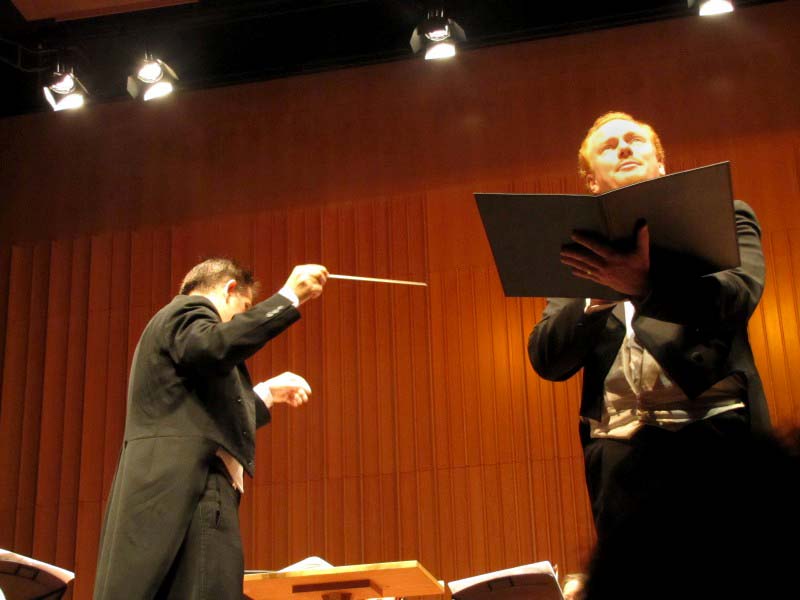
    Drama in the crypt

    The Catholic mass is theatrical and the Requiem mass is passionate, but Verdi’s Requiem just didn’t click for me in expressing the earthly loss but religious hope of the occasion. I’d heard Mozart’s requiem a few months before, and it was pained and deep. This seemed theatrical: more operatic in its drama and not unexpected given Verdi’s fame as a composer of operas. But the performance by the Canberra Symphony Orchestra and combined choirs was satisfying and capable: well presented, with four decent voices up front and a confident orchestra. We had seats in the second row, so my pics are more individual than inclusive, but it does let you feel a part of the performance. You hear the pages ruffling; the charts cover the singers’ faces and muffle their voices; the instruments come from a generous stereo sound stage; the instruments become almost individual (I thought I could hear Leigh Miller’s individual bass pizzicato tone, and it was wonderful). But I wonder if I missed some of the effect of the choir because of this. They were down the back, behind rows of strings, and they didn’t seem to have a great presence. It could have been the piece: I didn’t notice many big choral segments of richly moving parts. The choir seemed to provide a support role for the more frequent solo voices up front. We were all thrilled by one loud and dramatic theme that recurred several times. Other spots I noticed were two female voices with flutes behind (at least I thought they were flutes, although the program doesn’t list any flute players) and a passage of nice runs of long intervals from the cellos and highlighted trumpets up front for another segment. Suffice to say it was lush and dramatic and emotional if not a deep work. Stereotypically Italian, as is opera itself: the musical equivalent of flailing arms (which I can say as I am one). But why no list of choral singers in the program? Verdi Requiem was presented by the Canberra Symphony Orchestra, with Nicholas Milton conducting. Tobias Cole led a combined choir made up of the Canberra Choral Society, SCUNA, Oriana Chorale and the Llewellyn Choir. The front line singers were Eva Kong (soprano), Christina Wilson (mezzo-soprano), Warren Fisher (tenor) and David Parkin (bass).