22 March 2012

The sound of snow and long nights

The Reuben Lewis Quintet concert was called Scandinavian reflections and it started just as I expected: slow, meditative, rubato feels or barely implied beats, long crescendos, bass pedals, piano arpeggios, cymbals and rolls and mallets. These are the sounds of snow and chill and white to my ears, and this seems perfectly appropriate for Scandinavian jazz. This jazz sounds as you see it.
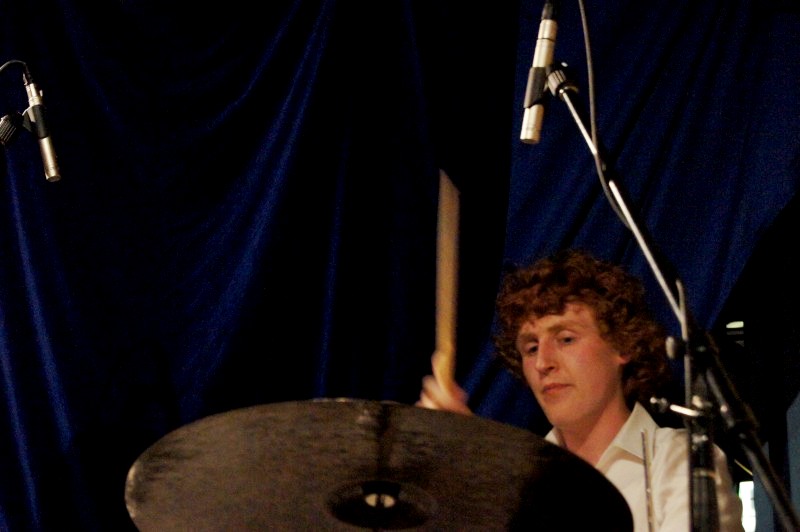
I was thinking of how this varies from US jazz, or perhaps the jazz of warmer countries. Partly, through the influence of ECM and its stable and its uncompromising recordings. But some of the tunes sounded more American to me: livelier, stronger grooves. Luke was playing a Rhodes, and although he tells me there are plenty in Europe, I hear Euro-jazz with classical (and folk) influences and played on fine grand pianos. The Rhodes is more swampy to my ears, especially when effected. And while Reuben in very influenced by this jazz (he mentioned Tomasz Stanko), I often heard bop conceptions in Max’s playing. (No problems there: I actually prefer it). But it was as I meditated on Reuben’s introduction that mentioned “melody and communication”, and as I listened to Simon’s sparse but clear and concentrated bass lines, that I felt the difference. There’s an intensity of interaction and a love of pure, unaffected tone here, along with a slow, folk-affected melodic sense. Simon was just defining one chord, but every note was a treasure and every interval was well considered. Aidan’s drumming sat the same way: sparse and melodic, story telling rather than rudimental. This was a unified whole rather than a soloist and rhythm section. It’s not such a new discovery, of course. Musicians have been concerned with this since the ’50s from the cool and modal and free eras but this style is at a high level and riddled with solitary intensity. This is the music of people thrown together for long nights. It’s not urgent or urban. It’s close to music of the very late night jazz club. But there’s also a feeling of darkness and unspoken closeness and unfilled time in this music. Slow or single chords, open rhythms, internalised thought spreading quietly. Even a pop song, when it arrived, was like this. They played Bjork’s tremulous Hyperballad, and the intriguing melody appeared occasionally amongst more obscure improvised meanderings. Nice but icy.

Anyway, that’s how I heard it. Reuben Lewis (trumpet) led a quintet at the Gods Café with Max Williams (tenor), Luke Sweeting (Rhodes piano), Simon Milman (bass) and Aidan Lowe (drums).

  • Cyberhalides Jazz Photos by Brian Stewart
  • 20 March 2012

    Information is the currency of democracy

    So said Bob Brown, but of course it’s been said before.

    I was at the launch of a new book by David McKnight on the political power of the Murdoch media empire (Rupert Murdoch : An investigation of political power / David McKnight. Crows Nest, NSW : Allen & Unwin, 2012). The event was organised by the Australia Institute and it occurred in the backyard of the Manning Clark House. The session was a discussion with David and Bob, led by questions from the AI’s Exec Director, Richard Denniss, and some audience questions. It wasn’t a large group in attendance and I wondered if they were disproportionately grey-haired. Perhaps the printed media is considered old hat, but they retain their agenda-setting importance and this inevitably gives political power, and this political power is very poorly contested in Australia, with only 2 major newspaper chains (News Ltd and Fairfax) and News Ltd having 70% of the overall market and several markets to itself. This allows News Ltd a great ability to share costs or cross-subsidise across its fleet of papers. There’s plenty of discussion of the power of media barons, and Murdoch/News Ltd in particular. Some interesting themes were: “everything comes down to the market” as an “emaciated view”; democracy is getting ideas out, yes, but not just selected points of view; exclusion as a key tactic in moulding political thought; big parties are restrained on climate change and politicians are “supine”; “the problem is .. you seek consistency” rang a bell; the call for inquiries by media, but the fretting over Finkelstein’s mild suggestions; more positively, the ultimate success of alternative themes in the face of media obstruction over recent decades, eg, feminism and environmentalism; the threats to media power when they break the rules and are seen to do so; the dangers for any power when it chooses the wrong side, eg, against science (Physics waits for no man); “we live in a work where wealth counts” evidenced by the ability to gain Australian residency with $250K in your pocket; “Australians are generous, good-hearted people, but fear is a great motivator” in reference to boat people; the power that comes with massive wealth is plutocracy - now in battle with democracy; the effectiveness of Murdoch as a great business person and the business-centred biographies written over the years. I felt it was an interesting encounter if sometimes disheartening. Despite the GFC, plutocracy keeps gaining, and we get closer to various emergencies: climate change, peak whatever. But I was thinking of another quote by the end: death comes to all men.

  • Abstract of Rupert Murdoch : An investigation of political power
  • 19 March 2012

    Stings classical to romantic

    Such a pleasurable afternoon it was! Yes, lovely weather, but I was inside for the Canberra Concerto Orchestra (CCO) String Quartet. They performed the final concert of an 11-gig tour through Victoria and NSW, and it was a gem. Beethoven, Mendelssohn, Tchaikovsky. In my classical-ignorant way, I knew none of the works, but they were all well spoken. I checked out the Beethoven (String Quartet no.1 in F major) before I went, so I felt comfortable when the first strains appeared and expected the affectionate and passionate Romeo & Juliet second movement and the rest. But the Mendelssohn (String Quartet no. 2 in A minor) was a delight, and the Tchaikovsky (String Quartet no. 1 in D major) was, to my surprise, perhaps my favourite. The change of eras, from classical to romantic, was obvious. I don’t see myself as a lover of the Romantic period, but these works got progressively more modern, less courtly, and perhaps the quartet also settled into the gig and played with more ease.

    The quartet was made up of professional and student players. Charlotte Winslade (first violin) is the musical director of the CCO. The CCO “exists to create the most inspiring and highest standard training opportunity for aspiring musiciians, mentored by some of the country’s finest professionals”. I could believe it. This music had lovely feel, nice comfortable tempos, the players worked together well, with eyes frequently on Charlotte. As a bassist, I was watching cellist Anne Ewing at the bottom end and it was a delight. It was a lesson in watching your colleagues and following a chart and the playing was luscious, too. There was one oddly groove-like passage in the Tchaikovsky, but there were also passages passed through the ensemble and low-pitched melod parts and some very pacey lines. The violins were edgy at times, but high strings are that way to my ears. But they, too, were in synch with Fia Walsh (second violin) also watching closely. Thad Shadduck (viola) was watching under his brows, too. The skills of all were glorious to watch: lithe, fluid, well read. But what a range these instruments have! They are tuned in fifths (unlike the fourths of the double bass that I know) so just one position covers a generous range. And while the cellist has to move liberally over a larger instrument, the viola is small, but the violins are diminutive. Charlotte went way into the stratosphere with some notes, and they all covered extended ranges with little arm movement. But I fear the intonation issues: these semitones are seriously close, especially when venturing up the violin’s neck. But thus is the life of a violinist. I hear that Fia and Thad are both students seeking to enter a conservatory program. I couldn’t see how they could fail. They performed perfectly comfortably with their senior colleagues. This was a concert of 3 major works and unusually with two intervals. Perhaps not CD-release-perfect but very impressive. Just another lovely Sunday arvo in Canberra, but Canberra’s like that. I’ll be back for more.

    The Canberra Concerto Orchestra (CCO) String Quartet comprised Charlotte Winslade (first violin), Fia Walsh (second violin), Thad Shattuck (viola) and Anne Ewing (cello).

    17 March 2012

    Festival fare

    I chanced the rain: I went to Stage 88 to see the Australian Ballet for the Canberra Festival. This was a free performance, the cultural leadup to the following night’s pop extravanga, Skyfire (urgh). I was surprised to find a generous audience sitting under umbrellas with their picnics despite a heavy downpour an hour before and the spitting rain at the start.

    What was this show? The skills, the strength, the balance, the stunning bods are evident, but you have to ask why. I wonder if this is inevitable with an allcomers show of this type. This was clearly the equivalent of opera’s favourite arias. You can understand this. The unwashed (I include myself here) don’t know the repertoire or understand the style or customs of the art. Maybe it’s just that, but I’m mulling further. On the morning after, the Canberra Times featured a half page review of the Australian Ballet performing Infinity in Sydney (Extreme triple bill a challenging delight, by Michelle Potter, in Canberra Times, 17 Mar 2012, p. 24). I was thinking what to write here so I read this with some interest. Michelle obviously was impressed and the three works comprising the show were far more complex and purposeful than this show, but what surprised me was how little there was to say. Ballet and music are both wordless arts so their messages are ill-defined, received differently by different audiences, emotional rather than rationally explicable. I’m not sure I say much in these pages other than that a technique is thus or a purpose is sound. Seeing an art form that I don’t understand leaves me at a loss and somewhat unsatisfied. Ballet is a highly refined form, and French at that, so can seem mannered and affected. The little girls in tutus rollicking in the mud before the stage enjoyed the playtime, and I enjoyed the skills and strength and beauty, but I can’t say I was sorry when it ended. It’s a stunning artifice, perhaps a pack of cards, and I need to see the sharp end before I could form any half-valid opinion. I once saw Nureyev and what I remember was just the hero calisthenics. There was a bit of that here, too, and it garnered the most applause (and it was impressive). I used to attend modern dance. That was also skilled and obscurely metaphorical, but at least it seemed closer to home without the formal artifice of a pre-Revolutionary French court. This show was like your favourite top hits album - but then it didn’t claim to be more. It made for a classy picnic, even in the rain, and a goggle at impressive skills. But I await a more profound connection.

    15 March 2012

    Will we fry?

    Ian Fry is the International Environment Officer for the Government of Tuvalu and he’s represented Tuvalu at climate change meetings from Kyoto to Durban. He doesn’t seem a happy man but he does seem both realistic and resilient. You’d need to be, given the state of climate change negotiations and the fact that the (increasingly unlikely) 2degC common target for temperature rise will swamp Tuvalu.

    I seem to have got back on the Australia Institute’s Politics in the Pub mailing list, so I got an invitation to hear Ian Fry talk and respond to a few questions. We are variously told that the recent Durban conference was a failure and a success, so I was interested in his view. As I understand it, there’s an agreement to make some form of agreement – legally binding or otherwise – by 2015 for implementation by 2020, and this agreement includes all parties. That’s claimed as a success by some but it seems to have put action on the backburner and it’s obvious plenty of uncertainly remains. This is disappointing given that the Rio Conference back in 1992 agreed that climate change was real, that humans were causing it, that carbon is best controlled by pricing and that the rich countries should act first. We have successfully backpedalled since then. But it is a difficult problem. It requires massive changes over a relatively short period before the problem is popularly evident, it’s only been understood recently, it threatens vested interests and is not urgent enough to interest many of the public, it’s complex and interdisciplinary and messages are difficult. But it’s also cheaper to deal with if we go early. Ian presented the USA as key: the centrally influential developed country that seems unable to act on climate change. Without commitment by the wealthy world that is mostly the origin of the problem to date, we can understand that developing countries don’t want to act. He saw American politics and democracy as in dire straits and cited the $5billion cost for the last election and the Citizen’s United decision that ended limits on corporate donations as evidence. This is a “grim view” and a “salutary note for Australia”, with our increasingly presidential styles and the effectiveness of political advertising in influencing elections and political decision-making, viz. mining tax, and I guess I should also mention Workchoices. In the meantime, Australia acts in diplomatic lock-step with the USA on climate change. On the positive side, there’s action even in the USA, eg, California has just commenced an emissions trading scheme and the Keystone XL pipeline was blocked by Obama. But Canada has withdrawn from Kyoto and Russia and Japan are threatening to, carbon pricing in Europe is struggling and “intransigent right wing gangs” continue to confuse public opinion while the scientific reports keep coming: CSIRO and UNCTAD reports were mentioned. Is the UN process failing? Maybe, but what else is there? One audience member suggested dealing at city level, given that the top 100 cities produce most of the carbon. That was interesting. Another mentioned that Native Americans suggested dealing directly with companies. (I’m always wary of claims for superior indigenous wisdom). Ian noted that Native Americans have constitutional privileges over land. I wondered if this is not just relegating democracy to the dustbin and accepting corporate control – a black-as-white version of Communism’s power of workplace democracy? Another suggested bypassing politics and dealing with people directly, but that seemed more like just education than people-power. In the meantime, Australia is now mining $400m tons of coal annually, and this will rise to 1billion in 20 years.

    It’s not a rosy picture. I feel for our children, and in the meantime for Ian Fry and Tuvalu and its Environmental department of 4 people up against the might of corporate wealth and influence. It’s a brave, if doomed, battle: for Tuvalu and maybe for all of us.

    13 March 2012

    Even more secret!

    Now, what followed was seriously secret: “Secret gig that is even more secret than the secret gig before it”. So what were we in for? Not music, but poetry and readings. Poetry is pretty underground these days, so I guess it’s apt. I enjoyed it. Four presenters: Miranda Lello and Mathew Abbott from Canberra, Zoe Norton-Lodge and Pip Smith down from Sydney.

    Miranda’s poetry was straightforward and eminently under-standable. She spoke of men and women and passion and personal battlegrounds in daily language and with street expletives. She spoke of cities and of failures that are not big enough to be art. She responded to Charles Bukovsky’s poem “Swingers” with her poem “Women who sleep with too many men” that spoke to me with eminent truth (eg, speaking about swinger sex: “the bed is a battleground / that measures only losses”). She stood for another poem dedicated to Walt Whitman that again spoke a woman’s view with clarity and intelligence. I liked her poetry: this was a woman speaking proudly and true.

    Mat is a PhD and a punk bassist. Perhaps this all shows in his poetry. I felt there was more literature and history and symbolism in these words, and it wanted another listen. He spoke of waking from sleep and of the nature of twelve surfaces. He played on impersonal constructions “it’s raining” for one poem and on 10 maladies for another. I truly understood souvenir collection as a malady. This was rich and complex and difficult, and that from a punk bassist!

    Zoe followed with a performance of a scene from a play she had written. It was lively, rhyming, auto-biographical and punny and poetical in style. It was really very well written and I enjoyed that aspect, but as a father of two boys, I can understand now why lots of parents have said girls are more difficult. Here’s a quote: "I’m not supposed to have fun, isn’t that right, Mum?” and “I feel so, so, so, so, so … sorry for myself”. I wasn’t young enough to appreciate the humour and not understanding enough as a father of boys. Nicely done, though.

    Pip presented a series of poems. One on the Sydney skyline and the manic business happening therein. Several on animals: whales and the end of the world; cows and their love for us; snakes that you can fear and that you cannot reason with. She told a story of an office plant that gives purpose to a disappointed office worker. Capable and lively writing presented with vivacity.

    Miranda Lello, Mathew Abbott, Zoe Norton-Lodge and Pip Smith presented poetry and stories at the YouAreHere Festival.

    Secret!

    It was announced on Facebook and the Web and it was in the YouAreHere festival program, but it was secret. Even the name was secret: “The secret gig that noone knows about”. But it was pretty well attended anyway and the music was good. This is indie or alt music and it’s a field I only visit at the edge every now and then. Sometimes I’m disappointed; sometimes I’m blown out; sometimes my judgement is poor. I remember the first time I caught the Cashews and I wondered what all the hype was about. I was wrong then. Whenever I’ve caught them since, I’ve enjoyed them immensely and I have great respect. This is bordering on folk. It’s singer/songwriter material. It doesn’t live by chops or harmonic embellishements, although the quality of the voices and vocal harmonies are essential. This is music of words and thoughts and connection. So how was the secret concert?

    There were four acts. I came at the end of the first and just managed a pic, but I’ve mentioned Drew Walky on CJ before. Next was the Burley Griffin. They are missing a bassist these days, so just guitar, drums and banjo. They had an interesting sound, with that uncommon banjo, and played a fairly rocky set. “Tell me honey / do you still know my name / you love me like the drug you’ve used” was earthy and street-wise. “Life is full of changes / on these moments we are found” had depth and was interesting. I wish I had caught more words; they seemed serious and fairly overt in their writing. The Burley Griffin is Evan Murray Buckley (vocals, guitar), Henry King (banjo, vocals) and I didn’t catch the drummer’s name. [I've now learnt his name is Kyle Mitchell. EP, 15 May 2012]

    Hashemoto followed with humour and wonderful harmonies and very nicely structured pop tunes. I was dumbfounded when they started with a dissonant cacophony, then elated when they dropped into lovely three-part harmonies that soared with Bec Taylor’s female (soprano?) voice, then impressed by the songwriting and structures. Professional, clear, well played and interesting: what more can you want from such a band? One thing: humour and audience connection. They had that too. I noticed some lovely pure pop anthemic chants and the audience joined in on some, like “Some good things will come”. It was better than it seems: anthems sound innane out of context. There were Beatlesque decays and thuddy drones and those lovely vocals. Much enjoyed. BTW, this may be the first time I’ve seen a band haul out an acoustic piano after a gig. Hashemoto comprise Damo Flanagan (guitar, vocals), Bec Taylor (piano, vocals), Potsy Webber (bass, vocals).

    The Cashews took the concert out with their songs of Canberra. Of course, they always sing songs of Canberra, they are renowned for it. Witty, capable and oddly informed by local history. Songs about Sullivan of Creek fame, Weston of Nursery fame and more. But they are also touching (“Little things I have written at the Cotter River / and I can’t wait to tell you everything”) and clever (“Like the 2010 election / I was lacking in direction”) and humane (“You don’t have to be a high achiever / to be a golden retriever”). Alison’s voice is all smiles and Pete’s demeanour is remote until he cracks a joke. The Cashews are a Canberra institution and a perfect expression of what Canberra is: unrevealed but often quite brilliant. And did I mention that they sing songs of Canberra? The Cashews are Alison Procter (guitar, vocals, accordion, ukelele, baby glockenspiel) and Pete Lyons (guitar, vocals, trumpet, ukelele).

    12 March 2012

    Everything is related

    It was only because I attended Jazz@Gallery on Thursday that I knew of Aimee Fitzgerald’s photographic exhibition that was to be opened on Saturday at the Canberra Grammar School Gallery. Her exhibition had a theme of channelling icons of Western art, so there was an obvious link to the Renaissance exhibition that I attended on Friday. It’s a small world but an interesting one.

    Since spending time in Europe, I have an abiding interest in history, and Aimee’s photos display a similar interest. You may see them as dress-ups but I didn’t. To me, they were an attempt to enter the world of another era through self-presentation. It was said that clothing maketh the man. I’m a daggy Aussie male of a dressed-down era so I’ve come to this late, but these days I’m developing a respect for fashion as personal expression. Some influences are the Grace Kelly : style icon exhibition at the V&A in London (now at the Bendigo Art Gallery), the self-presentation of a few locals and a film on the NY fashion photographer Bill Cunningham that I saw just last week. In her bedroom studio, Aimee entered the world of Leonardo and Mona Lisa, Vermeer, Caravaggio, Enlightenment males, Eighteenth Century women. Her colours and backgrounds and emotional surroundings display some very capable technique in lighting and photoshopping but, more importantly, I felt the results are nicely true to the spirit of the originals. But Aimee is also exploring other ground and I only realised the extent of it as I explored her website. She’s not just exploring herself in history but also closer relationships by putting herself in the shoes of the other. Most of these pics are monochrome and undemonstrative, but they are close to home. She appears in one series as her brother with heaby metal windcheaters and makeup suggesting facial hair. She presents another as herself as Narcissus, naked and mirrored. She appears as her mother in childbirth, this time in a glorious Caravaggian chiaroscuro. It’s both intriguing and touching and I much enjoyed the exhibition and my later research on her website. Aimee was the winner of a Canberra Grammar Gallery prize for emerging artists that led to this worthy exhibition.

    Thanks to Aimee for permission to publish her photographs
  • http://www.aimeefitzgerald.net/
  • 11 March 2012

    Quattrocento > Cinquecento

    Carlo Crivelli. Madonna and child c.1482-1483. Accademia Carrara, Bergamo, legacy of Guglielmo Lochis 1866

    I love the art of the quattrocento/cinquecento from Italy. I saw tons of it when I lived in Italy for a few years so I was happy to attend the National Gallery’s blockbuster exhibition, Renaissance, but I didn’t expect to be thrilled. But I was. It was a nice small exhibition with just a few works that I recognised, but it I thoroughly enjoyed watching the changes from Mediaeval to Rennaissance and was stunned by how 100 years-or-so was all it took to move from odd perspective and flat surfaces and glowing-eggshell skin tones to the realism and humanism of Northern Italy around 1550. I learnt lots because the change was so concentrated and so obvious. Megan and I walked around with a “shared adult” audio tour and it was a great choice. The descriptions were informative (despite some questionnable Italian pronunciation) and the shared audio made for a strangely intimate but social visit.

    Giovanni Bellini. Madonna and Child (Alzano Madonna) c.1488. Accademia Carrara, Bergamo, bequest of Giovanni Morelli 1891


    Sandro Botticelli. Christ the Redeemer c.1495-1505. Accademia Carrara, Bergamo, bequest of Giovanni Morelli 1891


    Titian. Madonna and Child in a landscape c.1507. Accademia Carrara, Bergamo, legacy of Guglielmo Lochis 1866


    Giovan Battista Moroni. Portrait of a child of the house of Redetti c.1570. Accademia Carrara, Bergamo, legacy of Guglielmo Lochis 1866


    After the first few rooms, I chose the Carlo Crivelli Madonna and child as my favourite with its glowing tempera skin and its luscious and suggestive peaches (I later discovered these were apples, to my disappointment) and the two landscapes (one rich and on the side of Heaven, one dry) and the symbolic cucumber (!) (=Jonah in the whale, ie, Resurrection) and cherry (=sweetness, ie, joy of Heaven) and carnation (= ardent love, ie, Mary). But then we were stunned by several wonderfully authentic portraits (Lazzaro Bastiani's Portrait of the philosopher Lucio Crasso; Andrea Solario's Ecce homo; Lorenzo Lotto's Portrait of a young man). We loved Raphael’s well-balanced Saint Sebastian, I enjoyed Titian’s soft Madonna and child in a landscape and was intrigued by the cartoon-like Botticelli Christ the redeemer. Then a few more portraits from the late-Renaissance (Altobello Melone’s Portrait of a gentleman [Cesare Borgia?]; Lorenzo Lotto’s Portrait of Lucina Brembati). Then the stunning change to the Northern Italian realism of the Renaissance (Giovan Moroni’s Portrait of a child of the house of Redetti; and Moroni’s Portrait of an old man seated and his paired portrait, Portrait of the nobleman Bernardo Spini and Portrait of the noblewoman Pace Rivola Spini). It was fascinating and quite a stunning little exhibit. We loved it. But that was not all.

    This is the Canberra Day weekend and a time of many festivals. I have just discovered there’s a new and youthfully energetic and iconoclastic one in Civic called YouAreHere. The Multicultural Festival was on recently and Enlighten is on now. The National Folk Festival comes up at Easter. All the big events at the national instituions get listed in these programs, like Handwritten at the National Library and Renassance. I was remiss in not writing up Handwritten when we saw it a few weeks ago. It was a display of several manuscripts (Virgil, Dante, Bibles, books of hours), letters with signatures from immensely famous people (Macchiavelli, Erasmus, Michelangelo…), several famed music manuscripts (Handel, Bach, Beethoven, Mozart…). We missed a concert of Beethoven’s 5th piano concerto for four hands (the manuscript was on display in Handwritten) because we had a conflict with Renaissance but unexpectedly there was also music at the National Gallery. I just caught one short set: Tegan Peemoeller on harp with Katie Cole doubling on soprano and violin. Tegan was admirably calm and professional in accompaniment. Katie was dramatic in performance and daring on both voice and violin. This was music of the era (or close enough) and expressed with that mostly unwavering pre-classical voice. We recognised Bach’s Song of love and a modern popular interloper, Balfe’s I dreamt I dwelt in marble halls. There was also a recorder ensemble and Tobias Cole singing with Tegan, but we missed them.

    Renaissance was an exhibition of Italian art of the Mediaeval and Renaissance periods on loan from the Accademia Carrara in Bergamo at the National Gallery of Australia. Handwritten was an exhibition of letters and manuscripts on loan from the Staatsbibliothek zu Berlin at the National Library of Australia. Tegan Peemoeller (harp) performed with Katie Cole (soprano, violin). What a wonderfully rich life we can live these days in the West (if we choose to do so, of course). And this is not even NYC!

    PS, These pics are borrowed from the National Gallery's exhibition website with permission - thanks to NGA

  • NGA's excellent Renaissance website
  •