09 July 2019

Our fave Beethoven

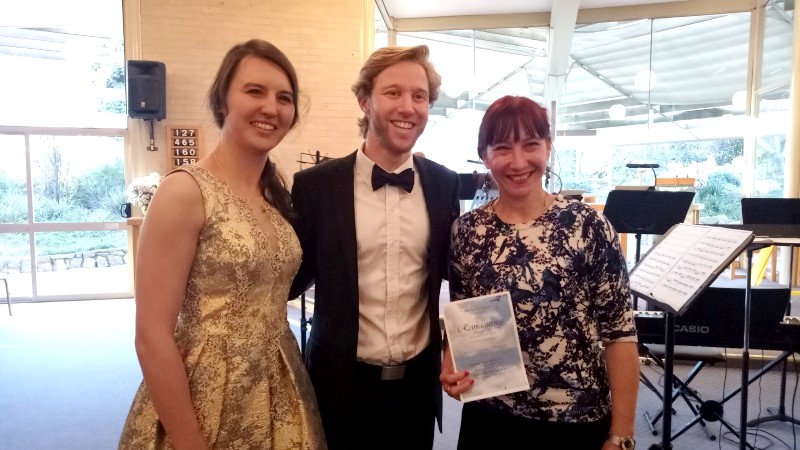
ABC ClassicFM has its annual Classic100 awards and this year it was for favourite composer and Beethoven won it. Probably you could have guessed the outcome, but Bach (no.2) and Mozart (no.3) were always runners, too. So it was opportune for the Llewellyn Choir to stage a Beethoven program. The main work was his Mass in C major; the others were Egmont overture and Choral fantasy. It was a great program and wonderfully performed. I hadn't heard the mass, but a mass is inevitably recognisable and thus familiar comprising the same run of titles, and, I guess, text. After all, the Catholic mass is a standardised and repetitive thing with a long history. The Egmont overture is well known but perhaps my least favourite on the night despite the effective performance. The Choral fantasy was new to me and a strange thing harking to the ninth symphony. It's solo piano for the first adagio movement, then into piano accompanied by orchestra and the choral section with two vocal soloists for the last few minutes. Odd and somewhat amusing but with some nice lines and several passages that clearly lead to the choral symphony. Renowned local piano accompanist Anthony Smith appeared as a piano soloist and did a great job. Four soloists appeared in the mass and their voices and interweaving harmonies were a great pleasure. I especially enjoyed Greta's soaring soprano and Paul's firm and strongly enunciated tenor. The Llewellyn Sinfonia was a nicely capable outfit and a great pleasure, obviously brought together for this program but featuring a string of CSO and such players. Nice to see the bass section of Max McBride and Dave Flynn. So, this was a great performance and a huge pleasure and, from the drinks and congratulations after, widely seen as a success. Wonderful and inspiring.

Llewellyn Choir and Sinfonia performed a Beethoven program including his Mass in C major in Llewellyn under Rowan Harvey-Martin (conductor) with soloists Anthony Smith (piano), Greta Claringbould (soprano), Jennifer Bennett (soprano), Ellen Malone (mezzo-soprano), Paul McMahon (tenor), Peter Ellis (tenor) and Christopher Richardson (bass). Lisa Stewart (violin) was concertmaster and Max McBride and David Flynn (basses) filled the bottom end.

08 July 2019

Instructive

It was a busy day so I only managed two of three groups in the masterclass, but what I saw was instructive. This was a masterclass arranged by the Canberra Chamber Music Players, the Canberra branch of the ACMS, at the ANU School of Music, with violinist Kristian Winther as the instructor. First up was a string quartet of Joy, Kathryn, Marilyn and Justine playing an arrangement from Playel's op.48 no.2. Next was Thea and Hang playing Franck violin sonata mvt.4. I missed the Faure piano quartet Cmin movt.1 by Thea, Suzanna, Terry and Heng. This is somewhat like family. I've played with virtually every player here, in various incarnations. Thus is the classical music scene in Canberra. Masterclasses are for players who already play, so the guidance tends to interpretation rather than technique. So we heard of ideas like "who's the boss" meaning who is the leader at any time (it moves); how to express notes and lengths and melding and joining phrases; sharing ideas and interpretations; how notes are bowed and formed and attacked. Nerves were mentioned and one suggestion was to squeeze toes to avoid tension in the hand when playing soft (mostly a joke!). There were stories of famed musos and descriptions of composers' "schtick". And further, of telling a story and having to make the journey to earn the end; creating, even exaggerating, each twist and turn; of coordinating phrasing between different instruments (here, piano and violin, very different). The comments are a thing of the moment and of the performance, so it sounds vague here but is relevant in context. There's still stuff to learn even at this level. Revealing and informative.

Kristian Winther (violin) instructed a masterclass for the Canberra Chamber Music Players. Instructees were Joy Searle, Kathryn Collins (violins), Marilyn Moir (viola) and Justine Gibbings (cello) and Thea Lau (violin) and Heng Lin Yeap (piano). I missed Suzanna Powell (viola) and Terry Neeman (cello).

07 July 2019

Talking dirty


A political book launch in Manuka will bring out the political actors, Canberra being the heart of federal government. Perhaps more-so when it's a surprise tell-all with attributions and the author is a journo at the Australian who had worked in the office of Liberal treasure (Costello). It's a fascinating experience in some ways but also revealing. One thing I notice is that the revelations are usually not too surprising. Being somewhat a political junkie, I hear much of this and it is mostly available in print or on radio. Another thing is that I'm not too good on the personalities. It was Megan who commented that the old bloke we'd shuffled our seating for was Tony Eggleton. I hadn't recognised him. Nor others. We did get to chat to journo Paul Bongiorno about a great uncle of mine who used to sell pasta to Paul's father's grocery store. But that was about personal matters not politics. This was the launch of Niki Savva's new book on the Turnbull putsch. It's particularly interesting for her connections and especially for the attributed comments that were given before an election that was then considered lost. So apparently the rashness was rife ... or should we say honesty? The title is Plots and prayers : Malcolm Turnbull’s demise and Scott Morrison’s ascension and it follows her success with The road to ruin : How Tony Abbott and Peta Credlin destroyed their own government. Henry Rosenbloom, publisher of Scribe press, started the evening off, then Laurie Oakes launched the book proper. He introduced with references to a current love, crime fiction. The discussion was quite damning of current politics; "a depressing book" . He spoke further on despair and current politics; the current "embarrassing ineffective rabble" and comparisons with Hawke's time; the wrath of the DelCons which was felt by Niki for her previous book; Corman quoted as the "ultimate seducer and betrayer"; an ability to "utter inanities" as one of Morrison's strengths (but not that he's the first!); that the media has some responsibility for being so close and caught up in the games; finishing with the observations that "all political careers end in tears". The observations were damning, and that from such a long-standing and admired political journalist, but particularly telling as it came after a few years outside Parliament House. I hate to talk of the "bubble", for that's just served as an excuse for Morrison to avoid discussing LNP failures and scandals, but there is some truth in the term (not that there aren't many other "bubbles", in politics and out). Niki Savva then got up to give thanks. She spoke of how she had been shocked by the revelations of these interviews; shocked by Corman's sudden change; predicted it will end poorly for Morrison, seeing him as clever but cold blooded, joking that Divine intervention would have been from an Old Testament God; how the moderates had sacrificed Julie Bishop; how Dutton is more liked by mates of left and right than Morrison (this seems a surprise to many, including me); how several had literally shed tears after the stress of the Turnbull affair (although I could only wonder where the tears are for New Starters or RoboDebtees). Like I said, such a booklaunch is always interesting and revealing and to some degree confirming what we read daily, if we read. And some free wines and party and paper spotting, too, so quite good fun.

Laurie Oakes (journalist, retired) launched the new book by Niki Savva (journalist) at Paperchain Bookstore, Manuka. Henry Rosenbloom (publisher) introduced them all.

05 July 2019

A hopeless case and a great dane


Barbara's title for the concert was so good I could only steal it (as in "Good artists copy; great artists steal" or thereabouts - see link below). Barbara Jane Gilby was playing with Katherine Day and Emma Rayner. The hopeless case was Theodore Kirchner, a German who led a dissolute life of drink, gambling, affairs and inevitable money problems and lost friends, suffering a strike, losing his sight and dying early while being cared for by a student. Schumann and others had raised money to settle his debts, but he just returned to his ways. He was a great arranger and wrote mainly miniatures. We heard his Zwei terzetti for violin, cello and piano. The great Dane was Nils Gade, Danish, well known and influential, living in Germany then returning to Denmark due to war, teaching Grieg an others and writing much including symphonies, concerti and sonatas. We heard his Sonata no.2 Dmin op.21 played on violin and piano. The stories and the contrasts were interesting; the playing was wonderfully capable; the concert was a pleasure throughout. Barbara told how she wishes to present concerts of interest rather than youthful display and this was just that. A great pleasure.

Barbara Jane Gilby (violin) performed Kirchner and Gade with Katherine Day (piano) and Emma Rayner (cello) at Wesley.
  • Quote investigator on "Good artists copy; great artists steal"
  • 04 July 2019

    Challenges


    It was Geoff's Jazz@Lab outing, this time at AlterEgo, with the most incredible band comprising some of our most renowned Aussie performers: Sandy Evans, Andrew Robson, Lloyd Swanton and Hamish Stuart. Stars in their own right and a work of bliss together. The room wasn't the best - the smallest of stages split a long room in two - but the fabulous playing and compositions defeated all that. I was amused to watch passersby passing the door behind the stage where you could hear all pretty well. Some noticed and responded, perhaps challenged or perplexed; some just walked by; a few came in. This is not the stuff of commercial radio and this was the commercial heart of Civic. Andrew's compositions channelled Ornette to my ears: spiky and twisted but also an inevitable fit. Sandy's works went off, but in a different way. I was all smiles and admiration listening to the group dissolve into free then recompose itself just before the interval on one of Sandy's tunes. This was Sandy with Andrew's trio but these people are friends and have played together forever so it's a knowing coming together. As often, they featured one tune by Sydney jazz mentor Bernie McGann, Salaam, inviting Miro to sit in. His solo was different again. As were Hamish' and Lloyd's, on their different instruments, both setting down the most delicious and inevitable extemporisations. At this level, it all sounds so right, not fast or flashy (although speed makes its appearance when it fits) but with that feeling of continuity, inevitability, correctness that the great improvisers display. This was a great concert with intimacy despite a difficult room. Maybe that even helped, as challenges can. I missed Ornette at the Opera House so this will have to suffice, and suffice it will, with ease. A fabulous display. Many thanks.

    Sandy Evans (tenor, soprano) played with Andrew Robson (alto, baritone) and his trio comprising Lloyd Swanton (bass) and Hamish Stuart (drums) at AlterEgo for Geoff Page's Jazz@Lab series. Thanks to Bob Howe for some pics from the night.

    02 July 2019

    Jazz messages from Brussels


    Our CJ Belgian correspondent is at it again. As if the election wasn't exciting enough for him. Neal and Anne are in Brussels at the Music Village bar (not far from the Grand Place) to see a tribute to Belgian sax. That's apt given that Adoph Sax, the inventor of the modern saxophone, was Belgian. The band comprised four saxes, bass, drums and piano, playing Jazz Messengers, swing and the like. He says it's damn hot in Brussels; presumably the jazz is too. Thanks to Neal. I'll check it out soon enough.

    Pic by Neal Gowan

    30 June 2019

    Revisiting youth

    I've enjoyed my last few years playing in orchestras but I really thought I'd left my run for the Canberra Youth Orchestra a little late. But no! Last night I played with CYO in Carmina Burana! I joked about that with someone and they commented on the interchangeability of orchestras in Canberra. Perhaps because we are a smallish community where people have common connections and are physically mobile and flexible. Also that we are pretty well endowed with classical opportunities. I hope this lasts. At least last night, the complete viola and bass sections were friends or alumni. And they often just drop in at the last minute. I only sat in Friday night and Saturday morning before the performance on Saturday night. But it's quite readable for bass and I'd played it before. Not sure the singing was so easy. Canberra Choral Society provided most of that and they performed a treat. There were less frequent kids voices from the Canberra Children's Choir and some accompanying aged voices from Seasoned Voices. That was fascinating: the two ends of a singer's life represented in these mediaeval words put, fairly recently, to music (Carl Orff wrote Carmina Burana in the 1930s using mediaeval texts). Plus there were solo singers, soprano Rachael Duncan, tenor Tobias Cole and baritone Andrew O'Connor. They impressed massively, not least Rachael's glorious and touching resolution with the endless (8 bar+) sustained high note and Tobias' black boa and matching theatricality. The choir had been prepared by Dan Walker and he sang amongst the tenors. Otherwise, there was the CYO itself with its friends and alumni. Great job by them and all. I sat by the percussion and they were wondrously varied and sharp. The winds did a great job with their features. The basses done good, too. I'm pleased to notice my own improvement over recent years. I played CB with NCO in July 2016 but I felt far more in command this time. That's a personal satisfaction. And again Lenny is passing a baton: this was his last concert with CYO before going off to study in Baltimore. And perhaps just one oddity to mention: a classical concert with no interval, just the uninterrupted Carmina. This was a great pleasure and a wonderfully evocative and successful rendition of this popular classic.

    Carmina Burana was presented by Canberra Youth Orchestra, Canberra Choral Society, Canberra Children's Choir and Seasoned Voices with soloists Rachael Duncan (soprano), Tobias Cole (tenor) and Andrew O'Connor (baritone) under Leonard Weiss (conductor) and Dan Walker (chorus master). The bass section was Hayley Manning (principal), Kyle Daniel, Chelsea Kennett and Eric Pozza.

    28 June 2019

    Workplace


    I've lamented the poor visuals of organ concerts before. This was another RSCM concert, at St Paul's Manuka with organist Anne Marie Neilsen. I was lucky enough to be in the loft with Anne Marie so had a decent view. The respectable turnout below couldn't even see an organist's back, sitting as they were in pews facing the altar with the organ loft behind. But that's how it is. But in the loft it's a workingman's experience, close to the pipes so they are genuinely stereo, hearing the clumping on pedals and the noise of blowers (or heaters in the Canberra cold) and feeling the vibrations of the boards below us responding to the pedalling. But what a sound! MA played Bach, Mendelssohn, Durufle, Franck and Vierne without interruption. The driving inevitability of a Bach fugue, the pensive melody and harmonic sequences of the Mendelssohn, the mighty religiosity of this Durufle, some variety from Franck and the amusing play on the instantly recognisable bells of Westminster. All played so convincingly by AM. I'm intrigued by the organ playing, fingers stretched to sustain notes, diverse manuals with their pre-set sounds and pitches and the variety of tones and those deep and powerful pedal notes. It's a thrilling thing and must have been an outlandish experience for mediaeval listeners in churches in the days before amplification, when nothing other than nature (and gunpowder) was so loud. As with much (European) art of the time, it was just further proof of the power of God. In our more secular age, we hear these things as art or entertainment but are aware of their power and beauty. I feel religious art is not of our time: a visit to the modern galleries at the Vatican Museum were just evidence to me. But the experience remains true and beautiful. Loved it.

    Mary Anne Neilsen (organ) performed for the RSCM (Royal Society of Church Music, ACT Branch) at St Paul's Manuka.

  • Royal School of Church Music (RSCM) Australia
  • Organ Historical Trust of Australia
  • 27 June 2019

    Parts

    My singing is not the most renowned, but I struggle with the tenor parts and Harmonica Monday gets it pretty right on the night. HM is a modest group, practicing mornings and performing for friends and relatives and taking on the most satisfying on repertoires. This concert covered the waterfront for choral eras, from mediaeval through to modern, extant, Canberra compositions: de Victoria, Bennet, Handel, Dvorak, Tchaikovsky, Brahms, Faure, Barber and Canberran international choral master, Stephen Leek. His piece was a quirky song from the northern Australian islands, Monkey and turtle. Fabulous fun. There were some seriously interesting harmonies and considered parts displayed. Nice one.

    Harmonia Monday (choir) is directed by Sheila Thompson and Oliver Raymond (conductors) with accompanist Jenny Kain (piano).

    25 June 2019

    Double barrelled


    I don't like weapon references, but this is too good to miss. Musica da Camera has just played one of its weekend concert pairs and the country segment was a Gunning. Thus double barrelled. Lenny chose the music, as musical director, and conducted. This was our last concert with Lenny before his further studies overseas. Katia Beaugeais, Selmer artist saxist and Sydney Con composition lecturer, provided our original for the day, first recorded by ACO Collective for ABC, none-the-less. Helena Popovich soloed on our recomposed Seasons. Tim Lamble recorded the Saturday (Cook) concert for ArtSound (expect that sometime in coming months). The music was delightful and varied and modern. First up was Arensky Variations on a theme by Tchaikovsky. Lovely and eminently doable. Variations are an interesting exercise in classical music. Then Katia's Like snowdrops you will shine. This was deceptively challenging with its odd syncopations over changing time signatures (mainly 5/4) and pentatonics with a gull-call finish of harmonic slides. This was quite a challenge on day 1 but reasonably settled on day 2. It's a glorious, soft, heart warming piece dedicated to hospital staff and celebrating their good work. Lovely. Then the long work, Max Richter Four seasons recomposed. This was a hit of the CIMF a few years back: all minimalism and drones with odd, changing times as features and the well-known melodies peeking through. An impressive and convincing and often mesmerising reworking of the standard. Helena did a great job on the most demanding of parts. Again, an artistic and intellectual pleasure to play with Lenny and Helena and the MdC crew, and to feature Katia and such interesting new music.

    Musica da Camera performed Arensky, Beaugeais and Richter at Cook and Gunning. Leonard Weiss directed (conductor), Helena Popovic (violin) soloed. Katia Beaugeais (composer) attended both outings. Tim Gamble (recordings) recorded for ArtSound.

    21 June 2019

    Backs


    Organs are different things. The organ player's back is usually facing you; the music is variously grand or delicate and variously toned. It's different from other keyboard instruments, too. Sustain is achieved by holding down notes; notes are on/off rather than with a natural decay; volume is not controlled by the playing hands but by the foot pedal; there are several keyboards (=manuals) for hands and one for the feet. It must be confounding for pianists or harpsichordists, although obviously some aspects carry over. The ACT Organ School at Wesley Music Centre presented a student concert comprising 10 players over an hour-or-so. Again, they were varied: several school kids and some advanced students and ANU SOM students. The music was mostly Bach and Buxtehude, but the advanced performers branched out, into Hindemith, Messaien, Widor and Franck. I love baroque (we all do), but I particularly enjoyed the modern takes with the differing harmonies, the demanding dynamics and the rest. Wesley provides the organ and manages the Organ School. The teachers come in from interstate: tiring but obviously enjoyed. Brisbane organist Christopher Wrench is the senior tutor and he emceed for this event. A great pleasure from all players and an inspiration from several.

    Christopher Wrench (organ tutor) compered a student concert for the ACT Organ School at Wesley Music Centre. Performers were Christopher Taylor, Ariana Odermatt, Kate Cole, Jacob Wu, Timothy Kelly, Rebecca Anderson, Jayden Lohe, Jonathan Lee, James Porteous and Linus Lee.

    19 June 2019

    A few laughs


    Political cartoons provide a few laughs but, of course, they serve a much greater purpose, to explain or comment on the news and events of the day. They can be uproariously funny, snidely cutting, embarrassingly illuminating. There are great cartoonists across the world and Australia is right up there. Perhaps it's a thing of the culture, but I prefer ours to most others. Except maybe New Scientist or The Economist or sometimes New Yorker. Cartoons also require that you know the topic. The National Library has a large collection of cartoons and I got to their exhibition called Inked. It's arranged in date order, so the early rooms are largely unknown and no understood, at least for me. For me, it starts at Whitlam, although there's some awareness back to Menzies. For others, earlier or later. For Labor Party animals, it's earlier. But I got a good few belly laughs from some of those displayed. But they can be black, too, like Best we forget or Progress. Here are a few. Sadly some other favourites didn't photograph well. Worth a visit to the NLA along with the annual display of best political cartoons downstairs at Old Parliament House.

    Inked is a display of political cartoons at the National Library of Australia.

    17 June 2019

    Fine romances


    It was NCO again and this was exciting. We were playing the world premiere (in full symphony orchestra format) of Mike Dooley's first piano concerto. I'd heard it before in a smaller format but this was the full thing, beautifully melodic and inviting and played so well by Andrew Rumsay. Mike gave an excellent pre-concert talk, talking of his preference for consonance, or at least resolution of dissonance, complex with examples on piano. The work had some complex counts, too. Mike joked that he had a coffee cup with a caption of difficult counts - 11/16 and a few others - and apparently that's what we played. I'd missed playing Sally Greenaway with NCO so I was glad I didn't miss this one. Andrew is a Kawai artist, and Kawai had shipped in a new 8' grand for the event. And after interval, one of my most difficult but favourite plays, Rach 2. Madly romantic, teeming with ideas that are combined with sudden crossovers, slow to rabid times. Great fun and sweepingly attractive. The third movement is famous as providing the theme for the pop hit, All by myself / Eric Carmen. So, a great program with Mike's alluring new piano concerto played by Andrew combined with the romantic bliss of Rachmaninov Symphony no.2. What a great afternoon and a satisfying challenge.

    National Capital Orchestra performed Mike Dooley (composer) and Rachmaninov under Leonard Weiss (conductor) with Andrew Rumsey (piano) as soloist. BTW, the bottom end was Roger Grime and Eric Pozza (basses). National Capital Orchestra, Mike Dooley, Leonard Weiss, Andrew Rumsey