06 June 2010

Better old and new

Free orchestral concert in Llewellyn? Wouldn’t miss it; better than those late night offers on TV. This was the ANU School of Music Orchestra. Presumably they are the students. They certainly looked young, but they played well and the program was a pleasant one, with just a little challenge. Firstly Gershwin’s American in Paris. It’s a popular work. From the top it was a hoot, literally with the sounds of car horns, and figuratively with big European city aliveness. There were jazz syncopations that represented the brash, brassy yank, and cute, bouncy litheness that was the Parisian surroundings. It was a Paris that’s perhaps not so obvious these days, but you saw it in films of the period. There was a second movement that was more in awe and wonder, then the elephantine statement at the third movement with its bluesy, laid back, Yanky statement. Lovely and joyous and wonderfully, almost visually, descriptive.

Then followed the Piano concerto by Constant Lambert. This was not so well known, at least to me. It’s a work from 1924. I often find works of that period remind me of film. Presumably, the film composers at that time, and shortly thereafter were influenced by these styles. Megan was at a loss for a major theme. I found it attractive, in a Roman epic way. Earlier on, I thought of B-grade Roman epics and those strange cowboy-style horse chases they featured. Then mills and stream and brooks, then a denouement. Nicely played, and interesting, if somewhat typecast to my ears. Blame that on the commercial culture that also has me equating Carmina Burana with a brand of instant coffee. Anthony Smith was the pianist.

There was an interval, then the last work: Dvorak’s Symphony 9 “from the new world”. This was the longest work on the concert, and another one that’s hugely popular. I could feel the optimism of the work, but it seemed naive to my modern ear. I enjoyed it well enough but it remained unrealistic. All this hope and beauty and optimism. The first movement seemed enamoured of mountainous scenery and the grandeur of the plains, while referencing Errol Flynn’s Robin Hood in my mind. The second presented human dimensions of wives and horses and the trail west, all hardship and tenacity, and even a touch of doubt, but never of flag or country. Then a waltz for the third movement - that was difficult to fathom as it seemed to hark back to the old world. Then a fourth movement of sound and fury and again those filmic horses. I’m disrespectful, but I find this music too romantic: serious but verging on treacle. We’ve lost such hope for the new these days, and this music seems to me to be lost with it. I don’t prefer John Cage, but I do respect informed doubt, a willingness to question orthodoxy, a certain world-weary wisdom. These qualities say old world to me, not the new world of this music.

So what was my preference? Probably the Gershwin for its delightful mix of old world and new, and its open awareness and respect of the strengths of each. This was a wonderful balance of old and new and that’s the stronger path to the future. But it was a lovely program and a capable orchestra presented it. There were a few uncomfortable moments, but nothing to be concerned about. These are capable players who already provide a most attractive performance. And they are just students! I am in awe. Well done to the ANUSM and their lively orchestra and this amenable program. The ANU School of Music Orchestra was conducted by Mark Shiell. Anthony Smith joined on piano for the Lambert Piano Concerto.

Takes one to know one

Codgers had the most white- and grey-haired audience that I’d ever encountered. It takes one to know one: well attended, well enjoyed and good natured. None too deep, but its heart was in the right place. A group of five older men meet every week at the local gym for exercise, chin wags and Saladas. They reminisce about the war and complain about a changing, modern Australia. Then various events interrupt their routines: there’s a Chinese interloper who’s invited along one day; there are skirmishes between the Liberal and Labor voters; there’s even an unexpected GLBT theme (I won’t give this away), there’s a real estate deal that potentially flops and a death in the group. In the end, the group comes to better accept differences (racial, sexual, health), and gets on with its life. Interestingly, the Labor/Liberal stoush is in the context of the 2007 election (t-shirts proclaim “Kevin 07” and “Rudd’s a Dud”), so this is somewhat of a latter-day Don’s Party. (Given recent polls, it seems they were both right: 2007 was Rudd’s election and he subsequently became a dud). So, a nice play with a wholesome theme, a busy and entertaining dialogue, an interesting politico-social parallel and none too heavy. Of course, I couldn’t take pics. The pic is of a poster outside the theatre for another play, but it seemed strangely fitting.

04 June 2010

When the sky cries rainbows

It’s always good to hear Sandy Evans, but this night was special. The evening started with a set from her trio, comprising Brett Hirst and Toby Hall. This was wonderfully impressive playing on a range of tunes. A few po-mo-influenced modern pieces that were ironic and entertaining platforms for some great soloing. The first was the night’s starter, Hungry Head Shuffle, with its loping jollity and wildly syncopated bass and open drums that moved into interrupted walks and otherwise played with sparseness. HHShuffle morphed somewhere during solos into Mountview. Then a raga played initially by Sandy on soprano sax against a sitar-like drone from what is presumably the Indian equivalent of a drum machine. I was surprised to hear Brett on bass soloing here, but it was informed and apt. Then an end with unison instruments playing a devilishly difficult head. I’d heard this raga before, when Sandy appeared at the Gods with Citizens of Earth. Technically, it’s mostly Phrygian, but any note is playable subject to some rules of repetition, so some notes can only be played once an hour. Sandy warned we wouldn’t get to these notes. The last tune was back to po-mo fun and Toby controlling solos with a whistle. James Greening came on for this tune and he obviously enjoyed the humour of it all, but it was also hot soloing. But for all this great playing, it had nothing on the second set.

“When the sky cries rainbows” is a suite by Sandy lasting about an hour. I can write of it, but I didn’t take notes and its beauty and seriousness really have to be experienced. It comprises around a dozen pieces or themes that tell of personal tragedy around illness: the shock of diagnosis and coming to awareness; changing moods, depression and optimism; the journey to dealing with a major, irreversible illness; the strength of the ill person and the relationships of husband and wife in going through the experience. The rainbow is a symbol of hope, and the journey is ultimately hopeful but it’s an honest view of the strongest of emotions around despair and resignation and acceptance. Sandy’s trio was augmented by Miroslav Bukovsky, James Greening and Luke Sweeting for the work. There was a good bit of reading, and it’s not something they knew intimately, but the band played it with passionate embrace. I was stunned by Luke’s maturity in several important piano parts. By Miro’s beauteous strains of trumpet played to resonating piano strings. By James’ virtuosic fluency on trombone in various parts. By Sandy’s intent and honesty and openness, to speak nothing of her playing. By the congruent playing by Brett and Toby. It was not a large crowd in attendance and the music had some roughness from last minute learnings, but this was a work of honour and honesty and profundity that is rare in any medium. It was one to savour with closed eyes and sturdy emotions. If you get a chance to experience this, don’t miss it. I recorded so it should be on ArtSound’s Friday Night Live in the next few weeks or months. Keep an eye out for the broadcast and stay in for the night.

Sandy Evans (tenor, soprano sax) led a trio with Brett Hirst (bass) and Toby Hall (drums). She supplemented the trio with Miroslav Bukovsky (trumpet, flugel), James Greening (trombone) and Luke Sweeting (piano) for “When the sky cries rainbows”.

03 June 2010

Our heritage

We hear tell of Bernie McGann as a key person in our Australian modern jazz heritage, with biographies in print and film. But he’s here, and very much performing with the same intent and his unique voice. We had a chance to hear it again at the Gods on Tuesday. Bernie came with his quartet: Warwick Alder, Brendan Clarke and Andrew Dickeson. This is jazz that harks right back to bop invention but speaks also with voices following bop. Bernie played standards that we recognised, but were none too common: The breeze and I and Memories of you and a tune by Dizzy. I’d mostly place his originals (Spirit song, Brownsville and others) in the post-bop tradition, with latin feels and strong walking swings, but that unique, haunting, impassioned alto sound is unique and renowned and easily recognisable. Band-wise, I was taken by a few things. Those fabulously easy and pure harmonies on the heads from Bernie and Warwick. The way Bernie would meld the melody and Warwick would follow so closely. The long, but never indulgent, solos from all the members, so that the two sets comprised only six tunes. Their incredible ability to hold a slow tempo and space feel in their version of Eubie Blake’s ballad, Memories of you: this was truly musical art. As a band, they sat or swung with ease, but also with conscious purpose.

Individually, they were wonderfully capable, of course, in solos and accompaniment. Bernie’s imploring alto that I mentioned above: mellifluous like honey, but not sweet; earthy as blown dust; ethereal as an unexpected shooting star; assured but allowing of doubt and ever forming, as true emotions are. Warwick was the other front liner, with a sinuous trumpet that merged so perfectly with Bernie on the heads, but veered into a very diverse style on solos. He was superbly defined in his statements, etude-like in his accuracy and clarity of purpose, precise in pitch and articulation. But I felt a real willingness to move the beat: well behind on some fast pieces for a bluesy authority, and over the beat for some ballads for a sense of urgency. His ability to form lines of eighth notes, then sixteenth, seemed unlimited: practised and precise, but never without purpose. That’s without even mentioning the way he grew each solo, controlling form and flow. Overwhelming trumpeting. Brendan’s just a war horse for swing with his enviable clarity of harmony and with never a passing chord missed. The notes weren’t unexpected, but they flowed with ease, and the expectation we had of each note was evidence of his skill. And then solos. One was truly sublime: a whole solo of double stops that was a thing of beauty. Others were more standard boppy outings. I noticed how they were quiet after the horns up front, but also how the audience was all ears to catch them. Andrew was the post-bop drummer: steady in time but busy; hard fighting and energetic; interjections that were more loud than sharp. Pushing his colleagues but ever ready to respond in kind. I felt Warwick particularly responding to his goading in solos.

Great night. Bernie McGann (alto) led his quartet with Warwick Alder (trumpet), Brendan Clarke (bass) and Andrew Dickeson (drums).

30 May 2010

Cerebration

A mate described it as introspective, and I think the music of Matt McMahon is that. Matt is in Canberra for two concerts this weekend. The first was last night at Street 2 with later year students on bass and drums: Rafael Jerjen and Aidan Lowe. The other is tonight with Eric Ajaye. I’ve been watching Matt through a series of concerts. He’s here reasonably frequently now, given his gig as piano teacher at the Jazz School [PS. My mistake and my apologies due here. I've mixed up the two Matt pianists. Matt McMahon is from Sydney; Matt Thompson is the keys teaches at the ANU Jazz School. And their styles are quite different. MT is restrained; MMcM is much less so. Eric, Sept 2010], and he otherwise pops up in numerous different circumstances. He’s always capable but also understated, even minimalist, so somewhat difficult for me to comprehend. Introspection is not my musical style. But I felt last night I could understand him better. I had heard touches of it before, but some post-bop pieces displayed considerable fluency and inventiveness in harmony and an impressive ease with sequences through scales, that speaks of skills and perhaps classical background. I see he’s trained with Mike Nock but also with Peter Sculthorpe. I’m listening to tracks from his MySpace site as I write this, and it is introspection I hear, even beyond last night’s performance.

The gig started with a repeating single note on bass and piano in 6/8 with busy drums. It sounded of free jazz, but then some chordal movements appeared and we had a written tune. Time for a bass solo and those heavily improvising drums while Matt remained in the background. I thought waterdrops, given the light feel of Matt’s playing. Then Carl’s coat, referencing Carl Dewhurst, and another pensive piece called Ceremony. I was trying to decide just what ceremony it might refer to. Thoughtful and pensive: not a wedding, perhaps celebrating a birth. In the end, Matt said it was written after watching the Sydney Olympics opening ceremony. Matt spoke of how you try to write for a purpose, but something else comes. It was certainly more serious than are such public spectacles. I thought I counted 4-4-4-2 bars then 4-4-4 repeating: hardly the stuff of pop anthems. Heft followed, a straight 4/4 swing in modern style with a repeated 16 bar head. I enjoyed Raf’s walks on these faster swinging numbers. I guessed Raf felt most comfortable there. Given they’d only met that afternoon, I’m not surprised. Aidan impressed me as observant and very comfortable throughout. Nicely enriching the grooves; easily dropping into a more front line role when required. It looked pretty relaxed and easy, but worked nicely.

The second half started with a tune by Raf, For Leo, then another few tunes McMahon originals and a finish with Matt’s tune Relief, which was more introspective piano morphing to up-tempo modern swing. Matt showed his chops on the up-tempo with cascading sequences, irrespective of bar lines and such obstructions. A nice way to end the concert.

Matt McMahon (piano) played with Rafael Jerjen (bass) and Aidan Lowe (drums) at Street Theatre 2.

22 May 2010

Neville’s magic

It’s not really magic, of course, but skills and understanding and training and a feel for timber and sounds. I took my bass up to Neville Whitehead a few weeks ago and collected it last night. I was astounded at the change from the first ringing notes. I’d thought the strings were old and dull, but both strings and instrument seemed restored. Virtually a new instrument. Neville did a fairly big job on the bass. It’s a Reghin flat-backed timber instrument: decent but not particularly special. Reghin is a town of about 35,000 in Bulgaria and the home of Vasile Gliga. Gliga produced instruments under his own name, but most output was released to sell under other names. Presumably this is one of those lines. Neville removed the belly and did various internal tasks, then set the bass up (reshaped the fingerboard and built and fitted a new bridge and a few other tasks). Now constructed for the long term.

But what a change! Suddenly there’s a top end that I’d only heard on recordings and clarity throughout the frequencies; a growl when the action’s set low, or a firmness with slightly higher action. And an ease of playing that’s new. I’m experimenting: inevitable with what is essentially a new instrument. Learning about this feel and sound, and also watching it change with humidity and temperature. These things breathe, unlike electric basses. Acoustic is the musical journey that people speak of. BTW, Neville has quite a history as a bassist, not just as a luthier: stories of Tony Bennett, Daly Willson Big Band, Keith Tippett and more. He’d just had a session with Sandy Evans the night before. Well worth a long chat. Thanks to Neville, and I’ll be seeing you again.

  • http://www.nevillewhitehead.com/
  • 20 May 2010

    Pities of Poland

    It is with respect and some shared sadness that I write about the performance of Henryk Gorecki’s …songs are sung… last night in the foyer of the National Museum. The request that the audience not applaud was indicative of the gravity of the event. Gorecki wrote this piece in memory of Poland’s World War 2 experiences and the aftermath, then held it back for many years before finally allowing it to be premiered by the Kronos Quartet. This performance was claimed as a “premiere performance … for string orchestra”, presumably for this arrangement. The Polish Ambassador set the scene by reminding us, if necessary, of the harrowing contemporary history of Poland, the memory of the Katyn massacre and the recent loss of a large number of the political class travelling to memorialise that event. So this was not a performance to be treated lightly. It wasn’t: a quiet and respectful audience, candles, heavy and deeply moving music.

    The piece is in five movements lasting about 45 minutes. A goodly number of strings (I judge by the number of double basses: there were four) and a string quartet. I didn’t particularly notice the quartet in physical layout or in the music (other than a key cello part at the start of the fifth movement). I notice the program says the quartet included Max McBride on bass. I didn’t see Max but he may have been there. Bass would make it an unusual string quartet and no parallel to Kronos. The musicians performed in silhouette with candles, and I was down the back and had eyes closed most of the time. You couldn’t listen to this concert with your eyes. The music was often contemplative with long notes on deep bass and cellos. There was a hint of leavening at times, with simple and pleasant major lines, but they inevitably fell to a flattened note at the end for minor key sadness. Each hopeful line cut off after the shortest of possibilities. Brooding music, telling of people who know their losses and are pained by them. Not a music of ignorance, but of occasional hope being promptly and reliably trampled and low volumes speaking of self-preservation in a hostile environment. But it was surprisingly not music of resignation, more of the recognition of horror and of survival. Both profound and memorable.

    Coincidence. I was listening to Radio National as I arrived at the National Museum. An Iraqi was comparing Iraq to Poland, saying they had similar, tragic experiences due to their geography, both being located between power blocks where armies pass through. I’m an unrestrained rationalist, but I admit to the unnerving coincidence.

    Gorecki’s …songs are sung… was performed by the Canberra Camerata with the NZ String Quartet.

    17 May 2010

    Out of the woodwork

    I’m constantly amazed how musicians keep coming out of the woodwork – good ones; capable ones. Yesterday I heard Linda Tinney’s band, Blue in Red, at the Yacht Club. Linda and husband Graeme have been in Beijing for the last few years, but before they left, they were one of the first reported bands on CJ, and I used a pic of their band, Zip, as the header for the site. So Linda has a place in CJ’s history, and I was interested in hearing her again. But Linda’s accompaniment were all new to these pages.

    Linda was up front on vocals and piano. It’s a blues-infested gig that this band plays, although with some jazz training and sensibilities. Linda carries the show off with lively good will and an easy interaction with the audience. It’s a great skill, and makes for good entertainment. The tunes were well chosen and diverse, too. Famed ballads for the mellow times, like The nearness of your and Time after time, lively swing standards like My baby just cares for me and I got rhythm, soul and R&B including the Aretha Franklin’s spine-tingling People get ready, some funky earthy New Orleans grooves, and a few originals. Linda’s lively but also committed in voice: closed eyes, plaintive high notes, well formed phrasing, emotive dynamics. She’s similarly rollicking and solid at the keyboard, although there was a more subdued touch in the ballads. But overall, this is the blues, and there’s emotion a plenty on show. I loved it and I was not alone.

    Graeme usually plays bass, but had done himself some minor injury so Jared was in his place on double (from Melbourne luthier, Ross Anderson) and electric basses. He’s currently at the Jazz School and has some previous classical background, so he had chops aplenty for some nice fills. He also played a mammoth e-bass solo that was nicely done, although perhaps a bit challenging for the blues format. I enjoyed Jon Jones’ drumming. It just sat so nicely with easy temperament: nothing fancy, but spot on. I’m sure I’ve seen him with playing with Annie’s Armadillos, but he’s not alone there. And nice to see the old Ludwig label. Ringo played Ludwig and it was a big name in the past; not so common now. Another new name for me was Demetri Neidorf. He played a range of saxes - soprano, alto, tenor - and I hear tell he can put his chops to a range of other instruments, too. His playing was subtle and effective, soloing easily and very capably, dropping little fillers at apt times, even swapping saxes for effect at different times during a tune. I read this as very mature performance, restrained and nicely in place. Dimitri plays in Word made flesh, a band I must catch for a report sometime.

    Blue in Red was infectious with life and vigour and musical competence; not formal or intellectualised, but great entertainment and a pleasure to spend an afternoon with. On the day, Blue in Red was Linda Tinney (vocals, piano) with Jared Plane (bass), Jon Jones (drums) and Demetri Neidorf (saxes).

    Under the House

    Text by Daniel Wild; Pic by Sisiely Wong

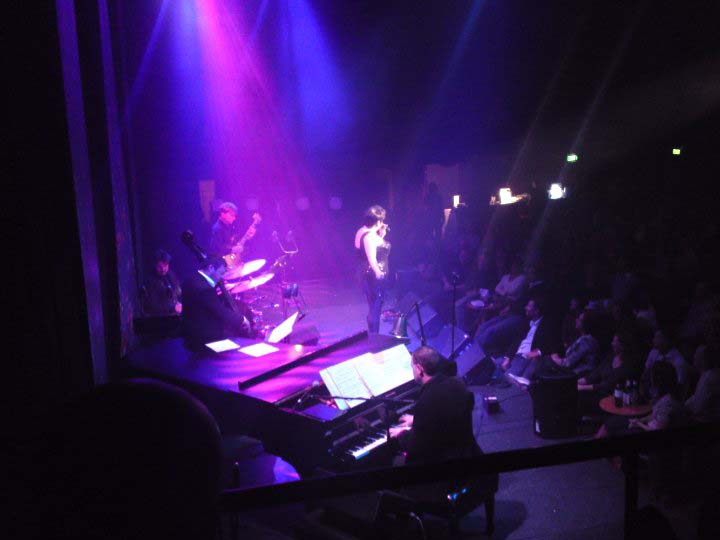
    Nestled in the bowels of the Opera House is The Studio, the perfect venue for variety show Late Night Lounge. Comedy, cabaret, death defying stunts, magic and good wine is the order of the night. Eclectic music accompanies many of the performances – folkish music, tongue in cheek rock and modern lieder with a gothic twist keeps the audience challenged and smiling. Intriguing for music lovers is the House Band – read whoever’s in town. Tonight we were treated to jazz musicians Matt McMahon, Jonathan Zwartz, Carl Dewhurst and drummer Evan Mannell. I wasn’t expecting to see so many top-flight musicians earning their crust in such a variegated fashion. Mannell certainly had the best view for a number of notorious acts – he kept the beat while stockinged buttock cheeks flapped in his peripheral vision during a voluptuous rendition of Turn Back Time. His concentration and courage should not go unrecognised.

    The House Band under the direction of McMahon accompanied guitar duo Dog Trumpet – Peter O’Doherty and Reg Mombassa, founding members of Mental as Anything – as they plied their original material from 2007 album anti-social tendencies. Zwartz executed a rollicking bass line while Dewhurst added texture on the third guitar. McMahon has great dynamic sense, knowing when to bring the piano into prominence and when to fade it into that zone where it can just be heard.

    In the interval the intimate cabaret action turned jazz club; while patrons procured more champers and beer, the house band played Nostalgia in Times Square. How many people in the audience knew what they were listening to? Such is the nature of jazz that it can add atmosphere, class and communicate directly with people who prick up their ears at such moments. A sharp nine chord can draw the attention of someone waiting at the bar, while a pentatonic run can just as quickly sooth them back into complacency. This laid back style of jazz is perfect for encouraging the audience to mingle, chill and prepare themselves for another descent into heavenly seediness.

    If you want to be surprised, shocked and lulled by the beauty of midnight song, get tickets to Late Night Lounge – they sell fast – and be entertained by the sheer (literally) variety of song, dance and provocation that takes place every month under Sydney’s iconic ‘House’. You never know who will turn up, and it’s a good place to see what musicians do best – getting a pile of sheet music and told to play, swing and rock.

    16 May 2010

    Sprogis and Woods

    Sprogis and Woods are presumably the sponsors for the new jazz composition competition associated with the Canberra International Music Festival. This seems to be its first year. It’s judged by Bill Risby, Miroslav Bukovsky and Mike Price. There are associated gigs at the Kingston Markets. Locals Austin Benjamin, Andy Butler, Andy Campbell, Nick Combe, Reuben Lewis, Ben Marston, Matt Lustri, Jack Palmer, Alex Raupach, Neils Rosendahl and Luke Sweeting are in the running. I know compositions from most of this crew, and they are worthy works. I’m glad to hear the judgements are not made from performance at the Kingston Markets. It’s not the place for a serious presentation, being busy and noisy and with the music treated as background. But as a laid back gig, it’s OK. Worth a visit to hear whoever is performing at the time. I think, for the actual competition, there’s a short-listing from CD, then a decision at the finals in the Fitters’ Workshop (of the renowned acoustics). Sadly I can’t make it, but will be interested in the outcome. Someone get there for me… Fitter’s Workshop, Kingston, 4.30pm, Sunday 23 May.

    Here are a few pics of competitor Jack Palmer’s band at the Kingston Markets. And thanks form CJ to Sprogis and Woods.