30 September 2018

Killers


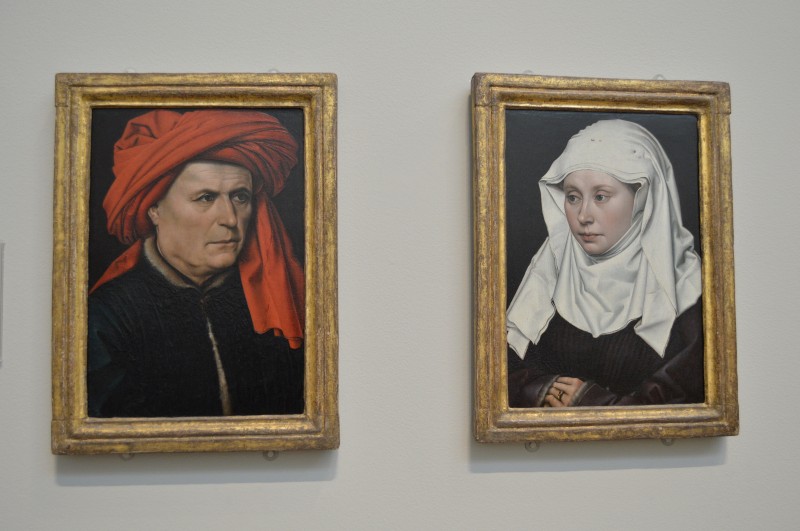
Then some time to kill and a walk to a true European national collection, the National Gallery of Art in Trafalgar Square. No particular intent, just a visit to kill time. We entered at the new Sainsbury wing mainly to see Van Eyck Arnolifini Portrait. I’d happened on it a previous visit and was entranced. It’s small and dark and unpretentious and gloriously touching. It had moved and, in our search, we ran into several Leonardos, Virgin of the Rocks and the Burlington House cartoon. Both hugely known. We found the Van Eyck and followed a guide who was discussing it and some other past masterpieces on panels and walls. There are littler-known gems that attract you amongst the stellar names. Plenty of these. Plenty of stars, too. I was amused by the signposts that list strings of art geniuses, eg, 13th to 15th century / Duccio, Uccello, van Eyck, Lippi, Mantegna, Botticelli, Dürer, Memling, Bellini. There’s a list of must sees and they are interesting and we did come across a few: Hans Holbein the Younger Ambassadors, The Wilton Diptych, Botticelli Venus and Mars. There were others that we saw from a distance, but we preferred other eras or the crowds were just too big. The van Gough sunflowers and chair were just surrounded. This museum was busy but the early halls and impressionists were impossible. Some didn’t make that august list-of-30 online, but were still stars. We discovered a few, like one room with Michelangelo, Bronzino, Raphael and more. All significant works, obviously, and featured, but not in the listicle. This place is a treasure and we just touched the edges in passing but I say nothing that’s not commonly known. Dream on.

One thing that amazed me was how close you can get to art in this museum. The Leonardos and van Eyck were behind glass, but not the Botticelli or numerous others. And there were no constant alarms for intrusion, just foot rails to limit your access, and then just a foot off the wall. I could have touched Botticelli, but of course I didn’t. But I did eye the work up close, perhaps a foot away, looking at brush strokes and edges and colour and the rest. It was fascinating and a huge privilege. Not like V&A with its constant accompaniment of sirens, so frequent that attendants worry little and were seemed relaxed. In contrast, the National Gallery attendants seemed highly attentive, even on edge, and less open to conversation. But then, in the V&A gallery with no alarms, I did see someone caress a bronze in passing.

The National Gallery is in London.

29 September 2018

Bigs and littles

I’ve been to London a few times so thought it would be interesting to look into some lesser-known tourist attractions. Not really so unknown, but not national museums. So off to the Royal Academy of Art in Burlington House. Firstly of Burlington House. It’s imposing for a local residence, Palladian in style, which it was until it was purchased from the Earl of Burlington in mid-C19th. It’s now the home of the Royal Academy of Arts, but also on the Geological, Linnaen, Antiquaries Societies of London, the Royal Society of Chemistry and the Royal Astronomical Society. That last one particularly interested me, but all I found was a locked door opening on the public courtyard. I did get a peek inside when opened for a delivery man, but otherwise, this is not a public site. On to the RA. We just visited the permanent collections which were mainly copies and casts for further copying. But then they do have an unfinished roundel of the Mary and Christ in marble by Michelangelo and some huge copies of interest, not least a Leonardo Last Supper. Again I’d seen the original and again yanks back. It’s in Milan overhead on a refectory wall (a lucky survivor of WW2 bombing). This one was at eye level even if the lighting was none too easy. So interesting. Not exactly a European national collection, but interesting.

The Royal Academy of Art is in London.

28 September 2018

Choices


We had found two interesting choices for a lunch-time concert and dithered a little. The Band of the Grenadier Guards Clarinet Ensemble was playing free in Charlton House and that would have been amusing and colourful and a story to tell some mates in the Duntroon Band but the program seemed consciously light, at the entertaining end of the scale. No doubt it would have been stunningly capable, though. Instead we were pulled by the big names, Bach, Saint Saens and Mendelssohn played on cello and piano. In the end, this too was free (or by donation), in a fascinatingly aged church that I’d passed numerous times, St James’s (sic) Piccadilly, but not entered. To my eyes, brought up as Catholic, it appeared strangely Protestant inside with burial notices on walls and balconies and huge windows allowing the strangely sunny London weather to enter. Europe has just had a seriously unseasonably hot summer (climate change induced, no doubt) and this day was 18C and mostly clear and sunny. Thus the church was much lighter than normal. The performers were from the RCM (Royal College of Music): Ricardo Pes of North Italy and Kumi Matsuo from Japan. All very informal. Ricardo recorded with a Zoom H4N (I know it well!), spoke informally of pieces and teachers and discoveries of unpublished works. His three movements from Bach Cello suite no.3 up front were indicative, strongly spoken in his dialect, firm and expressive and intelligent. And sounding so strong/loud on a new instrument (Edgar Russ, Cremona, 2014). The program changed a little, so a Bach movement disappeared and a Penderecki was dropped and a theme of Italian composition was discussed, not least his teacher at Santa Cecilia, Giovanni Sollima and his father and a final Tarantella to finish. He said that’s apt. Kumi provided a delicious accompaniment, gazing on his playing at times and caressing the keys with such delicacy. We forget that the piano is a percussion instrument so touch changes tone. It was certainly evident here. Such a capable but informal concert. So did we make the right decision, Grenadier Guards or RCM? It’s an impossible choice but had to be made. Either way, this was low key but wonderful.

Ricardo Pes (cello) and Kumi Matsuo (piano) performed at St James’s Church Piccadilly for the Royal College of Music Lunchtime Recital Series.

27 September 2018

Fave

We’re staying in Chelsea, comfy and upmarket, attractive with chimneys and brown brick and the rest. It’s a Mary Poppins view of London to some degree, even if there are many non-English speakers around. It almost seems that overheard speech is mostly some other European language rather than English. Certainly, we’ve heard frequent Italian and Spanish but perhaps we are attuned to these Latin languages. Not least a married couple having pics taken near Eros in Piccadilly Circus amongst much busy-ness and traffic. For a first outing, it’s an old fave, The V&A Museum. It’s an obvious choice but I’m still agog. We started with Europe mediaeval. The first rooms are killers over here, until you adjust to masterpieces by the display-cab load and realise you have to get a move on. Nothing particularly highlighted, but gloriously beautiful, stunningly presented, outrageously special. A fish broach caught my attention amongst the rest. Gold that inevitably glows like new and red ceramic fills in scale-like circles of metal. It’s easy to wonder if nothing is new: certainly it would look the part on a modern wearer. The religious themes are common and perhaps look more out-of-our-era, but at least I understand most of the references. There’s a good deal of saints and torture in this period but also loving devotion and gloriously pretty angels. But you have to get a move on. The attendants were outrageously helpful and probably enjoy the chat. I was entranced by one metal candlestick recounting salvation from Hell (below) to Heaven (above). An attendant came over to discuss it with us and tell the story. In passing she mentioned the Leonardo notebook the level up. We hadn’t known of this but it’s one of the treasures. So, everything is stunning and some more so, treasures to a degree that we just dream of, at least for these European histories. It was a small, squatty leather bound notebook with tiny text, mirror-imaged as was Leonardo’s way, with some sketches, dealing with pulleys and the like. Perhaps 10cmx7cmx3cm. Easy to miss. All small: paper was expensive back then. Another attendant helped and chatted. The V&A had 5 Leonardo notebooks that are rotated through displays. It’s a big museum, so both quality and quantity. I had thought it was for domestic arts, but no, it’s a design museum. Anything new, inventive in its time, is collected. Thus arts with practical things. Drool. Like huge cartoons painted by Michelangelo to guide weavers in creating tapestries for the Sistine Chapel. Owned by the Queen but on display at V&A. There are 5 in one huge room; the other 3 are lost to history. Even the casts are fascinating. Not original, but at life-size, and the selection is informative in itself. We took a free introductory tour and were presented with the David which surprised me for size. I’d seen him before, in the Academia in Florence, but decades back. It seemed much larger now. Then a cafe visit (another innovation of the V&A, apparently) and on to chase works by an ancestor of Megan’s (James Tassie) who appears in the collection (28 mentions in the catalogue for fewer actual works). The V&A is huge and a visit of days or weeks or a lifetime. The guide mentioned 7.5 miles of corridors, 3 million items on display, 2 million (?) items in storage. One secret of good travel is to leave something for next time but how many next times will there be? This was just a touch on the V&A and a return to London, but another full tongue-lolling stunner.

The Victoria and Albert (V&A) Museum is the London.

26 September 2018

One that got away


Megan had done it before, but it was my first international flight out of Canberra: by Qatar through Doha to London. (Mine have always been Murrays to the Sydney International terminal, or just once by flight connection). Exciting, even if a departure from Canberra is via a stopover in a transit lounge in Sydney (both coming in and out) but the customs and security is so relaxed in Canberra and so clear of crowds. We were to stay overnight in Doha at a 5-star hotel offered gratis with some Qatar flights. Seems a good time to fly Qatar, presumably as they prepare for the World Cup. We arrived just after midnight local time, checked in and passed a Jazz Bar with a performing band on the way to our room. I got a quick squiz and planned to come down after dropping our bags but the band had finished the gig and loud hip-hop was in its place by the time I returned. So this one got away. The band was High Times, playing 6 nights a week in this bar, a quintet led by a female singer. I heard just a few bars and it sounded slick and capable as such a band will be. Standard fare playing favourite Billboard hits, old time jazz classics to Broadway headliners.

High Times played at the Jazz Bar at Oryx Rohana.

25 September 2018

Again

Day 2 was Goulburn. The cathedral was cold but ended up pleasantly well attended. The acoustics were rich and full even if the space was large and hearing Louise out front was not so easy. It was presumably different for the audience, under a cathedral roof with timber and stone and a replete reverb. The first notes we played were lovely but the temperature played havoc with bows and rosin. It wasn't just me: one long-experienced player mentioned a similar thing, that her instrument didn't perform so well in the cold. But it all went well and by the end I was glowing with smiles. I felt we were a little tentative for the arias, given we couldn't hear so easily, but later more unrestrained for the louder Mozart symphony no.40. Again, the program was bliss to play. Again, it was a massive privilege and pleasure to accompany Louise and always satisfying to be led by Lenny. By the end, the reception by the audience was great and we left contented after a very busy but pleasing weekend. The music was great and its reception was satisfying but there was an element of sadness: to see such a grand building in such disrepair. It's a common refrain that the Church has money, in Australia or otherwise. Yes, it has property and the Vatican Museums are bulging, but I'm not sure how much direct income, and despite failings, it does worthy work. Here are a few pics to show just that, along with our amusing Stonehenge just outside Canberra. But now a break from my own playing for a while and let's see what I can find to report for CJ in other places.

Musica da Camera performed Mozart and a series of opera arias at the St Peter & Paul Catholic Cathedral in Goulburn. Leonard Weiss (conductor) directed and Louise Page (soprano) sang.

24 September 2018

Falling in love


I'm not the first to fall in love with Mozart and I'm sure I've enjoyed him immensely before, but playing his Symphony no.40 with Musica da Camera was an emotional high. It's such a fabulous work, with such intrigue and unexpected variation and sometimes surprisingly modern phrasing and outlandish energy and the rest. I was stunned. And this was just the second half. Before interval was a series of opera arias with our Canberra diva, Louise Page, out front with the orchestra often hanging off Lenny's baton when the time goes vocal-led rubato. Louise is such a convincing performer and her voice so intimate and apt, but you don't appreciate all the art as you accompany. You have other things to do; your listening in accompaniment is different from the listening of a concert goer. But this was a hugely satisfying concert and we get to do it all again, this time in Goulburn, as is the way with the paired concerts of MdC. A deeply satisfying Saturday outing despite smelly flowers and the rest.

Musica da Camera performed Mozart and a series of opera arias at Cook. Leonard Weiss (conductor) directed and Louise Page (soprano) sang.

23 September 2018

Poles and the Duke


Well may you remember the stir over Blue Poles. It was purchased for $1.3m, a large amount at the time, with Gough Whitlam's approval, and made into an early run at a culture war. How could some drunk spilling paint on a canvas be other than worthless. My kid could have done better. It's a common refrain. I think sometimes it may be true. Maybe there's more concept than craft in modern art. Maybe. But Blue Poles is now worth a motza (current estimates, cited in Wikipedia, are $100-350m) but it's not for sale. It's considered Jackson Pollock's major work and, after seeing a very similar work at MOMA without the poles, I can agree. In the building its collection, the National Gallery recognised it would not afford lots of old masters, so sought the best of modern works, not least a string of American Masters of the mid-late C20th. The main works are on display together now. Blue Poles, but also names like Chuck Close, Willem de Kooning, Jasper Johns, Lee Krasner, Roy Lichtenstein, Man Ray, Robert Mapplethorpe, Claes Oldenburg, Yoko Ono, Robert Rauschenberg, Mark Rothko, Cindy Sherman, James Turrell, Andy Warhol from styles like Abstract Expressionism, Colour Field, Pop, Neo-Dada and Photo-Realism and Conceptual, Land and Performance Art. I remain a great lover of quattrocento / cinquecento and my favourite here has been for some time, the super realist Bob by Chuck Close. I don't warm so easily to some others (I've written before on Turrell), but it's worth the visit and least as it's free. And you can check out the Prince of Wales (Charles') watercolours on the way in. Convincing with the nature scenes if less so with more demanding forms. But then he could be doing much less admirable and much more harmful things with his time.

The National Gallery is displaying American Masters and watercolours of the Prince of Wales.

19 September 2018

Never enough


Lauren Davis convenes the Limestone Consort. They play Bach and other composers of the period but also, if less frequently, from other periods. This concert featured Telemann, Albinoni and two works by JS Bach. Someone had said they can never have too much Bach. I feel it too. Obviously it's a function of Bach's brilliance, but I wonder if it's also a musical style that suits our times. After all, he was lost at one time to be revived by Mendelssohn, his son JC was more popular in his time and his cellos suites, now considered great masterworks, were also little known before being repopularised by Pablo Casals in the 1936. So Bach has had his forgotten times. But for us and our time, he's a sublime genius. The two works here were his double violin concerto and his Brandenburg concerto no.3. Both are instantly recognisable for several themes even if you can't name them. I'd played Brandenburg 3 so wanted to hear it again, and I was again amused by that diminutive second movement, but this day I was most taken by the double violin concerto. It was a thing of sublime beauty so I could have had more Bach. But the other two were interesting. Lauren had likened Telemann/JS Bach to Art Deco/Nouveau. I guess in that order, even if it's out of precedential order. I think Bach would be the mellifluous one (Nouveau) but then the dignity and order (Deco) might also be with him. The Telemann was his Burlesque de Quixote, a suite of 8 movements telling the Don Quixote story which seemed pretty ordered and simple against the Bach. You could hear amorous breathing and horse galloping and otherwise but it didn't cut to either intellect or heart like the Bach. But then I also have respect for quantity as well as quality and Telemann is apparently the most prolific composer in history: 1,043 church cantatas and 43 passions amongst the rest. Albinoni was no slouch either, penning about 50 operas alone, although many are lost. All interesting and all worthy enough, but Bach remains supreme. The playing was great. I thoroughly enjoyed the pairing of violins in the concerto; Kyle laid down some outstanding bass lines and quick, quippy fills; we were sitting right next to Lauren and could enjoy her lead and phrasing and bowing and the rest. That intimacy is a thing I also greatly love. Give me a decent player in an intimate setting anytime. So, a lovely concert with some outstanding music from one of my favourite ensembles around town.

Limestone Consort performed Telemann, Albinoni and JSBach at All Saints Ainslie. LC comprised Lauren Davis, Michelle Higgs, Claire Phillip and Matthew Witney (violins), Iska Sampson and Elysia Fisher (violas), Clara Teniswood and Nicole Wang (cellos), Kyle Ramsay-Daniel (bass) and James Porteus (organ).

18 September 2018

Llewellyn

The day was all leading to the Llewellyn stage and our National Capital Orchestra performance of Gorecki, Gordon and Smetana. In the inverse order. The Gorecki was his Symphony no.3, better known as Symphony of sorrowful songs. Gorecki was apparently a serialist, but then produced this, his religious work, to be rejected by the modernists. It's a strange piece, long at 55 minutes, slow and sparse and meditative, with occasional soprano singing of three pieces over three movements, of women's laments, one Mary for her crucified son, another by a young girl from the wall of a gestapo cell, a final one by a mother lamenting her son lost in Silesian uprisings in 1919/20. the work starts with depp, slow bass and continues pretty much throughout, with dynamics and rising pitch at various times. Louise Page sang the songs, sad and slow and pensive but dignified. I came to love this work with playing so not surprised how well it was known amongst musos and how much they wished to play it. And it's got a following. One guy at the afterparty had come from Sydney to hear it: he'd otherwise heard it numerous times. The first half from lighter and livelier. First up Smetana The Moldau, a programmatic piece picturing the Moldau river that not least, runs through Prague. Then Christopher Gordon Ceremonial Games. This was a world premiere of this suite of comprising three movements (from 13) written for the opening ceremony of the Melbourne Commonwealth Games. This was more grand, lively, even rocky, with times switching between 4/4 and 7/8 and moving through arpeggiations, then to a dramatic end. Great fun and great to play for the composer. Then pics and after-party and congrats. Much enjoyed.


National Capital Orchestra performed Smetana, Gordon and Gorecki at Llewellyn Hall under Leonard Weiss (conductor) with Louise Page (soprano) singing Gorecki songs. Christopher Gordon (composer) was present. The bass section was Roger Grime, Chelsea Kennett, Hayley Manning, Kate Murphy, Eric Pozza and Geoff Prime.

17 September 2018

Before Llewellyn 2

Then a little jazz. The Sydney Con Jazz Orchestra was on tour and in town at Smiths. I only managed one set, but what excitement was this! Stunningly capable playing; richly complex and busy charts; some seriously capable soloing (I find some big bands lack hot soloists); all taught and conducted by David Theak and with special guests Steph Russell and Josh Meader. Steph sang; Josh soloed on guitar. Both were capable and impressive. I particularly enjoyed Josh's modern style which I recognise but don't quite understand. Exciting sweeps but more importantly intervals and harmonies and intervals that speak of current NYC players, all with a satisfying tone. I was also taken by bassist Jacques Emery for some quick and firm playing and even use of a bass extension. He's got a classical and family music background so perhaps no surprise. But all round, this was a supremely capable band, energetic, tight, virtuosic. Loved this set.

The Sydney Conservatorium Jazz Orchestra performed at Smiths. It comprised David Theak (conductor) with Zac Olsen (lead), Ned Olive, Anthony Tummillo, Anthony Rositano and Kali Gillen (saxes), James Sarno (lead), Deven Rahman (assoc lead), Tom Avgenicos, Jack Purdon and Miles Rooney (trumpets), Jacob Parks (lead), Jack Lincoln, Lawson Mcguinness and Nick Barnard (trombones), Roshan Kumarage (piano), Jacques Emery (bass), Alex Inman-Hislop (drums) and Nick Ruberg (guitar) with guests Steph Russell (vocals) and Josh Meader (guitar).

16 September 2018

Before Llewellyn 1

This was the day of another Llewellyn concert with NCO but a strange one. It was more than just making sandwiches for the after-party. That's common for these non-professional orchestras. As usual, the day started with a warmup on stage at Llewellyn. The CYO (Canberra Youth Orchestra) was there before us, practising an orchestral take on David Bowie Space oddity. I was surprised to see the full bass lines charted out for Hayley, very busy with semiquavers. It's odd that a line that would have been improvised on a chord chart becomes dots for an orchestral player but congrats to Hayley for taking on such a demanding thing. I noticed a score for a Star Wars suite by Lenny's music stand, so this looks like a very approachable and popular concert coming up. Then our practice. Mainly a warmup for the first half. Smetana Moldau and Christopher Gordon Ceremonial Games. Christopher, the composer, was there for the rehearsal and gave some input. This work had only been heard at the opening of the Melbourne Commonwealth Games. The suite that we played was a selection of 3 from the original of 13 movements and we were to play the world concert premiere. A premiere always adds a little excitement to a concert. Then off home to make those sandwiches.

Canberra Youth Orchestra and National Capital Orchestra rehearsed on the stage at Llewellyn Hall.