06 October 2023

Our locals

You can get nonchalant after seeing the local names often enough, but take a break and settle in and you can be floored.  I was floored the other night for the latest band incarnation at Geoff Page's monthly concert.  Just friends John Mackey, Miro Bukovsky, Lachlan Coventry and Chris Thwaite, and just eight tunes taken from the standards repertoire, but a stunning outing with depth and purpose and Immense capability.  It should be no surprise but you can take the locals for granted.  It would have been just 7 tunes but Giant steps was called as an encore.  And there was that intense contact, too, with the dedication of the concert to once student, friend and musical prodigy, Niels Rosendahl, recently, sadly deceased.  Thus the Giant steps request.  Otherwise, this was a hugely satisfying outing, supple and malleable with instructive improvisations.  I followed John with awe at the alacrity, yes, but mostly his structured investigations, his awareness of pitch and its relevance, meaning somewhat harmony but also the interaction with melody.  Then Miro, spelling out the chords and keys with a different approach, like Miles to John's Coltrane, a more high altitude view of pitch colours and harmonic movements, perhaps moving phrases chromatically over the changes.  Then Lachlan, this time in bass form on his Fender VI, sometime finger picked, mostly picked, soft and thumpy, playing with dampened notes, fabulously astute rhythmic plays, on latins or others and extravagant guitar-like lines in some solos, and a readiness to lay out or leave space or change grooves to move through and alter the essence of a tune.  And Chris there just with Lachlan on that, chops and change but following the choruses where sometimes I wondered how and where.  So this was a fabulous outing by some immensely capable locals.  Just locals?  Yes, our locals, although locals pop up all over as I've found often enough in the jazz world.

John Mackey (tenor) led a quartet at Smiths with Miroslav Bukovsky (trumpet, flugelhorn), Lachlan Coventry (bass) and Chris Thwaite (drums).  The session was dedicated to Niels Rosendahl (sax).

PS.  As for vegan tatooing, I never knew there was such a thing.

05 October 2023

Newness

Marian Budos is a prolific composer.  I've played one of his works with Musica da Camera.  The bio lists an abundance of orchestras and others who have played his music, especially in Europe.  This concert was no different, featuring a few of his Personalities series and more and a world premiere thrown in for good measure.  They were not long and they were guitar works and this instrument defines much of its music to my ears: the interplay of chords and moving notes, perhaps the top note, that define the tune and the clipped, chipped tone of the acoustic guitar and perhaps the occasional unexpected strum.  Many of Marian's tunes covered friends so had names like Vince and Ivana, and a few were even dogs, Elza and Coco, I think.  Either way, this was expressing personality, but it didn't end there.  Marian obviously is touched by the natural world, so those dogs but also his garden and trees.  He had a quartet on trees in his garden, still with short names, Alba or Stella, and even a tune on a lost possum, Momo, which we heard as a world premiere this day, and concerns with birds and babies in a mother tree.   So interesting stories to help us picture the sources.  And a political but personal one called Ukrainian boy, about a young son put on a bus by a mother to successfully reach family in Slovakia.  Awareness all around.  And a final snippet encore exploring two loves in one song, Bach and Barcelona, Bachelona.  I hope I got the spelling right.  Whatever, some lovely playing and intriguing compositions but also an admirable awareness of the greater world out there.

Marian Budos (guitar, composer) performed at Wesley.

04 October 2023

New wave

My early days of jazz had no women other than singers but times are turning and it's good.  I saw Olivia Uebergang and her trio last night at Molly and it was a student turnout and a Real book read and a great little outing even with some amusing reconsiderations of the playlist.  That's common enough for all.  With Olivia were Sean Kirk and Harrison Whalan, drums and bass.  There were some comfy rhythms, mid- and up-tempo swings and latins and the like from the fake books.  Mostly heads from Olivia but a few from Harrison; several nice intros from Sean; swapped fours (sometimes spilling to 2s and 1s).  All the standard takes.  I really liked Olivia's mix of chordal plays and single notes, in both melodies and solos, and mixing in and out.  Guitar is great for that, the sudden richness of chordal colours amongst the determined single notes.  Nice extensive solos, too, interesting and varied, crisp or coloured.  Harrison, too, took some lengthy solos, often up the neck, more quick and sustained rather than phrased.  His volume was a touch low, but the tone was full with a tingling top end; nice.  Sean was busy and creative on his drums, with lovely fitting syncopations over a satisfyingly rounded kick tone that punched through complex snare and tom improvs.  This was serious business - it showed in his closed eyes and expressive face - and busily effective.  And that discussion on the play list, over the shared music stand, well that was just an amusing performance from a good natured trio.  A nice outing from some fresh players.

Olivia Uebergang (guitar) led her trio with Sean Kirk (drums) and Harrison Whalan (bass) at Molly.

29 September 2023

Revisits

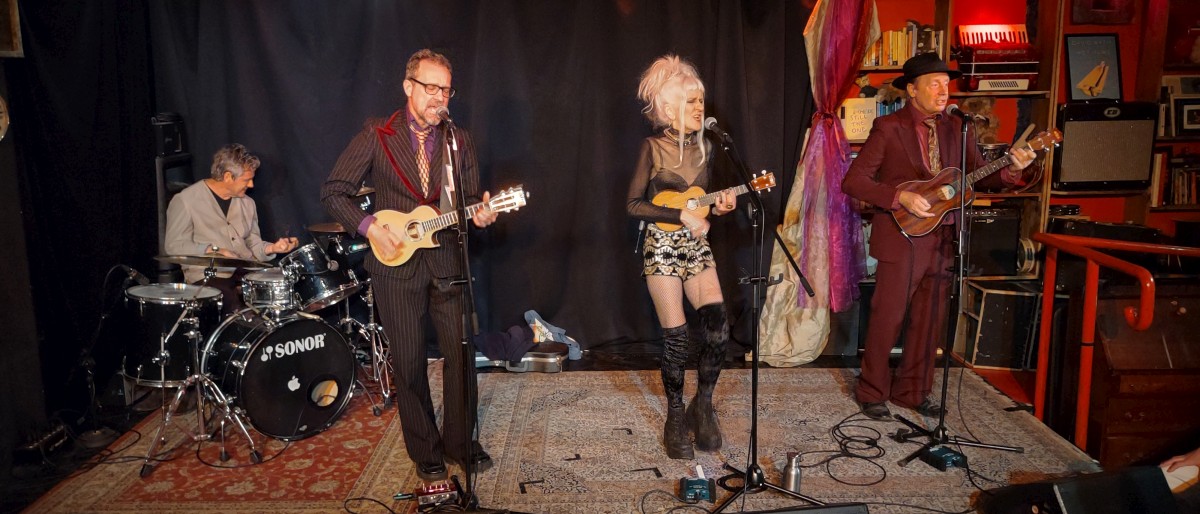
You know that sometimes you are wary of revisiting something you immensely enjoyed in case it's not the same the second time around.  Well, I wondered about that before but I was enamoured after and for strangely similar reasons.  At the first gig by The Thin White Ukes, I was quietly sitting listening to perceptive lyrics in admiration while sunk in a very satisfying interpretation by the band.  Given this is Bowie played by 3 mandolins, you could be excused for skepticism, but I found it the same second time around.  Perhaps this time even more aware of lyrics, of emotional depth, of intellectual playfulness and evident empathy.  I think it was Hello Spaceboy , track 4, set 1, a tune I don't think I'd ever heard before, that rekindled this.  Suffice to say this band has a great time playing the original lines on the most improbable of instruments (ukes, of course, not the drums) and laying down harmonies that were sweet and correct and rich and sourced from the originals.  Michael confirmed it from the stage: that they play music of Bowie on "instruments seemingly ill-suited to the purpose".  As for playing other than Bowie, he introduced a self-penned track written on the bus about admiring Bowie but had a second take.  The TWUs played 2 sets, of 9 then 11 tunes, all from Bowie.  There were old standards, some funkies, a few that were unrecognised by me (Hello Spaceboy, Everyone says "Hi").  Everyone says "Hi" just confirmed my chats in the break about Bowie and his empathy.  The stylophone reappeared in Moonage daydream for a bigger solo this time (wow! jazz! Stylophone!).  The band's  joy and humour and interactions were there in this intimate space with a very supportive and Bowie-aware audience.  The final tunes was The man who sold the world.  Bowie spoke of himself often.  I'd just caught a snippet of a show on ABCRN recently which spoke of Bowie being lucky to fall on great backing musos.  Yes, but.  He seems so much more.  Given all this I can't think of him as other than a star of considerable depth.  One chatter had studied Bowie and called him a genius of the C20th including from all musics.  More to think of there, but suffice to say I was not disappointed by my revisit and my admiration for the Duke himself just grows, along with the Ukes, the band that portrays his so well if so implausibly.

The Thin White Ukes play the music of David Bowie, the Thin White Duke.  TWUs performed at Smiths.  They comprise Michael Dwyer, Better France and Robert Stephen (ukes, vocals) with Ashley Davies (drums).

PS.  I just checked how prolific was Bowie.  Bowiebible.com lists 469 songs.  Just to compare: beatlesbible.com lists 342; bobdylanfandom.com suggests 456 songs; jonimitchell.com suggests 212.

28 September 2023

Pleasures

It was telling how the chatter after the Marie Cull Studio concert at Wesley was just a little taken aback but very admiring.  Marie had introduced the students as aged 11-17, saying this is the first question she's always asked.  We heard 7 performers playing 8 pieces.  It turns out they will be presenting for exams next week, the likes of AmusA and LMusA.  Perhaps a few slips, but this is nerve-wracking stuff for young performers, but so well played.  Rachmaninov, Mendelssohn, Liszt, Ravel and publicly lesser knows Labunski, Bridge, Glinka; romantics and impressionists and more.  Marie herself speaks of developing love and knowledge of music.  It works.  This was a wonderful, inviting and satisfying concerts by a string of young players.  Much enjoyed.

Piano students of Marie Cull performed at Wesley.  The players were Alicia Fernando (Labunski), Mion Kirk (Bridge), Oreste Rollas (Rachmaninov), Nancy Xu (Glinka), Belle Andrewartha (Mendelssohn), Miani Kirk (Liszt) and Benjamin Francis (Rachmaninoff, Ravel).

25 September 2023

Alternatives

The NCO concert was called Hope Struggle Victory, seeing as the program was Nat Bartsch Hope, Shostakovich Cello concerto no.1 (with Stalin as the struggle) and Tchaikovsky Symphony no.4 (all exaltation and excitement).  As for alternatives, there was a lovely Handel playing in town at the same time, which would have been nice.  Obviously you can't be in two places at once and playing this program was a blast.  It just goes to show that Canberra is a civilised place beyond its size.  I love that.  Meanwhile, the playing was great.  First up Nat Bartsch is all slow dynamics and tempo, swelling tones, perhaps filmic and absolutely beguiling.  It's not a hard read and not so long, but you find yourself feeling the slow bows and concentrating on the consistency.  Lovely.  Shostakovich was anything but lovely.  James Munro soloed and did a magnificent job every time I heard him, in rehearsal and performance: wonderfully confident, neat intonation up the neck, always expressive.  No brass, so they got to sit out.  I think it was Jeremy who said our role was like percussion, and that's some truth there.  Odd times, reasonably simple but hugely tricky lines, perhaps the only time I've had to read Fb, but I admired (not sure I can say enjoyed) the capricious count and the deviant melody.  Fabulous.  Then the biggie, Tchaikovsky.  I love his work.  It's not as idiosyncratic as Shostakovich or as hard to read, but massively exuberant and a joy and challenge to play.  In a different way, it's still hard work: way more notes that Shosta and the full pizz movement 3 and the dotted quavers in 9/8 time were a challenge along with considerable chromatics and blazing lines.  So a big concert and not a slouch.  Congrats to Louis Sharpe, our conductor.  Ever jokey and positive but also demanding and always with a Canberra suburb on call.  A great combination.  And nice to catch up with Leonard Weiss, previous NCO conductor, who's in town for West Side Story, and who dropped in to the warmup for a short time.  Again, evidence of an intriguing local community.  And a small world: my offsider Jeremy is playing banjo in Lenny's WWS production.

National Capital Orchestra performed Nat Bartsch, Shostakovich and Tchaikovsky at Albert Hall under Louis Sharpe (conductor) with James Munro (cello) as soloist.  The bottom end were Juliet Flook, Jennifer Groom, Jeremy Tsuei and Eric Pozza (basses).  Sally Macourt (violin) sat in as concert master.

21 September 2023

A different sounding song

I've sung in choirs and heard quite a few but they were always mixed choirs, usually with four parts, two male, two female, soprano, alto, tenor, bass (SATB) so it was somewhat a surprise to hear a male choir.  I asked about parts: still four parts, but tenor 1 /  2, baritone, bass, so closer in pitch but still wonderfully satisfying.  I was a little surprised by that.  I thought the choir might sound deep and stodgy but not at all.  There were still some relatively high pitches and they were lovely (one guy stood out to my ear) and the harmonies were lovely although not always so easy to hear.  But suffice to say, I really enjoyed the sound and the performance.  This is the Canberra Men's Choir, directed and accompanied by women in our modern world, Leanne McKean and Vivian Zhu.  The choir has been around since 1986, it's non-auditioned and invites new members.  They played a popular set of 13 songs.  They were mostly short and I might have enjoyed some more substantial numbers, but they were popular and attractive and some faves of mine: '70s/80s pop including Raindrops keep falling on my head, Here comes the sun, Moon river, Love is all around, Hallelujah; early standards like Blue moon, What a wonderful world; some more folky tunes, Wayfaring stranger, Shady grove, Hand me down my silver trumpet.  I liked it all: good harmonies, copious male voices.  I thought some more swing was called for occasionally, but that's something for the jazzers.  A wonderful and entertaining and satisfying concert.  Beats hanging out in the front bar, but they probably do that, too.

The Canberra Men's Choir was conducted by Leanne McKean (musical director) with Vivian Zhu (piano) accompanying.

20 September 2023

Many happy returns

There was a time with three large ensembles at the Jazz School.  Now there are two, or at least at the Friends concert we heard two, and they were wonderful, inventive, capable groups and a huge pleasure to revisit.  Why am I so excited?  Because small bands are wonderful but relatively easy to create; big bands, jazz orchestras and the like are difficult.  They require charts and practice and interplay at a different level and they return a complex, integrated sound at best.  The bands were the ANU Jazz Orchestra and the ANU Recording Ensemble.  They are mostly made up of ANUSOM students but also open to non-SOM ANU students.  Greg Stott is musical director for the Orchestra; Miro Bukovsky for the Recording Ensemble.  The Jazz Orchestra is a more standard format.  I find a Jazz Orch to be more modern and exploratory in its charts, but essentially the format is much the same as a traditional big band: rhythm section and colours from saxes, troms and trumpets.  Perhaps a singer.  Miro's recording ensemble is a return to its previous purpose as a group that creates and performs its own music.  We heard three member-created originals from six tunes from them on the night.  The Recorders format was different though, more a product of membership, I guess: rhythm section with percussion and two (acoustic and electric) pianos, three/four horns up front, guitar and two singers.  So they were different groups with different players and a few stars in each.  I was taken by a few players, but don't take this as a full list: Jeremy was a blast on bass, highlighted by a double bass solo on Jaco's Chicken; Mereki, George and Fergus all impressed on saxes; Elliot on the Steinway; Koebi on voice; Rory on trumpet; humourously cocky Olivia on guitar.  Others too, but I missed some names.   Great to hear some words, too, from Koebi and Imogen on Mingus' uber-standard Goodbye porkpie hat, I think using Joni Mitchell's lyrics.  It reminded me of reading Mingus' autobiography so far back.  The book was Beneath the underdog; one line of lyrics was "They put him in an underdog position."  I will never forget that Mingus wrote so little of just the music in that book, but he dropped in one passage that something happened at the time he was practising 8 hours pd.  Words do impart further meaning.  As for the three original compositions from George, Ryan and Fergus (did I get that right?), they were impressive in any company.  So, great to see the large ensembles coming back and a huge pleasure to be in the Band Room for such a gig.

The ANU Jazz Orchestra and the ANU Recording Ensemble performed in the Big Band room at the ANU School of Music for the Friends of the ANUSOM.

18 September 2023

Lazy Sunday afternoon

Got no mind for worry, so I idled down to the National Gallery as I am wont to do.  It's often a sole experience, but somewhat different this day.  First up was the latest Know my name exhibition, subtitled Making it modern, featuring works by six significant Australian women artists from ~1930: Ethel Spowers and Eveline Syme, Margaret Preston, Grace Cossington Smith, Clarice Beckett and Olive Cotton.  Linocuts, woodcuts and such prints were a major part of the production, seemingly a modern movement at the time, and also Olive Cotton's photos.  To finish there was a videostream being made of a drawing workshop.  All very busy with several people off set controlling it all, and a surreptitious guitarist.  I say surreptitious because his music was unintrusive, all sparsely spaced guitar chords with a swelling volume pedal.  It seemed so apt for this purpose, to fill audio space  around drawing being observed.  Sam Andrews is a local, involved with studio and backing work around Canberra.  Greeting to Sam!  Then off through some New York photography from 1980s by Nan Goldin, recording friends and experiences, friends and lovers, falling in and out of love, having children, violence, bar and club life: her "public diary".  The title was The Ballad of sexual dependency.  Then working back, I joined a tour group near its end.  Close to the final work was Lucien Freud After Cezanne.  Interestingly, it references a work with the same theme from Cezanne.  I asked where that work it: NGA!  I remember it now: Paul Cezanne L'Après-midi à Naples.  Then a fascinating visit to the Aboriginal Memorial (with no discussion of the Voice: NGA policy) and some final chatter.  Our host was Sally who had a US background.  We got on to Taylor Swift, somehow, and she spoke of TS buying a $17m mansion in a town Sally has connection to.  I've now investigated: it's the Holiday House in Rhode Island.  Despite guards on the property, locals apparently speak well of TS independently visiting local shops, relaxed and conversing.  So then off.  A short but interesting and chatty visit.  Oh, and that red pic, it's Audrey Flack Jolie madame: oil on canvas but nothing like any oils I've seen before.  How did she get it so soft and hazy.  Perhaps it's sprayed?

Sally is a guide at the National Gallery of Australia.  Sam Andrews was playing guitar to accompany a video drawing workshop. 

  • PS, Sally if you see this, here's the link to my recorded
  • music (Bandcamp; all welcome)
    The Pots > https://thepots1.bandcamp.com/
    Musica da Camera > https://musicadacameracanberra.bandcamp.com/

    17 September 2023

    Epitrochoidialisms

    Spirograph Studies performed at Street Theatre on a very delayed tour for their post-Covid release of their pre-Covid  recorded album.  Thus is the way recently.  Also of the era, the album is available on vinyl and digital; no CD.  Ah, how things change.  I remember someone refusing to buy a record player because digital (=CDs) were coming.  Then I remember how easy were CDs: no clicks and pops; no religious cleaning routines.  But records do sound analog-good.  Like Spirograph Studies.  I was intrigued by this band.  It's a contemporary jazz style, improvised over regularly changing chord structures, although not obviously cycles, with heads that are also melded and shared and not too obviously divorced from solos that are not too obviously solos and not too obviously by one player as piano and guitar play off each other.  And all manner of rhythms and complex polyrhythms, mostly from drums, but also from bass, and also from guitar with slow upward and other strums and deliciously loose timings all around.  Nothing too obviously stated; this is not bop.  It's busy and rich, playful but serious; Tamara spoke of composed rules in Locked but they seemed to invite players to transgress.  The vibe was busy and involving and often loud and the definitions were fluid and diverse.  Sounds modern, really.  I asked Tamara about the compositions and it seems she writes them all, somewhat more recently on piano, but always a product of harmonic pursuits or trials.  If I understood correctly.  I've heard such chordal movements otherwise, still often enough in some form of repetition, perhaps ABA or whatever, or maybe just a descending pattern, but it worked a treat here with this responsive and interactive playing.  For this was not an individualistic pursuit, but a communal activity.  Whatever, I loved it.  BTW, Wikipedia says:"Spirograph is a geometric drawing device that produces mathematical roulette curves of the variety technically known as hypotrochoids and epitrochoids. The well-known toy version was developed by British engineer Denys Fisher and first sold in 1965".  I remember playing with one as a kid and this music just fits a treat.

    Spirograph Studies performed at Street Theatre 2.  SS are Tamara Murphy (bass), Luke Howard (piano), Fran Swinn (guitar) and James McLean (drums).

    05 September 2023

    Not one but two

    This was my sandwich weekend of Tchaikovsky, Mendelssohn and Bruch with a Bach filling.  The Bach filling was very wholesome given the capable, professional performers.  Lovely.  But Maruki's open and unauditioned thus somewhat aurally unbalanced presentation of Tchaiks, Mendelssohn and Bruch was hugely satisfying for players and I trust for the audience.  It was in Albert Hall as our concerts are.  The works were complete and  very much demanding works of that era.  No slouch is this group: we take on the real thing and present hefty concerts.  The Bruch was his Suite Modale for flute and strings, led by flautist James Gibson.  The other two were symphonies, Tchaikovsky symphony no.5 Emin (locally famous as once an ad for a brand of cigarettes) and Mendelssohn symphony no.1  Cmin(written by a 15-year old, no less).  Two symphonies?  As I said, Maruki does not shirk.  We were led by Kristen Simpson in the absence of our formation musical director, John Gould.  A fabulous, long, demanding, difficult concert that we played better than ever in practice.  That's the nature of a gig.  "She'll be right on the night" is a well tested assertion and proved by the level of concentration that comes with an audience.  So this was great training and awareness and a great outing.  And thanks to visitors who often join us at short notice including Olivia Herbert (violin), fairly recently of the Australian Youth Orchestra and a tour to Germany, who came from Brisbane to play with relative Bev Simpson (cello).  See the pic: Olivia with a representative of another generation of youth orchestrists, Anne Stevens of the Canberra Youth Orchestra and much music thereafter.  Great fun and a satisfying achievement.

    Maruki Community Orchestra performed Tchaikovsky, Mendelssohn and Bruch at Albert Hall.  Kristen Simpson (conductor) led the orchestra including Paul Hibbard (violin, concertmaster), Olivia Lambert (violin), Anne Stevens (viola) and James Gibson (flute).

    04 September 2023

    Early prep for Thomaskirche

    I rushed off from one practice (Mendelssohn, Bruch, Tchaikovsky) to feed the dogs and then assist Tim to set up his recording of Canberra Bach Ensemble in St Christopher's.  It was quite a change of scene and musics.  CBE was playing three cantatas and a mass by Bach and a few smaller pieces by Schein and Schutz who had influenced JS.  So this was gut string intimacy and choral exuberance and vocal passion with early, even curved winds of all styles.  Something period and truly lovely.  I watched the various instruments and the frequent soloists and the milling of the choir entering and leaving for not too many choral movements.  The inherent sound of Bach was evident against Schein and Schutz, but they were worthy none-the-less and indicative of musics of the time, I guess.  There was not a lot of patter.  Andrew writes generous notes for his programs but remains fairly quiet on stage.  I particularly watched Dave on bass, as I am wont to do, and mostly it was easy reading other than a few quick and unrelenting and richly varied passages.  I could appreciate his concentration there.  So CBE is on track once again to visit Leipzig and its Bach Festival next June 2024.  Covid prevented the last expedition.  Let's hope they make it this time.  And good on them.  So wonderful to hear Bach with authenticity, and it can only grow in Bach's own venue, Thomaskirche.

    Canberra Bach Ensemble performed at St Christopher's, Manuka.  Andrew Koll (musical director) led a choir of 25 and an orchestra of 18 with concertmaster Bianca Porcheddu (violin) and vocal soloists Greta Claringbould (soprano), Maartje Sevenster (alto), Richard Butler (tenor) and Andrew Fysh (bass).

    01 September 2023

    Whiskey's a warmer

    The Glenfiddich Whiskey Wanderer was back in town and Tilt took a gig in the open in mid-winter Canberra.  Just 2 hours, but suffice to say we were concerned about the cold.  Just look at the puffer jackets: not pretty.  In fact, in the end, there was no wind, the temp was ~7degC and I was mostly too hot.  But hot is good for jazz and this was a best eva, but I've been saying that too often recently.  Suffice to say we played well, nice driving rhythms and lovely solos, some adventurous free forays, one almost endless solo coaxed from Dave.  Let's face it, when playing fours you can't squib and you also can't determine how long it goes for.  Someone bought me a whiskey and tonic and it was interesting although I drink mine straight.  And a cash tip even fell on Dave's snare at one stage.  Generous!  As for the venue, it's a 1972 Leyland double decker bus that's been decked out with bar and seating and an upstairs lift-ceiling.  Self-sufficient and cute.  We were so taken by it all that we just played a single, long 2-hour set.  We've been enjoying longer sets recently although not to 2 hours straight, but when you're on a high, make the most of it.  So quite a night to remember.

    Tilt played at Molly for the visiting Glenfiddich Whiskey Wanderer 1972 Leyland double decker bus.  Tilt are James Woodman (piano), Dave McDade (drums) and Eric Pozza (bass).

    31 August 2023

    Dunera and other losses

    They entitled this concert Heartfelt Storytelling and I can see the reasons.  First up was one movement of a composition by one of the Dunera boys, a ship of Europeans deported to Australia by the Brits in early WW2, comprising a few hundred each of Italian and German POWS and ~2,000 German and Italian civilians, mostly Jewish refugees.  Plenty of others went to Canada.  Max-Peter Meyer was one and the group played mvt.2 of his Piano Quartet.  Nice one.  But the highlight was Faure Piano Quartet no.1.  Again, a work of heartfelt loss, in this case, by Faure of his bride-to-be, Marianne Viardot, who left sometime during their engagement.  This was a fabulously powerful and emotive piece and played with both passion and musical precision by this group.  I'd seen them, or at least most of them, at Government house and was impressed, but these works were more demanding and involving and the concert hall setting allowed it.  Suffice to say there were whoops and standing ovations at the end of this one.  I was particularly taken by the ensemble nature of the group, often with eyes up, frequently by Brad and often enough by James.  And the accuracy in expression and intonation that just spelt impressive listening.  What a fabulous concert.  As I heard later, "the future of classical music is in good hands".  Yep, this was a seriously satisfying outing.

    The Callistemon Quartet performed Meyer and Faure at a Wesley lunchtime concert.  CQ comprised Anika Chan (violin), Brad Tham (viola), James Munro (cello) and Rhys Butterworth (piano).

    29 August 2023

    Taking me back 2j

    This was not rekindling past memories, but it was a finality for the busy night at Smiths.  Thus 2j.  I play classical with Jeremy and we often talk jazz and teachers and techniques.  He was playing the next day at a small coffee bar near ASIO HQ in Campbell and invited me along for a listen.  I chatted with various jazz mates and families while Joel and Jeremy played a string of standards.  Both played well but I was particularly taken by regularly neat and quick solos from Jeremy.  Interestingly, I could hear Eric Ajaye, one of his teachers, in his slides and tonality, it being an ex-Eric bass.  A nice interlude on an increasingly stormy Sunday afternoon. 

    Jeremy Tsuei (bass) played with Joel Dreezer (flute, sax) at Purple Rain bar.